The job looked simple enough on paper. My neighbor Dave had borrowed my pressure washer to clean the siding on the back of his house, and he called me twenty minutes later, slightly defeated. He had already dragged the machine across the yard twice, wrestled the garden hose around a fence post, and somehow managed to spray the dog, the mailbox, and himself in the same afternoon. The problem was not the machine. The problem was that his short factory hose reached exactly four feet past the porch, which meant every new patch of dirt forced him to move the entire setup again.
That is the moment a lot of homeowners start searching for a 100 foot pressure washing hose. It sounds like a small upgrade, but it quietly changes the way you work. One connection, one spot for the machine, and suddenly the whole perimeter of a house is within reach. In this guide, I will walk you through what a 100 foot hose actually does, how much pressure you lose over that distance, which materials hold up best, how to match the fittings, and the small maintenance habits that decide whether the hose lasts two seasons or ten.
Whether you are cleaning a long driveway, a two-story colonial, a fleet of vehicles, or a rental property with a sprawling fence line, the length of your hose is one of the most underrated upgrades you can make. Let us break it down properly.
Why Hose Length Changes Everything
Manufacturers ship most residential pressure washers with a hose somewhere between 20 and 35 feet. That number is not chosen because it is ideal for cleaning. It is chosen because it is cheap, light, and fits neatly in the box. Once you actually start working, 25 feet disappears fast. Add the height of a second story, the width of a three-car driveway, and the curve around a garage, and you spend more time relocating the machine than you spend spraying.
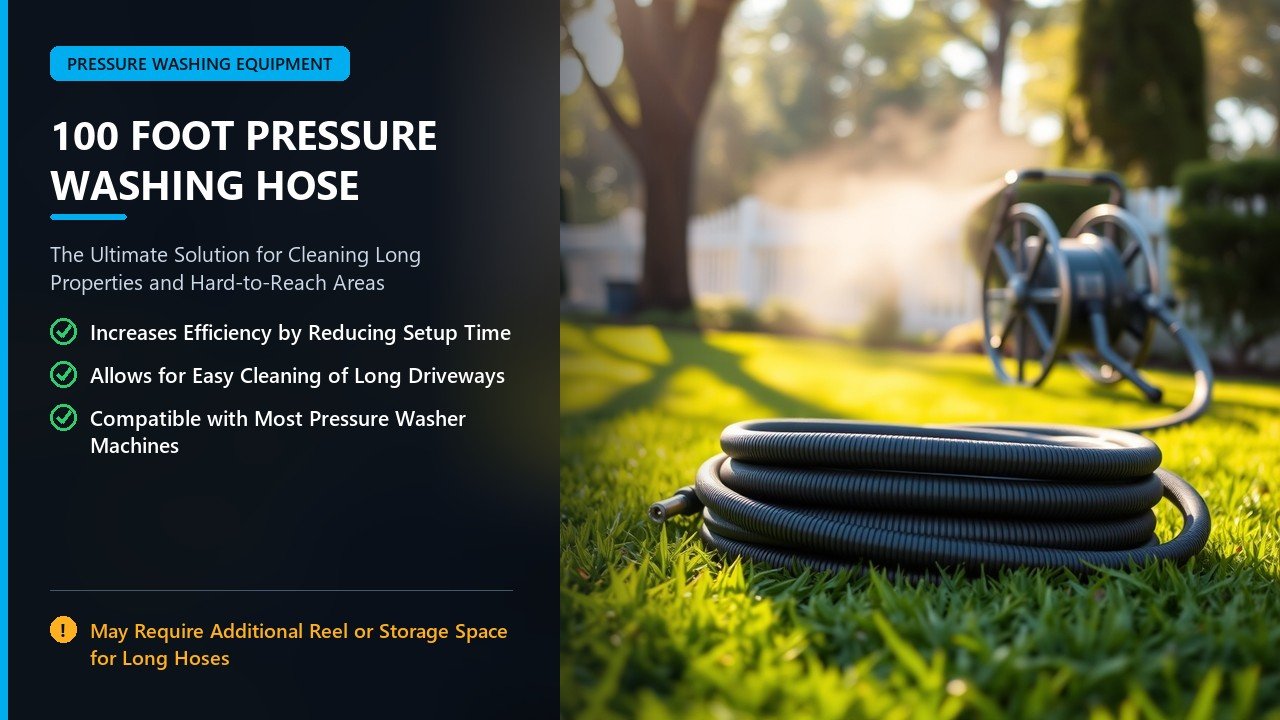
A 100 foot pressure washing hose solves that specific frustration. But length is not free. Every extra foot of hose introduces friction, which costs you pressure and flow. The goal is not simply the longest hose you can find. The goal is the longest hose your machine can still drive effectively. That balance is the heart of everything that follows.
Here is the practical math most people miss: a pressure washer is rated in PSI (cleaning force) and GPM (gallons per minute). The PSI number on the box is measured at the pump, not at the nozzle. Between the pump and the nozzle sit the hose, the gun, the wand, and the fittings. Each one steals a little energy. A proper 100 foot hose on a capable machine loses surprisingly little. A bad 100 foot hose on a weak machine turns a fire hose into a drinking fountain.
What Exactly Is a 100 Foot Pressure Washing Hose?
Despite the name, a 100 foot pressure washing hose is not a garden hose. Garden hoses are built to carry low-pressure water, usually under 60 PSI. A pressure washer hose is built to contain water moving at 2,000 to 5,000 PSI without bursting, kinking permanently, or scuffing your paint. The two are cousins at best.
Most 100 foot hoses sold today share a few common traits:
- A working pressure rating between 2,000 and 4,000 PSI, with a burst rating two to three times higher.
- An inner tube of rubber or thermoplastic, wrapped in a reinforcing braid, then a protective outer cover.
- Standard thread ends such as M22, 3/8 inch quick connect, or 1/4 inch quick connect.
- Common inner diameters of 1/4 inch (lighter, less flow) or 3/8 inch (heavier, better flow).
The single most important spec is the inner diameter, often written as ID. A 1/4 inch hose pushes less water than a 3/8 inch hose of the same length. At 25 feet, you barely notice. At 100 feet, the difference becomes obvious in your cleaning speed.
The Pressure Loss Reality: Does 100 Feet Weaken Your Spray?
Yes, but not as much as the internet horror stories claim, and the amount depends entirely on your hose diameter and your machine. Pressure loss across a hose comes from friction between the moving water and the hose wall. Longer hose, more friction. Narrower hose, more friction. Softer, kinked, or coiled hose, more friction.
The chart below gives a realistic picture. These are approximate field values for cold water at common residential flow rates. Treat them as a guide, not gospel, because every pump, nozzle, and fitting behaves a little differently.
| Hose Inner Diameter | Typical Use | Approx. Pressure Loss Over 100 ft | Best For |
|---|---|---|---|
| 1/4 inch | Light residential | High (can drop 300-500 PSI or more) | Small jobs, low GPM machines |
| 5/16 inch | Mid residential | Moderate (roughly 150-300 PSI) | Balanced weight and flow |
| 3/8 inch | Heavy residential and commercial | Low (often under 150 PSI) | High GPM machines, long reach |
The rule of thumb seasoned contractors repeat: match a wider hose to a bigger machine, and a narrower hose to a smaller one. If you run a small electric washer around 1,600 PSI, a 100 foot, 1/4 inch hose is perfectly fine because you are not asking much of it. If you run a gas belt-drive unit, step up to 3/8 inch and let it breathe.
There is one more factor people forget: heat. Hot water hoses are rated separately, and using a cold-water hose on a hot-water machine is a fast way to turn your new 100 foot hose into a burst balloon. We will get to that shortly. The U.S. Occupational Safety and Health Administration (OSHA) also reminds operators that high-pressure streams carry real injury risk, so never point a wand at people, and always respect the ratings printed on your equipment.
Types of 100 Foot Pressure Washing Hoses Compared
Once you decide on a length, the next question is material. There is no single best hose, only the best hose for your machine, your water temperature, and your tolerance for weight. Here is how the main categories stack up.
| Hose Type | Feels Like | Durability | Best Suited For |
|---|---|---|---|
| Thermoplastic (PVC blend) | Light, stiff when cold | Good for light use | Electric washers, budget setups |
| Rubber | Heavy, flexible, grippy | Excellent | Daily use, cold weather, pros |
| Steel braided rubber | Heavy, armored feel | Outstanding | Commercial, high PSI, hot water |
| Non-marking rubber | Heavy, matte finish | Excellent | Driveways, painted surfaces, decks |
Thermoplastic hoses are the value option. They are light, affordable, and fine for a homeowner who cleans twice a year. The trade-off is stiffness. In cold weather, a cheap thermoplastic hose turns into a garden snake that refuses to coil and kinks at the worst moment.
Rubber hoses are the sweet spot for most people. They stay flexible in cool temperatures, resist abrasion against concrete and brick, and do not leave black streaks on light-colored surfaces. A good rubber 100 foot hose is the single best upgrade for a machine that came with a flimsy stock hose.
Steel braided hoses are built for abuse. The braided jacket protects the inner tube from sharp edges and constant dragging, which matters if you run a commercial setup or a trailer-mounted machine. They are heavier and pricier, but they often outlast two or three cheap hoses.
Non-marking hoses deserve a special mention. If you have ever finished cleaning a white driveway only to see black scuff marks trailing behind your hose, you already understand. Non-marking outer covers are designed to glide without leaving rubber residue, which is worth every extra dollar for detailers and anyone with a light-colored drive.
Fittings, Threads, and Getting the Connection Right
A 100 foot hose is useless if it will not connect to your machine and gun. This is where most returns happen, so let us be precise. Pressure washer fittings generally fall into a few families.
- M22 threaded fittings: The classic screw-on connection found on many pumps and guns. They come in male and female versions and in metric thread pitches that are easy to confuse.
- Quick connect fittings: Push-and-click couplings, usually 1/4 inch or 3/8 inch, that let you swap hoses, guns, and nozzles in seconds.
- Adapter fittings: Small brass or stainless couplers that convert one thread standard to another. These are the unsung heroes of every mixed-brand setup.
The simplest path to a stress-free install is to standardize on quick connect. If your machine uses M22 threads, add an M22-to-quick-connect adapter and do the same at the gun. From then on, hoses click in and out without tools. This also lets you keep a short hose for quick jobs and a 100 foot hose for big ones, swapping them in one motion.
Hot Water vs Cold Water Ratings
Not all 100 foot hoses are alike on the inside. Standard cold-water hoses are rated for ambient temperatures and will soften, blister, or burst if you push hot water through them. Hot water pressure washers, which heat water to 180 degrees Fahrenheit or more, demand a dedicated hot-water hose with a temperature rating clearly printed on the jacket.
If you own a hot water machine, or plan to add a heater to a skid or trailer setup, buy the hot-water hose from the start. Upgrading later always costs more than buying correctly the first time. Cold water through a hot-rated hose is perfectly safe. Hot water through a cold-rated hose is a hazard waiting to happen.
How to Choose the Right 100 Foot Hose
Rather than overwhelm yourself with every spec, run through this short checklist in order. Each answer narrows your options until only a few hoses remain.
- Machine PSI and GPM. Match the hose working pressure to or above your machine rating. Never go below it.
- Water temperature. Cold, warm, or hot? This decides the hose construction immediately.
- Thread standard. M22, 1/4 quick connect, or 3/8 quick connect. Buy adapters if brands differ.
- Inner diameter. Small machine, 1/4 inch. Larger machine, 3/8 inch. Middle ground, 5/16 inch.
- Weight you can live with. A 3/8 inch, 100 foot rubber hose full of water is heavy. If you work alone all day, test the weight before committing.
- Surface sensitivity. Cleaning light concrete, vinyl, or vehicles? Choose non-marking.
- Storage plan. A 100 foot hose is only manageable if you have a reel or a tidy coiling method.
Answer those seven questions and you will almost never buy the wrong hose. The mistake almost everyone makes is buying on length and price alone, then discovering the fitting does not match or the hose bursts under their machine’s actual pressure.
Pairing a 100 Foot Hose With a Reel
Here is the honest truth about a 100 foot hose: it is a pain to coil by hand. Left loose, it tangles, kinks, and wears out along the same stress points over and over. A reel changes the entire experience. You pull out exactly what you need, work, then wind it back in a minute.
There are three practical options for managing the length:
- Wall mount reels: Fixed to a garage or trailer wall. Great for a permanent cleaning station.
- Cart or frame reels: Move with the machine, ideal for renters or anyone who cleans multiple sites.
- Manual vs powered: Manual reels are affordable and reliable. Powered reels save your arm on very long, heavy hoses.
A reel also protects the hose itself. When a hose is stored properly, the inner tube is not crushed by tight, uneven coils or pinched under a bucket. That single habit can add years to the life of an otherwise ordinary 100 foot hose.
Real-World Use Cases Where 100 Feet Shines
The value of a longer hose becomes obvious in specific situations. Here are a few where a 100 foot hose stops being a luxury and starts being the whole point.
Long driveways and rural properties
On a rural lot, the nearest outlet and nearest spigot are rarely close together. A 100 foot hose lets you park the machine at the spigot, keep the electrical connection dry and short, and still reach the far end of a long concrete drive.
Two-story homes and tall siding
Cleaning the second story already calls for an extension wand and a tall reach. Add horizontal distance from the machine to the wall, and a 100 foot hose suddenly makes a second-story job a one-setup task instead of a climbing-and-dragging marathon.
Mobile car detailing
Detailers work around a vehicle, not over it. A longer hose lets the machine sit safely away from the car while the operator circles the vehicle without stepping over a tangled line. Paired with a foam cannon and the right nozzles, it turns a tight driveway into a clean, efficient workspace.
Fleet, trailer, and commercial cleaning
When you are washing trucks, equipment, or dumpsters, downtime from repositioning is pure lost money. A 100 foot hose keeps the operator moving and the machine parked. Many commercial washers are already built around 50 to 100 foot hoses, so matching that length keeps your workflow consistent.
Fences, decks, and pool surrounds
Winding around fences, decks, and pool cages eats hose fast. Extra length means fewer awkward snags and less risk of dragging a stiff hose across delicate surfaces.
Common Mistakes to Avoid
Most 100 foot hose problems come down to a handful of avoidable errors. Watch for these.
- Buying a cold-water hose for a hot-water machine. The single most expensive mistake. Always check the temperature rating.
- Going too narrow for the machine. A big pump squeezing through a tiny hose wastes the pressure you paid for.
- Ignoring the thread standard. Buying before confirming M22 versus quick connect leads to a drawer full of useless adapters.
- Kinking at the gun. A sharp bend at the connection point is where hoses fail first. Use a swivel or a short whip hose to relieve the stress.
- Overrunning the pressure rating. If your machine peaks higher than the hose rating, you are gambling every time you pull the trigger.
- Storing wet and coiled tight. Trapped water and tight loops crush the inner tube and invite mold and freezing damage.
- Dragging over sharp edges. Concrete corners, rebar, and glass shred outer covers. Route the hose around hazards, or use a braided cover.
Maintenance and Storage That Doubles Hose Life
A pressure washer hose is a wear item, but with a little care it can last far longer than most people expect. The routine is simple.
- Flush after every job. Run clean water through the hose for a minute to clear detergent and grit.
- Inspect the ends. Check the crimps and threads for cracks, fraying, or corrosion before each use.
- Drain completely. Elevate one end and let gravity do the work so no water sits inside over winter.
- Coil loosely. Use a reel or large loops. Never fold a hose back on itself.
- Store out of direct sun and away from freezing. UV degrades outer covers, and trapped water splits them when it freezes.
- Replace, do not patch. A bulging or deeply scuffed hose is a burst waiting to happen. Replace it before it fails mid-job.
Winter is the season that kills the most hoses. If you park your machine in an unheated garage, drain the hose and store it indoors. Ten minutes of care in the fall saves a replacement hose in the spring, and it protects the pump at the same time.
Frequently Asked Questions
Is a 100 foot pressure washing hose too long for my machine?
It depends entirely on your machine’s GPM and your hose diameter. A high-flow machine with a 3/8 inch hose handles 100 feet beautifully. A small electric washer with a 1/4 inch hose will lose noticeable pressure but still work for light cleaning. Match the two and length becomes a non-issue.
Will a 100 foot hose reduce my PSI?
Some, yes. Friction reduces pressure over distance, and narrower hoses lose more. Wider hose, higher flow, and clean fittings minimize the drop. On a properly matched setup, the loss is small enough that most users never notice it in practice.
Can I connect two 50 foot hoses to make 100 feet?
You can, and it is a common budget move. Each extra connection is a potential leak point and adds a small pressure loss, so fewer joints mean fewer problems. If you know you need 100 feet regularly, buy one quality hose rather than chaining two.
What is the best inner diameter for a 100 foot hose?
For most gas machines and anything above roughly 2.5 GPM, go with 3/8 inch. For smaller electric washers, 1/4 inch keeps the setup light and manageable. In between, 5/16 inch is a sensible compromise.
Do I need a special hose for hot water?
Yes. Hot water pressure washers require a hose rated for high temperatures. Using a cold-water hose with hot water risks bursting and injury, and it will fail far sooner than its rating suggests.
How long should a pressure washer hose last?
A quality rubber hose used and stored properly can last several years. A cheap thermoplastic hose abused and left in the sun may fail in a season. Maintenance and storage matter as much as the price tag.
Final Thoughts
A 100 foot pressure washing hose is one of those upgrades that sounds minor until you use one. The freedom to set up the machine once and reach the entire job changes how a cleaning day feels, and it saves real time on driveways, siding, fleets, and detail work.
The secret is not the length itself. It is matching the length to the right diameter, the right material, the right temperature rating, and the right fittings. Do that, add a reel to keep it tidy, and maintain it with a few simple habits, and a single 100 foot hose will outperform a drawer full of cheap short ones. Get the connection right once, and you will wonder why you ever dragged that machine around the yard.