For most homes, there is a magic number in hose length, and it is not 50 feet, and it is not 200. It is 100. That is long enough to reach around the average house from a single outdoor spigot, cover a two-car driveway, and still clean the far side of the yard, yet short enough to stay portable and manageable. Once you accept that 100 feet is the practical sweet spot, the next logical step is finding a 100′ pressure washer hose reel to keep all that hose organized, protected, and ready to grab.
A hundred feet of high-pressure hose is a significant amount of heavy rubber and wire. Left loose, it tangles, kinks, and wears out at the same weak points over and over. Wound onto the right reel, it becomes a clean, reliable part of your setup that takes seconds to deploy and wind back. This guide focuses on the 100-foot reel specifically: how to choose one, match it to your hose, mount it well, and keep it working for years in a typical home or garage.
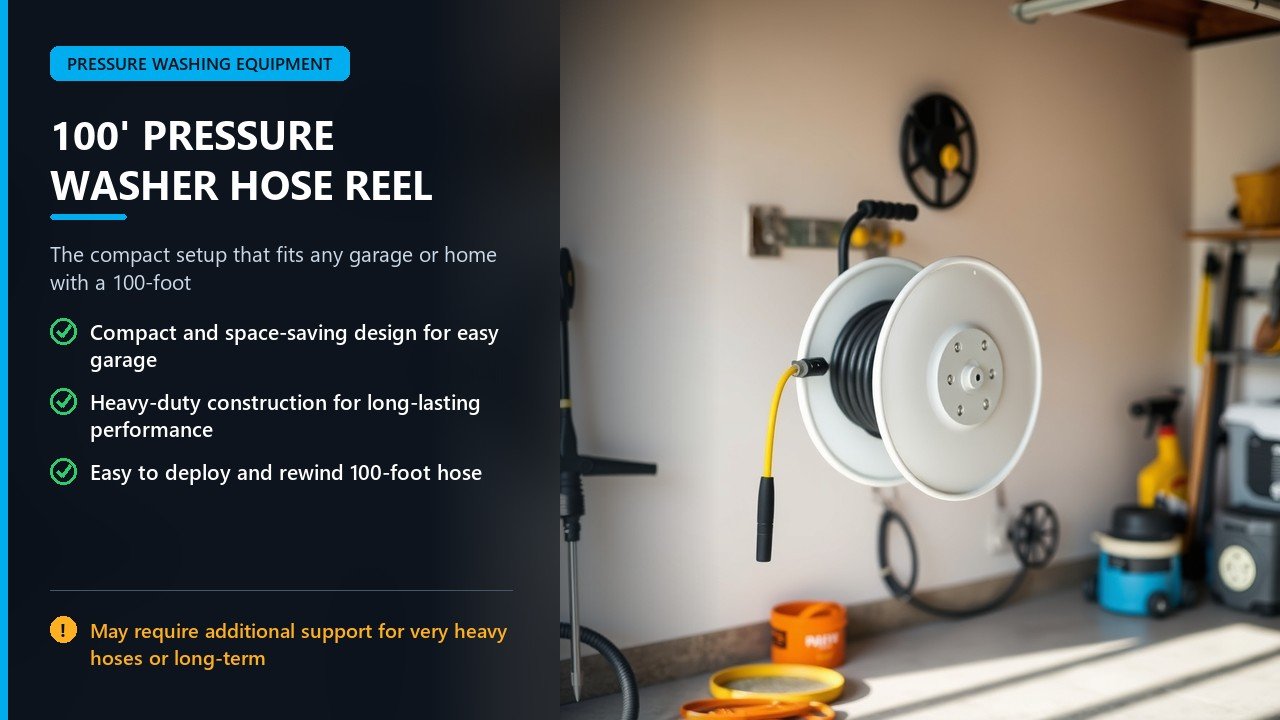
Why 100 Feet Is the Residential Sweet Spot
Hose length is a trade-off between reach and manageability. Fifty feet is often too short for a whole house, forcing you to relocate the machine and reconnect everything for each new side of the property. Two hundred feet is more than most homes need and becomes heavy, expensive, and prone to pressure loss.
A hundred feet hits the balance most homeowners actually want:
- Whole-house reach. From a central spigot, 100 feet usually covers the front, side, and part of the backyard.
- Driveway coverage. Enough length to clean a long driveway without moving the machine.
- Manageable weight. Heavy enough to matter, light enough to handle alone.
- Reasonable pressure loss. With a 3/8 inch hose on a capable machine, 100 feet loses little pressure.
- Easy storage. Fits neatly on a standard wall-mount reel in a garage or shed.
That is why 100 feet has become the default upgrade length for homeowners. The reel simply makes it practical to live with.
What to Look For in a 100-Foot Reel
Not every reel can handle 100 feet of high-pressure hose. Size and construction matter.
- Capacity for 100 feet of your hose diameter. A reel that holds 100 feet of 1/4 inch hose may hold less of 3/8 inch hose. Check the manufacturer’s capacity chart.
- A high-pressure swivel rated to meet or exceed your machine’s PSI.
- A rigid steel frame strong enough for the loaded weight.
- Smooth, even winding to prevent overlapping coils and kinks.
- Solid mounting hardware suited to a garage wall or a cart.
- Replaceable seals so the swivel can be serviced instead of replaced.
Types of 100-Foot Hose Reels
| Reel Type | How It Winds | Best For |
|---|---|---|
| Manual hand crank | By hand | Most homeowners |
| Manual geared | Hand with gear reduction | Heavier 3/8 inch hose |
| Powered electric | Motor driven | Frequent or commercial use |
| Retractable housing | Spring auto-rewind | Neat, light-duty setups |
For a 100-foot high-pressure hose, a manual crank is usually the smart starting point, because it is affordable and reliable. If your hose is thick 3/8 inch and you wind it often, a geared reel saves real effort. Powered reels are worth it mainly for people who clean several times a week.
Matching Reel Capacity to Hose Diameter
Capacity is the most common source of buyer disappointment, so let us be precise. Reel capacity depends on hose diameter, and a reel advertised for a certain length assumes a particular size.
| Hose Diameter | Fits a 100 ft Reel? | Notes |
|---|---|---|
| 1/4 inch | Usually with room to spare | Light, for compact machines |
| 5/16 inch | Comfortable | Middle-ground flow |
| 3/8 inch | Depends on reel size | Choose a reel rated for 100 ft of 3/8 inch |
| 1/2 inch | Often too large | Overkill for residential 100 ft setups |
Always confirm the capacity for your exact diameter. A reel that holds 100 feet of thin hose comfortably may not hold 100 feet of thicker hose without overstuffing.
Mounting Options for a Home Setup
Where the reel lives determines how convenient it is every time you clean.
Garage wall mount
The most popular option for homeowners. It saves floor space, keeps the hose off the ground, and puts the reel exactly where the machine lives. Anchor it into studs or solid framing, since a loaded 100-foot reel is heavy and under constant pull.
Cart or frame mount
Attaches to the pressure washer cart so the reel travels with the machine. Ideal if you move between locations or store everything together.
Post or fence mount
Useful in a backyard where a dedicated washing post makes sense. Ensure the post itself is solid and anchored.
The Swivel and Hose Guide
Two small features make a big difference on a 100-foot reel.
- The swivel: The rotating joint that lets water flow while the reel turns. It must be rated for your pressure and temperature, made of machined brass or stainless, and ideally serviceable with replaceable seals.
- The hose guide or roller: Keeps the hose centered as it feeds out, reducing abrasion and side load on the reel. It is a simple part that extends hose life noticeably.
Installation Steps
- Pick a strong mounting point. Anchor into studs, steel, or reinforced framing, never drywall alone.
- Position the swivel inlet for easy access so you can connect and service it.
- Connect the feed hose from the machine to the swivel inlet with quality fittings.
- Add a hose guide at the payout point to reduce wear.
- Wind a few turns by hand to confirm even layering before relying on the mechanism.
- Pressure test slowly, checking every joint for leaks before full operation.
Hose Habits That Keep 100 Feet Manageable
- Lay the hose straight before winding. This releases stored twist, so it coils flat.
- Relieve pressure and drain before winding. Never store the hose pressurized.
- Wipe off grit so abrasive material does not get wound against the hose.
- Do not overfill the reel. Leave room for relaxed, even coils.
- Pull the hose out smoothly and let the reel spin freely.
- Use a swivel at the gun to keep the hose from storing twist while you work.
Maintenance for Long Life
- Rinse the hose and reel before storage to remove grit and detergent residue.
- Check the swivel and O-rings for drips and replace seals at the first sign of wear.
- Lubricate the winding mechanism as the manufacturer advises.
- Tighten mounting bolts periodically, since vibration loosens hardware.
- Winterize fully. Trapped water freezes and can crack the swivel and hose.
- Inspect the hose for bulges and soft spots, and replace it before it fails.
- Buying a reel too small for 3/8 inch hose. Overstuffing damages both hose and swivel.
- Ignoring the pressure rating. A weak swivel means leaks or a burst.
- Mounting into weak material. The reel must hold the loaded weight and pull.
- Winding a kinked hose. Always straighten first.
- Never servicing the swivel. Small leaks grow into failures.
- Using a garden hose reel. They are not rated for high pressure.
- Storing wet and tight. It crushes the inner tube and invites mold and freezing damage.
Common Mistakes to Avoid
Frequently Asked Questions
What size reel do I need for a 100 foot pressure washer hose?
A reel rated to hold 100 feet of your specific hose diameter. Capacity varies with diameter, so confirm the manufacturer’s chart, especially for 3/8 inch hose.
Can a 100 foot reel handle 3/8 inch hose?
Many can, but not all. Choose a reel explicitly rated for 100 feet of 3/8 inch hose, or size up to ensure it winds easily without overstuffing.
Wall mount or cart mount for a 100 foot reel?
Wall mount for a fixed garage or shop station. Cart mount if you move the machine between sites. Choose based on where you clean most often.
How do I stop a 100 foot hose from kinking?
Lay it straight before winding, use a reel with a good swivel and guide, avoid overfilling, and add a swivel at the gun to prevent stored twist.
Is 100 feet too long for my pressure washer?
With a 3/8 inch hose and a capable machine, 100 feet is fine and loses little pressure. With a thin 1/4 inch hose on a small unit, expect more pressure loss. Match the hose and machine.
Final Thoughts
A 100′ pressure washer hose reel turns the most practical residential hose length into a manageable, protected, ready-to-use part of your setup. It prevents the kinks and abrasion that ruin hoses, speeds up every job, and keeps your garage or yard organized and safe.
Match the reel to your hose diameter and pressure, mount it to solid structure, choose a serviceable swivel, and practice a few good winding habits. Do that, and your 100-foot hose will last far longer and work far better, making the reel one of the best small investments in your cleaning gear.