When a cleaning contractor I know switched from a cheap hundred-foot hose to a quality rubber one, he expected a minor improvement and instead got a different job. The old hose kinked every few feet, left black marks on delicate surfaces, tangled into knots, and lost so much pressure over its length that the spray felt weak at the nozzle. The rubber hose coiled smoothly, never kinked, left no marks, and delivered noticeably stronger cleaning at the same distance. That single change improved every job he ran. If you are shopping for a 100ft pressure washer hose, the material you choose matters more than most buyers realize, and this guide explains the differences, the sizes, and how to pick the right hose for your work.
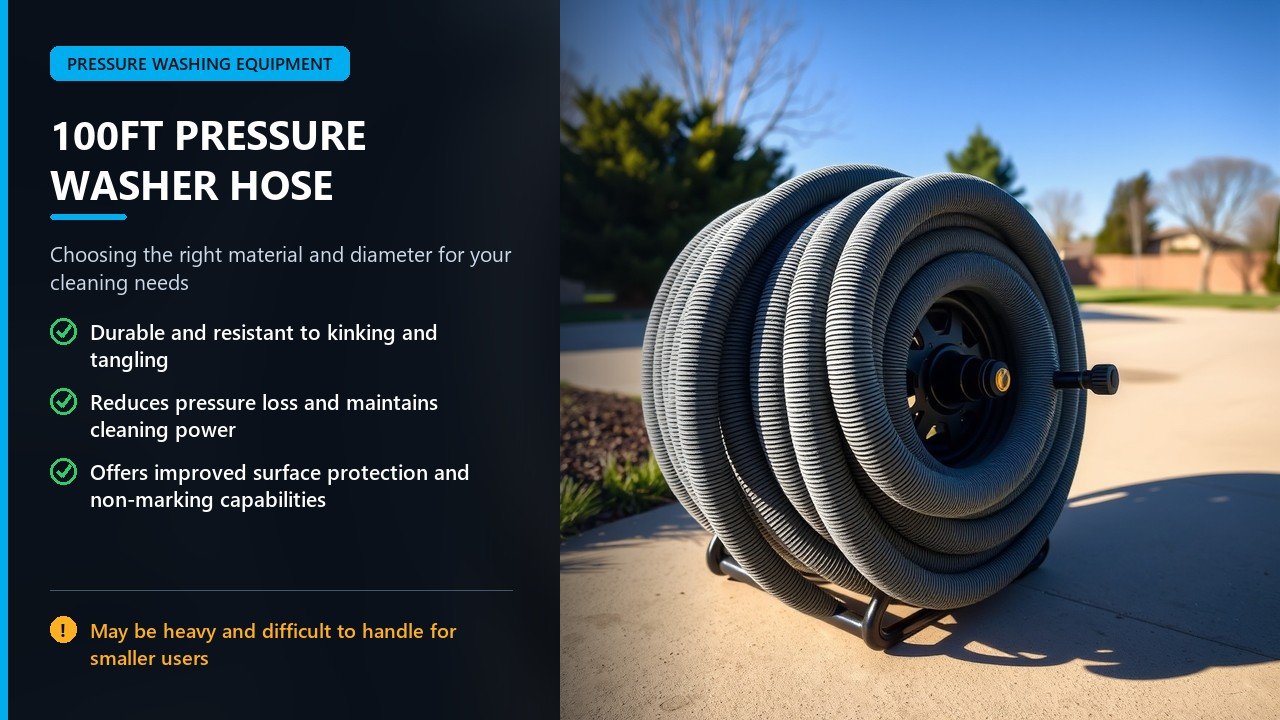
What a 100 Foot Hose Means for Your Setup
A hundred feet of hose is a serious length. It lets you clean large areas, reach around buildings, and work far from the machine, all without moving the washer. That reach is genuinely useful for driveways, fences, large vehicles, and commercial work where repositioning a heavy machine is a hassle.
But length comes with tradeoffs. A hundred-foot hose is heavy, takes time to deploy and coil, and loses some pressure to friction along its length. It also needs somewhere to live, which is why so many owners pair a long hose with a reel. The goal of choosing a hundred-foot hose wisely is to gain the reach you want while minimizing the weight, kinking, and pressure loss that a poorly chosen hose brings.
Understanding the hose as a system, from material to diameter to fittings, is what separates a hose that frustrates you from one that serves you for years. That system is what this guide covers.
The Big Decision: Hose Material
Material is the most important choice and the one that most affects how a hose performs and feels.
Rubber. The premium choice. Rubber hoses are flexible, resist kinking, hold up to heat and abrasion, and often carry a higher pressure rating. They coil smoothly, which is a huge advantage at a hundred feet, and they resist the cracking and hardening that cheap hoses suffer. Rubber is heavier and more expensive, but for serious or frequent use it is often the best investment.
Hybrid or blended. Hybrids combine rubber and thermoplastic materials to balance flexibility, weight, and cost. They are lighter than pure rubber, still resist kinking reasonably well, and cost less. For many homeowners and light commercial users, a good hybrid hose offers an excellent balance.
PVC or thermoplastic. The budget option. These hoses are light and inexpensive but tend to kink, stiffen in cold weather, and wear faster, and they often have lower pressure and temperature ratings. At a hundred feet, a stiff, kink-prone PVC hose is a chore to manage and a frequent source of frustration.
| Material | Strengths | Tradeoffs |
|---|---|---|
| Rubber | Flexible, kink-resistant, durable, heat-tolerant | Heavier, higher cost |
| Hybrid | Balanced weight and flexibility | Between rubber and PVC in durability |
| PVC/thermoplastic | Light and inexpensive | Kinks, stiffens cold, wears fast |
The practical rule is that the longer the hose, the more material quality matters. A cheap short hose is tolerable; a cheap hundred-foot hose is a constant annoyance. If you can afford rubber or a quality hybrid, the improvement in handling and durability is worth it.
Inside Diameter: 1/4 Inch vs 3/8 Inch
After material, inside diameter is the most consequential choice, especially over a hundred feet.
A hose’s inside diameter, often one-quarter or three-eighths of an inch, determines how much water flows and how much pressure is lost to friction. A larger inside diameter moves more water with less friction, preserving pressure over a long run. A smaller inside diameter is lighter and more flexible but loses more pressure, and the loss grows with length.
This is why a hundred-foot hose usually benefits from a larger inside diameter. Over a hundred feet, the friction loss in a small hose can be significant, leaving you with noticeably weaker cleaning at the nozzle. A larger inside diameter hose keeps more of your machine’s pressure available where it matters. The tradeoff is that larger hose is heavier and bulkier, which is exactly why pairing it with a reel helps.
| Inside Diameter | Over 100 Ft | Handling |
|---|---|---|
| 1/4 inch | More pressure loss at the nozzle | Lighter, more flexible |
| 3/8 inch | Better pressure retention | Heavier, bulkier |
Match the inside diameter to your machine’s flow and pressure. A high-flow machine benefits from a larger diameter, while a lower-pressure machine may tolerate a smaller one. When in doubt over a long run, favor the larger diameter to preserve performance, and let a reel handle the bulk.
Pressure Loss Over a Hundred Feet
Pressure loss, sometimes called friction loss, is the pressure the water loses as it travels through the hose. Two factors drive it: length and inside diameter. A hundred feet is a long path, and a narrow passage increases the loss.
The practical effect is that the pressure at your nozzle is always somewhat lower than the pressure at the machine, and the longer and thinner the hose, the greater the gap. A hundred-foot hose in a small diameter can lose a meaningful amount of the machine’s pressure, which is why the same washer can feel stronger with a short hose and weaker with a long one.
You cannot eliminate friction loss, but you can minimize it by choosing an adequate inside diameter, avoiding unnecessary adapters and restrictions, and keeping the hose in good condition. If your cleaning feels weak at the end of a hundred-foot hose, the hose’s diameter and condition are the first things to check, before blaming the machine. A quality, properly sized hose ensures the machine’s power actually reaches the surface.
Temperature Ratings and Hot Water
If you use hot water, the hose’s temperature rating matters.
Hot water cleaning improves grease and oil removal, but not every hose can handle heat. Rubber hoses generally tolerate higher temperatures than PVC, which can soften, deform, or fail under hot water. If your machine heats water, confirm the hose is rated for the temperature it will see, because using a cold-water hose with hot water risks a burst and injury.
Even for cold-water machines, a higher temperature rating is a sign of a more robust hose, because it indicates better material quality. It also gives you the flexibility to add heat later without replacing the hose. Before buying, check the hose’s rated temperature and confirm it covers your needs.
Non-Marking and Surface Protection
If you clean driveways, decks, vehicles, or building exteriors, you have probably seen the black streaks that cheap hoses leave behind. Dark rubber hoses can transfer marks to light-colored surfaces, especially when dragged across concrete or siding.
Non-marking hoses are made with compounds and sometimes a light gray color to reduce or eliminate this transfer. If you clean surfaces where marks would be a problem, such as a pressure-treated deck, painted siding, or a customer’s pristine driveway, a non-marking hose is worth the slight extra cost. It saves you from having to explain, or clean up, the marks your own equipment left behind. For professional cleaners, non-marking hose is often the standard for exactly this reason.
Beyond marking, consider abrasion resistance. A hose dragged across concrete wears on its outer jacket, and a durable jacket lasts longer. For heavy use, a hose with a tough outer cover is a wise choice.
Fittings and Connections
The ends of your hundred-foot hose must connect to your machine outlet and your gun, and the fittings must be correct.
Hoses terminate in various fittings, commonly quick-connect or M22, depending on the machine. When buying a replacement or additional hose, confirm both ends match your equipment, or buy the correct adapters. Mismatched fittings are a common source of leaks and frustration, and M22 fittings come in two variants that are not interchangeable. Bring the old hose or its measurements with you when shopping, or buy from a seller who specifies the fittings clearly.
The fittings also need to be high pressure rated and made from durable material, usually brass or stainless steel, to hold up under continuous pressure. Cheap fittings corrode, leak, and fail. Our article on the original 100 ft pressure washer hose covers fitting and connection basics in more detail. Check the fittings as carefully as the hose itself, because the connection is where leaks most often begin.
Weight and Handling
At a hundred feet, weight and handling become real considerations. A hundred-foot rubber hose in a larger diameter is heavy and takes effort to drag and coil, while a lighter hybrid or PVC hose is easier to handle but less durable and more prone to kinks.
The balance is personal. If you move the hose frequently and care about ease, a hybrid or a rubber hose in a moderate diameter may suit you. If durability and kink resistance matter most and you can manage the weight, rubber in a larger diameter performs best. A reel transforms handling for any of these, turning a heavy loose hose into a tidy, easy-to-deploy system. If you regularly work with a hundred feet of hose, a reel is the accessory that makes the length practical.
Matching the Hose to Your Machine
A hundred-foot hose performs best when it is matched to the machine driving it. The relevant factors are the machine’s pressure, its flow, and the fittings it uses.
Start with pressure and flow. A machine with high pressure and high flow can push water through a long hose with less relative loss and benefits from a larger inside diameter. A machine with modest pressure and flow will lose a greater proportion of its output over a long run, so choosing an appropriately sized hose, and avoiding an oversized one that strains the machine’s ability to fill, matters even more. The goal is a hose that lets the machine deliver its rated performance at the nozzle without adding unnecessary restriction or burden.
Next, match the fittings. Confirm the hose’s ends match your machine outlet and gun, whether those are quick-connect, M22, or another standard. If they differ, buy the correct adapters, and keep the number of adapters to a minimum, since each one is a potential leak. Confirm the hose’s pressure rating exceeds your machine’s maximum output, because a hose that is under-rated for the pressure can burst and cause injury.
Finally, confirm the temperature rating covers how you use the machine. Even if you only run cold water today, choosing a hose with headroom lets you add heat later without replacing it. A well-matched hose delivers the machine’s power to the surface and lasts for years, while a mismatched one wastes pressure and frustrates you on every job.
How to Extend Your Total Hose Length Safely
Many owners want to add a hundred-foot hose to a shorter one to gain even more reach. This is possible, but it must be done carefully.
You connect two hoses using a coupler that joins their ends, which requires matching fittings at the junction. Each added connection is a potential leak and a place where pressure is lost, and a loose or mismatched coupler can blow apart under pressure. The more hoses you join, the more pressure you lose and the more points of failure you create. For that reason, it is generally better to buy a single hose of the length you need than to chain several together.
If you do join hoses, use high-quality couplers rated for your pressure, confirm both hoses and the coupler share compatible fittings and ratings, and inspect the junction for leaks before each use. Keep the run as short in total as your work requires, and remember that a very long run of joined hoses can reduce pressure at the nozzle noticeably, especially with smaller inside diameters. Sometimes the better solution to insufficient reach is to move the machine closer with an extension cord or a longer water supply, rather than adding more hose.
Storage and Coiling Best Practices
How you store a hundred-foot hose determines how long it lasts and how easy it is to use.
Avoid coiling the hose tightly, which stresses the material and encourages kinks and cracks, especially in cold weather when hoses stiffen. Coil it in loose, generous loops, or better, wind it onto a reel. A reel is the ideal storage method for a long hose, because it prevents kinks, keeps the hose off the ground, protects it from sun and abrasion, and makes deployment quick. If you do not have a reel, coil the hose over a wide support or use a figure-eight pattern to avoid twisting, and hang it or lay it flat rather than stuffing it into a tight space.
Before storage, drain the hose completely. Trapped water can freeze in cold weather and damage the hose, and stagnant water can encourage mold and odor. Store the hose out of prolonged direct sunlight when possible, since ultraviolet exposure degrades rubber and plastic over time. Keep it away from sharp edges and hot surfaces, and avoid leaving it under pressure or connected to a pressurized machine for long periods. Treated well, a quality hundred-foot hose lasts many seasons, and proper storage is a large part of that longevity.
When a Hundred Feet Is Too Much
A hundred-foot hose is not always the right choice, and recognizing the exceptions saves money and effort.
If your cleaning is confined to a small area, such as a single garage, a short hose is lighter and faster to manage. A long hose in a small space means more hose to coil and store for no benefit. If you rarely need the extra reach, the added weight, cost, and pressure loss are drawbacks rather than advantages.
If your machine has limited pressure, adding a hundred feet of hose can make the spray feel weak and unsatisfying, though choosing a larger inside diameter mitigates this. For very low-pressure machines, a shorter hose may deliver a better experience.
If you have trouble handling heavy equipment, a hundred-foot hose in a large diameter is physically demanding to drag and coil. A lighter hybrid hose, or a shorter hose combined with a reel, may suit you better.
The point is not that a hundred feet is bad, but that it should match your actual needs. When your work calls for reach across large areas or around obstacles, a hundred-foot hose is ideal. When it does not, choose the length that fits your work rather than the longest option available.
Real-World Applications
Where does a hundred-foot hose genuinely earn its keep? A few examples make it clear.
Large driveways and parking areas. Cleaning a long driveway or a commercial lot without a hundred-foot hose means dragging the machine repeatedly. A long hose lets you work a broad area from a single position, which is faster and less tiring. Pair it with a surface cleaner for the best result on flat surfaces.
Multi-story and wrap-around exteriors. A long hose lets you walk a building’s perimeter and reach high areas without constantly relocating the machine, turning a stop-and-start job into a smooth, continuous one.
Large vehicles and equipment. Cleaning trucks, RVs, buses, and heavy equipment is easier with a long hose, letting you circle the vehicle and reach around it without moving the washer. An extension wand pairs well here for the high and low spots.
Commercial and mobile cleaning. For professionals, a hundred-foot hose is standard equipment, enabling efficient coverage of large properties and integration with a reel on a cleaning trailer. The reduction in repositioning time adds up to meaningful productivity across many jobs.
In each case, the value comes from covering ground without relocating heavy equipment. When your work involves large areas or awkward access, a hundred-foot hose transforms the job from a logistical challenge into a straightforward task, and that is exactly what it is designed to do.
100ft Pressure Washer Hose: Frequently Asked Questions
Does a 100ft hose reduce pressure? Yes, friction over a long hose reduces pressure slightly at the nozzle. A larger inside diameter hose minimizes the loss.
Is rubber or PVC better for a 100ft hose? Rubber is more flexible, kink-resistant, and durable but heavier and pricier. PVC is lighter and cheaper but kinks, stiffens in cold, and wears faster. Hybrids balance the two.
Should I get a 1/4 inch or 3/8 inch hose? Over a hundred feet, a larger inside diameter preserves more pressure but is heavier. Match it to your machine’s flow and pressure, favoring larger for long runs.
Can a 100ft hose carry hot water? Only if it is rated for the temperature. Rubber generally tolerates heat better than PVC. Confirm the hose’s temperature rating before using hot water.
What is a non-marking pressure washer hose? A hose made with compounds and often a light color to avoid leaving black marks on surfaces. It is valuable for cleaning decks, painted siding, and light concrete.
How do I stop my long hose from kinking? Choose a kink-resistant rubber or hybrid hose, use an adequate inside diameter, and store it on a reel. Avoid sharp bends and never coil it tightly when cold.
Final Verdict on 100ft Pressure Washer Hoses
A hundred-foot pressure washer hose is a tool of reach and convenience, but only when it is chosen well. The material determines how it feels and how long it lasts, the inside diameter determines how much pressure reaches the nozzle, the temperature rating determines whether it can handle hot water, and the fittings determine whether it connects cleanly to your machine. Get those right and the length becomes an asset, freeing you to clean large areas without moving the washer.
For most serious users, a rubber or quality hybrid hose in an adequate inside diameter is the sweet spot, and a non-marking jacket protects the surfaces you clean. Pair it with a reel to manage the weight and bulk, confirm the fittings match your equipment, and store it properly to avoid kinks and freeze damage. Do that, and your hundred-foot hose will deliver the reach and performance you bought it for. The contractor I mentioned never went back to a cheap hose, and neither will you once you have felt the difference a quality long hose makes.