Not everyone needs the raw power of a gas machine. For plenty of homeowners, an electric pressure washer that runs on a standard household outlet is simpler, quieter, and entirely sufficient. A 110V pressure washer — running on standard North American house current — is the most common and convenient type of electric machine.
This guide explains what 110V means for a pressure washer, the specs that matter, how pressure and flow are limited by household power, who should buy one, and how to use and maintain it.
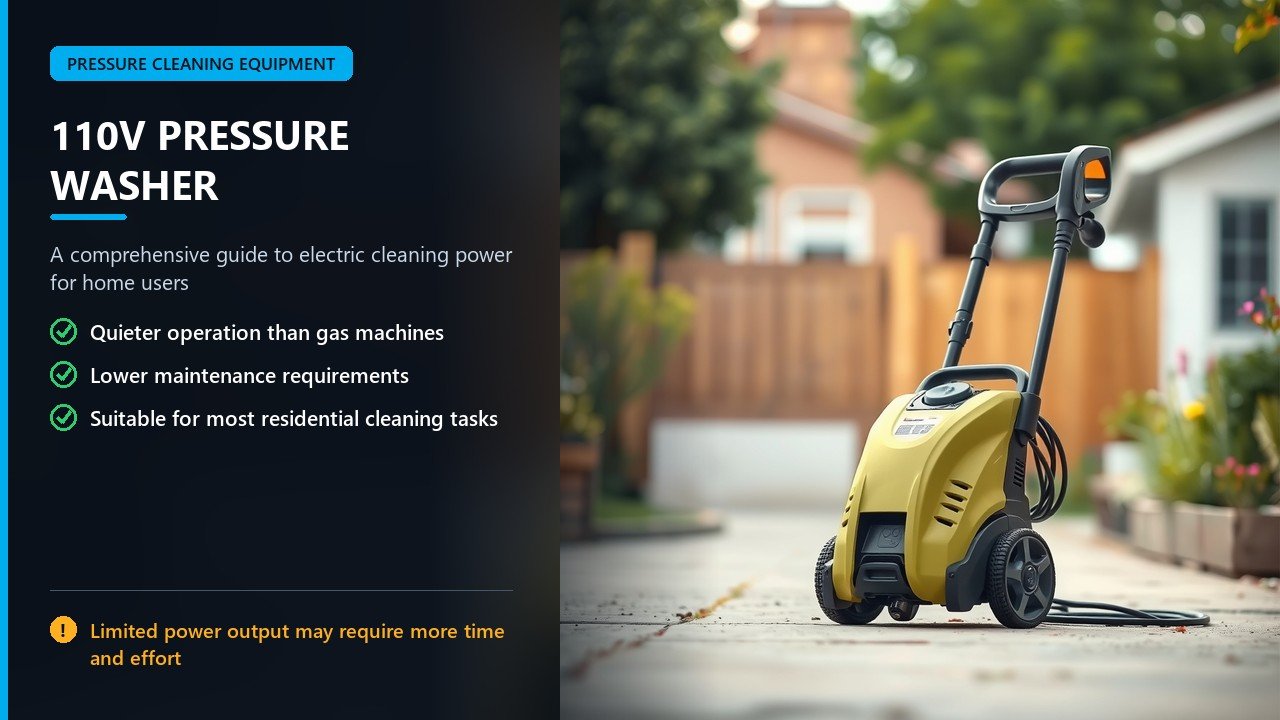
What 110V Means for a Pressure Washer
110V (technically 110–120V) is the standard voltage of ordinary household outlets in North America. A 110V pressure washer plugs into any normal wall outlet — no special wiring, no generator, no gasoline.
- Standard outlet — plug into a typical 15-amp household circuit.
- No fuel or fumes — safe for garages and near the home.
- Quieter operation than gas machines.
- Lower maintenance — no engine oil, fuel, or spark plugs.
- Pressure ceiling — household power limits maximum output.
Quick Note: A standard 15-amp, 110V circuit supplies limited power, so 110V machines usually max out around 1,500–2,000 PSI. That is plenty for most home tasks.
The Power Math Behind the Limits
Household power explains why 110V machines have a pressure ceiling. A 15-amp circuit at 110–120V provides roughly 1,650–1,800 watts.
| Circuit | Available Power | Typical Machine |
|---|---|---|
| 15-amp, 110–120V | ~1,650–1,800 W | Entry to mid-range electric |
| 20-amp, 110–120V | ~2,200–2,400 W | Higher-output 110V machines |
| 220–240V circuit | Roughly double | Heavy-duty electric machines |
Short Note: The circuit, not just the machine, decides performance. If you plug a high-draw unit into a circuit already serving other loads, you may trip the breaker.
Specifications That Matter
| Specification | What to Look For |
|---|---|
| Working pressure | Around 1,500–2,000 PSI for 110V |
| Flow rate (GPM) | Higher flow cleans and rinses faster |
| Amperage draw | Must suit your circuit |
| Cord length | Reach without extension cords |
| Hose length | Enough to move around the work area |
| GFCI protection | Essential for outdoor electrical safety |
Cleaning units (PSI × GPM) still describe productivity best. Among 110V machines, favor the one with the best balance of both.
How 110V Compares to Gas
| Factor | 110V Electric | Gas |
|---|---|---|
| Max pressure | Usually 1,500–2,000 PSI | 3,000–4,000+ PSI |
| Power source | Standard outlet | Gasoline engine |
| Noise | Quiet | Loud |
| Maintenance | Minimal | Engine care required |
| Portability | Limited by cord | True anywhere |
For most residential cleaning near the home, a 110V machine is the simpler and entirely adequate choice. Gas earns its place when you need maximum power and true portability.
Who Should Buy a 110V Pressure Washer
- Homeowners with typical cleaning needs.
- Apartment and condo residents with small outdoor spaces.
- Vehicle owners washing cars, bikes, and boats.
- Users who prefer no fuel or fumes.
- Anyone wanting low maintenance and quiet operation.
If your jobs are small to moderate and near a power source, a 110V machine is the practical choice. For large driveways or commercial work, a gas machine is worth the extra effort.
What a 110V Machine Can Clean
| Task | Suitability |
|---|---|
| Vehicles | Excellent |
| Patios and small paving | Good with patience |
| Outdoor furniture | Excellent |
| Fences and railings | Good |
| Gutters and bins | Good with the right attachment |
| Large concrete driveways | Possible but slow |
For most everyday household cleaning, a 110V machine at 1,500–2,000 PSI does the job well, often with a surface cleaner for patios and walkways.
Setting Up and Using It
| Step | Action |
|---|---|
| 1. Connect water | Garden hose fully on, water turned on |
| 2. Bleed air | Squeeze the trigger until water flows steadily |
| 3. Plug in | Use a GFCI outlet where possible |
| 4. Power on | Turn the switch on and squeeze the trigger |
| 5. Select a nozzle | Match angle to the surface |
| 6. Clean | Keep the wand moving; work top-down |
Never run the machine without water flowing. Even brief dry running can damage an electric pump.
Extension Cords and Outlets
- Use a heavy-gauge extension cord (12 AWG) if you must extend the reach.
- Keep extensions short. Long, thin cords cause voltage drop and overheating.
- Use a GFCI outlet or GFCI adapter near water.
- Don’t overload the circuit. Avoid sharing with other high-draw appliances.
- Check the cord and plug for damage before each use.
Note: Many manufacturers specify minimum cord gauges and warn against long extensions. Follow their guidance — it protects both the machine and your safety.
Performance Expectations
- Vehicles — fast, effective washing with a foam cannon and wide nozzle.
- Patios and walkways — good results, especially with a surface cleaner.
- Siding and fences — moderate cleaning with a wider nozzle.
- Outdoor furniture — quick and easy.
Expect effective cleaning with less force than gas. Where a gas machine would blast grime away in seconds, a 110V machine rewards a little patience and the right detergent.
Technique for Best Results
- Let detergent work. Pre-soaking compensates for lower pressure.
- Match the nozzle to the surface. 25° and 40° handle most tasks.
- Keep the wand moving to avoid streaks.
- Use a surface cleaner for flatwork — even a 110V machine benefits greatly.
- Work top-down and rinse as you go.
- Maintain a steady distance; closer is not always better.
- Test on a hidden spot on delicate surfaces.
With less pressure to rely on, detergent and technique matter more. Soap plus a wide nozzle does most of the work with a 110V machine.
Maintenance Schedule
| Task | Interval | Purpose |
|---|---|---|
| Check inlet filter | Every use | Protect the pump from debris |
| Inspect cord and plug | Every use | Electrical safety |
| Clear nozzle tips | As needed | Restore spray pattern |
| Check hose and O-rings | Regularly | Stop leaks at connections |
| Check pump oil (if applicable) | Per manual | Protect the pump |
| Winterize | Before freezing | Prevent freeze damage |
Electric machines need far less upkeep than gas, but winterization and inlet-filter care remain essential.
Storage and Winterization
- Drain all water from the pump, hose, wand, and gun.
- Flush with pump antifreeze if recommended by the manual.
- Coil the cord loosely and store it dry.
- Store indoors, above freezing.
- Keep nozzles in a case so they aren’t lost.
Water left inside an electric pump over winter is a leading cause of spring failure. Draining it fully protects your investment.
Common Mistakes to Avoid
- Using a long, thin extension cord. Causes voltage drop and overheating.
- Overloading the circuit. Trips breakers and strains the motor.
- Running without water. Damages the pump quickly.
- Ignoring the inlet filter. Debris harms the pump.
- Using a 0° nozzle on soft surfaces. Causes damage even at lower pressure.
- Leaving water in over winter. Freeze damage is expensive.
- Using an indoor-rated unit outdoors in wet conditions without GFCI protection.
110V vs 220V Electric Machines
Most household electric pressure washers run on 110V, but heavier-duty electric machines sometimes use 220V circuits. Understanding the difference helps you buy appropriately.
| Factor | 110V | 220V |
|---|---|---|
| Outlet | Standard household | Special circuit required |
| Typical pressure | 1,500–2,000 PSI | Higher, sometimes 2,500+ PSI |
| Convenience | Plug in anywhere in the home | Restricted to the circuit |
| Best for | Everyday home cleaning | Heavier home or light commercial |
Short Note: For most homeowners, 110V is the convenient choice. A 220V machine makes sense only if you have a suitable circuit and need the extra power.
Choosing the Right 110V Machine
| Priority | What to Prefer |
|---|---|
| 1. PSI and GPM balance | Higher cleaning units for productivity |
| 2. Amperage | Suit your circuit to avoid trips |
| 3. Cord and hose length | Enough reach without extensions |
| 4. Nozzle set included | Immediate versatility |
| 5. Total-stop system / auto shutoff | Convenience and pump protection |
| 6. Weight and wheels | Easy handling |
Because electric power is limited, choose a machine with the best balance of pressure and flow rather than the single highest PSI claim.
Accessories for a 110V Machine
| Accessory | Why It Helps |
|---|---|
| Foam cannon | Compensates for lower pressure with detergent |
| Surface cleaner | Even, streak-free flatwork |
| Nozzle set | Matches pressure to each surface |
| Extension wand | Adds reach without moving the machine |
| Turbo nozzle (low flow) | Extra cleaning power on concrete |
With a 110V machine, accessories matter even more, because detergent and the right nozzle can substitute for the pressure you don’t have.
Making the Most of Limited Power
- Pre-treat with detergent and let it dwell.
- Use a surface cleaner for even results on flat surfaces.
- Keep nozzles clean so flow is not reduced.
- Maintain adequate water flow at the inlet.
- Work in manageable sections rather than rushing.
- Use warm water (if supported) to boost cleaning.
- Keep the machine cool between long jobs.
Quick Note: A 110V machine cleaned patiently with detergent often matches a gas machine’s appearance results on light-to-moderate grime — it simply takes a little longer.
Choosing the Right Nozzle
| Nozzle | Best Use |
|---|---|
| 0° (red) | Stubborn spots only — high risk |
| 15° (yellow) | Concrete and hard stains |
| 25° (green) | General hard-surface cleaning |
| 40° (white) | Delicate surfaces and rinsing |
| Soap (black) | Applying detergent at low pressure |
On a lower-pressure machine, the 25° and 40° nozzles do most of the work. Use the 15° for concrete and treat the 0° with caution.
Electrical Safety With a 110V Machine
- Use a GFCI-protected outlet whenever water is involved.
- Never touch the plug with wet hands.
- Keep cords out of standing water.
- Inspect the cord for damage before each use.
- Don’t run over the cord or pinch it under doors.
- Unplug before servicing or changing accessories.
- Keep the machine dry and never submerge it.
- Use a drip loop so water runs off the cord, not into the outlet.
Guidance from the Occupational Safety and Health Administration (OSHA) and the U.S. Consumer Product Safety Commission (CPSC) on electrical safety around water is worth reviewing for any user.
Cost and Value
| Class | Typical Price | Best For |
|---|---|---|
| Compact 110V | $70–$150 | Light tasks and small spaces |
| Mid-range 110V | $150–$300 | Versatile home cleaning |
| High-output 110V | $300–$500 | Frequent heavy home use |
110V machines deliver excellent value for home use: low purchase price, low maintenance, and no fuel costs. Their limitation is power, not economy.
Real-World Scenarios
Scenario 1: A suburban homeowner. A 110V machine cleans the car, patio furniture, and fencing from a single outlet, with no fuel or fumes to manage.
Scenario 2: A condo resident with a balcony. The compact size and quiet operation make a 110V machine ideal for small-space cleaning.
Scenario 3: A detailer on a budget. A 110V unit with a foam cannon delivers impressive vehicle-cleaning results without the cost and upkeep of gas.
Frequently Asked Questions
What is a 110V pressure washer? An electric machine that runs on a standard household outlet, typically producing 1,500–2,000 PSI.
Is 110V enough to clean a driveway? For light grime and occasional cleaning, yes, especially with a surface cleaner. Heavy or large driveways suit gas better.
Can I use an extension cord? Yes, but use a short, heavy-gauge (12 AWG) cord and keep it dry. Long or thin cords hurt performance.
Do I need a GFCI outlet? Strongly recommended. GFCI protection prevents shocks when water and electricity are near each other.
How is maintenance different from gas? There is far less — no engine oil, fuel, or spark plugs. Inlet filter care and winterization remain important.
Final Thoughts
A 110V pressure washer is the simplest, most convenient option for most household cleaning. It plugs into a normal outlet, runs quietly, and needs minimal maintenance — with performance that covers the vast majority of home tasks.
Respect the electrical safety rules, keep the cord and circuit in mind, and winterize it properly. For related reading, see our guides on the power washer electric 3000 PSI and 3200 PSI pressure washers.