A 12 GPM pressure washer is not a bigger version of a home machine. Twelve gallons per minute is a flood — close to ten times what a typical home pressure washer delivers — and it turns the tool into something closer to industrial plumbing than to a garden gadget. Machines at this flow are built for a different job entirely, and understanding that job is what stops a buyer from spending thousands on the wrong thing.
This guide explains what a 12 GPM pressure washer is, what it is used for, and what it takes to run one.
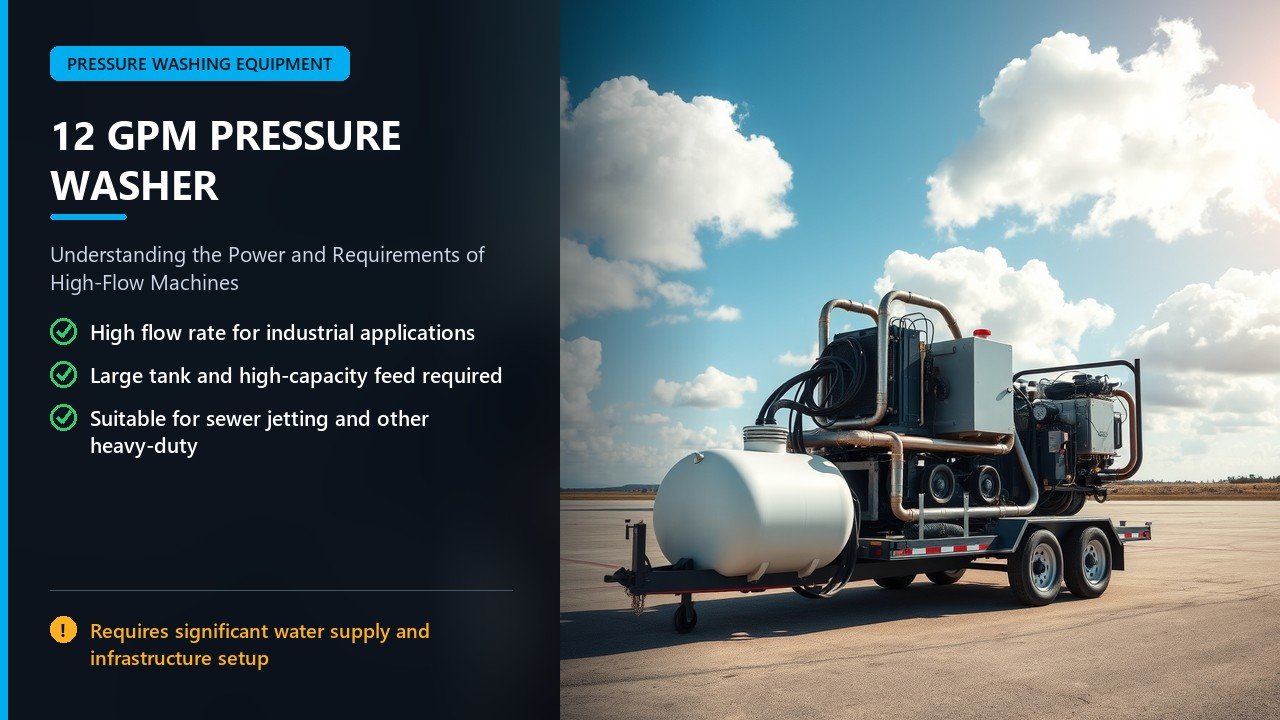
What 12 GPM Actually Means
GPM is the flow rate: how many gallons of water pass through the machine every minute. It is the number that decides how fast a washer cleans and, at the top end, what kind of work it can do at all. A home washer often runs 1.2 to 2.5 GPM; a pro machine 3 to 4 GPM; a 12 GPM machine is in a class of its own.
Pair that flow with pressure and the scale becomes obvious. At 3,000 PSI and 12 GPM, cleaning power — pressure multiplied by flow — reaches 36,000 cleaning units, several times that of a strong 4 GPM machine and roughly ten times a home unit. That is why 12 GPM machines are not used to wash a car more quickly; they are used where a large, constant volume of water is the point.
The consequence is a demand on supply. A 12 GPM machine drinks water far faster than a garden tap can supply, so it needs a large tank, a high-capacity feed, or a water source made for it. That single fact shapes almost everything else about these machines: their size, their engine, and where they can work.
Typical 12 GPM Configurations
Most 12 GPM machines share a common shape. The table below summarises the typical build.
| Spec | Typical value |
|---|---|
| Flow (GPM) | ~12 |
| Pressure (PSI) | ~2,500-4,000 |
| Engine | Large gas engine, often 20+ HP, or hydraulic/PTO drive |
| Pump | Industrial triplex |
| Mounting | Skid, trailer, or van |
| Water supply | Large tank or heavy supply line |
The pattern is heavy, mounted, and industrial. A 12 GPM machine usually needs a large gas engine or a hydraulic or PTO drive to spin an industrial triplex pump, and it usually rides on a skid, trailer, or van because it is too large and too demanding to be a portable cart machine. It also needs a big water source, since the pump pulls far more than any household tap can supply.
Why Machines This Size Exist: Sewer Jetting
The most common use of a 12 GPM pressure washer is not washing surfaces at all — it is sewer and drain jetting. A jetter sends a large volume of water, not just high pressure, down a drain line through a special hose fitted with forward and rear nozzles. The forward jet cuts through the blockage while the rear jets push the hose deeper and flush the loosened debris away.
Jetting is a flow game. To move a heavy blockage or clear a long line, the machine must deliver enough gallons per minute to flush the pipe, which is why jetters often run 8 to 12 GPM at 3,000 to 4,000 PSI and are typically trailer, skid, or van mounted. A high-pressure but low-flow washer cannot clear a main line the way a high-flow jetter can.
Machines in this class pair with dedicated sewer hose — often 1/4 to 1/2 inch, mounted on a reel — and with a variety of jetter nozzles for different pipe sizes and blockages. Some are offered as hot water units heated by a diesel burner, because hot water cuts through grease blockages in kitchen and industrial drains far better than cold.
Other High-Flow Applications
Beyond drain cleaning, high-flow machines serve any job where volume matters more than a fine spray. Large-scale surface cleaning with a wide, high-flow surface cleaner benefits from the extra gallons, because the same pressure over more flow rinses and cleans faster across big areas like parking lots and warehouse floors.
Industrial cleaning of tanks, pipes, and process equipment often needs high flow to flush residues, and some hydro-excavation and tube-cleaning work uses large volumes of water at moderate pressure. In each case the tool is chosen for its ability to move water quickly, not merely to pressurise it.
This is why buying a 12 GPM machine for ordinary pressure washing rarely makes sense. For driveways, siding, and vehicles, the extra flow is wasted and the machine is harder to supply, move, and afford. The high-flow class earns its keep only when the work genuinely needs the volume.
What It Takes to Run One
Water supply is the first constraint. A 12 GPM pump needs 12 gallons per minute arriving at its inlet, and no ordinary garden tap provides that. The solution is a large water tank fed beforehand, a high-capacity supply line, or a combination of both. Starve a high-flow pump and it cavitates, which quickly damages it.
Engine and drive come next. Delivering 12 GPM at pressure takes substantial power, so these machines run large gas engines or are driven by a hydraulic or PTO source. That means fuel, maintenance, and the weight that comes with a bigger power plant, all of which push the machine onto a skid or trailer.
Then there is the plumbing. Hoses, fittings, and nozzles must be sized for the flow; a thin hose or undersized nozzle will choke the machine and rob it of performance. Jetting and high-flow work need correctly sized hose and purpose-built nozzles, and often a reel to manage the length. Put together, a 12 GPM setup is a system, and every part of it has to match the flow.
12 GPM vs Ordinary Pressure Washers
It helps to place 12 GPM on a scale. A home electric washer might deliver around 1.2 to 2 GPM; a good residential gas machine 2.5 to 3.5 GPM; a professional surface-cleaning machine about 3.5 to 4 GPM. Each step up in flow cleans faster and needs a stronger engine and a bigger water supply, but they remain machines a person can move and a household tap can mostly feed.
A 12 GPM machine breaks from that pattern. It is not simply the next step — it is a different category, built for industrial and municipal work. It cleans far faster than a 4 GPM machine, but it cannot run from a garden hose, it needs a large engine, and it lives on a trailer, skid, or van. The gap between 4 GPM and 12 GPM is as much about infrastructure as it is about cleaning power.
So the choice is not “how much can I afford.” It is “what does the job require.” If the work is drain jetting or large industrial cleaning where volume is essential, a 12 GPM machine is the right tool. If the work is normal pressure washing, a 3 to 4 GPM machine will clean just as well and be far easier to own.
Choosing the Right High-Flow Machine
Start with the job, not the number. If you are clearing drains, measure the pipe sizes and the severity of the blockages, and choose a jetter with the flow and pressure to match — often 8 to 12 GPM. If you are cleaning large flat areas, a high-flow surface cleaner with a machine sized to its flow will outperform a pressure-heavy but low-flow setup.
Confirm the water source before anything else. A machine you cannot feed cannot work, so decide how you will supply 12 GPM — a tank, a mains line of sufficient capacity, or a combination — and build the rest of the setup around that. Match the pump inlet, hose diameters, and nozzle sizes to the flow so the machine can actually deliver its rating.
Then consider hot water. For grease-heavy drains and industrial cleaning, a diesel-heated high-flow machine removes soil far better than cold water. For general jetting of general debris, cold water is usually enough. Weigh the added cost, fuel, and maintenance of a burner against how much the heat will help.
Protecting a High-Flow Investment
These machines are expensive, so protection matters. Never let the pump run dry or cavitate — always confirm the supply before starting, and keep the tank or supply line and any inlet strainer clean. A high-flow pump moving 12 GPM of water can be destroyed quickly by running without water or with debris passing through it.
Follow the engine and pump maintenance schedules closely, since the power plant on a machine this size is a major cost to replace. Keep the oil changed, the filters clean, and the pump’s oil at the correct level. Check the high-pressure and jetter hoses for wear, since a failure at 3,000 to 4,000 PSI is a serious safety event, not just an inconvenience.
Protect the machine from freezing, drain it after use, and store it under cover when possible. For jetting machines, rinse the jetter hose and nozzles after each use so debris does not dry in the orifices. Looked after properly, a 12 GPM machine is a long-lived, high-earning piece of equipment; neglected, its pump and engine fail early and expensively.
Frequently Asked Questions
What is a 12 GPM pressure washer used for? Mainly sewer and drain jetting and large-scale industrial cleaning, where a high volume of water — not just high pressure — is needed to move debris and flush surfaces.
Is 12 GPM too much for home use? Yes, by a wide margin. A home washer runs about 1.2 to 2.5 GPM. A 12 GPM machine needs industrial water supply, a large engine, and a trailer or skid to carry it.
How powerful is 12 GPM at 3,000 PSI? That is 36,000 cleaning units, several times a professional 4 GPM machine and roughly ten times a typical home unit.
Can a 12 GPM washer run from a garden hose? No. It needs a large tank or a high-capacity supply line, because it draws far more water per minute than a household tap provides. Starving it causes cavitation and pump damage.
Why do jetters use high flow instead of very high pressure? Because clearing a drain is about flushing volume through the pipe. High flow pushes the hose and carries debris away, while pressure alone cannot move a large blockage down a long line.
What engine does a 12 GPM washer need? A large gas engine or a hydraulic or PTO drive, because powering an industrial triplex pump at that flow demands substantial input.
Do high-flow machines come hot water? Some do, with a diesel burner. Hot water cuts through grease blockages and oily residue better than cold, which matters in kitchen and industrial drains.
How do I maintain one? Keep a reliable water supply, never run the pump dry, change the oil and filters on schedule, inspect high-pressure and jetter hoses for wear, rinse the jetter nozzles, and protect the machine from freezing.
Final Thoughts
A 12 GPM pressure washer is an industrial machine, not an upgraded home tool. Its defining quality is flow — a volume of water that suits sewer jetting and large-scale cleaning but overwhelms any ordinary supply. To run one you need a tank or heavy supply line, a large engine or other drive, and plumbing sized to the flow, which is why these machines ride on trailers, skids, and vans rather than carts.
Choose one only when the job genuinely needs the volume: drain clearing, big flat surfaces, or industrial flushing. For normal pressure washing, a 3 to 4 GPM machine is easier to own and just as effective. Matched to the right work and properly maintained, a high-flow machine is a powerful, long-lived asset. For comparison, see our guides on 4 GPM pressure washers and 3 phase pressure washers.