Of all the nozzles clipped to a pressure washer’s storage rail, one tends to get the most use among people who know what they are doing. It is the one that splits the difference between gentle and aggressive, capable of stripping stubborn grime while still being controlled enough to use on most hard surfaces. Someone once asked me why their new machine felt “just right” on the driveway but too weak on the car, and the answer was a single colored tip on the end of their wand. Understanding one nozzle, the 15 degree nozzle for pressure washer setups, is the key to unlocking the machine’s real potential.
The 15 degree nozzle, often color-coded yellow, is the middle-ground tip that most experienced users reach for when a job needs real cleaning power. But it is not the right choice for everything, and using it carelessly is a fast way to damage surfaces or injure yourself. This guide explains exactly what a 15 degree nozzle does, how it fits into the color-coded system, when to use it and when to avoid it, how to size it correctly, and how to keep your nozzles performing.
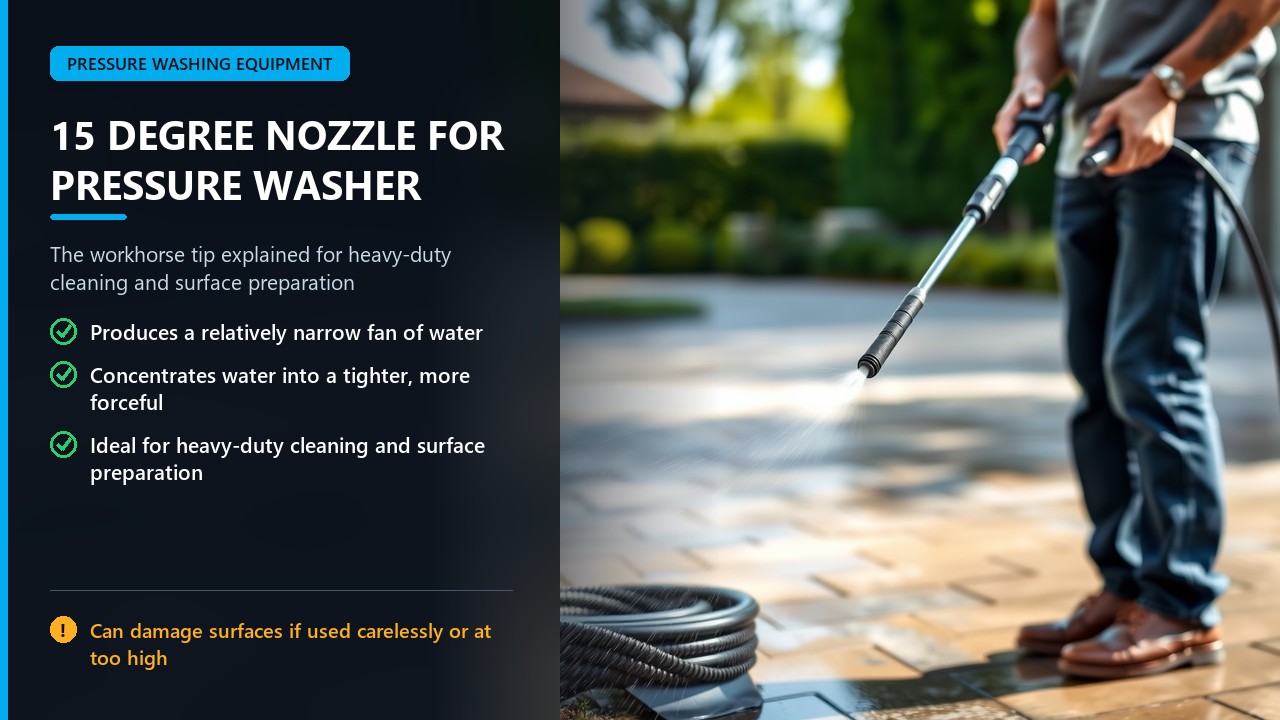
What Is a 15 Degree Nozzle?
A pressure washer nozzle shapes the stream of water that leaves the wand. The angle refers to how wide the spray fans out. A 15 degree nozzle produces a relatively narrow fan, concentrating the water into a tighter, more forceful pattern than wider nozzles, while spreading it enough to cover a workable strip of surface.
That combination of focus and coverage is what makes the 15 degree tip so versatile. It delivers more impact per square inch than a 25 or 40 degree nozzle, so it cleans faster, but it is not as brutally concentrated as a zero degree tip. For a wide range of tough cleaning tasks, it is the practical workhorse.
The Color-Coded Nozzle System
Pressure washer nozzles are color-coded so you can identify spray angles at a glance. The colors are widely standardized, though you should always confirm your set.
| Color | Angle | Relative Force | Typical Use |
|---|---|---|---|
| Red | 0 degrees | Highest (focused) | Tough, isolated spots, use with extreme care |
| Yellow | 15 degrees | High | Stripping, heavy cleaning, concrete |
| Green | 25 degrees | Moderate | General cleaning, most surfaces |
| White | 40 degrees | Lower | Delicate surfaces, siding, vehicles |
| Black | Low pressure | Lowest | Applying detergent |
The narrower the angle, the more concentrated and forceful the spray. The 15 degree yellow tip sits near the aggressive end, just below the zero degree red tip, which is why it is used for cleaning that demands power but not the pinpoint focus of red.
What the 15 Degree Nozzle Is Best For
The 15 degree tip excels where dirt is stubborn and the surface can take some force.
- Concrete and driveways. Great for stripping dirt and grime from hard concrete.
- Tough stains. Handles marks and buildup that wide nozzles only wet.
- Brick and stone. Effective on rugged masonry with careful, even passes.
- Heavy cleaning on durable surfaces. Anything that resists both water and force.
- Paint prep and stripping loose material. Useful for surface preparation where appropriate.
On these jobs, the 15 degree tip cleans noticeably faster than a wider nozzle because it concentrates more force on the surface without the risk profile of a zero degree tip.
When Not to Use a 15 Degree Nozzle
Just as important is knowing when to put it down and pick up something wider.
- Vehicle paint and clear coat. Too forceful for paint at close range. Use a wider white tip.
- Wood decks and siding. Can gouge soft wood and force water into cladding. Use wider angles and more distance.
- Vinyl siding. A narrow tip risks damage and water intrusion behind the panels.
- Windows and glass. Can etch or crack glass at close range.
- Anything delicate or newly finished. When in doubt, go wider and gentler.
The rule of thumb: use the widest nozzle that does the job, and step down toward narrower tips only when you need more force. Starting with a 15 degree tip on delicate surfaces is how people cause avoidable damage.
15 Degrees vs 25 Degrees vs 40 Degrees
Understanding how the three main working angles compare helps you choose quickly.
| Angle | Force | Coverage | Best Application |
|---|---|---|---|
| 15 degrees | High | Narrow strip | Concrete, tough stains, heavy cleaning |
| 25 degrees | Moderate | Medium strip | General cleaning, most hard surfaces |
| 40 degrees | Lower | Wide swath | Siding, vehicles, delicate or soft surfaces |
A good approach is to keep all three handy and move between them as a job changes. A driveway might start at 25 degrees for general dirt and step down to 15 for stubborn patches, while a car wash stays at 40 degrees throughout.
Nozzle Orifice Sizing: The Other Half
Spray angle is only part of a nozzle’s spec. The orifice size, the diameter of the opening, also matters and is often expressed as a number such as 3.0, 3.5, or 4.0.
- Orifice size must match your machine’s GPM and pressure. Too small an orifice over-pressurizes the pump; too large an orifice drops pressure and wastes power.
- Higher GPM machines generally need larger orifices.
- Using the wrong orifice size can damage the pump or deliver disappointing performance.
If you are unsure which orifice size suits your machine, consult the nozzle manufacturer’s sizing chart or your pressure washer manual. It is a common and overlooked detail that affects both performance and pump life.
Quick Connect Nozzles
Most modern pressure washers use quick connect nozzles that snap onto the wand and swap in seconds. This is a big advantage, because it lets you change angles as a job demands without tools.
- Confirm your connection type before buying replacements, typically 1/4 inch or 3/8 inch quick connect.
- Keep O-rings in good condition to prevent leaks at the nozzle.
- Store nozzles where they stay clean, because grit in the orifice affects spray quality.
- Keep spare tips on hand, especially the 15, 25, and 40 degree ones you use most.
Cleaning and Replacing Nozzles
- Inspect tips before each use for clogs, debris, or damage.
- Clean with a nozzle cleaning tool or a soft brush and water.
- Never poke the orifice with metal, which scratches and alters the spray pattern.
- Check for wear, since abrasive water eventually enlarges the orifice and weakens the spray.
- Replace worn or damaged tips promptly to protect performance and surfaces.
- Store in a case or holder to keep them clean and organized.
Safety With Narrow Nozzles
Because the 15 degree tip is forceful, safety matters. Remember:
- Never point a nozzle at a person or animal. High-pressure water can cause serious injury.
- Wear eye and hand protection, especially when using narrow tips that can kick up debris.
- Watch your footing, since concentrated spray can splash and create slippery surfaces.
- Keep the tip moving so you do not etch a single spot on the surface.
- Never use a narrow nozzle at close range on skin. Even a harmless-looking stream can pierce skin.
Frequently Asked Questions
What is a 15 degree nozzle used for?
Heavy cleaning on durable surfaces such as concrete, driveways, brick, and tough stains. It concentrates the spray more than wider nozzles, so it cleans faster but is too forceful for paint, wood, and delicate surfaces.
What color is a 15 degree pressure washer nozzle?
Yellow in the standard color-coding system. Always confirm your specific set, since color conventions can vary slightly.
Can I use a 15 degree nozzle on my car?
It is too aggressive for vehicle paint at close range. Use a wider 40 degree white nozzle for cars to avoid damaging the finish.
Is a 15 or 25 degree nozzle better?
They serve different purposes. The 15 degree tip is more forceful for tough jobs, while the 25 degree tip is more balanced for general cleaning. Keep both and switch as needed.
How do I know which nozzle orifice size I need?
Match the orifice to your machine’s GPM and pressure using the nozzle manufacturer’s sizing chart or your pressure washer manual. The wrong size can hurt performance or the pump.
Final Thoughts
The 15 degree nozzle for pressure washer use is the tip that balances power and control, perfect for concrete, tough stains, and durable surfaces. But it is a tool to use deliberately, not by default. On paint, wood, siding, and glass, step up to a wider angle and protect the surface.
Learn the color system, match your orifice size to your machine, keep your tips clean, and always choose the widest nozzle that does the job. Master that approach, and your 15 degree tip becomes exactly what it should be: a powerful ally you reach for with confidence, not a source of accidental damage.