In industrial cleaning yards, a 20,000 psi pressure washer is not a tool you point casually. It is a machine that cuts concrete, strips coatings down to bare steel, and requires operators to understand exactly what they are holding before they pull the trigger. At that pressure, water exits the nozzle at roughly Mach 2 – faster than sound – and can slice skin, penetrate boots, and destroy flesh without the operator feeling it for hours. That is the reality behind the number 20000 psi pressure washer: extraordinary capability paired with extraordinary responsibility.
For most people, this is not a machine to own. It is a specialized industrial tool used in surface preparation, hydrodemolition, and heavy equipment cleaning. Understanding what it does, who uses it, and the safety measures it demands is useful whether you are evaluating one for a business or simply trying to understand why the machines at the top of the market are so different from the one in your garage.
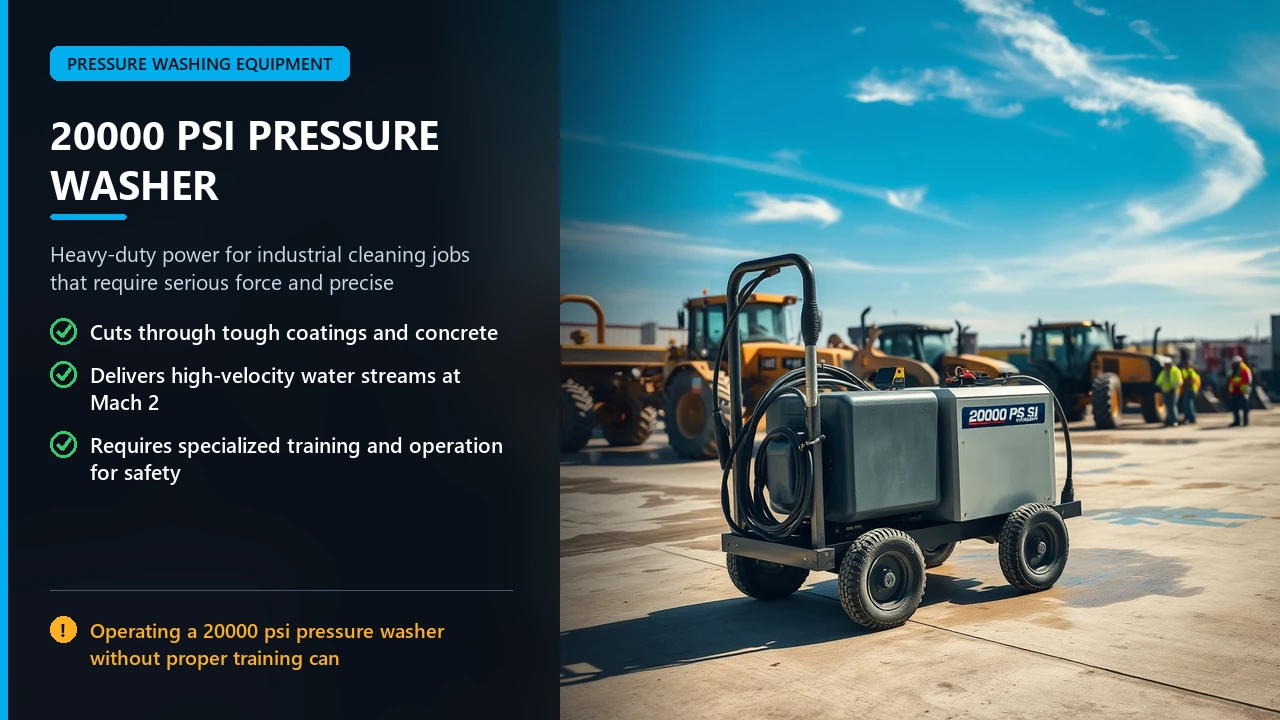
What 20000 PSI Actually Means
Pressure is force per unit area. At 20,000 psi, even a small stream carries enormous energy. To put it in perspective:
- A typical consumer electric pressure washer runs 1,500 to 2,000 psi – enough to clean a car safely with the right tip.
- A serious gas machine runs 3,000 to 4,000 psi – enough for driveways and heavy home cleaning.
- A professional trailer-mounted unit runs 4,000 to 8,000 psi – commercial cleaning and paint prep.
- A 20,000 psi UHP unit is five to ten times the commercial ceiling, used for cutting and profiling rather than washing.
At this level, the goal shifts from "clean the surface" to "remove material." Water becomes an abrasive tool, capable of cutting through concrete, rust, scale, and coatings, and even through steel in some configurations.
| Pressure Range | Typical Use | Operator Type | Relative Hazard |
|---|---|---|---|
| 1,500-3,000 psi | Home, vehicles, patios | Consumer | Low with basic care |
| 3,000-5,000 psi | Driveways, siding, light commercial | Prosumer / Contractor | Moderate |
| 5,000-10,000 psi | Commercial cleaning, paint prep, tube cleaning | Trained professional | High |
| 10,000-20,000+ psi | Hydrodemolition, surface profiling, industrial cutting | Specialist operator | Extreme |
What Ultra-High-Pressure Washers Do
The applications explain why the pressure exists. If a job only needed cleaning, 5,000 psi would do. At 20,000 psi, the machine is doing something fundamentally different.
- Hydrodemolition. Removing deteriorated concrete from bridges, decks, and structures while leaving sound concrete and reinforcing steel intact. Water at this pressure pulverizes weak concrete without damaging rebar – something no mechanical tool can do as selectively.
- Surface preparation. Stripping coatings, membranes, and years of buildup from concrete and steel before resurfacing. It creates a profile that new coatings bond to.
- Industrial scale removal. Cleaning heat exchangers, pipes, and vessels where scale and deposits build inside difficult geometries.
- Coatings and paint removal. Removing thick industrial coatings from large steel and concrete surfaces far faster than manual methods.
- Robotic and automated systems. Many UHP applications use automated or robotic lances because holding such pressure by hand is impractical and unsafe.
Notice how many of these involve material removal or automated systems, not hand-held washing. That is the defining characteristic of UHP equipment – it is often a cutting or demolition tool as much as a cleaning tool.
How UHP Systems Are Built
A 20,000 psi system is engineered very differently from a consumer washer. The components are specialized and expensive because nothing about them is ordinary.
- Pumps. Massive triplex or intensifier pumps, often diesel-driven, capable of continuous high-pressure duty. They are built to sustain pressure for hours, not minutes.
- High-pressure hose. Steel-braided helically wound hose rated for the pressure and tested with a burst margin. Hose failures at this pressure are catastrophic.
- Nozzles and lances. Precision-machined, often mounted in automated or robotic assemblies. Hand lances use heavy-duty controls and safety trigger systems.
- Safety systems. Pressure relief, burst containment, and remote shut-offs, because a leak or failure at 20,000 psi is lethal.
- Filtration and water supply. Clean water is essential; contaminants damage precision nozzles and pump internals instantly.
The cost reflects all of this. This is capital equipment for specialized contractors, not a purchase decision taken lightly.
Why It Is Not for Homeowners
The gap between 3,000 psi and 20,000 psi is not a matter of "more power for tougher jobs." It is a different category of machine with different physics and different risks.
- No safe hand-cleaning use. You cannot safely wash a car, siding, or deck at 20,000 psi. Any of those jobs is done with far lower pressure and different tools.
- Severe injury risk. At this pressure, water penetrates skin and clothing, causing deep tissue damage and injection injuries that appear minor but are surgical emergencies. The operator may not feel pain immediately.
- Destruction of surfaces. Ordinary surfaces – wood, asphalt, most concrete – are cut or destroyed by UHP water. It is designed to remove material.
- Cost and infrastructure. Price, power requirements, water supply, and maintenance put these machines far outside residential use.
The correct takeaway is straightforward: if your job does not involve demolition, profiling, or industrial scale removal, a 20,000 psi machine is the wrong tool entirely, and a dangerous one.
Safety: The Non-Negotiable Rules
Every credible UHP operation treats safety as the first requirement, not an afterthought. The fundamentals:
- Formal training and certification. Operators are trained in high-pressure physics, equipment systems, and emergency procedures.
- Personal protective equipment. Impact-resistant face shields, heavy waterproof gloves, steel-toe waterproof boots, hearing protection, and body coverage. Ordinary safety glasses are inadequate.
- Never direct at people. A UHP stream can cause fatal injection injuries. It is never pointed toward a person, including yourself, even briefly.
- Remote or automated operation when possible. Many UHP tasks use robotic lances precisely to keep operators out of the danger zone.
- Rigorous equipment inspection. Hose, fittings, and nozzles are inspected before every use. Fatigue failures at this pressure are catastrophic.
- Controlled access. The work area is cordoned off, with prohibited access for anyone not protected and authorized.
- Emergency response planning. Everyone on site knows what to do if an injury occurs, because minutes matter.
The Occupational Safety and Health Administration (OSHA) and industry associations publish detailed guidance on high-pressure cleaning hazards. Any operator working with UHP equipment should follow the applicable standards without exception.
What to Buy Instead, Based on Your Real Job
If you arrived here because you have a tough cleaning job, the honest answer is almost never a 20,000 psi machine. Match pressure to the task:
| Your Job | Recommended Pressure | Notes |
|---|---|---|
| Cars, patio furniture, light siding | 1,500-2,000 psi | Electric, with 25°-40° nozzles |
| Driveways, decks, home siding | 2,500-3,200 psi | Gas or heavy electric, surface cleaner helps |
| Heavy grease, farm equipment | 3,000-4,000 psi, hot water | Hot water does more than extra pressure |
| Commercial fleet, paint prep | 4,000-5,000 psi | Trailer-mounted, professional use |
| Concrete removal, profiling | 10,000-20,000+ psi | Specialist contractors only |
For nearly every cleaning task that involves a surface you want to keep, the answer is far below 20,000 psi. The exception is removing the material itself – and that is a job for trained specialists with the right certification, equipment, and safety systems.
Frequently Asked Questions
What is a 20,000 psi pressure washer used for?
Ultra-high-pressure applications: hydrodemolition of concrete, surface preparation and profiling before coating, industrial scale removal inside pipes and vessels, and coating or paint removal on large steel and concrete surfaces. These are specialized industrial tasks, often performed with automated equipment.
Can I buy a 20,000 psi pressure washer for home use?
You can purchase industrial UHP equipment, but it is not appropriate for home cleaning and is dangerous without training. It will destroy ordinary surfaces and poses severe injury risk. Home jobs should use machines rated 1,500 to 4,000 psi.
Is 20,000 psi dangerous?
Extremely. Water at this pressure can penetrate skin and tissue, causing injection injuries that require emergency surgery, and can cut concrete and steel. Operators must be trained, wear full protective equipment, and follow strict safety protocols.
What pressure do professionals use for cleaning?
Most professional cleaning uses 3,000 to 5,000 psi, with hot water for grease. Pressure above 5,000 psi is reserved for specialized tasks like paint prep and tube cleaning, while 10,000 psi and above is generally industrial demolition and profiling equipment.
What is the difference between pressure washing and hydrodemolition?
Pressure washing cleans a surface without removing the material. Hydrodemolition uses ultra-high pressure – often 10,000 to 20,000+ psi – to remove deteriorated concrete or other material while leaving sound structure intact. One cleans; the other removes.
How is a UHP system operated safely?
With formal training, full protective equipment, rigorous pre-use inspection, controlled work zones, remote or automated operation where possible, and emergency planning. No one operates UHP equipment casually or without certification.
The Bottom Line
A 20,000 psi pressure washer sits at the extreme top of the pressure washing world. It is not a cleaner in the ordinary sense – it is an industrial tool that removes material, from concrete to coatings to scale. Its applications – hydrodemolition, surface profiling, industrial descaling – are specialized, and its safe operation requires training, certification, and full protective equipment.
For virtually every cleaning job a homeowner or general contractor faces, the correct machine is far below this pressure. Match pressure to the surface, use hot water for grease, and reserve ultra-high-pressure equipment for the trained specialists who do demolition and profiling work. The number is impressive, but the right pressure is the one that cleans without destroying – and for almost everything, that number is a small fraction of 20,000 psi.