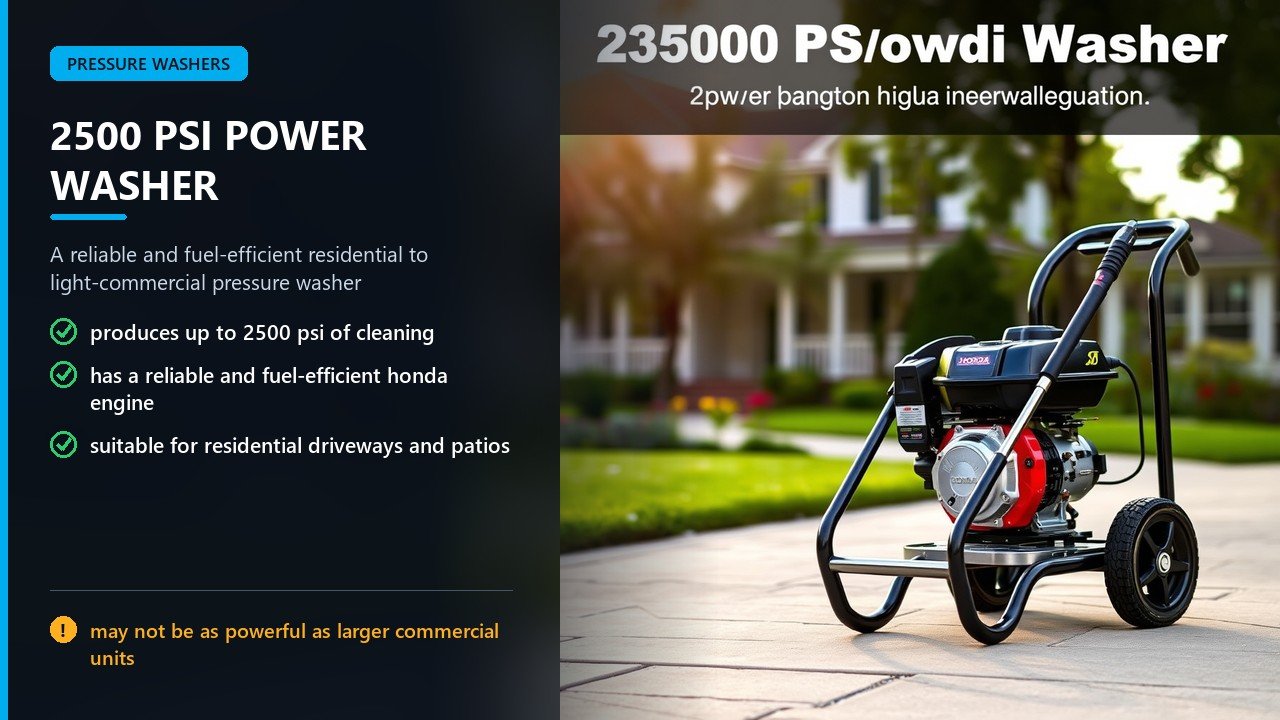
Some machines occupy a sweet spot so well that they become the default recommendation for an entire category, and the 2,500 PSI Honda pressure washer is one of them. It is not the biggest machine on the shelf and not the cheapest, but it has earned a reputation as the sensible middle: enough pressure for real residential work, especially driveways, patios, siding, and vehicles, paired with a Honda engine whose starting and durability owners trust. The result is a class of machine that trades peak power for reliability, fuel economy, and a manageable size, and for many homeowners it is the better buy than a larger, thirstier, harder-to-start unit. Understanding what a 2,500 PSI Honda machine delivers, where it outperforms its class, where it falls short, and how to get the most from it is the key to deciding whether it belongs in your garage.
A 2,500 PSI Honda pressure washer is a gas pressure washer producing around 2,500 pounds per square inch of pressure and typically two to three gallons per minute of flow, powered by a Honda small engine. It sits in the residential to light-commercial range, above small electric machines and below the heavy 3,000-plus PSI units. This guide explains what 2,500 PSI and the associated flow mean in practice, why the Honda engine matters, what jobs this class handles well and where it struggles, how it compares with electric and larger gas machines, what to look for when buying one, the maintenance that keeps it running, and how to get the best performance from this popular class of machine.
What 2,500 PSI and the Flow Numbers Mean
The two headline numbers describe the machine’s cleaning ability, and understanding them sets expectations.
Pressure, the PSI. Pressure is the force of the water, the number that strips dirt from a surface. Around 2,500 PSI is enough to clean concrete, siding, decks, patios, and vehicles without the surface-damaging power of a much larger machine. It is a practical residential level, strong enough to be useful and mild enough to be controllable in a homeowner’s hands. Our guide to how pressure works explains the concept.
Flow, the GPM. Flow is the volume of water delivered per minute, and it is what carries the dirt away and determines how fast a surface is covered. A typical 2,500 PSI machine delivers roughly two to three gallons per minute, a healthy residential figure that cleans efficiently. Pressure without flow means slow going, so the GPM matters as much as the PSI. Our flow guide covers the relationship.
Cleaning units, pressure times flow. The product of pressure and flow, sometimes called cleaning units, is a useful single measure of a machine’s cleaning power, with higher being faster. A 2,500 PSI, 2.5 GPM machine gives a healthy cleaning-unit figure that beats many higher-pressure machines with lower flow. Our guide covers the calculation.
What the class feels like in use. In practice, a 2,500 PSI Honda machine cleans a driveway or patio briskly, handles a car or deck easily, and tackles house siding with the right technique and nozzle. It is not a commercial machine that runs all day, but it is far more capable than a small electric unit. Our cleaning guides cover the techniques for each surface.
Why the Honda Engine Matters
The engine is the reason this class is recommended, because it determines how the machine starts and how long it lasts.
Reliable starting. Honda small engines have a reputation for starting readily, which matters enormously in a machine used seasonally, because a machine that will not start is useless regardless of its pressure. A reliable cold start after winter storage is a genuine benefit. Our guide to starting a pressure washer covers the routine.
Durability and parts support. Honda engines are durable and widely supported, with parts and service easy to find, which extends the machine’s life and eases repairs. An engine that can be serviced locally is more valuable than one with no support. Our engine oil guide covers the maintenance.
Fuel economy and running cost. A smaller, efficient Honda engine in the 2,500 PSI class sips fuel compared with larger machines, keeping running costs low for residential use. For a homeowner doing occasional jobs, the fuel economy is a real advantage. Our oil guide covers the engine care.
The engine brand versus the washer brand. Pressure washer makers buy engines from Honda, so the Honda engine may appear on machines from several brands, and the engine manual comes from Honda. The engine’s reliability is why the combination is sought after. Our oil guide covers the engine-specific specification.
Jobs This Class Handles Well
The 2,500 PSI Honda machine is a residential workhorse, and its strengths map to common jobs.
Driveways and concrete. At 2,500 PSI with good flow, this class cleans concrete driveways, walkways, and patios effectively, especially with a turbo nozzle or surface cleaner. It strips grime, mildew, and tire marks without the surface-etching power of a much larger machine. Our surface cleaning guide covers the method.
Siding and exterior walls. House siding, whether vinyl, wood, or fiber cement, cleans well at this pressure with the right nozzle and technique, and the moderate pressure reduces the risk of driving water behind the siding. Our guide to cleaning siding covers the approach.
Decks and fences. Wood decks and fences clean at 2,500 PSI when the nozzle and technique are controlled, and the machine’s manageability helps avoid the furring that excessive pressure causes. A careful operator gets excellent results. Our deck cleaning guide covers the technique.
Vehicles and equipment. Cars, trucks, trailers, and outdoor equipment clean easily at this pressure with a wider nozzle or a foam cannon, and the moderate force reduces the risk of damaging paint and trim. Our car washing guide covers the method.
Patios, sidewalks, and walls. The everyday residential hardscape jobs are exactly this class’s home ground, handled briskly and safely. It is the machine most homeowners need for the jobs most homeowners have. Our guide to beginner tips covers the common jobs.
Where This Class Falls Short
Honest limits help an owner decide whether a 2500 PSI machine is enough.
Heavy commercial work. A 2,500 PSI machine is not built for the all-day, every-day duty of commercial cleaning, where larger machines with higher pressure, flow, and duty cycles prevail. For a business running the machine daily, this class is too small. Our commercial guide covers the larger machines.
Stubborn, set-in stains. Old oil stains, heavy rust, and deeply set grime may need more pressure or a chemical pre-treatment that a 2,500 PSI machine alone cannot provide. The machine can still help with the right chemicals and patience. Our cleaning guides cover the tactics.
Stripping and heavy removal. Removing paint, heavy coatings, or thick buildup may require a larger machine or a different method, because the moderate pressure is a feature for cleaning but a limitation for stripping. Our surface guides cover the alternatives.
Very large areas quickly. A big commercial lot or a very long driveway takes time at residential flow rates, and a larger machine with higher flow covers ground faster. For the occasional big job, the smaller machine still works, just more slowly. Our flow guide covers the speed trade.
The limits are about duty, not just power. Beyond pressure and flow, the smaller engine and pump of this class are not meant for continuous commercial operation, so a homeowner’s occasional use suits it and a professional’s daily use does not. Matching the machine to the duty is essential. Our buying guide covers the match.
| Job | 2,500 PSI Honda Fits? | Note |
|---|---|---|
| Driveway, patio | Yes, with turbo or surface cleaner | Ideal class |
| Siding, decks | Yes, with technique | Watch nozzle |
| Vehicles | Yes, wider nozzle | Easy work |
| Daily commercial | No | Too small for duty |
The Honda Engine Variants
Understanding which Honda engine powers a machine helps an owner judge its character.
Honda GC and GCV engines. Common on residential machines, these engines are lighter and economical, well-suited to the 2,500 PSI class. They deliver reliable starting and good fuel economy for homeowner use. Our engine oil guide covers the maintenance.
Honda GX engines. The commercial-grade GX series is more robust, with greater durability and often a longer service life, and it appears on higher-end machines including some in the 2,500 PSI class. A GX-equipped machine costs more but is built for harder use. Our guide to the GX engine covers the commercial side.
Engine size and the machine’s power. The engine’s displacement roughly tracks the power the pump can drive, so a larger engine supports higher pressure and flow. In the 2,500 PSI class, the engine is sized to deliver that level reliably without being oversized. Our guide covers the engine-pump relationship.
Electric start versus recoil. Some machines offer electric start, which is convenient, while others use a recoil pull start, which is simpler and lighter. Both work well with a Honda engine, which starts readily on either. Our starting guide covers the methods.
What the variants mean for buyers. A residential GC or GCV engine suits occasional homeowner use, while a GX engine suits a buyer who wants commercial-grade longevity. The right variant depends on how hard the machine will work. Our buying guide covers the choice.
Buying a 2,500 PSI Honda Machine
A few factors separate a good buy from a poor one in this popular class.
Read both pressure and flow. Compare machines on pressure and flow together, preferring higher flow at the same pressure, because flow cleans faster. A machine marketed on pressure alone with low flow is slower than its headline suggests. Our flow guide covers the comparison.
Check the pump. The pump is what the engine drives, and a quality pump with serviceable oil and rebuildable parts lasts longer than a sealed unit. Look for a reputable pump brand and, ideally, one that can be serviced. Our pump oil guide covers the pump’s care.
Consider the frame and wheels. A sturdy frame and good wheels matter for a machine that moves around the property, and a well-built cart lasts and rolls over uneven ground. The frame is part of the machine’s value. Our frame guide covers the construction.
Look at the accessories included. Nozzles, a surface cleaner, and hose length vary by package, and the included accessories affect the machine’s ready-to-work value. A machine that includes useful accessories saves buying them separately. Our accessory guide covers the options.
New versus used. A used 2,500 PSI Honda machine can be an excellent value because the engine outlasts the pump, so a machine with a tired pump and a strong engine may be worth buying and re-pumping. Inspect the engine’s starting and the pump’s leaks before buying used. Our buying guide covers the inspection.
Match it to your jobs. A 2,500 PSI Honda machine is the right buy for a homeowner with the standard residential jobs and a preference for reliability. For a business or a heavy workload, step up in class. Our guide covers the match.
Maintaining a 2,500 PSI Honda Machine
The class rewards routine maintenance with long service and reliable starting.
Engine oil. Check the engine oil before each use and change it on the engine’s schedule, using the grade the Honda manual specifies, often a multi-grade such as 10W-30. Fresh oil is the engine’s lifeblood. Our engine oil guide covers the choice.
Pump care. Check a serviceable pump’s oil and never let the pump run dry, and change the pump oil per its maker if it is serviceable. Many pumps in this class are sealed, so confirm the design. Our pump oil guide covers the routine.
Fuel system. Use fresh fuel and a stabilizer, and treat ethanol fuel with care, because gummed carburetors are a common cause of a machine that will not start. Winter fuel preparation is essential. Our starting guide covers the fuel side.
Water and fittings. Check o-rings and fittings for leaks, keep the inlet filter clean, and inspect hoses for wear, since these small parts cause outsized problems. Our fitting guide covers the checks.
Winterizing. Drain the water from the pump and lines and treat the fuel before freezing weather, because the machine’s pump will crack if water freezes inside it. Our winterizing guide covers the steps.
Nozzle and wand care. Keep nozzles clean and unclogged and wands sealed, because a clogged or worn nozzle wastes the machine’s pressure. Our nozzle guide covers the maintenance.
How It Compares With Other Machine Types
Placing the 2,500 PSI Honda class against its neighbors clarifies where it fits.
Versus small electric machines. A typical electric pressure washer produces far less pressure and flow, often around 1,500 to 2,000 PSI with low flow, and is tethered to an outlet. The 2,500 PSI Honda machine is more powerful, portable, and capable, at the cost of fuel and engine maintenance. For anything beyond light cleaning, the gas machine wins. Our guide to electric machines covers the comparison.
Versus larger gas machines. Machines at 3,000 to 4,000 PSI deliver more pressure and flow and clean faster, but they cost more, use more fuel, are heavier, and can damage surfaces more easily in untrained hands. For most residential jobs, the 2,500 PSI class is sufficient, and the larger machines are worth it mainly for heavy or commercial work. Our guide to the 4,000 PSI class covers the step up.
Versus battery machines. A battery pressure washer offers cordless convenience for light jobs, but it cannot match the sustained pressure and flow of a gas machine, and its runtime is limited by the battery. For real cleaning, the gas machine is the more capable tool. Our cordless guide covers the battery trade.
Versus hot water machines. A hot water machine cleans greasy and oily surfaces better by adding heat, but it costs far more and is a commercial-grade tool. For residential cleaning of typical dirt, a cold-water 2,500 PSI machine is sufficient. Our hot water guide covers the heated alternative.
The value position. The 2,500 PSI Honda machine occupies the value middle: more capable than electric, more affordable and manageable than heavy gas, and reliable thanks to the Honda engine. For a homeowner with standard jobs, it is often the best value in the range. Our buying guide covers the decision.
Getting the Best Performance
A few practices let a 2,500 PSI machine deliver its full capability.
Use the right nozzle. Match the nozzle to the surface, a narrow tip for concrete and a wider one for siding, vehicles, and wood, because the wrong nozzle wastes pressure or damages surfaces. The nozzle is the operator’s main control over the machine’s effect. Our guide to nozzle selection covers the tips.
Use a turbo nozzle for concrete. A rotating turbo nozzle concentrates the spray and cleans concrete significantly faster than a fixed fan tip, making it one of the best upgrades for a machine in this class. It turns a 2,500 PSI machine into a quicker concrete cleaner. Our accessory guide covers the turbo nozzle.
Add a surface cleaner for flatwork. A surface cleaner attachment speeds up driveways and patios and produces more even results with less streaking than a wand alone. For a homeowner with concrete to clean, it is a high-value accessory. Our surface cleaner guide covers the use.
Pre-treat stubborn dirt. Applying a cleaning solution before washing loosens grime and lets the machine’s moderate pressure do more, which is especially useful for mildew and organic staining. The combination of chemical and pressure beats pressure alone. Our soft washing guide covers the pre-treatment.
Keep the setup clean. A clean inlet filter, unclogged nozzle, and sealed fittings preserve the machine’s pressure, while a partial clog quietly robs performance. Checking these before a job keeps the machine at full strength. Our fitting guide covers the maintenance.
Work methodically. Overlapping passes, consistent distance, and steady movement produce even results and use the machine’s pressure efficiently, while random spraying wastes time and leaves streaks. Technique multiplies the machine’s capability. Our beginner tips guide covers the method.
Common Mistakes With This Class
Reading pressure alone. Flow cleans as much as pressure. Compare both numbers.
Using it for daily commercial work. This class is a residential machine, not a commercial workhorse. Match the machine to the duty.
Neglecting the pump. The engine outlasts the pump, so care for the pump and never run it dry.
Storing ethanol fuel. It gums the carburetor. Stabilize or drain the fuel for storage.
Skipping winterizing. Freezing water cracks the pump. Drain and protect before the cold.
Using the wrong nozzle. Too aggressive a nozzle damages surfaces; too wide wastes time. Match the tip to the job.
Ignoring the engine oil. Low or old oil harms the engine. Check often and change on schedule.
Frequently Asked Questions
What can a 2,500 PSI Honda pressure washer clean? Driveways, patios, sidewalks, house siding, decks, fences, vehicles, and equipment. It is a capable residential machine for standard homeowner jobs.
Is 2,500 PSI enough for cleaning concrete? Yes, especially with a turbo nozzle or surface cleaner. It cleans concrete effectively without the surface-damaging power of a much larger machine.
Why is a Honda engine preferred? Honda small engines are known for reliable starting, durability, fuel economy, and easy parts support, which makes a machine using one more dependable and easier to maintain.
Is a 2,500 PSI Honda machine good for commercial use? No, it is a residential to light-duty machine. Daily commercial work calls for a larger, higher-duty machine. Match the machine to the workload.
What is the best oil for a Honda pressure washer engine? Follow the Honda engine manual, which commonly recommends a multi-grade oil such as 10W-30 for general use, matched to the climate.
How do I maintain a 2,500 PSI Honda machine? Check and change the engine oil, care for the pump and never run it dry, use fresh fuel and stabilize it for storage, check fittings, and winterize before freezing weather.
Final Thoughts on the 2,500 PSI Honda Power Washer
The 2,500 PSI Honda pressure washer earns its popularity by balancing power and reliability, delivering enough pressure and flow for real residential cleaning while pairing it with an engine that starts readily, sips fuel, and lasts for years. It is the machine for driveways, patios, siding, decks, fences, and vehicles, and it is the sensible middle for a homeowner who wants capability without the cost and temperament of a heavy commercial unit. Read both its pressure and its flow, because together they describe its cleaning power, and recognize that its limits are about duty as much as power.
Choose one by its flow as well as its pressure, favor a quality, ideally serviceable pump and a sturdy frame, and match the engine variant, GC or GX, to how hard it will work. Keep the engine oil fresh and the pump cared for, run fresh fuel and prepare it for storage, and winterize to prevent the freeze damage that cracks pumps. Do these things, and a 2,500 PSI Honda machine becomes the dependable, easy-starting workhorse that justifies its reputation, handling the jobs most homeowners actually have for years with minimal fuss.