If there is one diameter that professional pressure washing tends to settle on, it is three-eighths of an inch. Ask a contractor why, and you will hear the same reasoning: it moves enough water to clean fast, it survives high pressure and long runs, and it pairs with the fittings that serious machines use. The catch is that 3/8 hose is heavy, especially when it is full of water and stretched across a driveway. That weight is exactly why a 3/8 pressure washer hose reel becomes the natural partner to this hose size, turning a heavy, awkward coil into a controlled, easy-to-manage system.
This guide is all about that combination. We will look at why 3/8 is the go-to diameter, how it compares with thinner hose, why a reel matters so much for this size, how to match reel capacity to hose length, the reel features that count, and how to install and maintain a setup that can handle this heavier hose day after day.
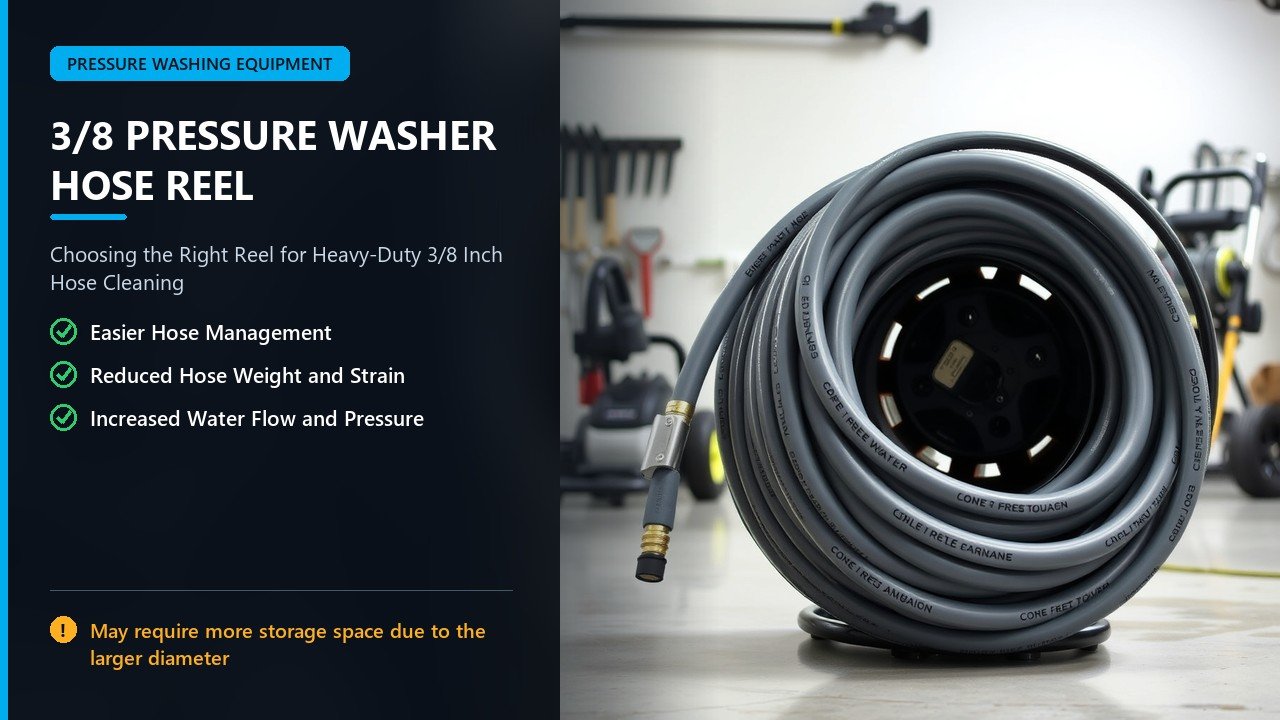
Why 3/8 Is the Standard
The 3/8 inch designation refers to the hose’s inner diameter, the channel the water flows through. A wider channel means less resistance and more flow, which matters more and more as hoses get longer and machines get stronger.
Here is why 3/8 became the professional default:
- Better flow. A 3/8 inch hose restricts water far less than a 1/4 inch hose, so it holds up under high-GPM machines.
- Less pressure loss over distance. On long runs, the wider channel keeps pressure losses reasonable.
- Durability. 3/8 hoses are typically built for higher pressure and heavier use.
- Fitting compatibility. 3/8 quick connect and M22 fittings are the standard on larger machines.
- Versatility. It works across residential and commercial machines with enough flow.
The trade-off is weight and cost. A 3/8 inch hose is heavier and pricier than a 1/4 inch hose, which is why budget machines and light tasks often use the smaller size. Once you move up in machine class and hose length, 3/8 is the right call.
3/8 vs 1/4 Inch Hose
Understanding the difference helps you decide whether 3/8 is right for your setup.
| Feature | 1/4 Inch Hose | 3/8 Inch Hose |
|---|---|---|
| Flow capacity | Lower | Higher |
| Weight | Light | Heavy |
| Pressure loss over distance | Higher | Lower |
| Typical machines | Compact electric | Gas and commercial |
| Fittings | 1/4 quick connect | 3/8 quick connect or M22 |
| Best for | Light home tasks | Big jobs, long runs, pros |
If you run a high-flow gas machine or need long hose runs, 3/8 is the correct choice. If you have a small electric washer, 1/4 inch keeps the setup light and is entirely adequate.
Why a Reel Matters Even More With 3/8 Hose
The heavier the hose, the more a reel pays off. A 3/8 inch hose resists coiling by hand, tangles easily, and punishes kinks with permanent damage. A reel solves several problems at once:
- Controlled bend radius. The hose coils at a gentle, consistent curve rather than being crushed into sharp folds.
- Less abrasion. Off the ground and off surfaces, the hose avoids the grit that wears through covers.
- Faster work. Deploy and wind in seconds instead of wrestling a stiff coil.
- Better safety. A heavy loose hose is a serious tripping and slip hazard.
- Longer hose life. A heavy hose that lasts twice as long justifies the reel many times over.
Reel Capacity for 3/8 Inch Hose
Capacity is diameter-dependent, and 3/8 hose takes up far more space than thinner hose. The table below shows the ballpark.
| Hose Length (3/8 inch) | Reel Size Needed | Typical Use |
|---|---|---|
| Up to 50 ft | Compact reel | Light home use |
| About 100 ft | Medium reel rated for 100 ft of 3/8 inch | Most residential |
| About 150-200 ft | Large reel | Big properties, light commercial |
| 200 ft and beyond | Heavy or powered reel | Commercial and mobile |
Always verify the reel is rated for your exact length and diameter. A reel advertised for 200 feet of thin hose may hold only a fraction of that in 3/8 inch.
Types of Reels for 3/8 Hose
| Reel Type | Winding | Best For |
|---|---|---|
| Manual hand crank | By hand | Occasional home use |
| Manual geared | Hand with reduction | Heavier 3/8 hose, regular use |
| Powered electric | Motor driven | Frequent and commercial use |
| Heavy industrial | Hydraulic or air | Fleets and industrial setups |
Because 3/8 hose is heavy, the effort of manual winding is greater than with thin hose. If you wind a long 3/8 hose often, a geared or powered reel is well worth considering.
The Swivel: Your Most Important Choice
The swivel is the rotating joint that lets water flow into the hose while the spool turns. On a 3/8 high-pressure reel, it must handle full system pressure, constant rotation, and heavy hose load without leaking.
- Pressure rating at or above your machine’s maximum PSI.
- Temperature rating for hot water if you use it.
- Machined brass or stainless construction.
- Replaceable seals for easy servicing.
- Live swivel capability to prevent stored twist and kinks in the hose.
Matching the Reel to Your Hose and Machine
- Confirm your machine’s PSI and GPM. The reel and swivel must meet or exceed the pressure.
- Know your hose diameter and length. Buy a reel rated for that exact combination.
- Decide on hot or cold water. Choose a hot-water-rated reel and swivel if needed.
- Pick the winding method. Manual for occasional use, powered for frequent work.
- Choose the mount. Wall, cart, or trailer, based on where you clean.
- Check the fittings. Ensure compatibility with your 3/8 quick connect or M22 setup.
Installation and Hose Management
Installing a 3/8 reel follows the same logic as any high-pressure reel, with extra attention to weight.
- Mount on solid structure rated for the heavy loaded reel.
- Position the swivel inlet for easy access.
- Connect the feed hose with quality fittings and pressure test slowly.
- Install a hose guide to reduce abrasion and side load.
- Wind a few turns by hand to confirm even layering.
Good habits keep 3/8 hose healthy:
- Lay the hose straight before winding to release stored twist.
- Relieve pressure and drain before winding.
- Wipe off grit before storing.
- Do not overfill the reel.
- Pull smoothly and let the reel spin freely.
- Use a swivel at the gun to stop the hose from storing twist.
Maintenance for a Heavy-Duty Setup
- Rinse the hose and reel before storage to remove grit and chemicals.
- Inspect the swivel and O-rings regularly and replace worn seals.
- Lubricate the winding mechanism per the manufacturer’s guidance.
- Tighten mounting hardware periodically.
- Winterize fully to prevent freezing damage.
- Inspect the hose for bulges and soft spots and replace it before it fails.
Common Mistakes to Avoid
- Buying a reel too small for 3/8 hose. Overstuffing damages the hose and swivel.
- Using thin fittings with thick hose. Match fittings to the hose diameter throughout.
- Ignoring the swivel pressure rating. A weak swivel leaks or bursts.
- Mounting into weak material. The heavy loaded reel needs solid anchors.
- Winding a kinked hose. Straighten it first.
- Never servicing the swivel. Small drips become failures.
- Storing wet and tight. It crushes the inner tube and invites freezing damage.
Frequently Asked Questions
What size reel do I need for 3/8 inch hose?
A reel rated for the specific length and diameter you use. Because 3/8 hose takes more space than thinner hose, confirm the capacity chart rather than assuming a large reel will fit it.
Is 3/8 or 1/4 better for a pressure washer hose reel?
3/8 is better for high-flow machines and long runs because it loses less pressure. 1/4 suits compact electric machines and short runs. Match the diameter to your machine.
Can a manual reel handle 100 feet of 3/8 inch hose?
Yes, with a reel rated for it, though winding heavy wet hose by hand is tiring. A geared reel makes the job easier if you wind often.
Does 3/8 hose reduce pressure?
Less than thinner hose, but any length causes some loss through friction. Wider diameter and a high-flow machine minimize it, especially over long runs.
What fittings go with 3/8 pressure washer hose?
Typically 3/8 quick connect or M22 threaded fittings, depending on your machine and gun. Match all components to the same standard for leak-free connections.
Final Thoughts
A 3/8 pressure washer hose reel is the natural companion to the diameter that professionals trust. The 3/8 inch hose delivers the flow and pressure stability that serious machines need, and the right reel makes that heavy hose manageable, protected, and quick to deploy.
Choose a reel rated for your exact length and diameter, insist on a quality serviceable swivel that matches your pressure, mount it to solid structure, and practice good winding habits. Done right, this combination delivers the performance and durability that make pressure washing easier and more effective every time you work.