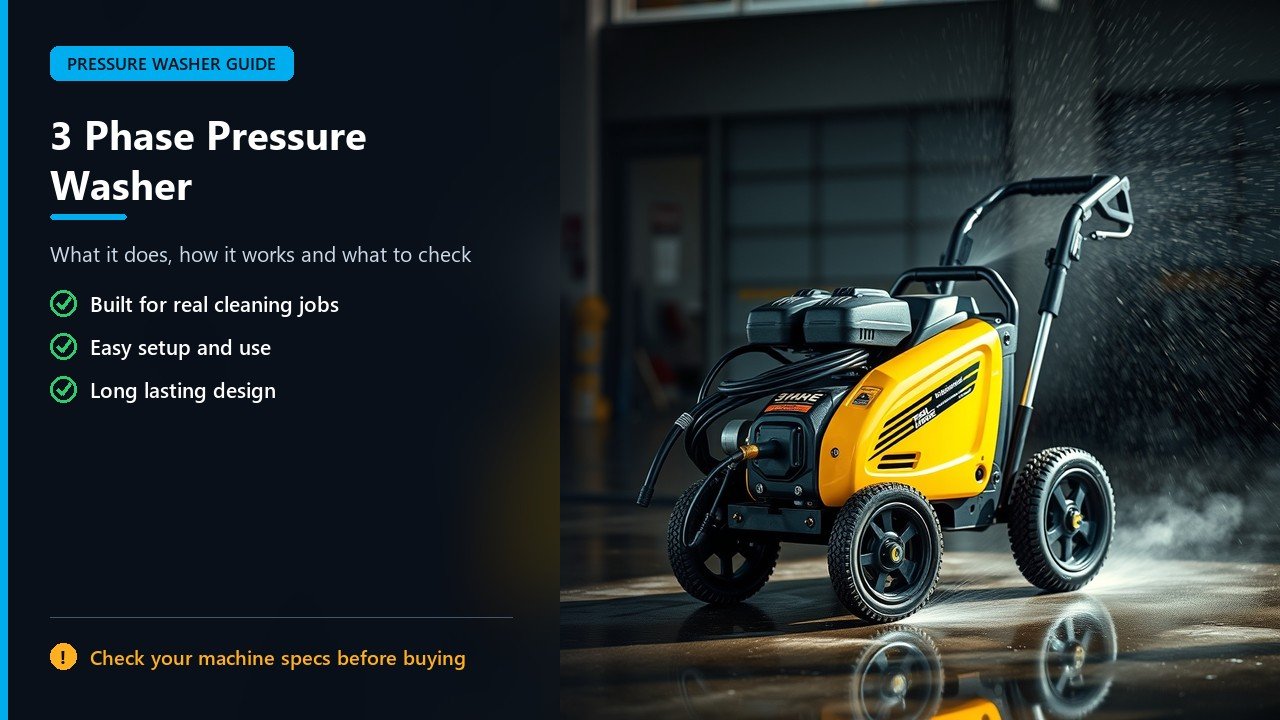
When a cleaning operation moves beyond a standard wall outlet, it often moves into three-phase power. A 3 phase pressure washer is an industrial electric machine that runs on three-phase electricity — the standard for factories, workshops, and commercial facilities where reliability and continuous duty matter more than portability.
This guide explains what three-phase power is, why it suits industrial pressure washers, how these machines compare to single-phase and gas units, and what to consider before buying or installing one.
What 3 Phase Power Is
Three-phase power delivers electricity through three alternating currents offset in time, producing smoother and more efficient power than a single-phase supply.
- Three live conductors — plus a neutral and ground in most systems.
- Constant power delivery — less pulsation than single phase.
- Higher efficiency — better motor performance and lower losses.
- More starting torque — ideal for powerful motors.
- Industrial standard — common in factories and large facilities.
- Higher voltages — often 208V, 240V, 400V, or 480V depending on region.
Quick Note: Three-phase washers are not portable home tools. They are installed, wired, and used in facilities with three-phase service.
Why Three-Phase Suits Pressure Washers
| Advantage | Benefit |
|---|---|
| Efficient motors | More cleaning power per kilowatt |
| High starting torque | Drives large pumps without strain |
| Continuous duty | Runs all shift without overheating |
| No exhaust | Safe for indoor use |
| Low noise | Easier on operators and neighbors |
Short Note: The point of a three-phase washer is sustained, efficient power. It cleans continuously without the fuel handling and exhaust of a gas machine.
Three-Phase vs Single-Phase vs Gas
| Feature | 3-Phase Electric | Single-Phase Electric | Gas |
|---|---|---|---|
| Power source | 3-phase service | Standard outlet | Gasoline/diesel |
| Portability | Low (installed) | Medium | High |
| Duty cycle | Continuous | Limited | Continuous with fuel |
| Indoor use | Yes | Yes | No (exhaust) |
| Maintenance | Motor and pump | Motor and pump | Engine + pump |
Three-phase electric wins on continuous duty, efficiency, and indoor safety. Gas wins on portability where no power exists.
Typical Specifications
| Spec | Typical Range |
|---|---|
| Pressure | 1,000–4,000+ PSI |
| Flow | 2–8+ GPM |
| Voltage | 208V–480V, varies by region |
| Motor | Industrial, TEFC enclosure |
| Pump | Triplex plunger; rebuildable |
| Mounting | Cart, skid, or wall |
Specs vary widely. A three-phase machine sized for a food plant differs greatly from one sized for a small workshop.
Typical Applications
- Manufacturing plants — equipment and area cleaning.
- Food processing — washdown of production lines.
- Workshops and garages — heavy equipment cleaning.
- Warehouses — floors, docks, and vehicles.
- Commercial kitchens — hood and floor cleaning.
- Industrial maintenance — recurring cleaning duty.
These are environments with three-phase service and a need for continuous, indoor cleaning power.
Electrical Requirements
| Requirement | Detail |
|---|---|
| Voltage | Match the machine to the site supply |
| Phase | Three-phase service required |
| Amperage | Must match the motor’s draw |
| Breaker | Correct size and type |
| Wiring | Correct gauge for the run and load |
| Grounding | Proper equipment ground required |
| Disconnect | Local disconnect for service |
Warning: Three-phase wiring is not a DIY task for the inexperienced. Have a qualified electrician install and verify the circuit. This is a safety and code requirement.
Motor and Pump Design
| Component | Industrial Standard |
|---|---|
| Motor type | Three-phase induction, TEFC |
| Enclosure | Totally enclosed, fan-cooled for harsh areas |
| Pump | Triplex plunger, rebuildable |
| Drive | Direct, belt, or gear |
| Controls | Start/stop, thermal protection, overloads |
Industrial machines favor triplex pumps and enclosed motors because they run long hours in demanding environments.
Key Features to Look For
- Continuous-duty rating — built to run all shift.
- Thermal overload protection — protects the motor.
- Rebuildable triplex pump — serviceable, long life.
- Robust frame — cart, skid, or wall mount.
- Lockable controls — safety and access control.
- Unloader and safety valve — pump protection.
- Proper electrical protection — breakers and disconnects.
The best three-phase machines are built around serviceability: rebuildable pumps, replaceable motors, and accessible controls.
Advantages and Drawbacks
| Advantages | Drawbacks |
|---|---|
| Efficient and powerful | Requires three-phase service |
| Continuous duty | Not portable or fuel-driven |
| No exhaust; indoor-safe | Installation cost and complexity |
| Quieter than gas | Higher upfront purchase price |
| Long motor life | Tied to a fixed power point |
Short Note: If the facility already has three-phase power and the cleaning is continuous and indoor, a three-phase washer is often the best tool available.
Installation Considerations
| Factor | Detail |
|---|---|
| Power supply | Confirm voltage, phase, and amperage |
| Location | Near power, water, and drainage |
| Water supply | Meets the machine’s GPM demand |
| Ventilation | Motor cooling and moisture control |
| Drainage | Handles runoff water |
| Electrical protection | Breakers, disconnects, grounding |
Planning the installation around power, water, and drainage prevents expensive rework and unsafe setups.
Safety for Three-Phase Machines
Three-phase washers combine high-pressure water and industrial electricity — two serious hazards in one machine.
- Lock out / tag out before any electrical or pump service.
- Use qualified electricians for wiring and repairs.
- Ground the machine properly and verify it.
- Keep water away from electrical panels and connections.
- Wear PPE for high-pressure spraying.
- Never point the nozzle at people or equipment.
- Keep the work area dry around power sources.
Warning: Water and electricity are a lethal combination. Three-phase installations must follow local electrical codes; see guidance from the Occupational Safety and Health Administration.
Maintenance Schedule
| Task | Interval |
|---|---|
| Check pump oil | Every use |
| Inspect for leaks | Every use |
| Clean inlet filter | Every use |
| Change pump oil | First 50 hours, then per manual |
| Check motor and wiring | Per schedule by a qualified person |
| Service unloader and valves | Per manual |
| Winterize | Before freezing |
Industrial machines live or die by their maintenance. Oil, filters, and electrical inspection are non-negotiable.
Troubleshooting
| Problem | Likely Cause | Fix |
|---|---|---|
| Motor won’t start | Power, breaker, or overload trip | Check supply; reset; call an electrician |
| Motor trips under load | Overload or voltage issue | Reduce load; verify supply |
| Low pressure | Worn valves, seals, or nozzle | Service pump; replace nozzle |
| Pulsing flow | Air in the suction line | Seal inlet connections |
| Water in pump oil | Failed pump seals | Rebuild with a seal kit |
Electrical faults require a qualified electrician. Never open a three-phase panel or motor connection without training and lockout.
Common Mistakes to Avoid
- Ignoring the electrical requirements. Causes trips and damage.
- DIY wiring without qualification. Serious hazard.
- Undersized breakers or wiring. Overheating and failures.
- No lockout during service. Risk of electrocution.
- Running the pump dry. Destroys seals.
- Neglecting pump oil. Shortens pump life.
- Starving the water supply. Damages the pump.
Cost and Value
| Item | Typical Range |
|---|---|
| Three-phase washer purchase | $1,500–$8,000+ |
| Electrical installation | $500–$3,000+ |
| Seal/valve kit | $100–$400 |
| Replacement motor | $400–$1,500 |
| Annual maintenance | $200–$1,000 |
For facilities with existing three-phase service, the machine costs less to run per hour than a gas unit, and the lack of exhaust is a major safety and comfort benefit indoors.
Understanding Three-Phase Motor Ratings
Motor ratings tell you what a three-phase washer can do and how hard it can work. Knowing them prevents mismatches and premature failures.
| Rating | Meaning |
|---|---|
| Horsepower (HP) | Mechanical power to drive the pump |
| Voltage | Must match the facility’s supply |
| Full-load amps | Current draw at rated load |
| Duty rating | Continuous vs intermittent operation |
| Service factor | Reserve capacity above rated load |
| Enclosure | Protection from dust, water, and cooling |
Note: Match the motor’s voltage and amperage to the supply exactly. A mismatch risks overload trips, damage, and unsafe operation.
Water Supply and Flow Demands
| Requirement | Detail |
|---|---|
| Flow supply | Exceeds the pump’s GPM at all times |
| Inlet pressure | Adequate positive feed at the inlet |
| Water quality | Clean water protects valves and seals |
| Break tank | Used when supply is limited |
| Drainage | Handles the high volume of runoff |
Short Note: Three-phase industrial machines move a lot of water. A supply that starves the pump causes cavitation and rapid wear — plan for more water than the machine uses.
Noise, Heat, and Facility Fit
| Factor | Consideration |
|---|---|
| Noise | Quieter than gas but still loud; plan the area |
| Heat | Motors and hot-water units add heat |
| Moisture | Manage humidity and drainage |
| Spatial footprint | Industrial units need floor or wall space |
| Access for service | Room to reach the pump and motor |
Fitting the machine to the facility — noise, heat, moisture, and access — prevents daily annoyances and service headaches.
Parts and Service Life
| Part | Service Life |
|---|---|
| Triplex pump seals | Serviced on interval; consumable |
| Valves | Rebuilt periodically |
| Motor bearings | Long life with scheduled lubrication/replacement |
| Hose and gun | Replace as they wear |
| Unloader | Rebuild or replace on interval |
Choosing a machine with readily available parts is as important as its specs. Downtime costs more than parts.
When Three-Phase Is the Wrong Choice
- No three-phase service and no plan to install it.
- Mobile work that needs a portable, fuel-driven machine.
- Occasional light cleaning better suited to a single-phase unit.
- Outdoor jobs far from power where a gas washer fits.
- Budgets that cannot cover installation and maintenance.
Three-phase is powerful and efficient, but only when the facility and the work support it. Otherwise, a single-phase or gas machine is the better tool.
Choosing the Right Three-Phase Machine
| Question | What to Confirm |
|---|---|
| What am I cleaning? | A task that sets the needed PSI and GPM |
| What power is available? | Voltage, phase, and amperage of the supply |
| Indoor or outdoor? | Electric is ideal indoors; gas outdoors |
| Continuous duty? | Three-phase supports long shifts |
| Service support? | Pump and motor parts availability |
| Water supply? | Meets the machine’s flow demand |
Note: Match the machine to the power you already have. Retrofitting three-phase service is expensive; buying for an available supply is far cheaper.
Hot Water and Steam Options
| Type | Use |
|---|---|
| Cold water | General industrial cleaning |
| Hot water | Grease, oil, and food residue |
| Steam | Sanitizing and heavy residue removal |
Many three-phase industrial machines offer heated water or steam options. Heat dramatically improves grease and food-residue cleaning, though it adds cost and maintenance.
Accessories for Industrial Use
- Rotary surface cleaners — fast, even floor cleaning.
- Heavy-duty hoses — long lengths for large areas.
- Hose reels — storage and reach in big facilities.
- Stainless lances — corrosion resistance.
- Rotary and turbo nozzles — concentrated force.
- Foam and chemical injectors — detergent application.
Industrial environments reward accessories built to the same standard as the machine. Cheap parts fail under continuous duty.
Frequently Asked Questions
What is a 3 phase pressure washer? An industrial electric pressure washer powered by three-phase electricity, built for continuous duty in facilities.
Can I run a three-phase washer at home? Only if your property has three-phase service and proper wiring — which most homes do not. A qualified electrician must verify.
Why choose three-phase over single-phase? Three-phase motors are more efficient, have higher starting torque, and handle continuous duty better.
Is a three-phase washer safer than gas? Indoors, yes — there is no exhaust. But high-voltage electricity and high-pressure water together demand strict safety discipline.
Can I install it myself? Electrical installation should be done by a qualified electrician. Pump and routine maintenance can be handled by trained staff.
Are three-phase washers reliable? Well-built ones are very reliable, especially with a rebuildable triplex pump and scheduled maintenance.
Final Thoughts
A 3 phase pressure washer is the tool of choice for facilities with three-phase power that need continuous, efficient, indoor cleaning. It offers more power per kilowatt, no exhaust, and long motor life, at the cost of portability and a proper electrical installation.
Confirm your power supply, buy a rebuildable triplex machine, hire a qualified electrician, and maintain it on schedule. For related reading, see our guides on the 6000 PSI water blaster and the pressure washer pump 3000 psi.