The first commercial job I ever quoted was a chain-link fence line that ran the length of three suburban lots. I showed up with a 100 foot hose feeling confident, then spent the next hour leapfrogging the machine down the fence like a man mowing a lawn one strip at a time. The customer was patient. My back was not. By the time I packed up, I understood why serious operators talk about a 300 ft pressure washer hose reel the way a fisherman talks about a good reel: it is not a luxury, it is the tool that makes the whole job possible.
A quarter-mile of high-pressure hose is a lot of water and a lot of weight, and it will absolutely punish anyone who tries to manage it loose on the ground. A proper reel does not just store the hose. It protects it, extends its life, keeps your job site safe, and lets one person handle a length that would otherwise need two. In this guide, we will look at what a 300 foot reel can realistically handle, how to match capacity to hose diameter, the difference between manual and powered winding, the crucial role of the swivel joint, and how to install and maintain a setup that lasts for years.
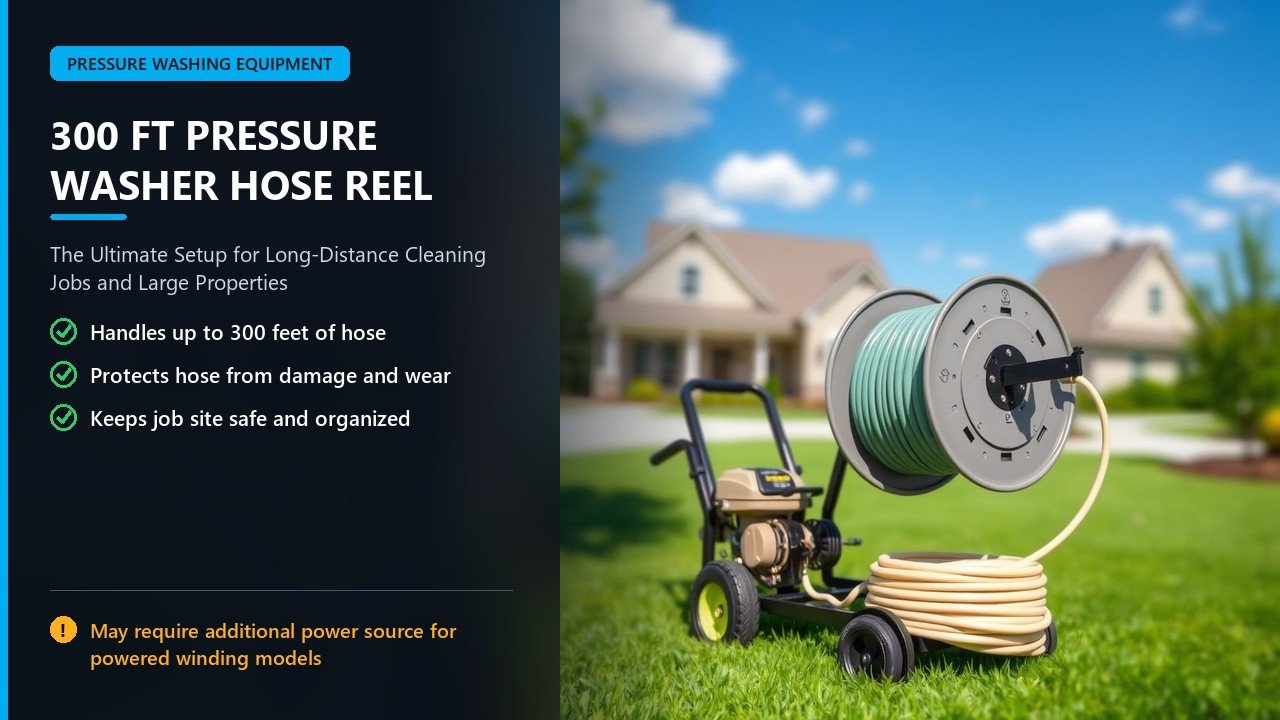
Why 300 Feet Changes How You Work
A 300 foot hose turns a machine into a fixed cleaning station. Instead of repositioning equipment, you plant the washer at the water source and the power outlet, then walk the hose to the work. For large properties, farms, commercial lots, municipal crews, and trailer-mounted operations, that single change eliminates the two biggest time-wasters in pressure washing: relocating the machine and reconnecting everything after each move.
But 300 feet of hose weighs a great deal when it is full of water, and it is stiff, heavy, and prone to tangling. Handling it by hand is a recipe for kinks, abrasion, tripping hazards, and premature failure at the exact spots where it bends too sharply. That is where the reel earns its keep. It keeps the hose coiled at a controlled bend radius, off the ground, and ready to deploy in a single smooth pull.
Can a Typical Machine Drive 300 Feet of Hose?
This is the question most people should ask before anything else, and it is the one most people skip. Length always costs pressure, and the amount depends on the hose inner diameter and the machine’s flow. A 300 foot reel does not create pressure loss by itself. The hose does. The reel simply decides whether that hose survives.
The table below gives a realistic sense of how diameter affects a 300 foot run. Values are approximate and assume clean fittings and a well-matched pump.
| Hose Inner Diameter | Flow Demand | Pressure Loss Over 300 ft | Realistic Use |
|---|---|---|---|
| 1/4 inch | Low GPM | Very high (often unusable) | Not recommended at this length |
| 5/16 inch | Moderate GPM | High | Light duty only, with caution |
| 3/8 inch | High GPM | Moderate | Standard for long commercial runs |
| 1/2 inch | Very high GPM | Low | Large machines, minimal loss |
The Occupational Safety and Health Administration reminds operators that long high-pressure lines must be rated for the system pressure and inspected for damage. A 300 foot hose running full pressure deserves respect. Always use rated components and check the line before every major job.
Types of Hose Reels Compared
Not all reels are built for 300 feet of heavy hose. The capacity, the frame rigidity, and the winding method all matter. Here is how the main categories stack up for long-hose work.
| Reel Type | Winding | Best For | Trade-Off |
|---|---|---|---|
| Manual hand crank | By hand | Homeowners, occasional use | Slow and tiring on long hose |
| Manual geared | By hand with reduction | Medium commercial use | Less effort, still manual |
| Powered electric | Motor driven | Daily commercial, very long hose | Needs power or battery, costs more |
| Powered hydraulic/air | Motor driven, heavy duty | Industrial and municipal fleets | Expensive, complex |
For a homeowner who occasionally stretches a long hose, a manual reel is enough. For anyone winding 300 feet of water-heavy 3/8 inch hose several times a day, a powered reel quickly pays for itself in time and frustration. The physical effort of cranking 300 feet by hand is real, especially when the hose is wet and cold.
The Swivel Joint: The Heart of a Long-Hose Reel
The part that makes a reel work at all is the swivel, the rotating joint that lets the reel turn while water flows continuously through a fixed inlet. On a 300 foot reel, the swivel has to handle full system pressure, every direction of force, and constant rotation without leaking.
Swivels come in a few arrangements:
- Single-plane swivel: Rotates on one axis. Common on basic reels.
- Dual-plane swivel: Allows rotation on two axes, reducing strain and hose twist during use.
- Live swivel: Lets the hose end rotate freely as you pull, preventing the hose from storing twist energy and kinking.
A quality swivel is the difference between a reel that lasts a decade and one that drips from day one. Never buy a reel with a plastic swivel for a 300 foot, high-pressure run. Look for machined brass or stainless steel with replaceable seals.
Matching Reel Capacity to Hose Size
Reel capacity is not a single number. It changes with hose diameter. A reel that holds 300 feet of 3/8 inch hose might hold noticeably less of heavier 1/2 inch hose, or more of thinner 1/4 inch hose. Always check the manufacturer’s capacity chart for the specific diameter you plan to run.
- Determine your max hose diameter first. Buy a reel that accommodates the largest hose you might use, not just your current one.
- Leave slack. Never pack a reel to its absolute maximum. A slightly oversized reel winds more easily and lays the hose more evenly.
- Check the swivel rating. It must meet or exceed your machine’s maximum pressure.
- Confirm mounting hardware. A full 300 foot reel is heavy when loaded. The mount must handle the weight plus the pull.
Mounting Options for a 300 Foot Reel
Where the reel lives determines how convenient the whole setup is.
Wall mount
Best for a fixed cleaning station in a garage, shop, or on a trailer wall. It saves floor space and keeps the hose off the ground. The wall or frame must be strong enough for the loaded weight and the pulling force.
Trailer or skid mount
Ideal for mobile operations. Mounting the reel beside the machine keeps the entire setup self-contained, letting a crew park, connect, and work without unloading equipment.
Floor or cart mount
Useful when you need to relocate the reel with the machine. A cart keeps the reel portable and is a good middle ground for renters or multi-site work.
Whatever you choose, route the lead hose from the machine to the reel inlet so it stays clear of foot traffic and sharp edges. A 300 foot run is long enough that good routing prevents most of the abrasion problems people blame on the hose itself.
Installing Your Reel the Right Way
Installation is manageable for a capable DIYer, but the details matter on a long-hose setup.
- Mount on solid structure. Anchor into studs, steel, or reinforced frame, not drywall or thin sheet.
- Position the swivel inlet for easy access. You will service it eventually, so do not bury it.
- Connect the feed hose to the swivel inlet. Use quality fittings and check for leaks at low pressure first.
- Wind a few turns by hand to confirm the hose lays evenly and the swivel turns smoothly.
- Pressure test slowly. Bring the machine up gradually and watch every joint.
- Set a hose guide or roller at the payout point so the hose does not rub the frame as it feeds out.
A small detail that pays off: install a hose guide or roller at the reel exit. It keeps the hose centered, reduces side load on the reel, and prevents the abrasion that wears through outer covers.
Common Mistakes With Long-Hose Reels
- Buying an undersized reel. Overstuffing a small reel stresses the swivel, frame, and hose.
- Skipping the swivel rating check. A low-pressure swivel on a high-pressure system is a leak or burst waiting to happen.
- Wrong hose diameter. Choking a high-flow machine with a narrow hose wastes pressure and slows every job.
- Cranking a kinked hose. Always lay the hose straight before winding, or you trap twists that become kinks.
- Ignoring the weight. A loaded 300 foot reel can be surprisingly heavy. Mount accordingly.
- Never servicing the swivel. Small leaks compound. Replace seals on schedule, not after failure.
- Leaving the hose pressurized while stored. Relieve the pressure and drain the line before winding it up.
Maintenance and Winter Care
A 300 foot reel repays good maintenance generously, because replacing that much hose is expensive.
- Rinse the hose before winding to remove grit and chemical residue.
- Inspect the swivel and fittings for drips before each major job.
- Check the frame and bolts periodically. Vibration loosens hardware over time.
- Lubricate the winding mechanism per the manufacturer’s instructions.
- Drain fully before cold weather. Trapped water freezes, expands, and destroys hose and swivel.
- Store the hose under light tension, not stretched tight, to avoid flattening the inner tube.
Winter is the destroyer of long-hose systems. A 300 foot hose is hard to drain completely by gravity alone. Use compressed air to blow the line clear, or store the reel in a heated space. Ten minutes of care in autumn protects an expensive setup through the cold months.
Frequently Asked Questions
How many feet of hose can a pressure washer reel hold?
It depends on hose diameter. Large commercial reels commonly hold 200 to 400 feet of 3/8 inch hose. Always check the manufacturer’s capacity chart for the exact diameter you plan to use rather than assuming.
Does a longer hose on a reel reduce pressure?
The reel does not reduce pressure; the hose length does. Friction over 300 feet drops pressure, and narrower hose loses more. Use 3/8 inch or larger and a high-flow machine to keep losses reasonable.
Can I run 300 feet of hose on a small electric washer?
Technically yes, but the pressure loss will be severe and disappointing. Long runs belong with higher-flow gas or commercial machines paired with wider hose.
What is the best reel for hot water?
One rated for high temperature, with a hot-water swivel and hose. Standard cold-water reels and swivels can fail quickly under hot-water use.
Wall mount or trailer mount?
Wall mount for a fixed station, trailer mount for mobile work. Choose based on whether your cleaning happens in one place or many.
Final Thoughts
A 300 ft pressure washer hose reel is the tool that turns an unwieldy length of hose into a controlled, professional system. It protects your investment, keeps your job site safe and organized, and lets one operator cover ground that would otherwise demand constant repositioning.
Match the reel capacity to your hose diameter, insist on a quality swivel rated for your pressure, mount it to structure that can take the weight, and service it before small leaks become big ones. Get those things right, and a 300 foot reel will quietly do its job for years, one smooth pull at a time.