Few pressure washer ratings are as widely chosen as 3000 PSI. It sits at the sweet spot between the gentle machines meant for cars and furniture and the heavy commercial units built for stripping and concrete work. For most homeowners and many small businesses, a 3000 psi power washer is the most versatile single machine they can buy.
This guide explains what 3000 PSI means, the jobs it handles, the difference between gas and electric versions, how flow and nozzles affect performance, what to look for when buying, and how to keep the machine running well.
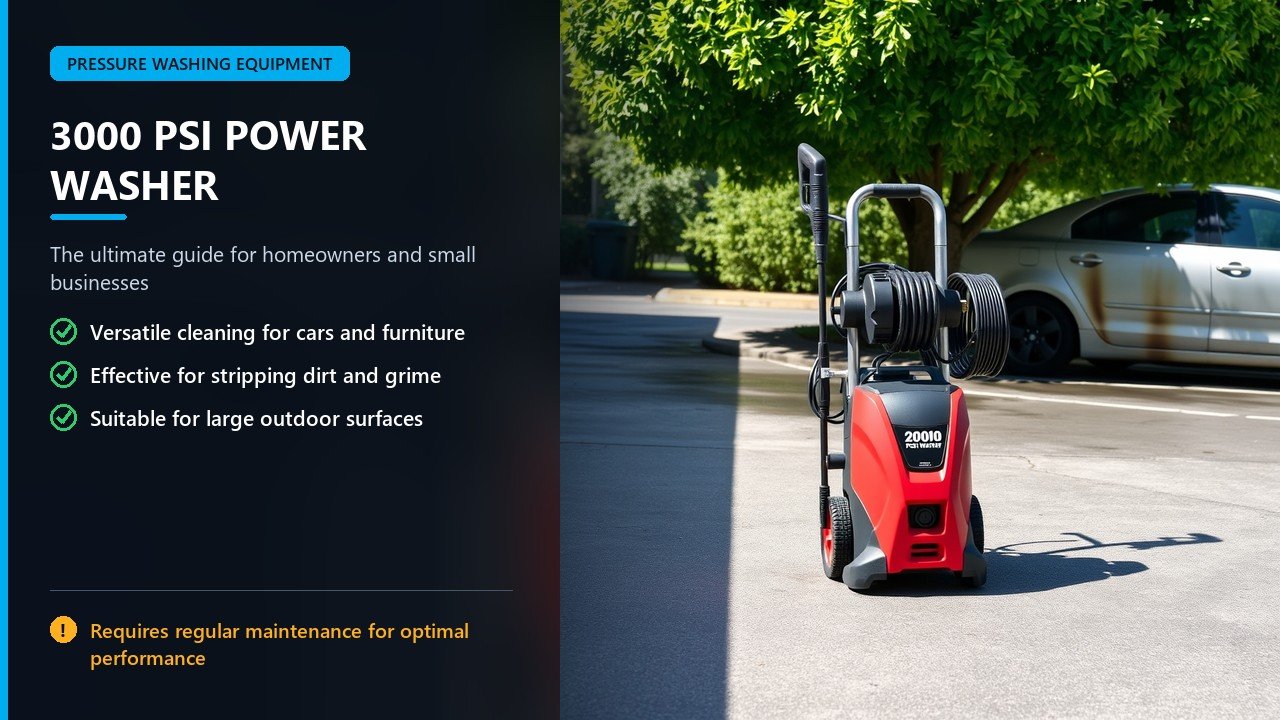
What Does 3000 PSI Mean
PSI stands for pounds per square inch, and it measures the pressure of the water at the nozzle. A 3000 PSI power washer delivers water forcefully enough to strip dirt, mold, and grime from hard outdoor surfaces, yet it can be tamed with the right nozzle and distance for gentler work.
Pressure is only half the story. Flow, measured in gallons per minute (GPM), determines how much water moves through the machine. Cleaning performance is roughly the product of pressure and flow, which is why a machine with good GPM cleans faster even at the same PSI. A 3000 PSI machine with higher GPM will rinse and cover surfaces more quickly than one with low GPM.
Together, the two numbers define the machine’s character. High pressure with moderate flow is effective for concentrated cleaning; high flow with moderate pressure is faster for large surfaces. The best 3000 PSI machines balance both, and matching them to your nozzles is what turns the rating into real results.
What a 3000 PSI Power Washer Can Clean
A 3000 PSI machine is genuinely versatile. It handles driveways, sidewalks, patios, and garage floors, where its pressure is enough to lift stubborn dirt and stains. It cleans brick, stone, and concrete walls, strips loose paint and mildew from siding, and rinses decks and fences when used with care. It also washes vehicles, though you must use wider nozzles and more distance to protect paint and trim.
Around the property, it is useful for outdoor furniture, grills, lawn equipment, and trash bins. In small commercial settings, it handles entryways, dumpster pads, and equipment that a lighter washer would struggle to clean. With the right accessories, such as a surface cleaner or undercarriage cleaner, it expands into specialized tasks.
The main caution is that 3000 PSI is powerful enough to cause damage if misused. It can etch concrete, strip paint, gouge wood, and force water into places it should not go if you use a narrow nozzle too close. Matching the nozzle and distance to the surface is essential, and it is what separates a good result from a costly mistake.
Gas vs Electric 3000 PSI Machines
A 3000 PSI machine comes in two main forms: gas and electric. Gas machines are typically more powerful overall, with higher flow, no power cord to manage, and unlimited portability. They suit large properties, rural locations without easy power, and commercial use. Their trade-offs are noise, exhaust, fuel and engine maintenance, and a heavier frame.
Electric 3000 PSI machines are quieter, lighter in some designs, and free of fuel and engine upkeep. They start instantly, run clean, and are ideal for garages, patios, and residential areas where noise matters. Their limitation is that they need a power outlet and generally deliver lower flow, so they may clean large areas more slowly than a gas unit.
The choice comes down to where and how you work. If you have power nearby and value convenience and quiet operation, electric is appealing. If you need maximum flow, portability, and power far from an outlet, gas is the better fit. Both can reach 3000 PSI, but their real-world performance and ownership experience differ.
Flow, Nozzles, and Real Performance
A 3000 PSI rating is a ceiling, and the nozzle you attach determines how that pressure actually reaches the surface. Narrow nozzles concentrate the spray for tough spots on hard surfaces. Wide nozzles spread the water for gentler cleaning of vehicles, wood, and siding. Soap nozzles drop the pressure to apply detergent safely.
Flow amplifies everything. Higher GPM flushes away loosened dirt faster and covers more area per minute, while low GPM means slower rinsing even at high pressure. This is why two machines with the same PSI can feel very different in use. When comparing 3000 PSI washers, weigh the GPM as heavily as the pressure rating.
Accessories change the equation further. A rotary surface cleaner turns a single jet into an even spinning spray for fast, streak-free flat-surface cleaning, and an undercarriage cleaner reaches where a wand cannot. Choosing the right nozzle and accessory for each job is what makes a 3000 PSI machine feel capable rather than clumsy.
What to Look For When Buying
Start with the numbers that matter: PSI, GPM, and the pump type. A 3000 PSI machine with higher GPM will clean faster. A triplex pump, with three plungers, is more durable and rebuildable than an axial cam pump, which is common on consumer machines and usually replaced rather than repaired. For frequent use, a triplex pump is worth the extra cost.
Next, look at the engine or motor. Gas models with a reputable engine brand tend to start more easily and last longer. Electric models should have a strong motor and, ideally, a total-stop system that shuts the pump down when the trigger is released. Check the warranty, which often reflects the manufacturer’s confidence in the components.
Then consider the included accessories and build. A good nozzle set, a quality hose, a sturdy frame, and never-flat wheels make daily use easier. Quick-connect fittings throughout simplify setup and upgrades. Carloads of cheap accessories are worth less than a few well-made ones.
Matching the Machine to Your Job
The right 3000 PSI machine depends on what you clean and how often. A homeowner with a driveway, a patio, and a car is well served by a mid-priced machine with good flow, a solid nozzle set, and a surface cleaner. Someone with a large property or a small business will want a gas unit with higher GPM and a triplex pump for durability and speed.
Consider your water supply as well. A pressure washer needs a feed that exceeds its flow rating at the inlet, or the pump will cavitate and wear. If your tap is weak, a buffer tank may be necessary. Ignoring this is one of the most common causes of premature pump failure.
Also think about storage and winter. If you live where it freezes, plan for winterizing from the start. If space is tight, consider a compact or wall-mounted design rather than a large gas cart. Matching the machine to your real conditions beats chasing the highest number on the box.
Using a 3000 PSI Washer Safely
At 3000 PSI, safety is not optional. Never point the wand at people, pets, or yourself, and wear eye protection. The spray can cut skin, and the force can knock you off balance, so brace for recoil and keep your footing. Keep both hands on the gun and wand when the spray is on.
Keep water away from electrical sources. With electric machines, use a ground-fault-protected outlet, keep connections dry and off the ground, and never touch the plug with wet hands. Never spray toward the machine or any electrical fixture. On gas machines, refuel only when the engine is off and cool, and never run the engine in an enclosed space.
Protect surfaces as well as yourself. Work with wider nozzles and greater distance on anything painted, sealed, or soft, and test a small hidden area before cleaning a whole surface. When in doubt, start gentle and increase only if needed. Careful technique protects both the surface and the machine.
Maintenance for Long Life
A 3000 PSI machine rewards basic maintenance. Keep the inlet water clean with a filter or strainer, never run the pump without water, and never deadhead it for long. Check the nozzle and inlet filter if pressure drops. Inspect O-rings, quick-connects, and hoses for wear, and replace worn parts before they fail mid-job.
If the pump has a crankcase, check the oil before use and change it on schedule, watching for milky oil that signals water intrusion. On gas models, maintain the engine with fresh oil, a clean air filter, and treated fuel. Flush detergent from the system after each use, and drain the machine of water before storing it.
Finally, winterize before freezing by draining water and drawing pump protector fluid through the pump. Even a single hard freeze can crack a pump that was not protected. These simple routines are what let a 3000 PSI washer last for years instead of seasons.
Common Mistakes to Avoid
The most common mistake is using too narrow a nozzle too close to a surface, which damages concrete, wood, and paint. Another is starving the pump by running it from an undersized supply or a kinked hose. Deadheading the pump by holding the trigger closed for long periods is a third, and it causes rapid internal damage.
Other frequent errors include running the machine without an inlet filter, ignoring pump oil changes, leaving detergent in the system, and failing to winterize. Each is easy to prevent and expensive to ignore. Avoiding these habits is far cheaper than repairing the damage they cause.
Gas vs Electric at a Glance
Both gas and electric machines can reach 3000 PSI, but they differ in ways that matter for everyday ownership. The table below summarizes the key trade-offs to help you decide which fits your situation.
| Factor | Gas 3000 PSI | Electric 3000 PSI |
|---|---|---|
| Power source | Gasoline engine | Corded or cordless motor |
| Typical flow (GPM) | Higher | Lower |
| Portability | Excellent, no cord | Limited by cord or battery |
| Noise and exhaust | Loud, produces fumes | Quiet, zero emissions |
| Maintenance | Engine oil, fuel, filters | Minimal, no fuel |
| Best for | Large jobs, remote sites | Home use, noise-sensitive areas |
Neither type is universally better. The right choice follows from where you clean, how much power you need, and how much maintenance you are willing to do. Many buyers find that a mid-range gas machine or a strong electric model covers their needs well.
Getting More From Your Machine
A few techniques and accessories get more out of any 3000 PSI washer. Work top to bottom and use overlapping passes so dirty water does not run over clean areas. Keep the nozzle at a consistent distance and let the flow do the work rather than pressing closer. Pre-treat heavy grime with detergent and a little dwell time before rinsing.
A surface cleaner is the single biggest upgrade for flat work, cutting cleaning time and improving evenness on concrete and patios. An extension wand adds reach for high walls and siding, and a foam cannon improves detergent coverage on vehicles. A longer, quality hose reduces repositioning and hose kinks.
Also match the task to the tool. Use a gentle nozzle and more distance for vehicles and wood, and a stronger nozzle for bare concrete. Rinsing with a wide pattern and clean water at the end prevents streaks. Small technique changes often matter more than a higher pressure rating.
Winterizing and Storage
Water left inside a 3000 PSI machine over a cold winter can crack the pump, so storage deserves attention. Flush detergent from the system, then drain the machine and hoses as completely as possible. Draw pump protector fluid or a non-toxic, pump-safe antifreeze through the pump to displace any remaining water.
Store the machine dry, covered, and above freezing. Keep hoses drained and coiled loosely indoors, and store nozzles and fittings in a dry container. On gas models, drain or stabilize the fuel and fog the cylinder to prevent rust and varnish during the off-season.
At the start of the next season, flush the protector fluid from the pump with clean water, check the oil, inspect the seals and fittings, and test the pressure before the first job. A careful startup after storage catches small problems early, when they are cheap to fix.
Is 3000 PSI the Right Choice for You
A 3000 PSI power washer is the right choice for most homeowners and many small businesses, because it is strong enough for serious outdoor cleaning yet manageable with the proper nozzle and technique. If your work is limited to washing a car and rinsing patio furniture, a lower-pressure machine will do. If you are stripping paint, cleaning heavy concrete, or working commercially, a higher-pressure machine may be warranted.
For the broad middle ground — driveways, patios, siding, fences, decks, and vehicles — 3000 PSI is hard to beat. It offers enough power to handle demanding jobs while remaining versatile enough to clean delicate surfaces when you choose the right nozzle and distance. That balance is exactly why it is one of the most popular ratings in the category.
Frequently Asked Questions
What can a 3000 PSI power washer clean? Driveways, patios, sidewalks, garage floors, brick, stone, siding, decks, fences, vehicles, outdoor furniture, and light commercial surfaces, using the appropriate nozzle and distance.
Is 3000 PSI too powerful for a car? Not if you use a wider nozzle and keep more distance. A narrow nozzle close to paint can damage it, so always match the spray to the surface.
Is gas or electric better at 3000 PSI? Gas offers more flow, power, and portability; electric is quieter, cleaner, and lower maintenance. The better choice depends on where and how often you clean.
What GPM should I look for? Look for the highest GPM you can afford and your water supply can support. Higher flow cleans faster and rinses better than pressure alone.
Do I need a triplex pump? If you use the machine frequently or commercially, a rebuildable triplex pump lasts longer. For occasional home use, an axial pump is adequate.
Why does my 3000 PSI washer lose pressure? Common causes are a clogged nozzle, a dirty inlet filter, worn valves or seals, or air in the suction line. Check the simple causes first.
How do I maintain a 3000 PSI machine? Keep water flowing, never deadhead, clean the inlet filter, change pump oil on schedule, flush detergent, and winterize each year.
Can 3000 PSI strip paint? Yes, with a narrow nozzle at close range, which is useful for removing loose paint but risky on surfaces you want to keep intact.
Final Thoughts
A 3000 psi power washer is the versatile middle of the market: strong enough for serious outdoor cleaning and, with the right nozzle, gentle enough for vehicles and delicate surfaces. Weigh pressure and flow together, choose a pump and power source that fit your work, and match the nozzle to the job.
Feed the pump plenty of water, never deadhead it, keep it maintained, and winterize it before the cold. Treated well, a 3000 PSI machine delivers reliable cleaning for years. For related reading, see our guides on the pressure washer pump 3000 psi and the 3500 PSI pressure washer pump.