A 3200 PSI washer is a capable machine that suits a lot of people. But “3200 PSI” alone does not tell you whether it is the right one for you, because pressure is only half of what makes a washer effective. Understanding what 3200 PSI can do, how it pairs with flow, and whether you need gas or electric at this level helps you decide with confidence.
This guide looks at the 3200 PSI class as a whole — what it cleans, who it suits, and what else to check before buying.
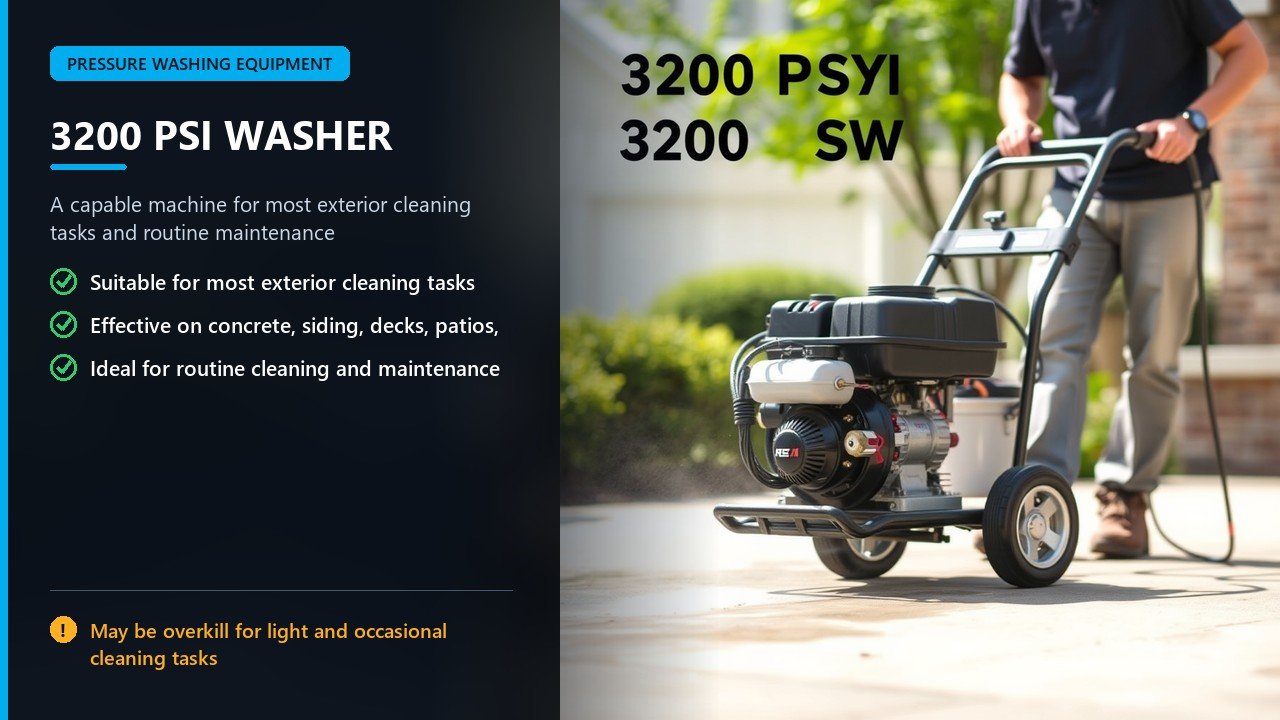
The 3200 PSI Class
At 3200 PSI, a pressure washer sits in the capable middle of portable machines. It is well above the light-duty range of small electric washers and comfortably able to clean concrete, siding, decks, patios, and vehicles. For a homeowner with a decent-sized property, or a small business doing routine cleaning, it is a sensible target.
It is also not the top end. Machines at 3500 PSI and above add more power for tougher, larger jobs, and industrial machines go far higher. A 3200 PSI washer is the point where capability becomes real without the machine becoming heavy, expensive, or overkill for normal use.
The question is less about the number and more about the job. If you routinely clean hard surfaces, wash vehicles and equipment, and have a large area to cover, 3200 PSI is a strong fit. If your cleaning is light and occasional, you may not need this much, and a smaller machine would save money.
What 3200 PSI Can Clean
A 3200 PSI washer handles the majority of exterior cleaning tasks. It strips grime from concrete driveways and pathways, cleans patios and stone, refreshes decks and fences, washes siding, and handles cars, trucks, and outdoor equipment. It can also remove loose paint and heavy buildup with the right nozzle and technique.
What it will not do is serve as an industrial machine. For continuous commercial use, very large flatwork, or the toughest deposits, you need more pressure and flow, usually with a professional-grade pump and drive. And even at 3200 PSI, some surfaces need care: too much pressure too close can damage wood, strip paint, or drive water into cracks.
The key is that 3200 PSI is enough to be genuinely useful across a wide range of jobs, provided you match the flow, the nozzle, and the technique to the surface. Pressure is a tool, not a guarantee of a good result.
Pressure Is Only Half: Why Flow Matters
Pressure measures how hard the water hits; flow, measured in gallons per minute, measures how much water comes out. The real cleaning power is the two combined. A 3200 PSI washer with good flow cleans faster and rinses better than one with the same pressure and poor flow, especially on large surfaces.
Multiply pressure by flow to compare machines fairly. A 3200 PSI washer at 2.5 GPM gives about 8,000 cleaning units, while a 2.8 GPM version gives roughly 9,000. That extra flow is worth more than a small bump in pressure, because it covers more area and carries dirt away faster.
Be wary of listings that boast a very high pressure and very high flow together. Sometimes the top pressure is reached only at a reduced flow, and the top flow only at much lower pressure. Look for a machine whose pressure and flow are both realistically rated together, and favour more flow when the pressure is already adequate.
Is 3200 PSI Enough?
For most household and light-commercial cleaning, 3200 PSI is more than enough. It cleans concrete, siding, decks, and vehicles with ease and makes short work of jobs that frustrate a lighter electric washer. If your cleaning includes large hard surfaces and regular use, it is a good level to target.
For very heavy or professional cleaning, it may fall short. Big commercial flatwork, decades of built-up grime, or continuous daily use call for more pressure and, importantly, more flow, often with an industrial pump. In those cases, step up to a higher class rather than pushing a 3200 PSI machine beyond its design.
For light, occasional cleaning, 3200 PSI may be more than you need. A smaller washer would clean cars, furniture, and small patios perfectly well for less money and less fuss. Match the machine to how much and how hard you clean, and 3200 PSI is the right answer for the capable middle of the market.
Electric or Gas at 3200 PSI
Most machines in this class are gas-powered, because reaching 3200 PSI with good flow generally needs the power of a small engine. A gas washer at this level is portable, powerful, and right for outdoor use, though it brings fuel, exhaust, noise, and engine maintenance.
A few high-voltage electric washers approach this pressure range, offering quiet, fume-free operation with less maintenance. They depend on a suitable electrical supply, and their flow is often lower than a gas machine of the same pressure. For indoor or emission-sensitive use, an electric machine at this level can be the better choice.
The table below summarises the trade-off at this pressure.
| Aspect | Gas 3200 PSI | High-voltage electric |
|---|---|---|
| Power and flow | Highest at this pressure | Approaches it; often less flow |
| Portability | Anywhere; no cord | Limited by the power supply |
| Noise and exhaust | Loud; outdoor use | Quiet and fume-free |
| Maintenance | Engine and fuel care | Low |
Both can reach this pressure class, but they suit different users and settings.
Specs to Check Before Buying
When buying a 3200 PSI washer, look past the pressure figure. Check the flow rate paid for, the pump type and brand, and the engine make on a gas machine or the motor rating on an electric one. A machine with a triplex pump and a reputable engine lasts far longer than one with a cheap sealed pump, at the same pressure.
Confirm the machine’s drive arrangement, direct or belt, and its build quality. Check the hose length and rating, the gun and wand quality, and the nozzles supplied. These details decide how pleasant the machine is to use and how long it lasts. Cheap accessories on a capable machine undermine the whole setup.
Also consider the practical side: weight, wheels, and handle, because you will move it around. A machine that is awkward to shift gets used less. And check the water supply requirement, since a high-flow machine needs a supply that can keep up or the pump will cavitate.
Matching Accessories and Water
Every accessory you use at 3200 PSI must be rated for that pressure, and the nozzles must suit the machine’s flow. A nozzle that is too small raises pressure and strains the pump; too large, and you lose cleaning power. Matching the nozzle to the flow keeps the machine at its design pressure.
A surface cleaner is an excellent addition at this pressure for large flat areas, and a foam cannon suits vehicle washing. A good hose reel keeps things tidy and protects the hose. Confirm that hoses, guns, wands, and fittings are all rated to at least 3200 PSI so nothing becomes the weak link.
The water supply matters as much as the machine. A 3200 PSI washer flowing around 2.5 to 2.8 GPM needs a tap that can supply that continuously. A supply that cannot keep up starves the pump, causing cavitation and damage. Check your supply before you commit to the machine.
When to Step Up or Down
Not everyone should land on 3200 PSI, so it helps to know the signs pointing elsewhere. Step up if you clean large flatwork often, deal with stubborn buildup, or work commercially; higher pressure and, more importantly, higher flow will save you time and effort. A machine that struggles on a big driveway is a false economy.
Step down if your cleaning is light and occasional. Cars, garden furniture, small patios, and bikes do not need 3200 PSI, and a smaller, cheaper, easier machine will do the job with less fuss. Buying more power than you need means paying more, moving more weight, and using a machine that is harder to handle.
The honest test is the size and type of your regular cleaning, plus how often you do it. Let that, rather than the biggest number you can afford, decide the pressure class you buy.
Maintenance and Longevity
To keep a 3200 PSI washer working, look after its core. Keep the pump oil and inlet filter in order, never run it dry, and protect it from freezing. On a gas machine, add engine oil, air filter, spark plug, and fuel care, since old fuel causes most starting problems. On an electric machine, keep the motor dry and cool and respect the duty cycle.
Replace worn seals, O-rings, and nozzles as routine maintenance, and replace rather than repair any damaged high-pressure part. Flush detergent after use, store the machine properly, and cover it when not in use. These habits extend the life of the machine well beyond careless ownership.
Looked after this way, a 3200 PSI washer is a dependable, versatile tool for years. The number is a good starting point, but flow, build quality, matched accessories, and maintenance are what make it truly capable.
Frequently Asked Questions
What can a 3200 PSI washer clean? Concrete, patios, driveways, decks, fences, siding, cars, trucks, and equipment. It handles most exterior cleaning around a home or small business.
Is 3200 PSI enough? For most home and light-commercial cleaning, yes. For heavy, large-scale, or continuous professional cleaning, step up to higher pressure and flow.
Is 3200 PSI too much for a car? It can be, if used too close or with a narrow nozzle. Use a wider nozzle, keep distance, and use moderate pressure to protect the paint.
What flow should a 3200 PSI washer have? Usually around 2.4 to 2.8 GPM. Higher flow cleans and rinses faster, so weigh it as heavily as pressure.
Is it electric or gas? Most 3200 PSI machines are gas-powered. A few high-voltage electric models approach this pressure, with lower flow but quiet, fume-free operation.
What specs matter most? Flow rate, pump type and brand, engine or motor quality, drive arrangement, and the quality of the hose, gun, and nozzles.
What accessories should I use? Only those rated to at least 3200 PSI, with nozzles matched to the flow. A surface cleaner, foam cannon, and hose reel are useful additions.
How do I keep it working? Maintain pump oil and the inlet filter, never run it dry, protect it from freezing, and on a gas machine keep up with engine and fuel care.
Final Thoughts
A 3200 PSI washer is a capable machine for the middle of the market, strong enough for concrete, siding, decks, and vehicles, and reasonable enough in cost and size to suit many owners. The pressure figure is a useful starting point, but flow, build, and matched accessories decide how well it actually cleans.
Decide by your job and your water supply, check flow, pump, and build before buying, and match every accessory to the machine’s output. Maintain the pump and engine and protect the machine in storage. Chosen and cared for well, a 3200 PSI washer is a reliable, versatile tool that earns its place. For related reading, see our guides on a 3200 PSI gas pressure washer and GPM pressure washers.