Two pressure washers both rated at 3800 PSI can clean very differently, and the number on the box will not tell you which is which. That is because cleaning power is not pressure alone — it is pressure multiplied by water flow. At the same 3800 PSI, a machine flowing 2.5 GPM moves far less water than one flowing 3.6 GPM, and for cleaning large surfaces, the higher-flow machine wins.
This guide explains what a 3800 PSI pressure washer really delivers, why flow matters, and how to pick the right one for the work.
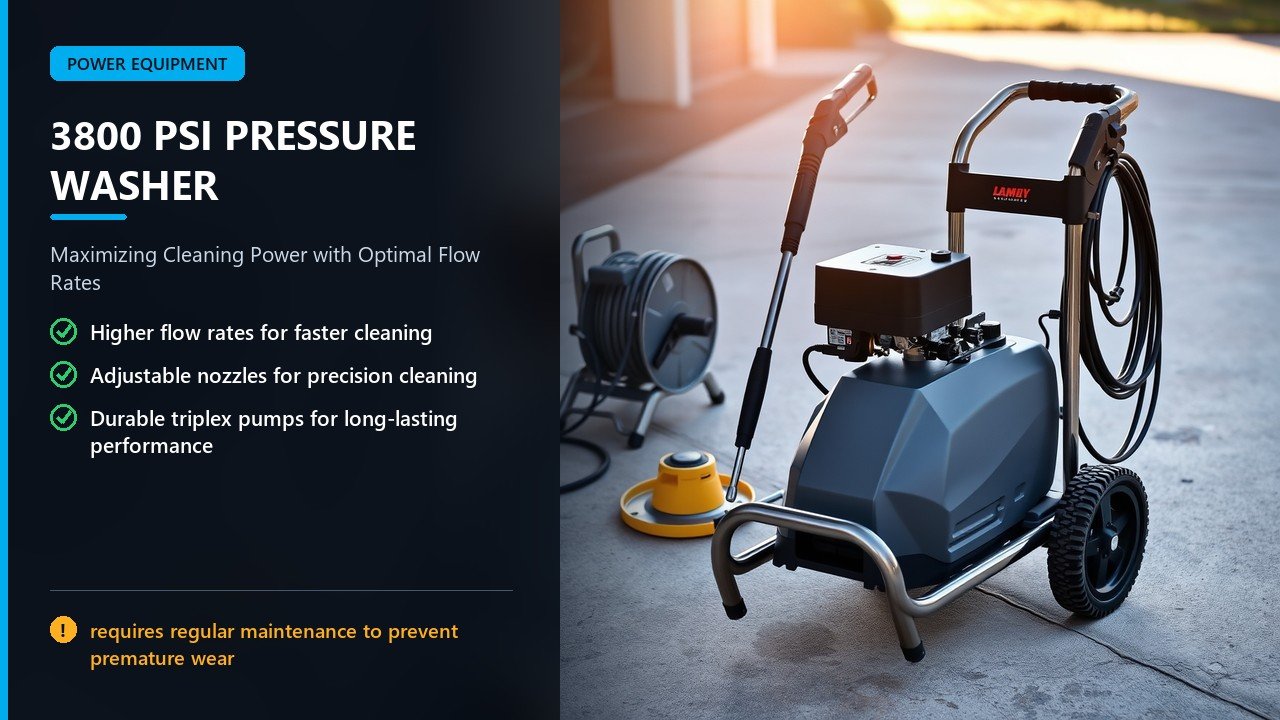
What 3800 PSI Actually Means
PSI is pounds per square inch — the force of the water stream, the force that strips dirt off a surface. GPM is gallons per minute — the volume of water that carries the dirt away. Cleaning power is the product of the two, often called cleaning units, and it is that product, not PSI alone, that decides how fast a machine cleans.
A 3800 PSI washer at 2.5 GPM moves about 9,500 cleaning units. The same 3800 PSI at 3.6 GPM moves nearly 13,700 — roughly 45 percent more cleaning power from the same pressure rating. That difference shows up as faster work on driveways, siding, and decks, because the extra flow rinses away the dirt the pressure has loosened.
This is why a high PSI number by itself is not enough. Two machines can both say 3800 PSI while one is a light-duty unit with a small engine and the other is a commercial-grade machine with a triplex pump and a much larger engine. The pressure rating is the same; the machine is not.
What Separates One 3800 PSI Machine From Another
Flow rate is the first differentiator. In the 3800 PSI class, flow commonly ranges from about 2.5 to 3.6 GPM, and a few units push higher. More flow needs a bigger engine to drive the pump, which raises cost, weight, and fuel use — but it also raises cleaning power.
Pump type matters just as much. Consumer machines often use an axial cam pump, which is lightweight and inexpensive but has a shorter life under heavy or commercial use. Better machines in this class use a triplex plunger pump, often with ceramic plungers and brass heads, which handles higher pressure and continuous work far better. If you plan to use the machine hard or for business, the pump type is a deciding factor.
Drive style is the third difference. A direct-drive pump spins at engine speed and is compact, while a belt-drive pump runs cooler and slower and typically lasts longer, at higher cost and slightly more weight. Generator-style brands and pro-oriented models lean toward belt drive for longevity. The engine itself — Honda GX270, a 274cc or 302cc OHV unit — also separates a rugged machine from a budget one.
Typical 3800 PSI Configurations
The table below shows how much the machines behind the same pressure rating can differ.
| Spec | Light end | Heavy end |
|---|---|---|
| Flow (GPM) | ~2.5 | ~3.6 |
| Engine | ~200 cc | ~270-300 cc |
| Pump | Axial cam | Triplex, brass head |
| Drive | Direct | Belt or direct |
| Nozzle size | ~3.0 | ~3.5 |
| Hose | ~25-35 ft, 1/4″-5/16″ | ~50 ft, 3/8″ |
Read across and the lesson is clear: the same 3800 PSI can be a homeowner machine with an axial pump and a short thin hose, or a professional machine with a triplex brass-head pump, a larger engine, and a longer 3/8-inch hose. If the work is heavy or repeated, the heavy-end machine is worth the extra cost; if it is occasional home use, the light end is enough.
Gas Only at This Pressure
Everything in the 3800 PSI class is gas powered, and for a good reason. Delivering that much pressure at a useful flow takes the power of a gasoline engine; a standard household electrical circuit cannot supply it. That means a 3800 PSI machine is inherently a job-site machine — it needs fuel, a place to vent exhaust, and more maintenance than the electric washers used for lighter home tasks.
The trade-off is worth it when you need the power. A 3800 PSI gas washer cleans a driveway in a fraction of the time a small electric unit takes, and it can run at that output continuously without overheating a motor. The cost is weight, noise, and upkeep: fuel to buy, oil to change, and a pump to protect from freezing. For heavy exterior work, that is a fair bargain.
Understanding Nozzle Orifice Sizes
The nozzle orifice number must match the flow. A nozzle that is too small for the flow chokes the machine and raises pressure beyond its rating, while one that is too large drops pressure and wastes the machine’s potential. In the 3800 PSI class, a 3.0 orifice suits about 2.5-3.0 GPM and a 3.5 orifice suits around 3.5 GPM.
Most machines in this class ship with a set of quick-connect tips: 0, 15, 25, and 40 degrees plus a soap nozzle. The 0-degree tip is a concentrated pencil jet for stripping stubborn spots on hard, unyielding surfaces; it can gouge wood and etch concrete, so use it with care. The 15- and 25-degree tips handle general masonry, concrete, and heavy grime; the 40-degree tip is for gentler work and rinsing; the soap tip draws detergent at low pressure.
Using the wrong orifice or the wrong tip angle is one of the most common ways to damage a surface or a machine. Match the nozzle to both the flow and the task, and never use a 0-degree tip on a surface that can be marked.
What a 3800 PSI Washer Can Clean
At this pressure and flow, a 3800 PSI machine is a serious tool for exterior cleaning. Driveways, concrete patios, walkways, and garage floors are its natural territory, where the combination of pressure and flow strips dirt, mildew, and tire marks quickly. It also handles house siding, decks, fences, and retaining walls with the right nozzle and a careful hand.
For flat surfaces like driveways and patios, a surface cleaner attachment is the partner of choice. It uses two rotating jets under a hood to clean evenly and about four to five times faster than a wand, while avoiding the zebra striping that a single jet can leave. On a 3800 PSI, 3.5-3.6 GPM machine, a surface cleaner sized to that flow is a big time saver.
It is also strong enough for paint prep and stripping, graffiti removal in some cases, and cleaning machinery — but that strength is exactly why care is needed. Used too close, high pressure can etch concrete, strip paint, gouge wood, and force water behind siding. Even a capable machine should be used with the right tip, the right distance, and the right pressure for each surface.
Matching the Machine to the Job
Choose the light end of the class for occasional home cleaning of small areas: a 2.5 GPM, axial-pump machine with a short hose is cheaper, lighter, and easy to store, and it cleans a single driveway or patio well. Choose the heavy end for regular, large-area, or commercial work: a 3.5-3.6 GPM machine with a triplex pump, a larger engine, and a 50-foot 3/8-inch hose will finish jobs faster and last longer under repeated use.
Think about the whole system, too. More flow means the nozzle orifice, hose diameter, and gun must all match; a machine choked by a thin hose or a wrong nozzle will not deliver its rated performance. If you plan to add a surface cleaner, foam cannon, or long-reach hose, the flow rate matters even more, because those accessories need volume, not just pressure.
Finally, decide whether you want a direct-drive or belt-drive machine. Direct drive is simpler and lighter; belt drive runs cooler and typically lives longer, which matters if you will use the machine hard. On a 3800 PSI purchase, that drive choice and the pump type often separate a tool that lasts a season from one that lasts years.
Keeping a 3800 PSI Washer Alive
High-pressure machines punish neglect quickly, so basic care pays off. Keep the pump oil at the right level and change it on schedule, check the oil before every long session, and never run the pump without water. Always fit the correct-size nozzle, and never let the machine run against a closed gun for long, which overheats the pump and can trip or damage the unloader.
Flush the pump after use and winterize it fully before cold weather, since trapped water can crack the pump and fittings. Protect the machine from freezing, store it dry, and keep the air filter and spark plug in good condition. With reasonable care, a good 3800 PSI triplex machine gives years of service; abused, the pump is the first thing to fail.
Frequently Asked Questions
Is 3800 PSI good for home use? It is more than enough for home cleaning. A 3800 PSI machine can handle driveways, siding, decks, and patios, though a smaller machine is often sufficient and easier to manage for light jobs.
Why do two 3800 PSI washers clean differently? Because cleaning power is pressure times flow. A 3.6 GPM machine moves far more water than a 2.5 GPM machine at the same pressure, so it cleans faster.
What is a good GPM for a 3800 PSI washer? Around 3.2 to 3.6 GPM suits serious work; a 2.5 GPM unit is lighter duty. More flow means more cleaning power but needs a bigger engine.
What nozzle should I use? Match the orifice to the flow — about 3.0 for 2.5 GPM and 3.5 for 3.5 GPM — and choose the angle for the task: 0-degree for tough spots, 15- and 25-degree for general work, 40-degree for rinsing, and a soap tip for detergent.
Can 3800 PSI damage surfaces? Yes. Used too close or with the wrong tip it can etch concrete, strip paint, and gouge wood. Use the right nozzle, distance, and pressure for each surface.
Do I need a triplex pump? If you clean often or for a living, yes — a triplex pump outlasts an axial cam pump. For occasional home use, an axial pump is acceptable.
What is the difference between direct and belt drive? Direct drive is simpler and lighter; belt drive runs cooler and typically lasts longer, which helps under heavy use.
How do I protect the pump? Keep oil at the right level, never run dry, use the correct nozzle, avoid long dead-head periods, flush after use, and winterize before freezing weather.
Final Thoughts
A 3800 PSI pressure washer is a capable class, but the number alone tells you only half the story. Cleaning power comes from pressure and flow together, and the same rating can hide a light home machine or a heavy commercial one. Before you buy, look past the PSI to the flow rate, the pump type, the drive style, and the hose — those are what decide how fast and how long the machine works.
Match those to your job: the light end for occasional home cleaning, the heavy end for large or repeated work. Then match the nozzle, hose, and accessories to the flow so the machine can actually deliver its rating, and maintain the pump carefully so it lasts. Chosen and cared for well, a 3800 PSI washer is a strong, versatile tool. For more, see our guides on a power washer at 4 GPM and turbo pressure washer nozzles.