A 6000 PSI water blaster is not a backyard tool. It is industrial cleaning equipment — a machine built to strip coatings, blast concrete, and clean heavy machinery with water pressure so strong it can cut skin. Understanding what this class of machine is, what it can do, and where it belongs prevents expensive mistakes and serious injuries.
This guide explains what a 6,000 PSI water blaster is, how it compares to smaller machines, what powers it, who uses it, and the safety and maintenance rules that come with ultra-high pressure.
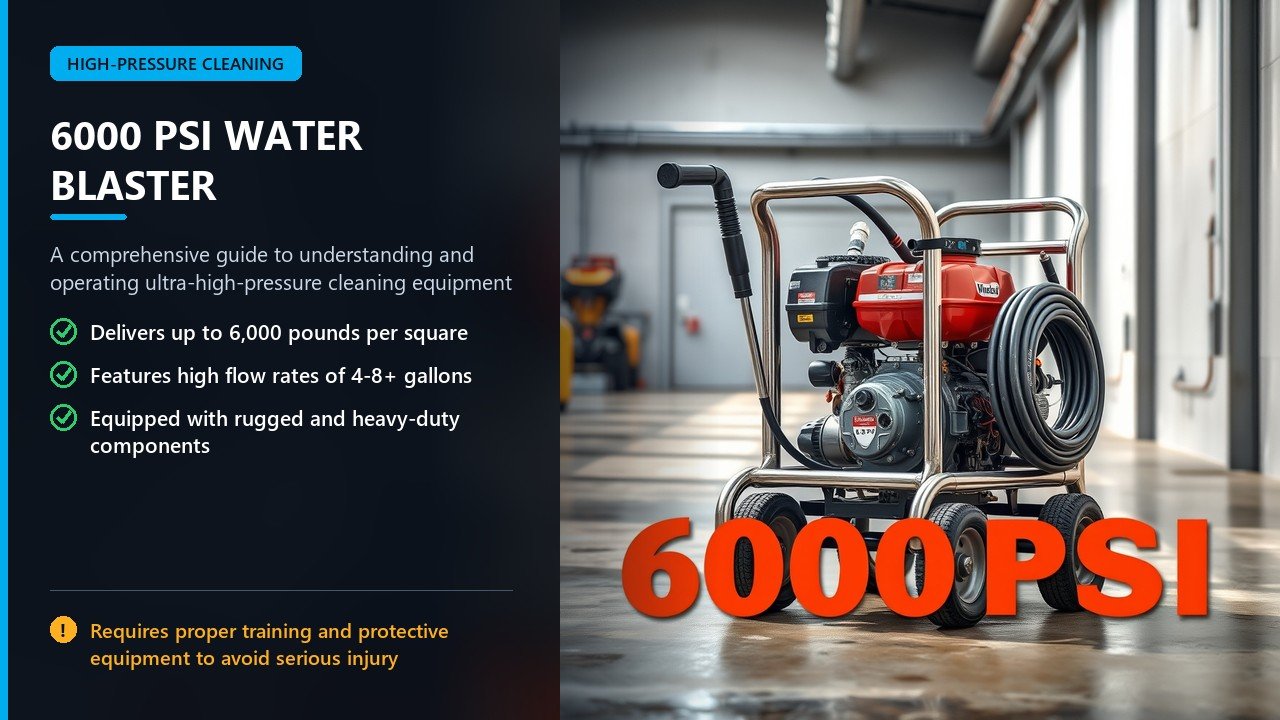
What a 6000 PSI Water Blaster Is
A 6,000 PSI water blaster is a high-flow, ultra-high-pressure cleaning machine that forces water at up to 6,000 pounds per square inch to remove material from surfaces.
- Ultra-high pressure — roughly two to three times a consumer machine.
- High flow — often 4–8 GPM or more.
- Heavy power source — large gas engine or electric motor.
- Industrial build — steel frame, heavy pump, rugged hose.
- Professional controls — unloader, safety valve, pressure gauge.
- Serious weight — often 200–500+ pounds.
Quick Note: At 6,000 PSI, water becomes a cutting tool. This machine class is for trained operators using proper protective equipment — not casual homeowners.
Water Blaster vs Pressure Washer
| Feature | Consumer Washer | 6000 PSI Blaster |
|---|---|---|
| Pressure | 1,500–3,000 PSI | Up to 6,000 PSI |
| Flow | 1.5–2.5 GPM | 4–8+ GPM |
| Power | Small gas or electric | Large engine or motor |
| Use | Home and light work | Industrial and commercial |
| Cost | $100–$600 | $2,000–$15,000+ |
Short Note: The term “water blaster” usually signals a higher-flow, heavier-duty machine than a “pressure washer,” and 6,000 PSI sits firmly in the industrial tier.
Power Sources
| Type | Characteristic |
|---|---|
| Gas engine | Portable; no power cord; common in the field |
| Electric motor | Quiet and emission-free; needs strong power |
| Diesel engine | High power; used on the largest units |
| Skid or trailer mount | For heavy, fixed, or mobile operations |
The power source sets the pump’s ceiling. A 6,000 PSI machine needs serious horsepower or a robust electric supply to drive it.
What a 6000 PSI Blaster Can Do
| Task | Notes |
|---|---|
| Coatings and paint removal | Strips failing coatings from concrete and steel |
| Concrete preparation | Roughens surfaces before resurfacing |
| Industrial equipment | Removes grease, scale, and grime |
| Tank and vessel cleaning | Interior cleaning in industry |
| Hydrodemolition (specialized) | Concrete removal in controlled settings |
| Heavy fleet washing | Large vehicles and machinery |
These are industrial jobs. The same force that makes the machine effective makes it dangerous when misused.
Components of a High-Pressure Blaster
| Component | Function |
|---|---|
| High-pressure pump | Pressurizes the water; usually triplex or plunger type |
| Engine or motor | Drives the pump at working speed |
| Unloader valve | Regulates pressure and bypasses when closed |
| Safety valve | Releases pressure if it exceeds safe limits |
| High-pressure hose | Rated well above working pressure |
| Gun and lance | Controls and directs the stream |
| Nozzle | Sets the spray pattern and impact |
Every component must be rated for the machine’s pressure, not just the gun. Ultra-high pressure exposes the weakest part of the system.
Nozzles and Attachments
| Accessory | Use |
|---|---|
| Rotating / turbo nozzle | Concentrated rotating force for hard surfaces |
| Flat fan nozzles | Broad cleaning swaths |
| Rotary surface cleaner | Even, streak-free concrete cleaning |
| Extension lances | Reach into tanks or up high |
| Rotating sewer / tube nozzles | Pipe and drain cleaning |
| Sandblasting attachment | Wet abrasive blasting for tough coatings |
Accessories extend the machine’s reach and force, but each one adds risk. Use attachments rated for the full system pressure.
Industrial Applications
- Construction — surface prep, form cleaning, coating removal.
- Manufacturing — equipment and production line cleaning.
- Oil and gas — tank, vessel, and pipe cleaning.
- Marine — hull and deck cleaning.
- Municipal — storm drains, sewers, and infrastructure.
- Mining and heavy industry — machinery and buildup removal.
- Rental fleets — heavy equipment cleaning between rentals.
These industries choose 6,000 PSI because nothing less removes the material fast enough to be economical.
Flow, Pressure, and Cleaning Power
| Concept | Meaning |
|---|---|
| Pressure (PSI) | Cutting and stripping force |
| Flow (GPM) | Rinsing and volume of work |
| Cleaning units | PSI × GPM — total cleaning power |
| Nozzle orifice | Balances pressure and flow at the tip |
Short Note: Industrial buyers care as much about flow as pressure. High flow speeds up large-area work, while high pressure does the stripping.
Choosing a 6000 PSI Machine
At this level, the machine should be matched to the work, the site, and the operator.
- Match pressure and flow to the toughest expected task.
- Choose the power source for the location and noise limits.
- Consider mounting — portable, skid, or trailer.
- Verify component ratings — hose, gun, and nozzle.
- Check service support — parts and repair availability.
- Budget for maintenance — pumps at this level need it.
- Plan operator training — safety is not optional.
A 6,000 PSI blaster is a capital purchase. Dealer support and parts availability matter as much as the spec sheet.
Safety at 6000 PSI
Ultra-high-pressure water can cut through skin, cause deep injection injuries, and shatter brittle surfaces. Safety discipline is the first requirement of operating a water blaster.
- Wear proper PPE — face shield, gloves, and heavy clothing.
- Never point the lance at anyone.
- Keep both hands on the gun and brace for kickback.
- Use the safety lock whenever the machine is not in use.
- Never clean yourself or others.
- Depressurize fully before disconnecting anything.
- Inspect hoses and fittings before every job.
- Keep bystanders well back with a defined work zone.
Warning: Water injection injuries are medical emergencies and can look deceptively minor. If skin is punctured by a high-pressure stream, seek immediate medical attention. For general safety context, see the Occupational Safety and Health Administration and the U.S. Consumer Product Safety Commission.
Nozzle Safety and Surface Damage
| Risk | Prevention |
|---|---|
| Etching concrete | Keep the nozzle moving; use a surface cleaner |
| Cutting soft materials | Reduce pressure or change the tip |
| Damaging wood or siding | Use a wider fan and lower pressure |
| Kickback injury | Brace the gun; use two hands |
| Nozzle clog blast | Inspect and clear; keep face clear |
At 6,000 PSI, the wrong nozzle can destroy a surface in seconds. Choose the tip for the material, not for maximum force.
Maintenance Schedule
| Task | Interval |
|---|---|
| Check pump oil level | Every use |
| Inspect hose for damage | Every use |
| Change pump oil | First 50 hours, then per manual |
| Service the unloader | Per manual / seasonally |
| Inspect valves and seals | Per manual |
| Service engine/motor | Per engine manual |
| Winterize | Before freezing |
Industrial machines run hard. Following the manual’s service intervals is what keeps a 6,000 PSI pump alive for years.
Maintenance Log Template
| Date | Service Performed | Hours |
|---|---|---|
| ____ | Oil change | ____ |
| ____ | Valve/seal service | ____ |
| ____ | Unloader check | ____ |
| ____ | Hose replacement | ____ |
A maintenance log turns guesswork into a schedule and supports warranty claims.
Troubleshooting
| Problem | Likely Cause | Fix |
|---|---|---|
| Pressure loss | Worn valves, seals, or nozzle | Service valves; replace nozzle |
| Pulsing flow | Air in suction or worn valves | Seal lines; rebuild valves |
| Water in pump oil | Failed seals | Rebuild with a seal kit |
| Unloader leaks | Worn seat or O-ring | Rebuild or replace the unloader |
| Engine bogs under load | Fuel, air, or governor issue | Service the engine |
Because these machines represent a large investment, diagnosing problems early — before running them damaged — protects both the pump and the budget.
Pump Types at Ultra-High Pressure
The pump is the heart of a 6,000 PSI machine. The type of pump determines durability, serviceability, and cost.
| Pump Type | Characteristic |
|---|---|
| Triplex plunger | Three plungers; rebuildable; industrial standard |
| Duplex | Two pistons; used on some heavy machines |
| Axial | Compact; usually not rebuildable; lower duty |
Industrial water blasters almost always use triplex plunger pumps because they are efficient, durable, and rebuildable. Axial pumps belong on consumer machines, not 6,000 PSI units.
Engine and Drive Options
| Configuration | Best For |
|---|---|
| Direct drive | Compact units; simplest coupling |
| Belt drive | Adjustable speed; easier on the pump |
| Gear drive | Efficient power transfer on large units |
Belt and gear drives let the engine run at its best speed while the pump runs at its own. That flexibility favors longevity on heavy machines.
Hoses, Guns, and Fittings
- High-pressure hose — rated well above working pressure, with steel or braided reinforcement.
- Quick couplers — rated for the system pressure, not generic fittings.
- Gun — heavy-duty, high-pressure rated, with a secure trigger lock.
- Lance — rigid, insulated, and pressure-rated.
- Nozzles — sized to match the pump’s flow.
- Unloader — correct for the pressure and flow range.
- Safety valve — set below the weakest component’s rating.
At 6,000 PSI, generic hardware is a hazard. Every connection must be certified for the working pressure.
Productivity and Efficiency
| Factor | Effect |
|---|---|
| Higher flow | Faster coverage of large areas |
| Surface cleaner | Uniform results; less overspray |
| Correct nozzle | Efficient use of pressure and flow |
| Operator technique | Consistent speed and angle |
Short Note: On industrial jobs, productivity comes from matching flow, pressure, and technique. Buying more PSI than the task requires wastes money and increases risk without cleaning faster.
Training and Operating Discipline
| Requirement | Why |
|---|---|
| Operator training | Prevents injuries and equipment damage |
| PPE at all times | Protection from spray, debris, and injection |
| Work zone control | Keeps bystanders safe |
| Emergency plan | Injection injuries need fast medical care |
Training is what separates a productive industrial machine from a serious accident waiting to happen. It is not optional equipment.
Protecting the Investment
- Never run the pump dry.
- Never deadhead. Use the unloader’s bypass.
- Filter the inlet water.
- Keep the pump oil clean.
- Service the engine on schedule.
- Inspect hoses and fittings constantly.
- Winterize before storage.
- Keep a maintenance log.
Simple habits — clean water, clean oil, a working unloader, and winter care — are what keep a high-value machine earning its keep for years.
Cost of Ownership
| Item | Typical Range |
|---|---|
| Machine purchase | $2,000–$15,000+ |
| Replacement hose | $100–$400 |
| Seal/valve kit | $100–$400 |
| Unloader valve | $80–$300 |
| Nozzles | $20–$150 |
| Annual service | $200–$800 |
Total cost of ownership matters more than sticker price. A rebuildable pump with available parts is cheaper over its life than a sealed unit with no support.
Water Supply Requirements
| Requirement | Detail |
|---|---|
| Flow supply | Must exceed the machine’s GPM |
| Inlet pressure | Adequate positive feed is best |
| Water quality | Clean water protects the pump |
| Supply tank | Needed when no mains supply exists |
Note: Starving a 6,000 PSI pump of water destroys it faster than almost anything. Ensure the supply always exceeds demand.
Common Mistakes to Avoid
- Buying more pressure than the work needs. Overspending and unnecessary risk.
- Ignoring component ratings. The weakest part fails first.
- Running dry. Kills the pump quickly.
- Deadheading. No bypass causes heat and damage.
- Skipping PPE. Ultra-high pressure injuries are severe.
- Neglecting maintenance. Turns a repair into a replacement.
- Forgetting to winterize. Freezing cracks the pump and lines.
Frequently Asked Questions
What is a 6000 PSI water blaster used for? Industrial cleaning — stripping coatings, preparing concrete, cleaning tanks and equipment, and heavy fleet washing.
Is a water blaster the same as a pressure washer? A water blaster is generally a heavier, higher-flow, higher-pressure machine. At 6,000 PSI, it is industrial equipment, not a consumer washer.
Can I use a 6000 PSI blaster at home? It is usually unnecessary and dangerous for home tasks. Consumer machines handle residential cleaning safely.
What powers a 6000 PSI water blaster? A large gas engine, diesel engine, or heavy electric motor, often mounted on a skid or trailer.
How dangerous is 6000 PSI? Very. It can cut skin and cause deep injection injuries. Proper PPE and training are mandatory.
How much does a 6000 PSI water blaster cost? Generally $2,000 to $15,000 or more, depending on power source, flow, and build.
Final Thoughts
A 6000 PSI water blaster is industrial equipment for the toughest cleaning jobs. It strips coatings, prepares concrete, and cleans heavy machinery with a force no consumer machine can match — and a risk to match.
If you need this level of power, buy for support and rebuildability, feed it clean water, maintain it per the manual, and treat every component and every operator with the safety discipline that ultra-high pressure demands. For related reading, see our guides on the 4000 PSI pressure washer gun and the 3500 PSI pressure washer pump.