There is pressure washing, and then there is the 7000 PSI class. Most consumers never see a machine like this outside an industrial yard, and few should, since it is a level of power that strips paint off steel in a pass and cuts through day-old sludge like a hot knife through butter. A 7000 PSI power washer is a specialist tool for a specific world, and understanding exactly what it does, where it belongs, and what it demands from its operator is the difference between a brilliant purchase and a one-way ticket to expensive trouble.
The story of 7000 PSI is the story of two worlds separated by zeros. A residential machine lives at 2,000 to 3,500 PSI and washes driveways and siding; an industrial unit at 7,000 occupies a different universe, one of pump trucks, detergent divisions, hydro-blasting crews, and safety procedures that read like operations manuals. This guide explains what the 7000 PSI class really is, what jobs explain its existence, and everything a buyer, contractor, or curious owner needs to weigh before a machine this serious enters their yard.
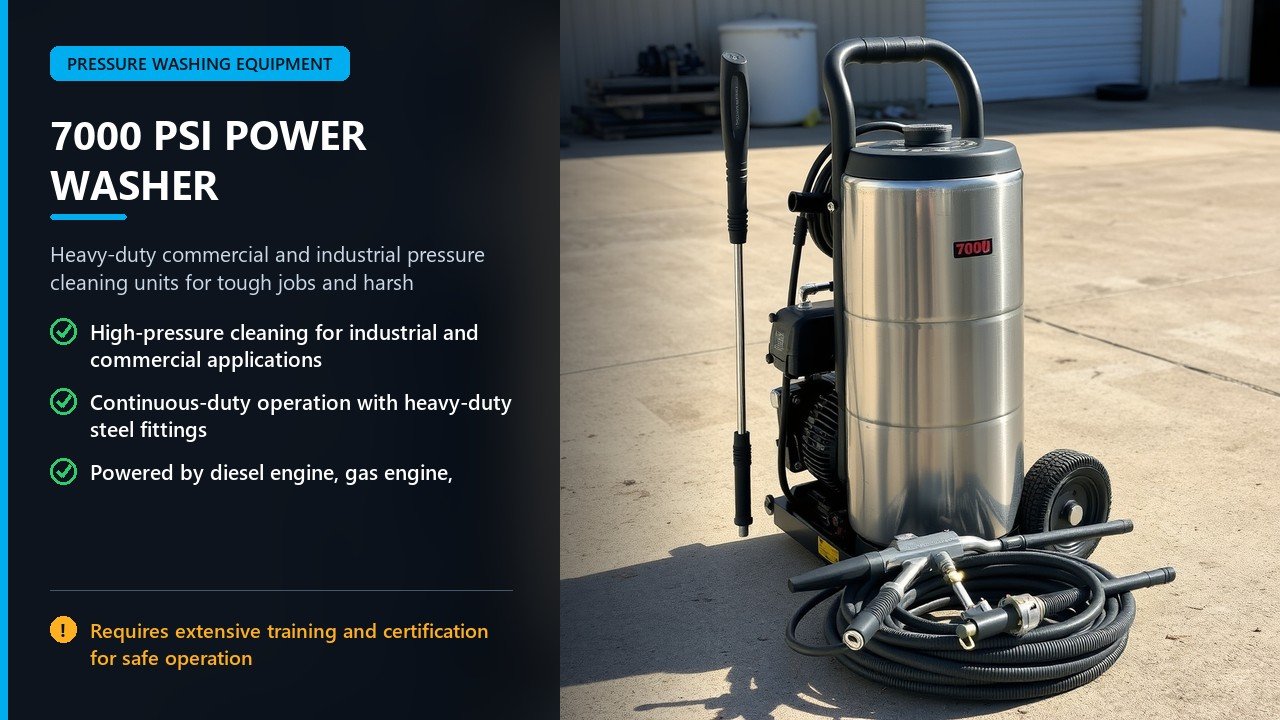
What a 7000 PSI Machine Actually Is
A 7,000 PSI power washer is a commercial and industrial pressure cleaning unit built around a large triplex or plunger pump driven by a diesel engine, a gas engine, or an electric motor, engineered to sustain continuous duty day after day. Unlike a weekend gas washer with an axial pump and a plastic wand, these machines run heavy steel fittings, reinforced hoses rated far above working pressure, and lance work held by an operator in full protective gear. Everything about the machine is scaled for abuse.
The numbers frame the class. A machine at 2,500 PSI and 3 GPM cleans a driveway; a unit at 7,000 PSI with a matching GPM moves a completely different class of challenge, and the delivered force concentrates into a pencil-tight stream or spreads through fan tips that blast grime off vertical surfaces. The physical force at the tip justifies the name, and it is precisely why these machines appear in industrial cleaning, where the objects under the spray are steel, concrete, and machinery rather than cedar siding.
The engine and pump pairing sets the commercial tone. Big-bore engines and belt or direct drives handle the load of a machine that runs six to ten hours a day, and pump models rated for sustained output at 7,000 PSI carry heavy triplex internals, ceramic or hardened steel plungers, and easy service access. A hobbyist who has only seen axial pumps would recognize nothing inside, which is the first honest signal that the 7000 PSI class belongs to the working fleet, not the weekend garage.
Where 7000 PSI Earns Its Keep
The classic home of the 7,000 PSI machine is industrial and infrastructure cleaning. Steel tanks, chemical plants, refineries, and construction equipment shed layers of scale, paint, and hardened grime that resist every lesser tool, and a 7,000 PSI unit with the right tip and technique removes those films in controlled passes. Water blasting at this pressure strips coatings and prepares surfaces for re-coating, and concrete work uses the class to texture and clean slabs where a wider machine cannot reach the muscle.
The sewer and pipe world depends on even more extreme equivalents, and the 7,000 PSI family sits at the heavy end of the accessible commercial range. Fleets and heavy equipment shops wash decades of oil and road film, fixtures and floor coverings in industrial kitchens get restaurated to bare metal, and municipal and utility crews use the machines on catch basins, culverts, and concrete structures. Each site brings PPE, procedures, and the machine’s manual to bear before the trigger is ever pulled.
The flow side runs almost as important as the pressure. A 4 GPM 7,000 PSI machine can out-clean a low-flow 2,000 PSI unit at a fraction of the moves, because the pressure does the lifting and the flow carries it away. Contractors pair the machine with surface cleaners, rotating nozzles, and hot water where oils are involved, and the class earns its place on jobs where time is money and the surfaces can take the power, exactly the conditions a driveway, a house, or a car never present.
Why Most Homeowners Should Think Twice
The honest advice for the residential buyer is blunt, a 7,000 PSI machine is overkill and a hazard for almost every home job. The force that strips a steel tank will carve cedar, blast through siding, and etch concrete in seconds, and the stream at close range is genuinely dangerous to skin, eyes, and the machine’s own parts. Every warning label, every safety manual, and every certified operator’s training says the same thing about this pressure class, and the warnings are not decoration.
The operating reality compounds the risk. A machine this powerful needs a reasonable flow supply, stable footing, hearing and eye protection, a dedicated operator stance, and a yard free of people and pets, none of which describe a crowded weekend driveway. The hose, fittings, and lance are specialized and costly, and the weight and diesel appetite make the unit a fleet asset rather than a household tool. A homeowner with a truck and a stubborn driveway gets no advantage from 7,000 that a proper 3,000 PSI surface cleaner does not already provide.
When the money math is done, the argument closes itself. A quality 7,000 PSI commercial unit costs multiples of a mid-range gas washer, plus the pump, the hoses, and the safety gear, and a contractor buying one bills it out across hundreds of jobs, where a homeowner’s single driveway would never recover the spend. The professionals choose the class because they earn with it, and the honest homeowner keeps the garage machine and the safety margin that comes with it.
The Safety Demands of Ultra-High Pressure
At 7,000 PSI the water stops being water and becomes a cutting tool, and every ounce of discipline follows from that single fact. The stream will amputate a finger, inject fluid into skin where it spreads unseen, and unaware face or limb damage comes faster than a human can react, which is why the PPE is not optional, full face shield, chemical-resistant waterproof suit, boots, and hearing protection, and why the machine ships with interlocks and shutoffs that must never be defeated.
The site rules are equally strict. Nobody operates a 7,000 PSI unit alone for serious work, the second set of eyes handles the hose, the machine, and the emergency stop, and the operator works from stable, non-slip footing with the lance held two-handed and never pointed at a person or self. The regulatory world frames the standards, and the OSHA guidance on high-pressure operations and the industry’s pressure-cleaning practice documents set the baseline an honest contractor follows without complaint.
Equipment inspection is the quiet third leg of safety. The hose must carry a rating above the working pressure and be inspected every shift for blisters, cuts, and coupling pullouts, because a 7,000 PSI failure whips a line like a bullwhip and sprays at lethal force. The fittings, all steel or armored, are inspected the same way, and the machine’s own gauges and reliefs are tested before each use. A unit at this power that is only half-inspected has already failed the test.
Buying a 7000 PSI Machine Wisely
When the price and the need are both real, buying the machine is a spec-by-spec exercise. Start with the pump, the heart of the unit, and confirm the triplex pump is rated for the pressure and continuous duty, not a marginal boost of a smaller design. The engine or motor must match the pump’s demand at full flow, the frame must carry the weight and the vibration for years, and the whole package wants a credible brand with a real parts network and dealer support, because a 7,000 PSI machine without service is a monument to regret.
The kit matters as much as the unit. Confirm the machine ships with a rated hose, a proper lance, and the tips for the jobs it will run, since the specialized fittings at this pressure are not interchangeable with the consumer hardware at the box store. A pressure regulator or an adjustable unloader pays for itself by protecting the expensive internals on softer days, and a drain, a shutoff, and the winterization plan complete the package. The high flow machine guidance on this site frames the flow side of the purchase.
Buy used only with proof of service. A commercial 7,000 PSI unit with logging hours and a service record is a sound buy; one without history is a gamble in a working fleet, where the previous owner’s maintenance failures hide behind a shiny paint. Look for the pump hours, check the oil and the water path, and run the unit under load before money changes hands, because the class does not tolerate guesswork at purchase any more than at the trigger.
Operating and Maintaining the Class
Operation is a procedure, not a habit. The operator starts with the lowest effective pressure, tests on a scrap surface, and builds up only as the job demands, uses the widest fan that will clean, and keeps the lance moving so the concentrated force never rests on one spot. Filters and strainers are inspected before each start, because the pump that builds 7,000 PSI is unforgiving of grit, and the water supply, clean, abundant, and consistent, is half the machine’s survival.
Maintenance follows the calendar and the hours. Pump oil changes on the schedule printed on the pump, engine services at their own intervals, and hoses and fittings replaced at the first sign of wear rather than at failure, each habit protecting equipment that costs real money to replace. The winterization ritual, covered in the winterizing guide, matters more at this pressure than at the consumer level, because a frozen pump case shrugs off no mistakes.
Repairs belong to knowledge. A triplex pump at this pressure is a serviceable, rebuildable unit, with seal kits and plunger sets available from the pump maker, and the trained operator or a service tech handles the work with the manual open and the torque spec respected. The machine, its hoses, and its fittings form a system, and maintaining the system as one keeps the 7,000 PSI class earning its rate for a decade, which is the true return that made the purchase sensible in the first place.
Tips, Lances, and Accessories at This Pressure
The hardware that carries 7,000 PSI bears no resemblance to a consumer kit. The lance is a heavy steel wand with a trigger ball valve and a rated fitting, the hose carries the working pressure with armored couplings, and the tips are hardened ceramics or steel rated for the class, stamped with flow numbers that must match the machine’s GPM. Buying consumer-grade tips for a 7,000 PSI unit invites a spectacular failure, so the parts come from the industrial line that shares the rating, and the machine’s manual names the exact tips.
Tip angles follow the same logic as the consumer world with heavier stakes. A 0-degree jet at 7,000 PSI is a genuine cutting tool for single-line work, a 15-degree fan blasts coatings and grime off steel, and a 25 to 40-degree fan rinses and soft-washes concrete and masonry, each matched by feel after a test scrap. Rotating and surface-cleaner heads spread the force and speed the big flatwork, and each accessory must carry the pressure rating, because the machinery, not the fantasy, sets the safe load.
The nozzle chart story on this site scales straight up to the industrial class, with the same colors, angles, and distance rules applied through a heavier lens. The operator plans the tip before the lance rises, keeps a spare rated tip in the kit, and treats every fitting as a pressure boundary, because each one is, and the discipline of the consumer toolbox simply moves up to the big machine with the bigger consequences.
Hot Water, Flow, and Chemistry at the High End
The industrial world pairs 7,000 PSI with heat and chemistry to widen its range. A hot water 7,000 PSI unit is the workhorse of restaurants, process plants, and machinery yards, where temperature softens oil and baked-on grease so the pressure blasts it free, and the combined effect beats either tool alone. The machine’s burner and coil add cost and maintenance, but for the heavy film jobs they pay back on the first shift, and the whole pressure-plus-temperature story is told in the hot water rig guides.
Flow completes the triangle. A 7,000 PSI machine at a modest 4 GPM concentrates its force; at 8 GPM it becomes a moving wall of water that strips whole surfaces in passes, and the high flow class scales the idea to the industrial floor. The GPM choice follows the job, with low flow for precise line work and high flow for flats and coverage, and the machine spec sheet frames the match before purchase.
Chemistry is the multiplier. Industrial degreasers, caustic blends, and sanitizing agents ride the same flow through a chemical injector or a downstream system, and the correct detergent for the contaminant turns a heavy blast into a surgical one. The tank and injector discipline from the tank guide applies wholesale, clean water to the pump, chemical to the injector, labels respected, and the whole arsenal, pressure, temperature, flow, and chemistry, becomes the contractor’s complete toolkit for the industrial grade.
The Real Cost of Owning the 7000 PSI Class
The price tag is only the first payment. A quality 7,000 PSI unit commands a serious purchase price, and the fleet costs stack on it, a rated hose that costs multiples of a consumer line, tips and lances that wear and replace, fuel at a heavy engine’s appetite, and a maintenance schedule that protects a pump rebuildable at a four-figure cost if ignored too long. The honest owner budgets the cost per hour the way a fleet manager does, because the machine’s value is realized across working hours, not across days in the garage.
The operating costs decide the pricing. Contractors bill the machine at a rate that covers the payment, the fuel, the pump service, the PPE, and the liability, and the number lands well above a hobbyist’s mental math. Insurance sits on the same ledger, since a machine at this force changes the risk profile of a business, and the honest rate-sheet reflects the coverage, which is why professional cleaning quotes look nothing like a homeowner’s DIY budget.
Depreciation and resale round the picture. A well-maintained industrial unit holds surprising value, because the pump, engine, and hose bend their way through a working life and the brand’s parts network keeps them serviceable. The buyer who buys for the job, maintains on schedule, and sells with documentation recovers a real share of the investment, while the buyer who treated the class like a backyard toy watches the value evaporate with the first seized pump.
Alternatives: When Flow and Heat Beat Raw Pressure
The 7,000 PSI class is not always the answer to a heavy cleaning problem, and the experienced operator weighs the alternatives. A hot water machine at moderate pressure cleans oils and greases faster than a cold 7,000 PSI unit on many industrial jobs, because heat softens the film while pressure merely pushes it, and the cold versus hot comparison covers the trade. A higher-flow machine at 4,000 to 5,000 PSI with the right surface cleaner often delivers equal result with less risk on flatwork.
The job, not the spec, should set the tool. Concrete texture, steel coating removal, and deep grime on machinery favor the ultra-high pressure unit; large flat cleaning, greasy engines, and delicate surfaces favor flow, heat, or chemistry instead. Contractors run a mixed fleet for exactly this reason, matching the machine to the substrate and the contaminant rather than dragging the most powerful unit to every site, and the discipline earns the keep of every tool in the fleet.
Renting rounds out the honest toolbox. A contractor who needs 7,000 PSI a few times a year rents the class instead of owning it, capturing the capability for a specific job without the purchase, storage, and full-time maintenance burden. The rental agreement comes with the proper PPE and instructions, and the operator treats the borrowed machine with the same discipline as the owned one, which is the surest sign that the class is being handled as seriously as it deserves.
Training, Certification, and the Professional Standard
The professional operators of 7,000 PSI machines do not learn the craft from a spec sheet. Manufacturer programs, industry training, and hands-on apprenticeship cover the pressure class, the machine’s controls, the tip selection, and the emergency response that a serious kit demands, and the certification that some industries require is not bureaucracy, it is the shared standard that keeps the whole trade safe. The hearing-protection guidance and the machine’s own operator manual set the floor for every shift.
The everyday discipline looks tame next to the machines but matters most. Operators work in pairs, keep the zone clear, log the machine’s hours and services, and stand in a stance that lets the lance move without taking a knee or a slip. The emergency routine, a hand on the shutoff, a signal between the pair, and a clear plan if a hose fails, is rehearsed before the pressure ever rises, and the practice turns a potential disaster into a managed stop.
For a contractor moving up into this class, the training is an investment that pays on both sides of the ledger, in jobs won by demonstrable competence and in the far rarer cost of a preventable incident. The professional standard, trained operators, inspected equipment, proper PPE, and a plan for every job, is exactly what separates the 7,000 PSI work done the right way from the cautionary tale, and it is the reason the class stays safely at work across the industrial world.
Common Questions About 7000 PSI Machines
Beginners ask the honest questions, and the answers set expectations correctly. No, a 7,000 PSI unit is not “better” for a house; it is dangerous on surfaces it will cut through. Yes, operators need training and the full PPE kit, and yes, the fuel, water, and service costs run high. The machine is chosen for a class of work, and every question circles back to the same line, this pressure buys force, and force demands respect.
Final Thoughts on the 7000 PSI Power Washer
The 7000 PSI power washer is a precision industrial instrument that occupies the far edge of the pressure washing world, built for steel, concrete, and the toughest residues, and paid back through the commercial jobs it runs. It is not a household upgrade, it is a specialist’s tool with specialist’s costs, procedures, and risks, and the honest buyer either uses it across a real workload or leaves it to the fleet that does. Respect for the class is the whole curriculum.
For the contractor whose jobs genuinely reach this pressure, the machine is a capable partner, bought on pump and brand, fed clean water, maintained on schedule, and operated with the discipline the class demands. For the homeowner tempted by the big number, the better answer is the machine that fits the driveway, the house, and the safety of everyone in it. The 7,000 PSI class earns its legend where it belongs, in the hands that understand it, on the jobs that need it, and nowhere else.