When a friend started a soft wash business, he made the mistake almost everyone makes: he bought an 8 gpm power washer first and figured out the rest later. The machine was powerful and beautiful, and for two weeks it sat unused because he had no tank, no proper hose, no injector, and no idea how to feed it. Once he built the supporting system around it, a water tank with a float valve, correctly sized hose, a downstream injector, and the right nozzles, the same machine became a business. That experience taught him something important: an 8 gpm power washer is not a tool you buy and use, it is the engine of a system you build around it. This guide is about building and running that system, from water supply to soft wash setup to daily operation and maintenance.
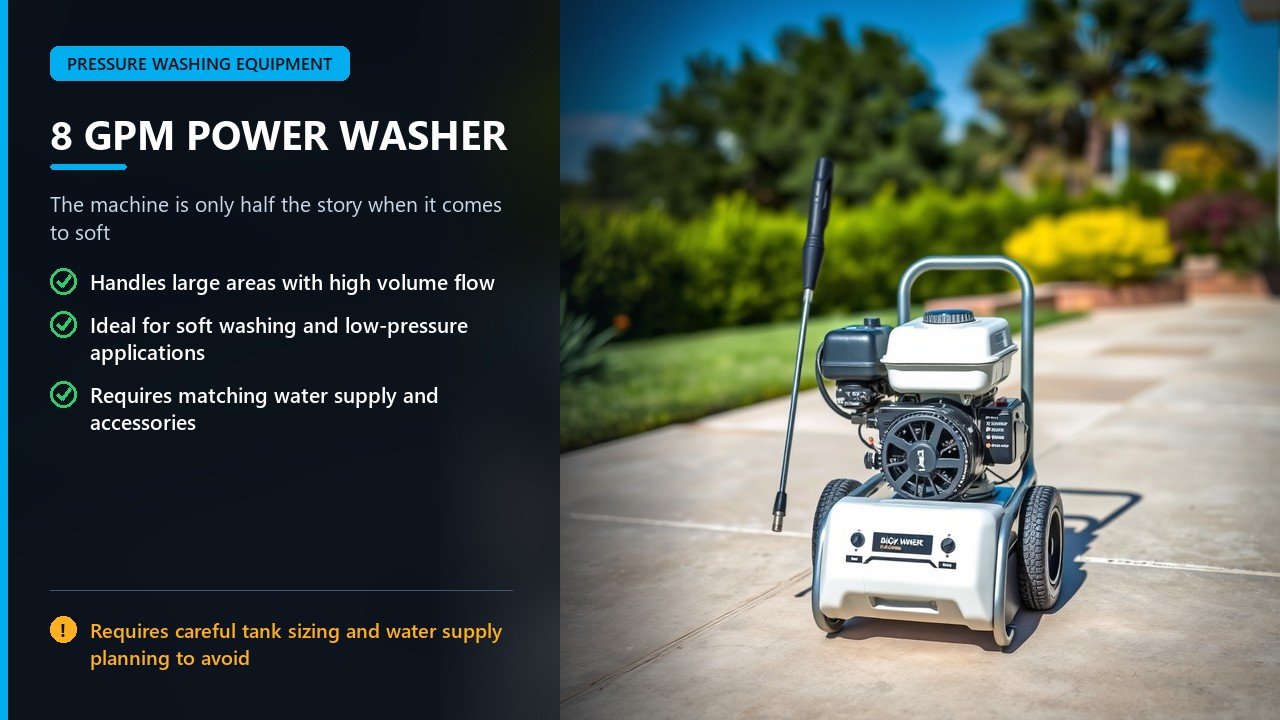
What an 8 GPM Power Washer Gives You
To set the foundation, recall what the flow rating means. GPM is volume; PSI is pressure. An eight-gallon-per-minute machine moves a large volume of water, prioritizing coverage and rinsing over brute impact. That flow makes it superb at applying and rinsing cleaning solutions, covering flat surfaces quickly, and handling soft washing, where low pressure and high volume are exactly the right combination.
The tradeoff is demand. Eight gallons per minute is far more water than a typical household or commercial building supply delivers, so the machine needs a buffer tank unless you have an unusually strong water source. It also needs hose, fittings, and accessories sized for high flow, because restrictive components choke the machine’s capacity. And it needs a pump and engine built for continuous high-volume service. Understanding these demands is the key to using the machine well.
If you want the conceptual background on how flow compares to pressure and why sizing the burner and supply matters, our guide to an 8gpm pressure washer covers the fundamentals. This article focuses on the practical system you build around the machine.
The Machine Is Only Half the Story
The single most important lesson about an 8 gpm power washer is that its performance depends on the entire system. A high-flow machine fed through a narrow hose, starved by an inadequate supply, or limited by restrictive fittings cannot deliver its rated flow, and you paid for flow.
Every element in the water path must be sized for the machine’s output. The supply must provide enough water, whether directly or through a buffer tank. The hose must be large enough in inside diameter to carry the flow without excessive pressure loss. The fittings must not restrict. The unloader must be sized for the flow. The nozzle must match the flow and pressure to produce the intended spray. If any of these is wrong, the machine underperforms, and the operator blames the equipment when the real problem is the system.
This is why building an 8 gpm setup is a systems exercise. Get the whole path right, from source to nozzle, and the machine delivers. Get it wrong anywhere, and you have an expensive machine that cannot do what it was bought for.
Water Supply and Tank Sizing
The water supply is the first system to get right, and it usually means a buffer tank.
Because most sources deliver less than eight gallons per minute, a tank holds a reserve that the machine draws from, while the source refills the tank. A float valve keeps the tank at a working level, opening to refill as the level drops and closing when full. The machine gets its high flow from the tank, and the source refills at whatever rate it can. As long as the average supply keeps up with average demand, the system works.
Sizing the tank involves a tradeoff. A larger tank gives more buffer for jobs where the supply is slow or interrupted, but weighs more when full, which matters for a mobile rig and its towing limits. A common approach is to size the tank so it holds enough for a realistic work interval, and rely on the float valve to refill it continuously from the source. Include an inlet filter to protect the pump from debris, because a high-flow pump is expensive and a filter is not.
Plan the refill situation for each job, too. Some jobs have a strong water source, some have only a slow spigot, and some have none at all, requiring a full tank for the entire job. Knowing the supply before you arrive determines whether you can work from the source or must carry all the water you need. Our guide to a portable power washer with water tank covers how tank and float systems keep a high-demand machine fed.
Hose Sizing and Flow
The hose must carry the machine’s flow without choking it, and this is where many high-flow setups fail.
A hose that is too small in inside diameter restricts flow, increasing friction loss and reducing the volume that reaches the nozzle. Over a long hose, this loss grows, so a high-flow machine on an undersized hose delivers far less than its rating. Matching the hose’s inside diameter to the machine’s flow is essential, and for high-flow work, the hose is typically larger than what a consumer machine uses.
Hose length is the other factor. Longer hoses lose more pressure and flow to friction, so a very long run calls for a larger inside diameter to compensate. When combining a high-flow machine with a long hose, choose the diameter that preserves flow to the nozzle, and keep the fittings and connections sized to match. A reel helps manage a long, large-diameter hose, preventing kinks and keeping the run organized. The principle is simple: everything in the water path should be sized for the machine’s flow, and the hose is a critical link that is often overlooked.
Pairing With a Surface Cleaner
A surface cleaner and an 8 gpm machine are natural partners, especially for flatwork.
A rotary surface cleaner needs adequate flow to spin and clean efficiently, so it depends on a high-flow machine to perform at its best. With eight gallons per minute behind it, a surface cleaner covers large areas quickly and leaves a consistent, even finish, without the streaks a wand can produce. The combination is the standard for commercial flatwork, from driveways and parking areas to sidewalks and plazas.
When pairing them, match the surface cleaner’s flow requirement to the machine’s output. A surface cleaner rated for less flow than the machine delivers may be over-driven, while one rated for more will underperform. Choose a cleaner designed for your flow class, and use the appropriate nozzle set. For edges, corners, and vertical surfaces, follow up with a wand, since the surface cleaner cannot reach these areas. Used together, the surface cleaner and the 8 gpm machine form the core of an efficient flatwork operation, and the speed and consistency they deliver are what make high-flow machines worthwhile for commercial cleaning.
Setting Up for Soft Washing
Soft washing is one of the strongest use cases for an 8 gpm machine, and it requires specific setup.
Soft washing cleans with low pressure and high volume, relying on cleaning solutions and flow rather than impact. This makes it safe for roof shingles, delicate siding, and surfaces that high pressure would damage. An 8 gpm machine provides the volume that soft washing demands, so it is the right tool for the method.
The central component is the chemical injection system. A downstream injector draws cleaning solution into the water stream after the pump, mixing it with the water before it reaches the nozzle. This lets the operator apply a diluted solution at low pressure and then rinse, using the machine for both application and rinsing. The injector must be sized for the machine’s flow and able to handle the chemicals used, and the operator must understand the dilution ratios to apply the correct strength for each surface and soil.
Proper soft wash setup also includes the right nozzles for low-pressure, high-volume application, the correct chemical tanks separate from the water supply, and protective measures for the pump and injector, since harsh chemicals can damage components if not managed correctly. When set up properly, an 8 gpm machine becomes a soft wash workhorse, applying and rinsing solutions across large areas quickly. The low pressure protects the surface, and the high flow does the cleaning.
Downstream vs Upstream Injection
Chemical injection can be done in different places, and the choice matters.
Downstream injection introduces the chemical after the pump, in the high-pressure line before the nozzle. It is the most common soft wash method, because the pump and its internals are not exposed to the chemicals, which protects them from harsh solutions. The injector is a simple, inexpensive device that draws solution into the stream using the Venturi effect. The tradeoff is that dilution depends on flow and pressure, so ratios can be approximate, and some injectors struggle with certain chemicals or flows.
Upstream injection introduces the chemical before the pump, mixing it thoroughly and allowing precise ratios, but it exposes the pump and seals to the chemicals, which requires chemical-resistant components and careful material selection. This method is less common for harsh solutions because of the risk to the pump.
For most soft wash operators, downstream injection is the practical choice, protecting the machine while delivering adequate dilution for typical cleaning. Understanding the tradeoff, protecting the pump, and matching the injector to the machine’s flow keeps the setup working reliably. Whichever method is used, the operator must know the dilution ratios and how flow and pressure affect them, because the strength of the applied solution determines both cleaning effectiveness and safety.
Soft Wash Chemicals and Safety
Soft washing typically uses cleaning solutions such as sodium hypochlorite, the active ingredient in bleach, often with a surfactant to help it cling and work. These chemicals are effective but require real safety precautions.
Chemical burns, eye damage, and respiratory irritation are genuine risks, so protective equipment is mandatory: chemical-resistant gloves, eye and face protection, protective clothing, and respiratory protection when vapors are present. Mixing must be done carefully, with the correct ratios for the surface, and never mixing incompatible chemicals, which can produce dangerous reactions. The machine’s components must be compatible with the chemicals to avoid degradation, and the operator must avoid spraying chemicals onto plants, people, and property that should not be exposed.
Runoff carries the chemicals and loosened soil, and it may be regulated, so the operator must consider where the wash water goes, especially in areas with storm drains or sensitive environments. Capturing or containing runoff where required is part of responsible soft washing, and it can be a contract requirement. As always with cleaning, the chemicals that make soft washing effective demand knowledge and care. An operator who understands dilution, safety, and runoff uses soft washing safely and effectively, and an operator who does not creates serious risks. Training and caution are not optional.
Operating Workflow
Once the system is built, a smooth workflow makes the machine productive.
Begin by assessing the job: the surface, the soil, the water supply, and any runoff considerations. Set up the machine where it can reach the work, connect the water supply, and confirm the tank and float valve are working. For soft washing, pre-mix the solution to the correct ratio and confirm the injector is drawing properly. Apply the solution at low pressure, working in sections, and allow dwell time for it to break down the soil. Then rinse with high volume, moving systematically to avoid missed areas. For flatwork, deploy the surface cleaner and work in overlapping passes, then detail the edges with a wand.
Throughout, monitor the machine: watch for adequate water supply, listen for cavitation, check for leaks, and keep the nozzle clear. Work in a logical sequence so you do not re-cover cleaned areas, and plan the job so you finish within the tank’s capacity, refilling as needed. A disciplined workflow turns the high flow of the machine into fast, consistent results, and it keeps the operator from wasting time and water. The machine does the heavy lifting, but the workflow is what makes the job efficient and professional.
Maintenance Schedule
An 8 gpm machine works hard and needs disciplined maintenance.
Change the pump oil on the manufacturer’s schedule with the correct specification, because the pump is the heart of the machine and high-flow service stresses it. Keep the inlet filter clean and always supply adequate water, since cavitation from a starved pump causes rapid, expensive damage. Inspect hoses and fittings for restriction, wear, and leaks, and keep them sized for flow. Service the engine as you would any engine, with fresh oil, clean air and fuel filters, and fresh, treated fuel. If the machine has a burner, service it and descale the coil. Clean the surface cleaner’s bearings and nozzles and check the swivel. Flush chemicals from the system after soft washing to protect the pump and injector, because residual chemicals cause corrosion. Finally, winterize the entire system before freezing weather, draining the pump, tank, hoses, and any heater, because trapped water cracks components. A logged maintenance schedule keeps the machine reliable and protects a substantial investment.
Common Problems and Fixes
Understanding typical issues helps you diagnose quickly.
Weak pressure or flow. Usually a restricted filter, an undersized hose, a clogged nozzle, or a supply problem. Check the water path from source to nozzle.
Cavitation and pump noise. A sign the pump is starved, often from an inadequate supply, a clogged filter, or an empty tank. Restore water flow immediately to prevent damage.
Injector not drawing chemical. Often a flow or pressure mismatch, a clogged injector, or an incompatible chemical. Clean or replace the injector and confirm it is sized for the machine.
Surface cleaner not spinning. Usually insufficient flow or a worn deck assembly. Confirm the machine meets the cleaner’s flow requirement and inspect the bearings and swivel.
Uneven cleaning. Often too fast a pass, a worn nozzle, or insufficient flow. Slow down, check the nozzles, and confirm the flow.
System Component Checklist
Before running an 8 gpm machine, verify every component in the system is matched to its flow. This checklist prevents the most common performance failures.
| Component | Requirement | Common Failure |
|---|---|---|
| Water supply | Meets or buffers the flow demand | Starved pump, cavitation |
| Buffer tank and float valve | Sized for job length and source | Tank too small, float stuck |
| Inlet filter | Clean, adequate flow, correct micron | Clogged, restricts flow |
| High-pressure hose | Inside diameter sized for flow | Too small, chokes performance |
| Fittings and unloader | Rated and sized for flow | Restriction, pressure spikes |
| Nozzle and surface cleaner | Matched to flow and pressure | Poor spin, uneven cleaning |
| Injector | Sized for flow, chemical compatible | Will not draw solution |
Working through this list before a job takes minutes and prevents the frustration of a machine that will not perform. When every component is matched, the machine delivers its rated flow and cleans as designed. When one is wrong, the whole system suffers, which is why high-flow cleaning rewards careful setup. Keep this checklist in mind not just at purchase but on every job, because a clogged filter or a kinked hose can degrade a perfect setup in moments.
Scaling an 8 GPM Setup for Growth
As a cleaning business grows, an 8 gpm system can be expanded or redeployed to match the work.
The simplest growth step is to add a hot water burner, turning a cold-water high-flow machine into a hot water system that handles grease and sanitation work. Because the machine already delivers the flow, adding heat unlocks premium services without replacing the machine. This is one reason an 8 gpm machine is a good platform for growth: it has the flow that both soft washing and hot water cleaning need. Our guide to a hot water pressure washer trailer shows how a complete mobile rig integrates the machine, heat, and water supply.
Beyond heat, growth may mean moving the system onto a trailer for mobility and organization, adding a surface cleaner for flatwork, expanding tank capacity for longer jobs, or adding a second machine to handle larger contracts or run two operators. The key is that the high-flow machine remains the foundation, and the surrounding system scales around it as the business’s work expands. Because the machine is the most expensive single component, building the system to grow with it protects the investment. A business can start with a basic soft wash setup and expand into hot water cleaning, flatwork, and fleet work over time, all on the same high-flow platform.
Quick Note: Plan your growth before you buy, because the water supply, tank, and plumbing that support soft washing can also support hot water cleaning later. Choosing a machine with headroom and building the system to accommodate future heat or flatwork saves you from rebuying equipment as the business grows.
8 gpm Power Washer: Frequently Asked Questions
What is an 8 gpm power washer used for? High-flow cleaning: soft washing, large-area rinsing, commercial flatwork, and fleet cleaning. It prioritizes volume, which suits low-pressure, high-volume methods.
Can I run an 8 gpm power washer from a normal water supply? Usually not directly, because most supplies deliver far less than eight gallons per minute. A buffer tank with a float valve is the standard solution.
Do I need a tank for an 8 gpm machine? In most field situations, yes. The tank lets the machine draw high flow while the source refills the tank, preventing pump cavitation.
Is an 8 gpm machine good for soft washing? Yes, it is ideal. Soft washing needs low pressure and high volume, which is exactly what a high-flow machine provides.
What size hose should I use? A hose with an inside diameter sized for the machine’s flow, larger than consumer hose, and long enough for the job without excessive friction loss.
How do I maintain an 8 gpm power washer? Change pump oil on schedule, keep the inlet filter clean, supply adequate water, service the engine, flush chemicals after soft washing, and winterize thoroughly.
Final Verdict on 8 gpm Power Washers
An 8 gpm power washer is the engine of a high-volume cleaning system, and its value is realized only when the system around it is built correctly. With an adequate water supply, a buffer tank, hose and fittings sized for flow, and the right accessories for soft washing or flatwork, this class of machine delivers fast, thorough cleaning that lower-flow machines cannot match. It is a professional tool for soft washing, large-area rinsing, and commercial flatwork, and for the right business, it is a productivity multiplier.
Its demands are real: substantial water supply, high-flow plumbing, disciplined maintenance, and careful handling of soft wash chemicals. None of these are obstacles for an operator who plans properly. Build the system, match every component to the machine’s flow, learn the soft wash method and its safety requirements, and maintain the equipment on schedule. Do that, and an 8 gpm power washer becomes the centerpiece of a profitable cleaning operation. My friend learned the hard way that the machine comes in a box but the system does not. Build the system, and the machine will do everything you bought it for.