Ask ten owners what oil for a pressure washer pump to use and you will get ten confident answers, most of them wrong. The truth is that pump oil is one of the few places where guessing can destroy an expensive pump in a single afternoon, because the crankcase holds only a few ounces and the moving parts inside run hot and fast with no room for the wrong fluid.
This guide cuts through the folklore. You will learn what a pressure washer oil actually does, which oils are safe, how to read a spec sheet, when to change the oil, and how to spot the warning signs that your pump oil type is failing before the pump does.
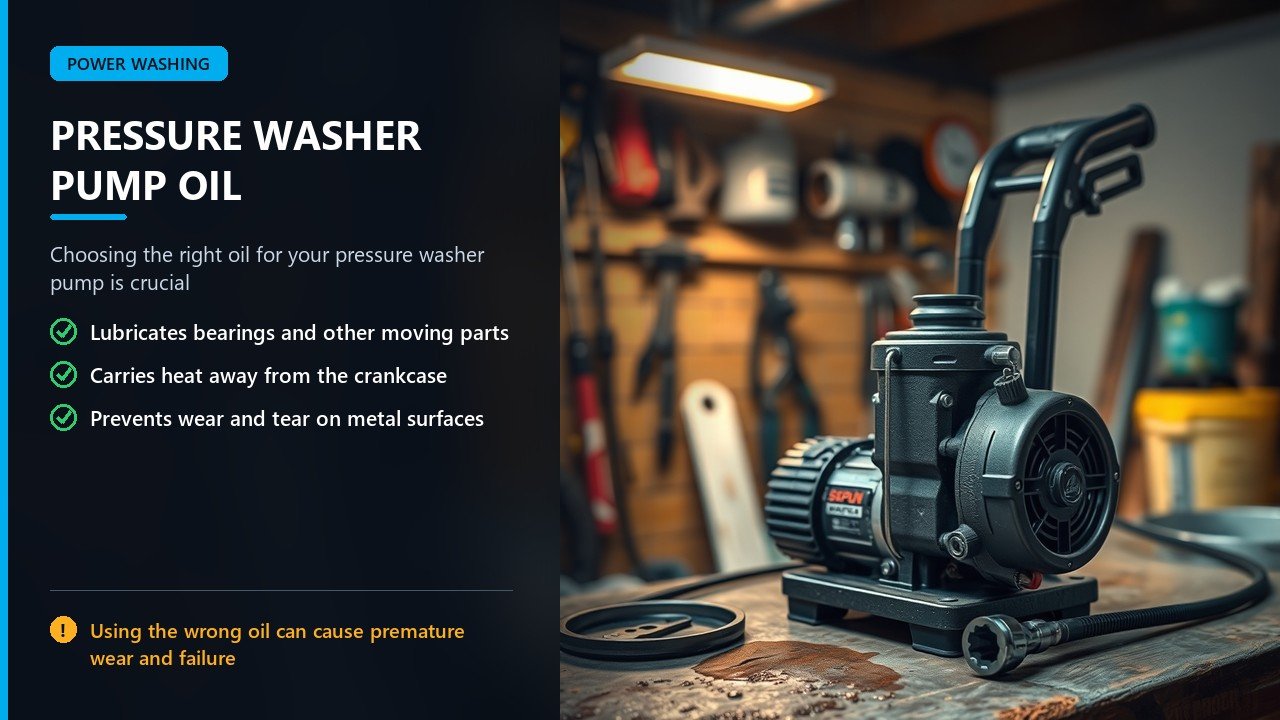
What Pump Oil Actually Does
A pressure washer pump has a crankcase filled with a small pool of oil that lubricates bearings, a wobble plate or cam, and the plungers or pistons that push water. Unlike the water side of the pump, which is sealed off, the crankcase side is a quiet mechanical world that depends entirely on its oil film to survive.
It separates metal from metal. The load on the bearings and the cam is high and constant. A proper oil film keeps surfaces apart, and when that film breaks down, the parts wear, gall, and finally seize. This is why the correct oil for a pressure washer is not optional.
It carries heat away. Friction generates heat, and the oil moves that heat to the pump body, where airflow and the cool water passing nearby help it escape. An oil that shears thin under heat stops doing this job and lets temperatures climb.
It fights corrosion. Moisture finds its way into any pump sooner or later. A good pump oil carries additives that resist rust, so internals do not pit while the machine sits unused for months.
It holds contamination in suspension. Tiny wear particles and any water that slips past a seal get carried in the oil rather than grinding between surfaces. When you drain the oil, you remove that contamination with it.
It maintains viscosity. The right pump oil type keeps a stable thickness across the temperature range a pump sees, from a cold start to a long hot run. Too thin and it cannot cushion the load, too thick and it cannot circulate to where it is needed.
Because the crankcase is small, the oil works hard in a tiny volume. That is why pressure washer pump oil is specified so precisely and why changing it on schedule matters so much. A car engine holds quarts and filters constantly, a pump holds ounces and relies on you.
The crankcase seal is the line of defense. Between the oil side and the water side sits a seal that keeps the two apart. When that seal is healthy, the oil stays clean and the pump runs cool. When it wears, water creeps in, the oil turns to a milky emulsion, and lubrication collapses in a matter of hours. Understanding this single part explains why water in the oil is treated as an emergency rather than a nuisance.
Oil quality fades quietly. Unlike a sudden mechanical failure, oil does not announce its decline. It simply loses a little film strength, holds a little more contamination, and lubricates a little less well, month after month, until one hot afternoon the damage shows up all at once. By then the bearings may already be scored, which is why scheduled changes matter more than reacting to symptoms.
The Right Oils for a Pressure Washer Pump
Most pressure washer pumps fall into a few broad families, and each accepts a small range of oils. Knowing the family of your pump is the first step.
Non detergent SAE 30 oil. This is the classic recommendation for many axial and triplex pumps. Non detergent matters because detergent oils foam and hold air, and foam does not lubricate. Never use motor oil with detergents in a pressure washer pump.
Purpose made pump oil. Many makers sell a branded pump oil blended exactly for their crankcase. It costs more per ounce but removes all doubt. When you are unsure, this is the safest answer to what oil for pressure washer pumps.
Hydraulic oil. Some pumps specify an ISO grade hydraulic oil, often around ISO 68. Hydraulic oil is clean, stable, and well suited to the small, tightly toleranced crankcase of a pressure washer pump. Check the manual before substituting.
Full synthetic pump oil. Synthetic pump oil resists heat and shear better than mineral oil and holds its viscosity longer. In a hard working commercial machine, it can extend drain intervals and protect the pump on hot days.
Gear oil, in rare cases. A few pumps call for a specific gear oil. This is uncommon, so unless your manual says otherwise, stay away from it, because gear oil additives can attack seals and are far too thick for some designs.
What to avoid. Standard automotive motor oils, automatic transmission fluid, cooking oil, and any random fluid from the shelf are all wrong. Foaming, seal swelling, and poor film strength follow quickly. When in doubt, buy the pump oil the maker specifies.
The short version: non detergent SAE 30, a branded pump oil, or the hydraulic oil your manual names. Anything else is a gamble on a part that is expensive to replace.
Why detergents are the enemy. Detergent additives are designed to suspend soot and dirt in a car engine and release them at the filter. A pressure washer pump has no filter and agitates its oil with a fast moving cam, so detergents turn the oil into foam. Foam is mostly air, and air cannot carry a load, which is why a pump filled with detergent motor oil can wear out even while the oil level looks fine.
Why the maker’s oil is worth the price. A branded pressure washer oil is blended with the right viscosity index, the right anti wear package, and seal friendly chemistry for that specific pump. It may cost a few dollars more than a generic bottle, but weighed against the cost of a replacement pump, it is the cheapest part of the whole machine. When two oils both claim to fit, the branded one removes the doubt.
Reading Your Pump’s Spec Before You Buy
The manual is the authority, but knowing what to look for makes you faster and more confident at the shelf.
Identify the pump model. The brand and model, Cat, General, AR, Comet, Annovi Reverberi, and others, determine the spec. A Cat pump oil and a General pump oil may both be right for their own pumps and wrong for a third brand.
Find the viscosity and type. The manual will state something like SAE 30 non detergent or ISO 68 hydraulic. Write it down before you shop so you are not decoding labels in the aisle.
Note the capacity. Most small pumps hold only a few ounces, sometimes even less. Pump oil capacity is tiny, so buy the right small bottle rather than a large jug you will never finish.
Check the drain and fill points. Some pumps have a sight glass, a dipstick, or a simple fill plug with a level mark. Knowing where they are tells you how you will check and change the oil.
Look for seal compatibility notes. Synthetic and additive packages vary. If the manual warns against a certain chemistry, respect it, because the wrong oil can swell or shrink the oil seal and let water into the crankcase.
Confirm the oil change interval. The manual also states how often to change, usually in hours of use or a period between changes. This number is your maintenance clock.
Reading the spec takes two minutes and settles every argument. It also tells you the exact drain interval, which is the part most owners ignore and regret.
Where to find the spec when the manual is gone. If the paper manual has vanished, look for a plate or sticker on the pump body, search the pump model online, or contact the maker with the serial number. Almost every pump has a published oil recommendation, and a few minutes of searching beats a guess that risks the whole machine.
Record the details once. Write the pump model, the required oil, the capacity, and the change interval on a label stuck inside the machine cover or in your phone notes. Next time you service the pump, the answer is already in front of you, and you will not be standing in a store trying to remember whether it wanted SAE 30 or hydraulic fluid.
Do not trust the color alone. Some owners judge oil condition purely by how dark it looks. Color is a weak clue compared with hours of use and the manual’s interval, because some oils darken quickly while still protecting well. Rely on the schedule and on the warning signs, not on color alone.
Non Detergent SAE 30 vs Pump Oil vs Hydraulic Oil
Because those three come up so often, it helps to compare them directly.
| Oil | Typical Use | Watch Out For |
|---|---|---|
| Non detergent SAE 30 | Many axial and triplex pumps | Must be non detergent |
| Branded pump oil | Any pump, safest default | Higher cost |
| ISO 68 hydraulic oil | Pumps that call for it | Only if manual says so |
| Full synthetic pump oil | Hot or continuous duty | Confirm seal compatibility |
If you remember nothing else, remember this: non detergent is the word that matters most for the SAE 30 route. Motor oil labeled for cars is detergent oil, and it does not belong in a pump.
When to choose non detergent SAE 30. This is the traditional fill for many axial and triplex pumps and it is widely available and inexpensive. Choose it when your manual calls for it, and confirm on the label that the oil is non detergent. It handles moderate temperatures well and keeps the crankcase protected in ordinary homeowner use.
When to choose branded pump oil. If your manual names a specific oil, or if your pump runs hot and hard, the branded option is the safer path. It is blended to resist shear, hold viscosity, and work with the pump’s seals. For a commercial machine run daily, this is usually the best answer to what oil for pressure washer units should carry.
When hydraulic oil fits. Some pumps specify an ISO grade hydraulic oil because it is clean, stable, and free of the additives that cause foaming. Only use it when the manual names it. Substituting hydraulic oil for a pump that wants SAE 30, or the reverse, can leave the pump under or over lubricated.
The bottom line. All three can be correct, depending on the pump. The mistake is choosing by convenience rather than by the spec. Pick the family your manual names, buy that exact fluid, and the comparison stops mattering because you already have the right one.
How Often to Change Pressure Washer Pump Oil
The crankcase is so small that the oil degrades faster than most owners expect. A little discipline here saves pumps.
Follow the hour count. Many manuals call for the first oil change after a short break in, then regular changes every fifty hours or so of running. For a homeowner who cleans a few times a season, that may mean an annual change at minimum.
Change at the start of the season. If you cannot track hours, change the oil before the season begins. Fresh oil protects the pump through the hard weeks ahead, and it lets you inspect the old oil for problems.
Watch for water. If the oil looks milky or tan, water has entered the crankcase, usually past a worn seal. That oil must come out immediately, the cause found, and the pump refilled, or bearings will fail.
Do the break in change. New pumps shed fine metal during the first hours. The break in oil change removes those particles before they circulate and wear the internals.
Increase frequency for hard use. A commercial machine that runs all day, every day, will need changes far more often than a weekend homeowner unit. Heat and hours are the two things oil cannot ignore.
Treat oil changes as the cheapest insurance you can buy. A few ounces of the right oil, changed on time, is the difference between a pump that lasts a decade and one that quits next spring.
Why the first change matters most. A new pump sheds fine metal during its first hours of work as the parts bed in. That is exactly why manuals call for an early break in change. Removing that initial debris before it circulates is the single best thing you can do for a new pump, and it costs one small bottle of oil.
Why seasons are a natural clock. Even if you do not count hours, the calendar gives you an easy rhythm. Change the oil at the start of each cleaning season, and you automatically give the pump fresh lubrication before its busiest weeks. Store the machine with clean oil, and it wakes up ready rather than sitting all winter in contaminated fluid.
Why heavy use changes the math. Heat and hours are the two things oil cannot ignore. A pump that runs all day, every day, breaks its oil down far faster than one used a few times a season. For commercial rigs, shorter intervals and a steady supply of the correct pressure washer pump oil are simply part of doing business.
Step by Step: Changing Pump Oil Safely
The job is genuinely simple, but a few steps keep you and the pump safe.
Let the pump warm slightly, then stop. Warm oil flows and carries contamination out. Do not run it so long that it is hot to touch.
Relieve pressure and disconnect. Shut off the water and the machine, release any pressure, and disconnect the hose and gun so nothing is under load while you work.
Find the drain plug. Many pumps have a drain plug low on the crankcase and a fill or vent plug up top. Place a small pan underneath before you loosen anything.
Drain completely. Remove the drain plug and let every drop run out. Tilt the pump gently if needed. Old oil left behind contaminates the new fill.
Inspect the old oil. Milky oil means water, metal flecks mean wear, and a burnt smell means overheating. Each tells you something important about the pump’s health.
Replace the plug and fill. Refit the drain plug snug, never over tight, and fill through the fill point until the oil reaches the level mark or the manual’s stated pump oil capacity.
Check for leaks and top up. Run the machine briefly and check for weeping at the plugs. Top up to the correct level, since overfilling can cause foaming and blown seals.
Log the change. Write the date on the machine or in a notebook. A simple record keeps you from missing the next interval.
Done carefully, a pump oil replacement takes minutes. Done carelessly, it strips a drain plug or overfills the case. Slow down, use the right oil, and the task is almost pleasant.
Gather the right tools first. You need the correct oil, a small drain pan, an allen key or wrench that fits the plugs, a funnel, a rag, and a spare drain plug washer. Some pumps use a sight glass instead of a dipstick, so have a bright light handy to check the level once you are done. Having everything within reach avoids a mid job scramble for the right hex key.
Fill slowly and check twice. A pump crankcase holds very little, so it is easy to overfill. Add a little at a time, check the level, and stop as soon as the oil reaches the mark. Overfilling raises internal pressure, which can push oil past seals and even cause the crankcase to vent oil through the breather. Underfilling is just as bad, so confirm the level after the pump has sat for a minute.
Dispose of old oil properly. Pour the drained oil into a sealed container and take it to a recycling or auto parts store that accepts used oil. Never pour it onto the ground or into a drain. Handling the waste responsibly is part of the job and keeps the cleaning trade an easy one to defend.
Signs Your Pump Oil Is Wrong or Failing
Your pump will tell you when something is wrong if you know the signals.
Milky or creamy oil. This is water emulsified in the oil, and it is the single most common pump killer. It points to a failing oil seal or a flooded crankcase, and it must be fixed at once.
Foamy oil or air bubbles. Foam usually means detergent oil, an overfill, or air entering the system. Foam cannot support a load, so the pump wears while it runs.
Metal particles. Fine flecks in the drained oil signal internal wear. A magnetic drain plug can reveal this early. If you find them, investigate before the pump seizes.
Burnt smell or dark, gritty oil. This points to overheating and contamination. Change the oil and look at why the pump is running hot.
Noisy operation. Growling or knocking often means the oil film is failing and surfaces are touching. Noise plus a low oil level is a warning you should never ignore.
Leaks around the crankcase. Seeping oil at plugs or seals lowers the level and invites water in. Fix leaks before they become a pump replacement.
Why the signs matter more than the schedule. A maintenance schedule is a guide, not a guarantee. A pump that suddenly sounds different, runs hotter, or shows milky oil is telling you something the calendar cannot. Learn to read these symptoms and you will catch problems while they are still cheap, long before a bearing seizes mid job.
What to do when you spot a warning. Stop using the machine, drain the oil, and inspect what comes out. Milky oil means replace the oil and check the seals. Metal means investigate the bearings. A burnt smell means look at heat and load. Acting on the first warning almost always beats waiting for the failure that follows it.
Mistakes That Kill Pressure Washer Pumps
Most ruined pumps share a short list of causes, and all of them are avoidable.
Using detergent motor oil. It foams, holds air, and does not protect the crankcase. This single mistake accounts for a huge share of failed pumps.
Running low. A few ounces is all a pump holds, so even a small leak drops the level dangerously fast. Checking the level regularly prevents most failures.
Ignoring milky oil. Water in the oil is never normal. Postponing the fix lets rust and wear work while you wait.
Overfilling. Too much oil causes foam and pressure that pushes past seals. Fill to the mark, not above it.
Skipping the break in change. New pumps need that first drain to remove break in debris. Skipping it spreads that debris through the pump.
Using the wrong weight or type. The wrong viscosity either starves the bearings or cannot circulate. Match the manual exactly.
Never changing the oil at all. Some owners treat pump oil as lifetime fluid. It is not. In a tiny crankcase, old oil is worn oil.
Every one of these is preventable with a manual, a bottle of the right oil, and a calendar reminder. The pump that gets clean oil on time almost never fails early.
Running the pump dry by accident. Some pumps lose oil slowly through a weeping seal, and the owner never notices until it is too late. Checking the level whenever you change the oil, and looking for drips under the machine after use, catches a slow leak while there is still time to fix it cheaply.
Using whatever is on the shelf. The most common cause of early pump death is not a hard failure but a careless substitute, a quart of car oil or a random bottle chosen because it was handy. A five dollar bottle chosen correctly protects a pump worth many times more, and there is no version of this trade where the shortcut makes sense. When the right oil is not on the shelf, wait for it to arrive rather than improvising with the wrong one.
Treating pressure washer maintenance as optional. Oil is only part of a broader routine. Checking the pump crankcase oil, watching for water in oil, inspecting fittings, and keeping the inlet filter clean all count as pressure washer maintenance, and together they decide how long the machine lasts. Owners who stay on top of these small jobs rarely find themselves replacing a pump, while owners who ignore them often do.
Assuming all SAE 30 is the same. A non detergent oil and a common motor oil can both be labeled SAE 30, yet only one belongs in your pump. Likewise a 30 weight oil blended for engines carries additives a pump cannot tolerate. The label words non detergent and pump specific matter, and so does naming the right hydraulic grade, such as iso 68 oil, when the manual calls for it rather than guessing a nearby substitute.
Frequently Asked Questions
Can I use motor oil in a pressure washer pump? Only if it is non detergent and the manual allows it, which is rare. Standard car motor oil contains detergents that foam, so it should not be used.
What oil for a pressure washer pump is safest? The oil named in your manual, or a branded pump oil from the pump maker. Those remove all guesswork.
Is SAE 30 the same as pump oil? Not exactly. SAE 30 describes viscosity, while pump oil is blended for the job. Many pumps accept non detergent SAE 30, but confirm it in the manual.
How do I know if there is water in the pump oil? The oil turns milky or tan instead of clear or amber. If you see that, drain and replace it and check the seals.
How often should I change pressure washer pump oil? Follow the manual, often around fifty hours of use, and at minimum once a season. More for heavy commercial use.
Can I mix different oils in the pump? Do not. If you do not know what is already in the crankcase, drain it fully and refill with a single correct oil. Mixing chemistries can cause foaming and unpredictable seal behavior.
My pump has no dipstick, how do I check the oil? Many pumps use a fill plug with a level mark or a small sight glass. Fill until the oil reaches the mark or just begins to show at the plug hole, then refit the plug snugly.
Does synthetic pump oil last longer? Synthetic oil resists heat and shear better, so it can extend change intervals in hard working pumps. Even so, regular checks for water and contamination still matter, because synthetics are not immune to a failing seal.
Can I use cooking oil in an emergency? No. Cooking oil breaks down under heat, attracts moisture, and offers poor film strength. There is no safe emergency substitute, so keep a small bottle of the correct pressure washer oil on hand instead.
Where is the oil fill and drain on my pump? Drain plugs sit low on the crankcase and fill plugs up top, but the exact layout varies by model. Check the manual or the pump housing for the small hex plugs and a level mark or sight glass.
Final Thoughts
Choosing what oil for a pressure washer pump is not about brand loyalty or the biggest bottle on the shelf. It is about matching the fluid to the pump the maker built, and then changing it before it wears out.
Non detergent, correct viscosity, changed on schedule. Those three habits cover the vast majority of pump oil decisions and protect a part that is costly and annoying to replace. Read the manual once, note the spec, and keep a small bottle on hand so a milky fill never catches you waiting on a delivery.
Do that, and your pressure washer oil becomes one of the least exciting and most valuable things you maintain. Quiet, cheap, and utterly dependable, exactly what a pump needs to run for years.
If you are new to pressure washing, start with the maker’s recommendation and a calendar reminder, and let the habit build from there. Once you know your pump’s rhythm, choosing the right fluid becomes automatic, and the anxiety over what goes in the crankcase disappears entirely. The machine rewards that small discipline with seasons of steady, trouble free performance.
Whether your pump is a common homeowner model or a brand that names a specific fluid such as AR pump oil, the principle never changes. Use what the maker specifies, keep it clean, and change it before it wears out. That single habit, repeated season after season, is what separates a pump that runs for a decade from one that quietly fails.
Remember that the whole decision comes down to a manual, a small bottle, and a date on the calendar. The pump does not care about brand names or clever theories, only about getting the correct fluid, in the right amount, at the right time. Give it that, and it will reward you with seasons of steady pressure and a cleaning day that never grinds to a halt.
Whether you are maintaining a single homeowner machine or a fleet of commercial pumps, the habit is identical and the payoff is identical. Learn the spec, keep the right oil on hand, and change it before it wears out. That is everything there is to know about what oil for a pressure washer pump truly needs.