When experienced operators talk about a machine they trust, the conversation usually turns to two things: the engine and the pump. A pressure washer honda motor cat pump combination sits right at the heart of that discussion, because it pairs one of the most reliable small engines ever built with one of the most respected pump makers in the industry. The result is a gas pressure washer that starts easily, runs all day, and holds pressure year after year with nothing more than sensible maintenance. This guide explains why that combination has earned its reputation, what the engine and pump each contribute, and how to choose a machine built around them so your money buys endurance rather than a short lived bargain that fails when you need it most.
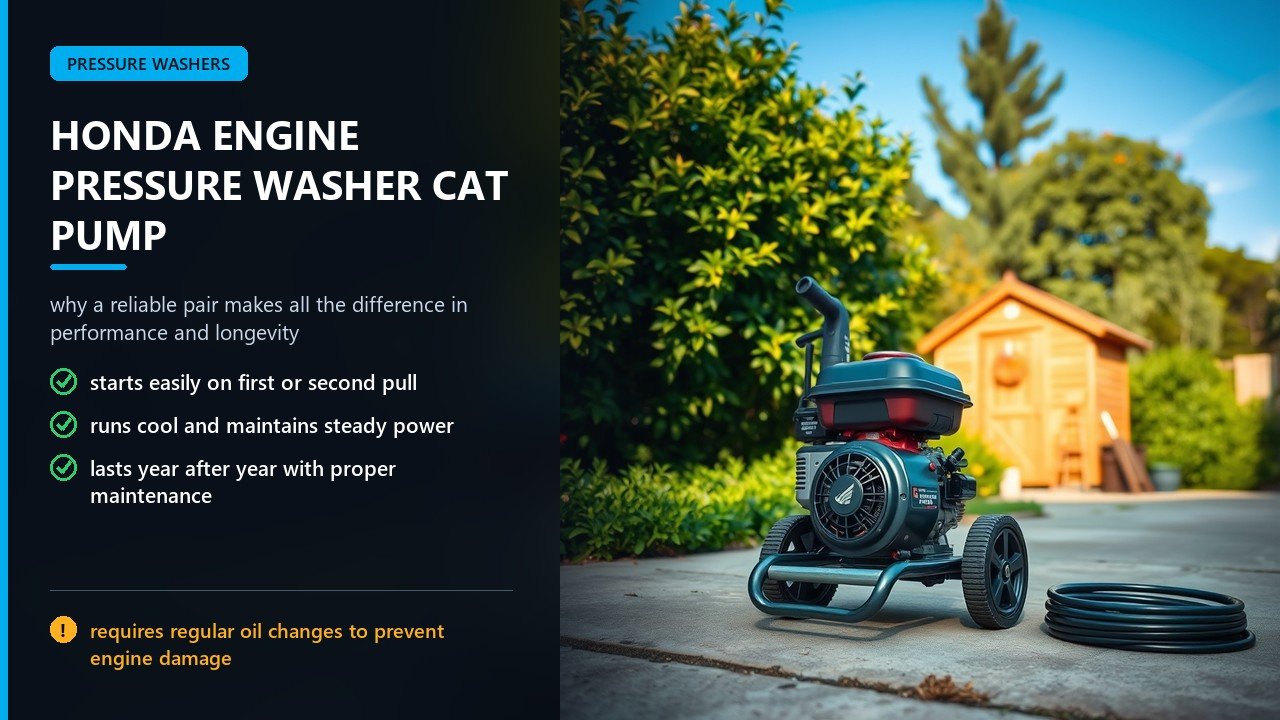
Why the Engine and Pump Decide Everything
A pressure washer is a simple machine at heart, but the quality of its two main components shapes every hour of its working life.
The engine is the machine’s stamina. The engine turns the pump and sets the pace at which the whole machine can work, hour after hour, job after job. A weak or poorly built engine may clean a patio, but put it under continuous commercial use and it will overheat, burn oil, and eventually stop when you can least afford it. A strong, well engineered engine runs cool, starts on the first or second pull even after storage, and keeps its power steady through long sessions. It also determines how much of the pump’s capacity you can actually use, because a pump can only deliver what the engine can drive. For anyone who depends on a pressure washer for income, the engine is not a detail, it is the foundation on which the whole machine’s reliability rests. Choose the engine carelessly, and no pump, however good, will save the machine from early failure and constant annoyance.
The pump is the machine’s heart. If the engine provides stamina, the pump provides the actual cleaning force, and it is the part most exposed to wear. It is the pump that pressurises the water and pushes it through the nozzle, and it is the pump that suffers when water runs dry, when the machine is left running against a closed gun, or when detergent is drawn carelessly. A quality pump tolerates the rough treatment of real work far better than a cheap one, holding its pressure and resisting wear on its seals and valves. When a pressure washer fails, it is far more often the pump than the engine, which is why experienced buyers pay close attention to who made the pump and whether replacement parts are easy to obtain. Get the engine and pump right, and the rest of the machine tends to look after itself. That is the quiet dividend of buying quality in the first place, and it is felt on every single job.
What a Honda Engine Brings to a Pressure Washer
Honda has become the benchmark for small engines on cleaning equipment, and the reasons are practical rather than merely reputational.
Easy starting and steady running. The first thing most owners notice about a honda pressure washer is how readily it starts. Honda’s engine design, fuel systems, and ignition make cold starts dependable, which matters enormously when a machine has sat unused for weeks between jobs. Once running, these engines hold a steady speed that keeps pump pressure consistent, so the cleaning does not surge and fade as the engine labours. They are also famously smooth and quiet for their class, which reduces operator fatigue on long jobs. That consistency translates directly into better cleaning, because a pump fed by a steady engine delivers a stable jet rather than one that weakens under load. For anyone who works regularly, dependable starting and steady running are not luxuries but the difference between a productive day and a frustrating one spent pulling a stubborn cord. A machine that starts and runs reliably lets the operator think about the job rather than about the equipment, and that alone changes the whole working day.
Durability and easy service. Honda engines are built to last, with robust internals and a reputation for running for years with basic care such as clean oil and a fresh air filter. Parts are widely available and well understood, so servicing is straightforward and inexpensive compared with more exotic engines. Fuel economy is another quiet strength, and the engines tolerate the long, hot sessions that commercial cleaning demands without the overheating that plagues cheaper units. The Honda GX series in particular is prized on professional pressure washers for exactly this combination of endurance and easy maintenance. All of this adds up to a machine that spends its time working rather than waiting for repairs, and that reliability is what owners are really paying for when they choose a Honda powered pressure washer for their business or their serious home use. For them, the engine is not a specification on a page but the reason the machine can be trusted to work whenever it is needed.
Why Cat Pump Has Earned Its Reputation
On the pump side of the equation, Cat pumps have earned a following among professionals for good reason.
Engineering built for pressure. Cat pumps are known for the quality of their engineering, from the materials used in the manifold and valves to the precision of the crankcase and bearings. This construction allows them to run at high pressure continuously without the rapid wear that cheaper pumps suffer, and to maintain their rated flow even as they age. A cat pump pressure washer tends to hold its performance far longer, which means the machine keeps doing the work it was bought for rather than slowly fading. The pumps also handle the thermal and pressure stresses of real cleaning work with composure, and they are forgiving of the minor abuses that happen on any busy site. For commercial operators, that durability is worth a great deal, because a pump that lasts for years spreads its cost across thousands of working hours and spares the owner the disruption of constant repair.
Serviceability and long term value. Cat pumps are also known for being serviceable, with seals, valves, and other wear parts available and replaceable, so a pump can be rebuilt rather than thrown away. This matters both financially and environmentally, because it keeps a good machine in service instead of sending it to scrap. The availability of parts and the large body of knowledge around these pumps also mean that a competent owner or local technician can keep them running without difficulty. When you buy a machine with a Cat pump, you are buying into a maintenance culture as much as a component, and that is part of why these pumps hold their reputation across generations of equipment. It is a case where the premium is repaid over and over in reliability and in the confidence that the machine will not let you down at the start of a big job.
Why the Combination Works So Well Together
Matching a Honda engine to a Cat pump is not a marketing trick; it is a genuine pairing of strengths that complement one another and are well matched in capacity as well as reputation.
Power matched to demand. A pump only performs at its best when the engine driving it can supply enough power at the right speed. Honda engines deliver smooth, consistent output that suits the demands of a Cat pump, so the pump receives the steady drive it needs to produce full pressure and flow without strain. Neither component is left working outside its comfort zone, which is exactly the condition in which both last longest. The pairing also tends to be well matched in capacity, with engines chosen to spin the specific pump model efficiently rather than merely adequately. This is why a pressure washer honda motor cat pump setup is often described as balanced: the engine has enough reserve to keep the pump happy, and the pump is not so demanding that it overloads or stalls the engine under load. That balance is the foundation of reliable, long lived performance.
Reliability compounded, not merely added. When two dependable components are combined, the reliability of the whole machine is greater than either alone, because each supports the other and neither becomes the weak link. A Honda engine that starts easily and runs steadily keeps the Cat pump working in its ideal range, and a Cat pump that holds pressure without complaint keeps the load on the engine predictable and moderate. The result is a machine that behaves well on good days and, more importantly, keeps behaving well on the bad days when the job is long, the water is hot, and the schedule is tight. Operators value this compound reliability because it removes a source of stress from their working lives. They are not gambling on whether the machine will start or hold pressure; they simply know it will, and they can focus on the work itself. That freedom from worry is exactly what a professional machine is meant to provide.
Reading Pressure, Flow, and Balance
The numbers on a pressure washer tell you a great deal about how it will perform, but only if you read them together.
Pressure versus flow. Pressure, measured in psi, is the force with which the water leaves the nozzle, and it is what loosens stubborn dirt. Flow, measured in gallons per minute, is the volume of water delivered, and it is what carries loosened soil away and covers ground quickly. A machine with high pressure but low flow cleans a narrow strip slowly, while one with generous flow and adequate pressure cleans broad areas quickly. For commercial work, flow is often the more valuable figure because it decides how many square metres you can clean in an hour. A machine rated around 3500 psi and four to five and a half gallons per minute, such as a pressure washer 5.5 gpm model, represents a serious commercial level of output, and it is a common target for machines built around a Honda engine and a quality pump. Reading pressure and flow side by side is what turns a dry specification into a realistic picture of how a machine will actually perform.
Cleaning units and honest ratings. Multiplying pressure by flow gives cleaning units, a single figure that lets you compare machines fairly, because it captures both the force and the volume of water. A machine with modest pressure but generous flow can outclean one with high pressure and a thin stream, and the cleaning unit figure makes that visible. It is also worth being sceptical of inflated claims, since pressure ratings can be quoted at the pump or at the nozzle, and those two numbers are not the same. A pump mounted pressure gauge tells you what the pump produces, while the effective cleaning pressure at the nozzle may be lower because of losses in the hose, fittings, and gun. When comparing machines built around a Honda engine and a good pump, a sensible specification and a truthful rating are signs of a manufacturer that respects its customers. That kind of honesty is well worth seeking out when you compare one machine against another.
Belt Drive, Direct Drive, and Pump Types
How the engine connects to the pump, and which pump design is fitted, both affect how the machine performs and how long it lasts.
Direct drive versus belt drive. In a direct drive machine, the pump bolts straight to the engine and spins at the same speed, which makes the setup compact and inexpensive. It is fine for occasional use but tends to run the pump hard, since the pump turns fast and receives little protection from vibration and heat. A belt drive pressure washer places a belt and pulley between the engine and pump, letting the pump run slower and cooler, isolating it from engine vibration, and allowing a choice of gearing. The result is a quieter, longer lived machine that many professionals prefer, particularly with high flow pumps that benefit from running at lower speed. Belt drives cost more and need occasional belt maintenance, but for commercial work the gain in durability and smoothness usually justifies the extra outlay and care. The extra attention a belt drive demands is repaid across the long working life of the machine.
Plunger pump design and its benefits. The pumps found on serious machines, including Cat models, are usually plunger pumps with ceramic plungers and quality seals, and that design is what enables reliable high pressure performance. Plunger pumps tolerate continuous duty well, handle high pressure without rapid wear, and can be rebuilt when parts eventually wear. They are generally more efficient and longer lived than the cheaper axial pumps often found on light machines, which are not intended for sustained commercial pressure. Knowing which pump design is fitted helps you judge a machine honestly, because a good plunger pump paired with a capable engine is the recipe for a tool that keeps working. When the specification lists a trusted plunger pump and a Honda engine, you are looking at a machine designed for real, ongoing work rather than occasional weekend use. A quick glance at the pump type tells you at once whether the manufacturer built the machine to last.
Choosing the Right Machine
With the theory understood, the practical question is how to choose a machine built around a Honda engine and a Cat pump, since the pairing sets the tone for everything the machine does and how reliably it will serve you.
Match the specification to the work. Start with the jobs you actually do, and let them set the pressure, flow, and duty cycle you need, rather than buying on a headline number. For residential work, a moderate machine may be enough, but for commercial cleaning, a commercial pressure washer of around 3500 psi with high flow is the sensible target, and heat should be added if oil and grease feature in the work. Consider whether the machine will run for hours at a time, because that decides whether you need the durability of a belt drive and a premium pump. Confirm that the engine is a genuine Honda rather than a lookalike, and that the pump is a real Cat or another equally reputable brand, since parts and rebuild kits depend on that being true. A little care in matching the machine to the work prevents both overspending and the frustration of an underpowered tool.
Check the details that signal quality. Beyond the headline engine and pump, the surrounding details tell you whether a machine is built to last. Look for a sturdy frame that protects the pump and engine, quality hoses and fittings, a proper unloader valve, a reliable thermal relief system, and a detergent system that works without risking the pump. Consider the ease of servicing, since a machine that is hard to maintain will not be maintained. Good pressure washer hose reels and quality couplers are small signs of an outfit that respects the whole assembly. Check that the pump can be rebuilt and that parts are available locally or readily shipped. These details distinguish a well made pressure washer honda motor cat pump machine from one that merely carries famous names on its spec sheet while cutting corners everywhere else. The famous names should sit on top of genuine quality, not stand in for it.
Maintenance That Keeps It Running
Even the best combination needs sensible care, and a little routine maintenance is what turns a good machine into a long lived one, and neglect is what shortens its life, often far sooner than the owner expected.
The engine’s simple needs. A Honda engine asks very little in return for its reliability. Check and change the oil at the recommended intervals, keep the air filter clean, use fresh fuel and store the machine properly between seasons, and the engine will start and run dependably for years. Spark plugs and fuel filters are cheap and easy to replace, and keeping the cooling fins clear prevents the overheating that shortens engine life. Avoid leaving stale fuel in the tank during long idle periods, since modern fuel can degrade and clog the carburettor. None of this is difficult, and all of it is far cheaper than repairing or replacing an engine that was neglected. Treat the engine as you would any good small engine and it will reward you with dependable starting and steady power whenever you pull the cord. That reliability is the whole point of choosing a Honda engine in the first place.
The pump’s critical needs. The pump deserves even closer attention, because running it dry or letting it overheat can destroy it in moments. Always ensure a steady water supply before starting, never let the machine run for long without the trigger pulled, and use the thermal relief feature as it was designed. Keep the oil in an oil bath pump at the correct level and change it as recommended, and check the inlet filter so grit never reaches the pump internals. Use nozzles sized correctly for the machine, since an oversized tip can overstress the pump. Watch for drips from the seals and deal with small leaks before they become failures. These habits cost almost nothing and are the difference between a pump that lasts a decade and one that is ruined within a season of careless use. A few simple habits are all that stand between a long lived pump and an expensive early failure.
Cost, Value, and Long Term Sense
The price of a machine with a Honda engine and a Cat pump can look high at first glance, but the value becomes clear over its working life and in the hours it saves.
Why the premium pays off. A cheaper pressure washer may cost less on the day you buy it, but the calculation changes once it is in use. A machine built around a quality engine and pump works faster, breaks down less, and lasts far longer, so its cost per working hour is often lower than that of a bargain that fails and is replaced. Downtime has a cost too, in lost jobs and unhappy clients, and that is the hidden expense of unreliable equipment. Servicing and parts for trusted components are widely available and reasonably priced, so the machine can be kept going without drama. The premium you pay up front is really a payment towards years of dependable work, and for anyone who relies on a pressure washer to earn a living, that is usually the cheaper choice in the end. The machine that works every day is almost always cheaper than the one that keeps stopping.
Resale and rebuild potential. Another quiet advantage of a well specified machine is that it holds value. Because Honda engines and Cat pumps are recognised and respected, a clean used machine of this kind sells for a meaningful price rather than being worthless once it is no longer new. Better still, it can be rebuilt and kept in service, so its useful life is measured in decades rather than seasons. That combination of resale value and rebuildability turns the machine into an asset rather than a consumable. When you weigh a pressure washer honda motor cat pump machine against a cheaper alternative, include this residual value in the comparison. The gap in total cost of ownership is usually much narrower than the sticker prices suggest, and it often tips clearly in favour of the better built machine. Weigh the whole picture, and the better machine usually wins on both money and peace of mind.
Honda Versus Other Engine Brands
Honda is not the only engine maker in the pressure washer market, and knowing how the alternatives compare helps you judge whether a particular machine is right for the work you do.
How the major brands compare. Several engine brands appear regularly on pressure washers, and each has its own character. Honda offers the widest spread of models, from light engines for home machines to the rugged GX series that dominates professional equipment, and it is prized above all for easy starting and long life. Kohler engines are strong and smooth, often found on mid range and commercial machines, and they hold their own on endurance. Briggs and Stratton engines are extremely common, affordable, and easy to service, which makes them a sensible choice for occasional or light commercial use where budget matters. Some Chinese built engines now offer reasonable value but vary widely in quality, so the brand alone is not enough to judge them. The table below sets out the broad picture, though the exact model matters as much as the name on the recoil starter. Compare the specification of the specific engine, not just the badge, before you decide.
| Engine Brand | Main Strength | Best Suited To |
|---|---|---|
| Honda GX | Easy starting and long life | Regular commercial work |
| Honda GC | Lighter and quieter | Home and light use |
| Kohler | Smooth, strong mid range | Mixed and semi commercial |
| Briggs and Stratton | Affordable and common | Occasional use |
| Generic engines | Low purchase price | Light, infrequent tasks |
Why Honda still leads for many. Despite strong competition, Honda remains the engine that most experienced operators reach for, and for practical reasons. The GX series has a reputation for starting after long storage, holding a steady speed under load, and running for years with only basic servicing, and that consistency is exactly what commercial work demands. Parts and knowledge are everywhere, so repairs are simple and inexpensive, and the engines hold their value on the used market. For a honda pressure washer that will be used hard and often, the premium for a genuine Honda engine is easily justified by the reduced downtime. Other brands can serve well within their limits, but when a machine must simply start and run, every single day, more professionals trust Honda than any other name. That trust was earned over decades of hard work in the field, not handed out by advertising. In this class of equipment, reputation follows performance, and Honda’s has been built one dependable machine at a time.
Common Mistakes That Damage a Pump
Most premature pump failures are not the fault of the pump itself but of a handful of avoidable habits that owners fall into, often without realising the damage they are doing until the pump is already failing.
Running dry and overheating. The single most destructive mistake is running the pump without a proper water supply, even briefly. Pump internals rely on water for both function and cooling, and running dry can score the plungers and destroy the seals within seconds. A related error is leaving the machine running for long periods with the trigger released and no flow, which lets the trapped water heat up until it damages the pump, a problem a thermal relief valve is fitted to prevent. Starting the engine before the water is connected, or letting a tank run empty mid job, are classic causes of sudden pump death. The remedy is simple discipline: connect and check water first, keep an eye on the supply, and never let the machine idle in a stalled, sealed condition for long. These small habits protect the pump far more effectively than any emergency repair ever could. Discipline costs nothing and saves everything.
Wrong nozzles and plain neglect. Even with water flowing, careless choices can shorten pump life. Fitting a nozzle that is too small drives pressure above the pump’s rating and strains every internal part, while a nozzle that is too large, or a worn general pump tip that no longer matches the pump, wastes flow and can cause the pump to cycle badly. Letting grit reach the pump by ignoring the inlet filter scratches the plungers and rapidly wears the seals. Neglecting the pump oil in an oil bath model, or leaving water in the pump to freeze over winter, are further common causes of failure. Together these habits, all cheap to avoid, account for a large share of the pumps that fail early. Treat the pump as the precision component it is, and it will outlast several sets of hoses, guns, and wands. Good habits around the pump are the cheapest insurance a pressure washer owner can buy.
Water Supply, Unloader Valves, and Nozzles
Around the engine and pump sits a small system of parts that decide how well the machine behaves and how long it survives, so they are worth understanding before anything goes wrong on a job, and before a small fault turns into a large one.
Feeding the pump properly. A pressure washer can only work as well as the water it receives, so the supply deserves careful attention. The flow from the tap or tank must exceed the machine’s rated output with margin to spare, or the pump will cavitate and lose pressure. The inlet hose should be short and wide enough to avoid restrictions, with a clean strainer to keep grit out, and a buffer tank is wise on commercial work where supply is uncertain. Water temperature and quality also matter, since very hot or dirty water can shorten pump and seal life. Checking supply before every session prevents the dry running that ruins pumps, and it keeps performance consistent. A generous, clean, reliable feed is the foundation on which the whole machine performs, and it is the easiest thing in the world to overlook until a job is already underway and the pump begins to complain.
The unloader, the relief valve, and the tips. The unloader valve is the part that lets the pump idle safely when the trigger is released, bypassing water instead of building pressure against a closed gun. A correctly set unloader protects the pump and gives smooth pressure at the nozzle, while a badly adjusted or failing one causes surging or dangerous overpressure. The thermal relief valve is a safety feature that releases hot water if the machine is left idling, and it should never be blocked or removed. Nozzles, too, are part of this system, and the right tip for each job keeps pressure within safe limits while matching the spray to the surface. Quality couplers and a good hose protect the flow between these parts. Together they form the plumbing that connects a fine engine and pump to the actual cleaning work, and each deserves the same attention as the headline components.
Frequently Asked Questions
Is a Honda engine really worth the extra cost? For regular or commercial use, yes. A genuine Honda engine starts more reliably, holds a steadier speed under load, and lasts longer than cheaper alternatives, which reduces downtime and frustration. For occasional home use, the premium may be harder to justify, and a good budget engine can serve perfectly well. The right answer depends on how hard and how often the machine will work, so be honest about that before deciding. If the machine will earn you money or run for hours every week, the Honda premium is quickly repaid in fewer breakdowns and less frustration. If it will sit in a shed until the odd sunny weekend, a good budget engine is a more sensible use of money, and there is no shame in that choice. The key is to match the engine to the real workload rather than to an aspiration, because an engine that suits the job will always give better value than one that is either over or under specified.
What is a Cat pump and why does it matter? Cat is a manufacturer of high quality plunger pumps, the component that actually builds the water pressure. A genuine Cat pump holds pressure well, tolerates continuous commercial duty, and can be rebuilt with replacement seals and valves rather than being thrown away. Because pumps are the part most likely to fail, choosing a machine with a trusted pump is one of the most effective ways to ensure a long, dependable working life. A trusted pump, correctly fed and maintained, will outlast the engine it is bolted to in most cases, and it can be rebuilt when the time comes rather than discarded. That combination of performance and rebuildability is what makes a genuine pump worth insisting upon. It is one of the few components where the difference between a good one and a cheap one is felt for years rather than merely noticed on the invoice. That is why experienced operators rarely compromise on the pump.
Should I choose direct drive or belt drive? Direct drive is cheaper, more compact, and fine for occasional use, but it runs the pump fast and hot. Belt drive places a belt between engine and pump, letting the pump run slower and cooler and isolating it from vibration, which suits commercial work and high flow pumps. Belt drives cost more and need occasional belt attention, but the smoother, longer lasting performance usually makes them the better choice for anyone working regularly. If your machine runs for hours on end, or you rely on it for income, the belt drive’s smoother and cooler running will pay back the extra cost many times over. For light, occasional use, a direct drive machine remains a perfectly sensible and economical option. Belt drive is not essential for every owner, but for anyone whose machine works hard every week, it is one of the smartest upgrades available. The smoother, cooler running repays the modest extra cost on every long session.
How long will a Honda and Cat pump machine last? With sensible maintenance, a well specified machine can last many years, often a decade or more. The engine and pump are both rebuildable, so the machine can be kept in service rather than replaced, with seals, valves, and other wear parts renewed as needed. The biggest threats are running the pump dry, letting it overheat, and neglecting the oil, so good habits are what unlock that long life. Keep the pump fed and cool, change its oil, use the right nozzles, and store the machine properly over winter, and you can reasonably expect many years of dependable service from a machine built around these well proven components. Most premature failures come from a handful of avoidable mistakes, so simply avoiding those mistakes can add many productive years to the machine’s life. Treated kindly, these machines have a habit of outliving expectations.
What pressure and flow should I look for? Match the figures to your work rather than to a headline number. For commercial cleaning, around 3500 psi with high flow is a sensible target, and heat should be added if oil and grease are common. For lighter home use, lower figures are perfectly adequate. Reading pressure and flow together, rather than trusting a single number, gives the truest picture of how a machine will perform. Higher flow cleans large areas faster, while higher pressure helps with stubborn dirt, so balance the two against the jobs you expect to do. A machine that is well matched to your actual work will always outperform one that simply advertises the biggest number. Match the figures to the work, keep a little margin, and the machine will feel powerful rather than merely loud on every job, and it will keep that feeling for years to come on job after job.
Final Thoughts
The reputation of a pressure washer honda motor cat pump combination rests on something simple and honest: when you pair a dependable engine with a well engineered pump, you get a machine that starts easily, holds its pressure, and keeps working long after cheaper equipment has given up. The Honda engine supplies smooth, steady power and easy starting, the Cat pump converts that power into reliable cleaning performance, and the two together produce a tool that professionals trust on the jobs that matter. Understanding pressure, flow, and the difference between direct and belt drive helps you choose the right machine, and sensible maintenance keeps it in service for years. Get the components right, respect the pump, and feed it clean water, and you will spend your time working rather than repairing. That simple formula is why so many professionals settle on this combination and stay with it for the whole of a working life. It is not a passing trend but a durable, practical answer to the question of what a pressure washer should be.
Buy the combination and look after it. Match the specification to the work you actually do, insist on genuine components, and check the details that signal quality rather than trusting a famous name alone. Then treat the engine and, above all, the pump with the care they deserve, and the machine will repay you with steady, dependable cleaning season after season. A pressure washer built this way is not just a purchase but an investment, and the reliability it delivers is the real reason experienced operators keep coming back to this engine and this pump. Buy well, maintain carefully, and the combination will keep proving its worth on every job you take on. Buy for the work you really do, respect the two components that matter most, and the machine will keep earning its keep for years to come. Buy with the long term in mind, and the combination will quietly prove that good engineering is worth every penny.
To explore machines and accessories that pair well with quality components, see our guide to pressure washer trailers and equipment.