When Angela’s old pressure washer finally quit after a decade, she set one rule for its replacement: it had to be quiet enough to use on a Sunday morning without waking the neighborhood, and it had to be ready to work within a minute of her deciding to clean. She did not want to mix gas, pull a starter rope, or listen to a small engine roar for two hours. But she also did not want a toy. What she found in the DeWalt 2800 PSI pressure washer was an interesting middle path: a serious machine that skips the gasoline. The current DeWalt 2800 is a corded electric unit that pairs a brushless induction motor with a professional axial cam pump, and it sits at the top of what a standard household outlet can feed. This guide explains the DeWalt 2800 line, what the electric and gas versions really deliver, what 2800 PSI at low flow means in the real world, and how to decide whether this is the right machine for your driveway, siding, and car.
The name “DeWalt 2800 PSI” can point to more than one machine, because DeWalt has sold a well-regarded gas model at that pressure in the past and now sells an electric one. Both are worth understanding, but the current flagship is the DXPW2800E electric washer. Let us break down the lineup, the specs that matter, the features that make it easy to live with, and the honest limits you should know before you buy.
The DeWalt 2800 Line: Electric and Gas
DeWalt’s pressure washer catalog spans electric and gas machines, and the 2800 number appears in more than one place. Understanding the two paths helps you avoid buying the wrong tool.
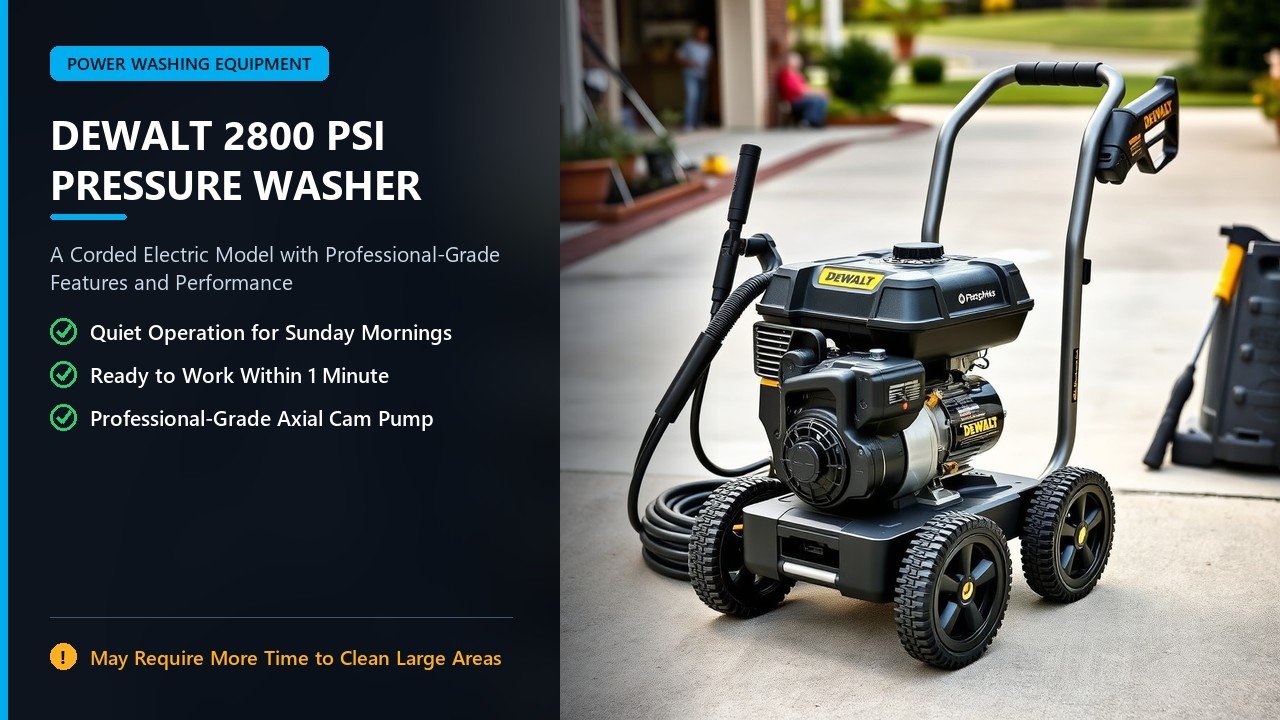
The electric DXPW2800E. This is the machine most shoppers mean today. It runs on a standard 120V household outlet, delivers 2800 PSI at 1.0 GPM, and uses a 120V brushless induction motor paired with a professional axial cam pump rated for about 500 hours of runtime. It has a built-in soap tank, a 35-foot kink-resistant hose, four quick-connect nozzles, never-flat wheels, and a GFCI plug. It carries a three-year limited warranty covering the motor, pump, and frame. The DeWalt product page lists the full feature set.
The legacy gas DP2800. Older DeWalt gas units at this pressure, such as the DP2800, used a CAT triplex pump and a Honda GX engine and delivered around 2800 PSI at roughly 2.3 GPM. Owners prized them for the Honda engine and the rebuildable CAT pump, and you still see these on the used market. The gas machine flows more than twice the water of the electric version, which makes it dramatically faster on big, dirty surfaces.
The step-up gas machines. If you want gas today, DeWalt’s current lineup moves up to 3200, 3600, 3800, 4000, 4200, and 4400 PSI models, many with Honda engines and CAT or AAA triplex pumps. The 3200 PSI Honda GX200 with CAT pump is the natural first gas step, delivering 2.8 GPM.
The DXPW2800E Electric in Detail
If you are comparing the electric DeWalt 2800 to anything else, these are the numbers and features that define it.
Pressure and flow. 2800 PSI at 1.0 GPM. That pressure is high for a 120V electric washer, but the flow is modest. The combination matters more than either number alone, which we will unpack shortly.
Motor. A 120V, 60 Hz brushless induction motor. Unlike the universal motors in most electric washers, an induction motor is smoother, quieter, and longer-lived, with no brushes to wear out. It draws close to 15 amps under load, so a dedicated circuit is ideal.
Pump. A professional axial cam pump rated for roughly 500 hours. Axial cam pumps are simpler and lower-maintenance than triplex pumps, and this one is a step above the sealed pumps found in budget electrics.
Reach and convenience. A 35-foot high-pressure hose plus a 35-foot power cord gives about 70 feet of working radius before you move the machine. Four quick-connect nozzles (0, 15, and 40 degrees plus a low-pressure soap tip), a built-in detergent tank, and never-flat 7.5-inch wheels round out a user-friendly package.
| Model | PSI | GPM | Power | Pump | Best For |
|---|---|---|---|---|---|
| DXPW2800E (electric) | 2800 | 1.0 | Brushless induction | Axial cam | Quiet home cleaning, cars, siding |
| DP2800 (legacy gas) | 2800 | ~2.3 | Honda GX gas | CAT triplex | Faster concrete and large areas |
| DXPW60603 (gas) | 3200 | 2.8 | Honda GX200 gas | CAT triplex | Speed and heavy-duty concrete |
What 2800 PSI at 1.0 GPM Really Means
Marketing loves big pressure numbers, but pressure alone does not clean. Cleaning power is the product of pressure and flow, and the flow number tells the honest story of how fast a machine works.
Cleaning units. Multiply PSI by GPM and you get a rough “cleaning units” figure. The DeWalt 2800 electric lands around 2800 cleaning units; the 3200 gas model, at 3200 PSI and 2.8 GPM, lands near 8960. That gap explains why the gas machine moves across a dirty driveway far faster: it is flushing roughly three times the water per minute.
High pressure, low flow. The electric DeWalt has real bite at the nozzle, because 2800 PSI is serious, but it flushes slowly. On a car or a section of siding, that is fine; on a large, grimy concrete slab, you will notice the slower pace. A helpful review at Toolstash makes the same point: against a 2.3 to 2.5 GPM gas machine, the electric unit cleans more slowly even though the spray has good pressure.
The trade-off you are buying. In exchange for slower coverage, you get quiet operation, no gas or fumes, no engine maintenance, one-button start, and a machine that stores upright in a garage corner. For a homeowner doing routine cleaning, that trade is often worth it. For someone restoring a neglected commercial parking lot, it is not. Our explanation of why GPM matters as much as PSI dives into the underlying physics.
Features That Make It Easy to Live With
The reason the DeWalt 2800 electric appeals to careful buyers is not the pressure rating alone; it is the quality-of-life features that reduce the friction of owning and running a pressure washer.
Quiet induction motor. DeWalt states the unit runs with substantially lower noise than gas models, and the smooth induction motor transmits little vibration to the wand. You can work near the house in the early morning without annoying the household, and you can talk over the machine while using it.
Low maintenance. There is no gas to mix, no spark plug, no carburetor, and no engine oil changes. The only consumables are the pump lubricant and the usual o-rings and nozzle care, which keeps ownership simple.
Built-in soap tank and nozzle set. The integrated detergent tank lets you apply soap through the low-pressure nozzle without a separate bottle, and the four quick-connect tips cover every common job. The included nozzle chart guides you toward the 40-degree tip for cars and the 15- or 0-degree tips for concrete.
Safety and reach. The GFCI plug protects you from shock around water, the trigger has a lock, and the long hose and cord mean fewer repositioning trips. These are the small things that make a machine pleasant rather than merely capable.
What the DeWalt 2800 Cleans Well
Match the machine to the job and it performs admirably across the routine cleaning most homeowners actually do.
Cars and trucks. Rinse with the 40-degree tip, foam with the soap tank, and rinse again. The 35-foot hose and gentle 40-degree fan make car washing comfortable, and the quiet motor suits a weekend detailing routine.
Siding and gutters. Vinyl and painted siding clean safely with a wide tip and detergent. The machine has enough pressure to strip pollen, dirt, and light mildew, and the low flow actually reduces the risk of driving water behind the panels.
Decks, patios, and furniture. Composite decks, concrete patios, and outdoor furniture clean quickly. For wood, use a wide tip and a deck cleaner rather than a tight nozzle.
Light to moderate concrete. Sidewalks, small driveways, and garage floors with normal dirt come clean with patience and the right tip. For heavily stained, large concrete, the low flow makes the job slow, and that is where a gas machine earns its keep.
Nozzle Guide for the DeWalt 2800
DeWalt ships a nozzle chart with this machine because picking the right tip is the fastest way to protect surfaces and get clean results. The table below translates the colors and angles into plain-English uses.
| Nozzle | Angle | Best Surfaces | Watch Out For |
|---|---|---|---|
| Red | 0 degrees | Concrete, brick, rust, oil spots | Never on wood, paint, or vehicles |
| Yellow | 15 degrees | Siding, patios, decks, garage floors | Use caution on soft wood |
| White | 40 degrees | Cars, furniture, general rinse | The safe default for delicate work |
| Black | Soap (low pressure) | Applying detergent | Cannot clean; soap only |
The practical rule is the same one that applies to every pressure washer: start with the widest tip that does the job and only step tighter when a hard, unpainted surface demands more bite. Our guide to pressure washer nozzle colors explains the whole system if you want to go deeper.
How the DeWalt 2800 Compares to Rival Machines
Buying decisions are easier with a little context. Here is how the DeWalt 2800 electric stacks up against the two alternatives shoppers usually weigh.
Against budget electric washers. Many entry-level electric units use universal motors and sealed pumps, with 1600 to 2000 PSI and limited serviceability. The DeWalt 2800 jumps ahead with a brushless induction motor, a serviceable axial cam pump rated for hundreds of hours, higher pressure, a longer hose, and a stronger warranty. It costs more, and it is worth it for anyone who wants the machine to last.
Against a small gas machine. A budget gas washer around 2800 PSI will flow far more water, often 2.3 GPM and up, and it will clean large, dirty surfaces much faster. It will also be louder, need fuel and oil, require more maintenance, and emit fumes. If you value convenience and quiet, the electric wins; if you value raw speed and flow, the gas wins.
Against the DeWalt 3200 gas. Within DeWalt’s own lineup, the 3200 PSI Honda GX200 with a CAT triplex pump is the performance upgrade. It triples the cleaning-unit figure and adds a rebuildable commercial pump and a five-year pump warranty. It is the machine to choose if your work is heavy or you want one tool that does it all, at the cost of noise, fuel, and upkeep.
The deciding question. Ask yourself two things: how much water flow does my typical job need, and how much do I care about convenience? If the answers are “not a lot” and “a great deal,” the electric 2800 fits perfectly. If the answers are “as much as possible” and “I will put up with gas,” the gas 3200 is the better tool.
Parts, Support, and Accessories
DeWalt’s biggest practical advantage is its support network. Replacement parts, nozzles, hoses, guns, lances, and o-rings are widely available through DeWalt, large retailers, and authorized service centers, so a worn component rarely means a new machine.
Warranty coverage. The electric 2800 carries a three-year limited warranty on the motor, pump, and frame, which is generous for the class. DeWalt’s gas machines extend coverage further, including multi-year engine, pump, and frame warranties on the premium models.
Common replacement items. The parts that wear first on any pressure washer are o-rings, nozzles, and the high-pressure hose. All are inexpensive and easy to swap. If you notice weak pressure, check the nozzle and o-rings before suspecting the pump, because those are the usual culprits and the cheapest fixes.
Useful add-ons. A foam cannon for car washing, a longer hose for reach, an inlet filter to protect the pump from grit, and a pump protector for winter storage are the accessories that pay off. Keep a spare set of o-rings on hand, and this machine will stay leak-free for years.
Where the DeWalt 2800 Reaches Its Limits
Honesty about limits is what separates a good buying decision from a regret. The electric 2800 is a residential machine, and a few jobs are beyond it.
Large, heavily soiled concrete. The 1.0 GPM flow makes wide, dirty slabs slow work. Stripping paint, restoring neglected driveways, and high-production flatwork belong to a high-flow gas machine. A surface cleaner attachment also needs more flow than this unit can supply to spin properly, so it is not the right pairing for serious flatwork.
Commercial, all-day use. The pump life and the household circuit limit make this a residential tool. Running it for hours on commercial accounts will wear it out faster than the warranty intends.
Cold water only. Like most consumer machines, it is cold water only. Grease and heavy oil respond far better to hot water, which is a different class of equipment.
Electrical constraints. At near 15 amps, it sits at the edge of a standard 120V, 15-amp circuit. A dedicated outlet is best, and if you must extend, use a short, heavy 12-gauge cord, because the manual and DeWalt both advise against cheap extension cords that defeat the GFCI and risk shock.
Setting Up and Using the DeWalt 2800
A few setup habits get the electric 2800 running smoothly and keep the pump healthy.
Assemble and connect. Attach the handle and accessory holders, connect the high-pressure hose to the machine outlet and to the gun, and thread the garden hose onto the inlet. Turn the water on fully before powering up; supplying a machine with too little inlet flow starves the pump and causes pulsing.
Bleed the air. With the machine off, point the gun in a safe direction, release the trigger lock, and squeeze until a steady stream flows. This purges trapped air before you start the motor.
Start and work in order. Flip the power switch on, then squeeze the trigger fully. Apply detergent to a dry surface with the soap tip, working bottom to top on walls to avoid streaks, let it dwell, then rinse top to bottom with a high-pressure tip. Keep the nozzle moving, and never let the unit run without water.
Shut down properly. Turn off the power, unplug the GFCI, turn off the water, pull the trigger two or three times to release pressure, and disconnect the garden hose. Never let the pump run dry for more than a minute, and avoid letting the machine idle in bypass for long stretches, which heats the pump.
Maintenance That Protects Your Investment
Even a low-maintenance electric washer needs some care, and the two killers of electric pumps are freezing and clogged nozzles.
Protect the pump from freezing. Water expands when it freezes and will crack the pump. Store the machine indoors in winter, or run a pump protector through it before storage. Our guide to how to winterize a pressure washer covers the full routine.
Clean the nozzles. A partially clogged nozzle causes weak, erratic, or pulsating spray. Use the included nozzle cleaning tool or a straightened paper clip to clear it, and back-flush with a garden hose.
Care for the o-rings. Keep the o-rings at hose and nozzle connections clean and lightly lubricated with a non-water-soluble grease, and replace them when they flatten or crack. Moisture and drying out are their enemies.
Check the inlet filter and pump oil. Keep the inlet screen clean so grit does not reach the pump, and if your manual calls for pump oil service, use the specified non-detergent pump oil. Our article on what oil a pressure washer uses explains the difference between engine and pump oil.
Quick troubleshooting. If the machine pulses or loses pressure, the usual cause is a clogged or worn nozzle, so clean or replace it first. If the spray weakens only at long hose runs, check for kinks and confirm the inlet supply is full and free-flowing. If the motor will not start and the GFCI has tripped, reset it and confirm the outlet is grounded; if it trips repeatedly, stop and have the unit serviced. If the machine runs but produces no pressure at all, ensure the water supply is fully on and the air is bled from the line. Most complaints trace back to a simple nozzle or o-ring issue rather than a failed pump, which is one more reason to keep spare tips and seals on hand.
Is the DeWalt 2800 PSI Pressure Washer Right for You
The DeWalt 2800 PSI pressure washer is an excellent fit if you value quiet operation, quick setup, low maintenance, and a proven brand with strong support, and your work is mostly cars, siding, decks, patios, and light concrete. The brushless induction motor, the professional axial cam pump, the long hose, and the three-year warranty make it a thoughtful, civilized machine that punches above its weight in pressure.
It is the wrong machine if your priority is speed on large, heavily soiled concrete or commercial flatwork. There, the low 1.0 GPM flow and the household electrical limit cap its usefulness, and a gas machine such as the 3200 PSI Honda-powered model is the honest choice. Buy for the work you actually do, not the number on the box.
Frequently Asked Questions
Is the DeWalt 2800 PSI pressure washer gas or electric? The current model, the DXPW2800E, is corded electric and runs on a standard 120V outlet. DeWalt also sold gas machines at this pressure in the past, and its current gas line starts around 3200 PSI.
How many GPM does the DeWalt 2800 electric produce? 1.0 GPM at 2800 PSI. The low flow is the main reason it cleans more slowly than a gas machine on large surfaces.
Can the DeWalt 2800 use a surface cleaner attachment? Most surface cleaners need substantially more flow than 1.0 GPM to spin correctly, so this machine is not well suited to a full-size surface cleaner. A small cleaner may work, but performance will be modest.
What nozzles come with the DeWalt DXPW2800E? Four quick-connect nozzles: 0, 15, and 40 degrees plus a low-pressure soap tip. Use the 40-degree for cars and siding, and the tighter tips for concrete and stains.
Does the DeWalt 2800 require engine oil changes? No, because it has no engine. It has an electric motor and a pump; follow the manual for pump care and any specified pump lubricant.
How long is the hose and cord? The high-pressure hose is about 35 feet and the power cord is about 35 feet, giving roughly 70 feet of total reach.
What is the warranty on the DeWalt 2800 electric? A three-year limited warranty covering the motor, pump, and frame.
Can I run it on an extension cord? DeWalt advises against extension cords because they defeat the GFCI and raise electrical risk. If you must, use a short, heavy-gauge cord.
Is the DeWalt 2800 electric as powerful as a gas 2800? No in practice. Both may read 2800 PSI, but a gas unit at that pressure typically flows 2.3 GPM or more, versus 1.0 GPM for the electric. The gas machine cleans large surfaces much faster, while the electric wins on noise, convenience, and maintenance.
What is the difference between the DXPW2800E and the older DP2800? The DXPW2800E is a modern corded electric washer with an induction motor and axial cam pump. The DP2800 was a gas unit with a Honda engine and CAT triplex pump. They share a pressure rating but are very different machines.
Final Thoughts on the DeWalt 2800 PSI Pressure Washer
The DeWalt 2800 PSI pressure washer is a reminder that a pressure washer does not have to be loud or complicated to be capable. With a brushless induction motor, a professional axial cam pump, a long hose, and a built-in soap tank, the electric DXPW2800E turns routine cleaning into something quick to start and easy to live with. Its 2800 PSI gives it real cleaning bite, and its 1.0 GPM sets a realistic ceiling on how fast it moves across big, dirty surfaces.
Angela chose the quiet path, and for the cars, siding, and patio work she actually does, the electrical machine is the right answer. If your jobs lean toward large, caked concrete, choose the gas 3200 instead and accept the noise and upkeep. Buy for the cleaning you do most, treat the pump kindly by keeping it from freezing, and the DeWalt 2800 will reward you with years of quiet, dependable service, one Sunday drive clean at a time.