A pressure washing contractor named Dana went through three budget machines in two seasons. Each one ran fine for a few months, then the engine grew hard to start or the pump began to leak, and each repair cost enough that buying another cheap unit made more sense than fixing the old one. She was throwing money at replacements instead of building a business. Then she bought a pressure washer with a Honda motor and a Cat pump, and the pattern changed. The machine started on the first pull every morning, the pump held its pressure season after season, and when parts finally wore, they were standard and cheap to swap. Five years later her competitor was on unit number six, and Dana still had her original machine, rebuilt once, still earning.
The pairing of a Honda engine and a Cat pump is one of the most respected combinations in pressure washing, and for good reason. Honda engines are known for easy starts and long life, and Cat pumps are known for holding pressure and being rebuildable instead of disposable. Together they form a machine that costs more up front and far less over time. This guide explains what each component brings, why the combination works, how to match engine size to pump output, where this setup is worth the premium, and how to maintain it so it outlasts the budget machines by years.
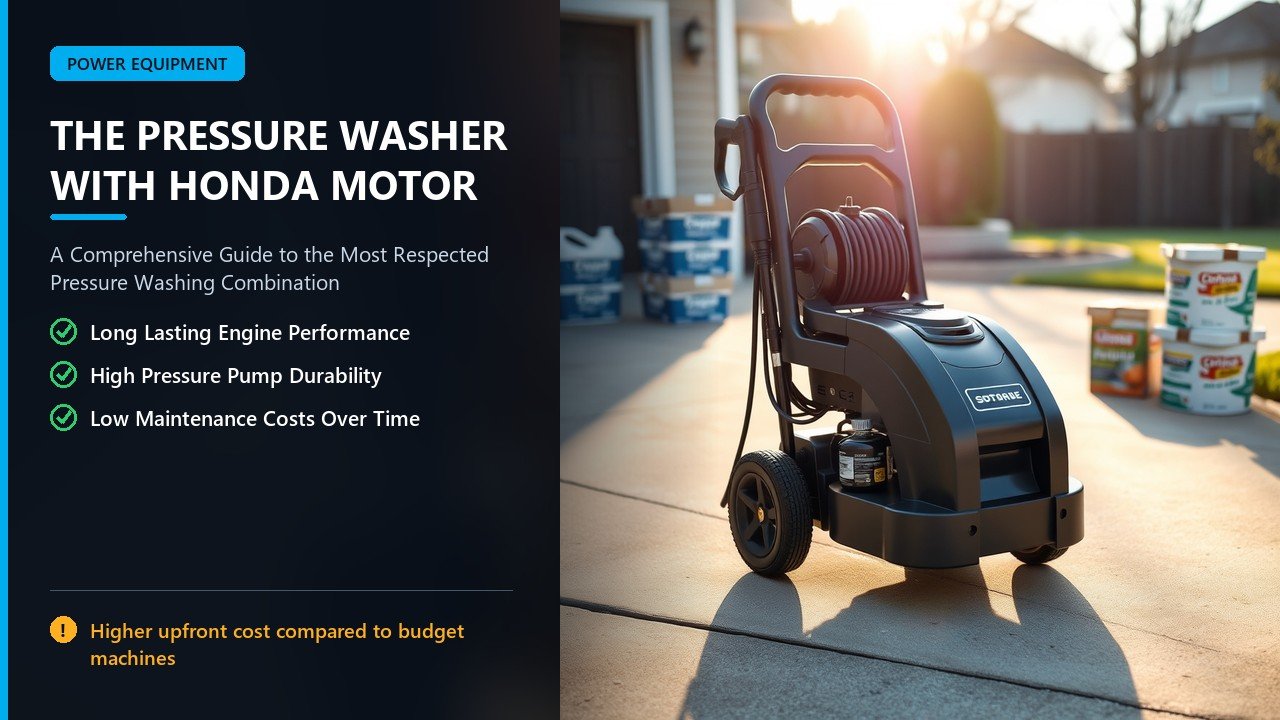
What the Honda Motor and Cat Pump Combination Means
Understanding the two halves explains why this combination commands a premium. The engine and the pump do different jobs, and each is judged by different standards.
The engine provides the power. It spins a shaft that drives the pump. The engine must start reliably, run smoothly under load, and hold up to hours of use. Honda engines, particularly the GX series, built that reputation over decades of commercial service. Our guide to Honda engines, models, and how to buy one covers why.
The pump creates the pressure. The pump turns the engine’s rotation into pressurized water flow. A good pump holds its pressure as it wears, resists corrosion, and can be rebuilt with new seals instead of replaced. Cat pumps are the standard by which many others are measured. Our guide to Cat pumps that outlast the engine explains the engineering.
The combination is the point. A great engine with a weak pump still fails early, and a great pump with a fussy engine makes every day harder. Putting the two best components together produces a machine that is only as strong as the weaker half, which is why the pairing is so valued. Our guide to a the Honda GX390 workhorse explained makes the case.
Why the Honda Engine Matters
The engine is what you interact with every time you use the machine, and its quality shows up in small ways that add up.
Easy starting. A reliable engine starts on the first or second pull, hot or cold. That seems minor until you factor it into every job. An engine that fights you in the morning costs time and patience on every start.
Parts availability. Honda engines are everywhere, which means parts, filters, and service information are easy to find. A machine from an obscure brand may run well until it needs a part you cannot source. Honda maintains a broad service network, so ownership stays simple, as covered by Honda. Our guide to why a Honda engine pays off over time covers the ownership math.
Fuel efficiency and stability. A well-built engine runs efficiently and holds a steady speed under the varying load of cleaning. Steady engine speed means steady pump output, which means consistent cleaning.
Resale value. A used machine with a Honda engine holds value far better than an off-brand unit. That matters if you ever upgrade or sell.
Why the Cat Pump Matters
The pump is the component that most often ends a budget machine’s life, and it is where the Cat advantage is clearest.
Triplex design. Most quality pressure washer pumps, including Cat, are triplex pumps with three pistons and ceramic plungers. Triplex pumps produce a smoother, more consistent flow and last longer than cheaper axial cam pumps. Our guide to why a triplex pump outlasts budget machines explains the difference.
Rebuildable instead of disposable. When a Cat pump wears, you replace seals and valves with a kit and keep the pump. A cheap pump is often sealed and thrown away whole. Rebuilding a pump you already own is a fraction of the cost of a new machine. Cat Pumps publishes service kits and manuals for its models, which is a large part of why owners can keep them running for decades.
Holds pressure as it wears. A quality pump maintains its rated output far longer, so cleaning performance does not quietly fade. Budget pumps lose pressure over time, and you notice the weaker spray long before they fail outright.
Corrosion resistance. Quality pumps use materials and coatings that resist the corrosion that kills cheaper pumps, especially when used with hard water or cleaning chemicals. Our guide to the Cat pump triplex upgrade covers the commercial case.
| Component | What It Does | Why the Brand Matters |
|---|---|---|
| Honda engine | Spins the pump via a drive shaft | Reliable starts, easy parts, strong resale |
| Cat pump | Pressurizes and moves the water | Holds pressure, rebuildable, corrosion resistant |
| Combined | Drives and pressurizes as one machine | Long life, predictable output, cheaper ownership |
Sizing the Engine to the Pump
A matched machine pairs an engine powerful enough to drive its pump at full output. An underpowered engine bogs down under load; an oversized engine wastes fuel and money. The key specs are the pump’s flow in gallons per minute and its pressure in PSI, against the engine’s horsepower.
The general rule. To drive a pump at its rated pressure and flow, the engine needs roughly 1.5 to 2 horsepower for every 1,000 PSI at around 2.5 to 4 GPM, depending on the pump’s efficiency. A 3,000 PSI machine at 3 GPM typically needs an engine in the 6.5 to 7 horsepower range, such as the Honda GX200. A larger 4,000 PSI unit at 4 GPM generally needs a GX390-class engine. Our guide to the Honda GX390 commercial workhorse covers the popular large combination.
Why over-driving is bad. Spinning a pump faster than designed to chase more pressure wears it out fast and can void its rating. Run the pump within its rated RPM and let a properly sized engine do the work. Matching, not overpowering, is the goal.
| Engine Class | Typical Horsepower | Common Pump Output |
|---|---|---|
| Honda GX160 | 4.8 hp | 2,500 to 3,000 PSI at about 2.5 GPM |
| Honda GX200 | 6.5 hp | 3,000 to 3,200 PSI at about 2.5 to 3 GPM |
| Honda GX270 | 9 hp | 3,500 to 4,000 PSI at about 3 to 3.5 GPM |
| Honda GX390 | 13 hp | 4,000 PSI at about 4 GPM |
Where a Honda and Cat Machine Shines
This combination is not for everyone, but for the right user it is the smart choice.
Professional and commercial use. A machine that runs every day for years is where the premium pays off fastest. Reliability that keeps a crew working is worth far more than the purchase difference.
Heavy home use. A homeowner who cleans property, vehicles, equipment, and outbuildings regularly benefits from a machine that will not need replacing in two years.
Hot water units. Higher-end hot water machines, including those from respected builders, commonly use Honda engines and Cat pumps, because those components hold up to commercial duty. Our guide to a heated pressure washer that earns its keep covers premium setups.
Anyone tired of replacing machines. If you have already worn out a cheap unit, stepping up to a Honda and Cat machine breaks the replacement cycle. Buying once, properly, is almost always cheaper than buying three times cheaply.
New Versus Used: Buying a Honda and Cat Machine
Because this combination holds its value, used machines are worth considering, with a few checks.
Check the engine. Confirm it starts from cold, runs smoothly, and does not smoke heavily. Ask about oil changes and check the air filter. A neglected-air-filter engine can still be saved, but heavy smoking or knocking means trouble. Our guide to a the engine spec that keeps it starting covers the basics.
Check the pump. Look for leaks around the manifold and under the pump, and test the pressure output if you can. A dripping pump is not a dealbreaker, because Cat pumps are rebuildable, but it should be reflected in the price.
Check for oil and freeze damage. Pump oil should be clean, not milky or metallic. A pump that froze without proper winterizing may have a cracked manifold, a serious flaw.
Value the rebuild. Because the pump is rebuildable, a used machine with a good engine and a tired pump can still be a smart buy. A seal kit is inexpensive relative to a new machine. Our guide to the why a Honda engine pays off over time helps you do the math.
Maintaining the Engine and Pump
A Honda and Cat machine rewards simple, regular care with a very long life. The maintenance is neither hard nor exotic.
Engine care. Change the engine oil on schedule, check and clean the air filter, replace the spark plug and fuel filter as recommended, and use fresh fuel. Store the machine properly for the off-season and drain or stabilize fuel. These simple steps are what keep a Honda starting on the first pull year after year.
Pump care. Check and change the pump oil on schedule, watch for leaks, keep the inlet filter clean, and never let the pump run without water. Maintain the unloader valve and replace seals when they begin to weep. Our guide to a the Cat pump triplex upgrade covers pump maintenance in more detail.
Winterize without fail. Freezing water cracks pumps, guns, and hoses. Run the machine dry or use antifreeze, and store it above freezing. Freeze damage is the single most common way a good machine dies early.
| Item | Interval | Why It Matters |
|---|---|---|
| Engine oil | Every 50 hours or per manual | Prevents wear and hard starting |
| Air filter | Check often, replace when dirty | Protects the engine and pump |
| Pump oil | Per manufacturer schedule | Prevents internal pump wear |
| Inlet filter | Check every use | Keeps debris out of the pump |
| Seals and valves | Rebuild when leaking or weak | Restores pressure cheaply |
| Winterizing | Every cold season | Prevents freeze damage |
Cost Over Time
The buying decision looks different when you compare total cost rather than sticker price. A budget machine might cost a few hundred dollars and last two seasons. A Honda and Cat machine costs more but lasts many years with inexpensive maintenance.
Spread the cost. Divide the purchase price by the years of service and add maintenance. A machine that costs three times more but lasts eight times longer is the cheaper machine. Our guide to why a Honda engine pays off over time walks through the comparison.
Factor in downtime. For anyone earning money with the machine, a breakdown is not just a repair bill, it is lost work. Reliability has a value that never appears on the price tag but shows up clearly in a bank account.
Count the resale. If you ever sell, the Honda and Cat machine returns more of its cost than an off-brand unit. The premium you pay is partly refunded at resale, which narrows the real cost difference further.
Why This Combination Beats a Big-Box Machine
A machine from a big-box store and a Honda and Cat machine can look similar on the shelf. The differences appear the moment you start using them, and they are differences that compound over a season.
Serviceability. On a quality machine, the pump, the unloader, the gun, and the hose are all replaceable and rebuildable with standard parts. On many box-store machines, several of those parts are proprietary or sealed, so a single failure can sideline the machine or force an expensive repair that approaches the price of a new unit. Serviceability is the quiet feature that decides how long a machine lasts.
Consistent output. A Honda and Cat machine delivers its rated pressure and flow steadily, job after job. Cheaper machines often advertise a peak pressure that they cannot hold, because they measure the highest transient number rather than the pressure you get while actually cleaning. Real cleaning power is pressure under continuous load, and that is where the quality combination pulls ahead.
Duty cycle. Budget machines are often rated for occasional use, not for running all day. A Honda and Cat machine is built for continuous duty, which is why contractors trust it. If you clean for hours at a time, the duty rating matters more than any single spec on the box.
Better components throughout. A machine built around premium parts usually uses premium parts everywhere, from the hose and gun to the frame and wheels. The whole unit is sturdier, more stable, and less likely to develop the leaks and rattles that plague cheap builds. Our guide to the triplex pump advantage shows how the pump alone changes the equation.
Common Mistakes When Buying a Honda and Cat Machine
Trusting the label without checking the model. Some listings use the words “Honda” and “Cat” loosely. Verify the exact engine model, such as a GX200 or GX390, and the exact pump model, then look them up. Genuine components carry genuine value.
Choosing the biggest numbers. More pressure is not always better. Excess pressure damages surfaces and wears the machine and the operator. Pick the pressure and flow for your actual work, then match the engine to the pump. Our guide to picking components that fit covers matching.
Forgetting the accessories. A quality machine deserves quality hose, gun, nozzle, and wand. A weak hose on a strong machine defeats the purpose, and a worn gun leaks pressure you paid for. Budget for accessories as part of the purchase, not an afterthought. Our guide to a high-pressure gun that fits helps you choose.
Neglecting the first service. The most common way a great machine underperforms is skipped maintenance. Break in the engine as the manual directs, change the first oil on schedule, and check the pump oil early. A careful first season sets up a long life.
Ignoring winter. Many good machines die their first winter because water froze inside the pump, gun, or hose. Winterizing takes minutes and prevents the most common fatal damage. Treat it as non-negotiable, every cold season.
Putting It Together
Choosing a Honda and Cat machine is really a decision about how you want to own a pressure washer. You can buy cheap, replace often, and keep paying, or you can buy once, maintain simply, and keep working. The engine and the pump are the two components that decide which path you take, and the Honda and Cat pairing is the version that leans hard toward the second path.
The practical steps are straightforward. Decide the pressure and flow your work needs. Confirm the engine is sized to drive that pump at its rated output. Verify that both components are genuine by checking model numbers. Budget for quality accessories. Then follow a simple maintenance routine and winterize without fail. Every one of those steps is ordinary, and together they are the difference between a machine that lasts two seasons and one that lasts ten.
For a homeowner, that means a single purchase that outlasts several budget machines. For a professional, it means a machine the crew can depend on every morning and a cost per year that keeps shrinking. Both outcomes come from the same two ingredients working together, which is exactly why the combination has earned its reputation.
Frequently Asked Questions
Is a Honda motor and Cat pump pressure washer worth the price? For frequent, heavy, or commercial use, yes. The combination lasts far longer, holds its pressure, and is cheaper to maintain, which usually makes it the better value over time even with a higher purchase price.
Are all Honda pressure washers paired with Cat pumps? No. Many machines use a Honda engine with a different pump brand. The premium combination is a genuine Honda engine with a genuine Cat pump, so confirm both model numbers.
Can a Cat pump be rebuilt? Yes. Cat pumps are designed to be rebuilt with seal and valve kits, which is a major reason they are so economical to own long term. A rebuild restores pressure for a fraction of a new machine’s cost.
What size engine do I need? It depends on the pump’s pressure and flow. As a rough guide, you need roughly 1.5 to 2 horsepower per 1,000 PSI for typical flow rates. Match the engine to the pump’s rated output rather than oversizing it.
How long should one last? With regular maintenance, a quality Honda and Cat machine can run for many years, often outliving several budget machines. Pump rebuilds and engine service extend that life further.
Does it need special fuel or oil? No. Use the fuel and the engine and pump oils the manuals specify. Fresh fuel and the correct oil on schedule matter more than any brand.
Can I run cleaning chemicals through it? Yes, through a downstream injector or a chemical injector, not by drawing chemicals through the pump unless the pump is rated for it. Always flush the system with clean water after using chemicals, because residue corrodes pumps, guns, and seals.
Is a Cat pump louder than a cheap pump? Pump noise is not the main difference. The engine dominates the sound, and a well-maintained machine tends to run more smoothly and with less vibration than a budget unit, which changes how it feels more than how it sounds.
Final Thoughts on the Pressure Washer With Honda Motor and Cat Pump
A pressure washer with a Honda motor and Cat pump is the combination that stops the replacement cycle. The Honda engine delivers reliable starts, easy parts, and strong resale, while the Cat pump holds its pressure, resists corrosion, and rebuilds instead of dying. Together they produce a machine whose real cost is lower than a cheap unit’s, because you buy it once and maintain it for years.
Match the engine to the pump’s rated output, confirm the exact model numbers so you get the genuine components, and choose new or used based on a careful inspection of the engine, the pump, and any sign of freeze damage. Then keep the maintenance simple and regular: engine oil, air filter, pump oil, inlet filter, the occasional seal rebuild, and thorough winterizing.
Do that, and the machine you buy this season is the machine you are still using many seasons from now, starting on the first pull and holding pressure like it did on day one. Dana’s story is not unusual. It is what happens when you stop replacing and start investing, and it is the quiet reason professionals keep choosing the same trusted pairing.