There is a moment every new pressure washer owner hits, usually after their third or fourth wash in the summer sun. The wash itself goes great. The rinse sparkles. And then, as the car or deck dries, it comes back: every single water spot the machine just cleaned so carefully. Hard water minerals bake into little white ghosts on the paint, deck boards spot where the sun touched them, and the whole wash felt like a waste. Jasmine hit this moment in the concrete driveway of an apartment complex, car gleaming, drying fast in late-morning heat, spots forming by the minute. She grabbed a leaf blower from the trunk, aimed it down the panels, and watched the beads skitter off before they could bake. That afternoon, blower air became a permanent part of her washing routine, and it has repaired the last step of every wash she has done since.
Blower air is the unsung final stage of proper pressure washing. After the machine strips the grime and the rinse carries it away, the last enemy of a perfect finish is not dirt, it is water sitting on a surface long enough to dry into spots. A blower erases that enemy in seconds, moving beads off the surface before minerals can bake in, drying nooks no towel ever reaches, and finishing a wash without a single swipe of lint. This guide explains why air drying works, the kinds of blowers that do the job, the exact technique that kills spots, the safety rules for a machine that moves a lot of air, and the mistakes that turn a drying tool into a dust cannon.
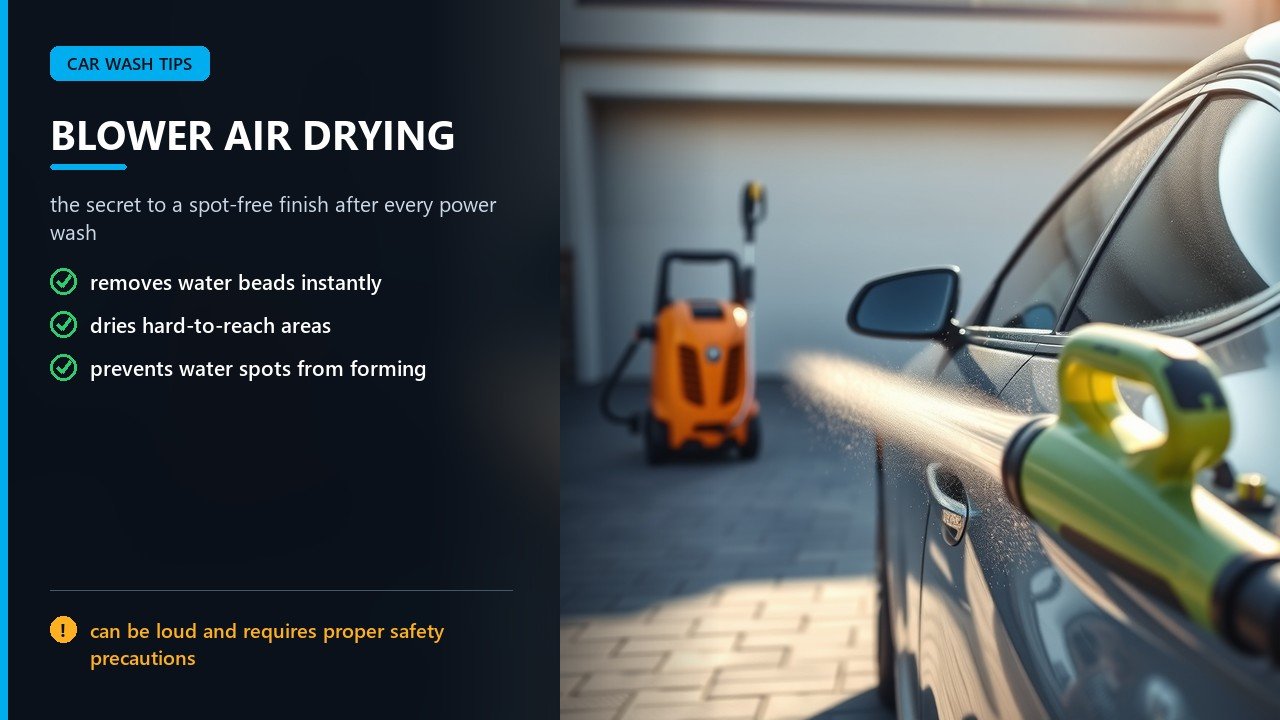
Why Water Spots Happen After a Wash
The spot-free result everyone wants is defeated by one physical process: water evaporates, and what is dissolved in it stays behind.
Hard water leaves minerals. Tap water carries dissolved calcium and magnesium. When a droplet dries, the minerals do not evaporate with it; they concentrate and remain as a white film etched into the surface. On dark paint and on concrete that has just been cleaned bright, the film is instantly visible. Our article on the chemistry behind water stains explains exactly what those white marks are made of.
The hotter and drier, the faster it happens. Summer sun, warm concrete, low humidity, each speeds evaporation and seals the spots faster. This is why the same wash that dries clean on a cool cloudy day leaves a galaxy of spots on a sunny one. It is also why bragging about sunny-day washing backfires on the finish.
Filters and softeners help, then cap off. A spot-free rinse system with a deionizer removes the minerals before they ever hit the surface, which is a genuine step up. But even with softened or deionized water, dust and grime settle onto the wet film as it dries, and beads rolling off imperfectly still leave trails. Blower air solves the residual problem no filter can: it removes the water film entirely before drying paints minerals anywhere.
The two-layer answer. Professional washes pair both: condition the water with a spot-free rinse, then dry with air before anything can settle. Together they produce the streak-free result that sells premium car washes and keeps decks looking like the day they were built.
What Blower Air Does That Towels Cannot
Drying with a towel is the traditional path, but it loses to air on several specific fronts, and the gaps are exactly where spots show up.
Towels push water across paint. A drying towel drags beads along the panel, and every drag across a dirty or rough lower panel can pick up grit and drag it into the clear coat, creating fine swirl marks that show only in bright sun. Air never touches the paint, so it can scratch nothing.
Air reaches the places towels cannot. Door jambs, mirror caps, emblems, grille slats, wheel wells, rocker seams. A towel wads into these awkward pockets and often just pushes the water deeper. A blast of air clears them clean in a single pass, which is why a blower is the tool under the towel for anyone who details seriously. Our comparison of a car drying blower versus towels is built around exactly these gaps.
Air does not lint. Microfiber is excellent and still leaves lint on some surfaces, none on a good mitt, some on plastics and trim. Compressed air and blower air leave zero lint, which matters on dark paint and on textured plastic trim where lint catches and reads as dust.
Air presses through seams. Water hides in seams, drip rails, and badges, then re-emerges twenty minutes later as a slow leak streak. A blower pops into those seams and forces the water out immediately, saving the “why is there a stripe on the door” moment at the end of the drive.
The Toolbox of Blowers That Do the Job
Not every blower is the same air, and the right one depends on the surface and how much air you need to move.
Leaf blowers. The budget genius. A gas or battery leaf blower moves huge volumes of air, and in the right hands it dries a car in minutes and blows a deck bone dry before the sun can bake spots. Its single drawback is force: a high-power leaf blower at close range can be too violent for loose trim and needs a light touch. This is the tool Jasmine used, and it is the entry point most owners already own.
Dedicated car dryers. Compact, balanced, and tuned for detail work, they move high airflow through a slim nozzle at moderate pressure, perfect for paint. Brands like the original professional units run off the car’s battery or a power station, which makes them genuinely portable. They cost more than a leaf blower and are the tool of the obsessive detailer.
Pressure washer blower attachments. A growing niche: attachments that mount a blower to the pressure washer frame or ride the hose, so the same rig that washes also dries with one owner moving one machine. Our guide to pressure washer blower attachments covers the shopping trade-offs, since they trade a little handling for a lot of convenience.
Shop-vac reverse and others. A shop vacuum run in reverse makes a serviceable mini-blower for small jobs, and a hose-mounted nozzle concentrates it. It is a loaner trick more than a daily tool, but it is proof that the technique needs no special gear to start.
| Blower Type | Air Volume | Gentleness | Best Use |
|---|---|---|---|
| Leaf blower | Very high | Moderate | Whole-car drying, decks |
| Car dryer | High | Gentle | Paint-focused detailing |
| Pressure washer attachment | Medium | Gentle | Wash-plus-dry single rig |
| Shop vac reverse | Medium | Harsh | Occasional loaner jobs |
If you already own a leaf blower, the upgrade path is not a new tool but a nozzle: a focused, flat-tipped air wand makes the drying pass cleaner and more controlled, and it is cheaper than a dedicated dryer. Our article on how a blower accelerates drying after the rinse goes through the nozzle trick in detail.
The Drying Sequence That Kills Spots
Technique turns “blow the car with the leaf blower” into a repeatable, spot-free result. The order is everything.
Dry from the top down. Just like washing. High panels first, then doors, then rockers, before any lower-stage water drips onto already-dried paint. Gravity is the enemy of a clean order.
Angle the air so water runs off, not around. Aim the airflow so droplets bead into rivulets that run toward the ground, not in circles. On a hood, work from the center outward; on a door, from the upper edge down toward the sills, where residual water can drip away instead of re-crossing dry paint.
Milk the seams last. Mirror housings, emblems, badges, door gaps, and drip trays each hold a reservoir. Hit them at the end with a short focused blast so the hidden water comes out immediately rather than hours later as a stripe.
Use the light touch on trim. Overpowering intended for the paint can ruffle a soft convertible top or puff loose trim. Near these, only the volume matters, not the pressure, so widen the nozzle or back off.
Finish with a rinse pass. If you are washing a vehicle, the flow should be: pressure wash, wash, rinse, then blower dry. The blower is the terminal step, not a mid-stroke interruption. For a deck or patio, the same sequence closes out with a blower pass that leaves nothing for the sun to bake. Our step-by-step drying sequence after the final rinse maps the whole order to the clock.
Blower Air Beyond the Car Wash
Drying is the headline use, but the same air that moves beads off paint serves a long list of washing-adjacent jobs.
Decks and patios. After a pressure wash, a swept blower pass moves standing water off wood boards and concrete joints before the sun turns it into streaks. On pavers, it flushes joint sand clean and reads out as a dry, finished surface.
Gutters and screens. A gentle blast clears gutter debris after washing, and blows dust and spider silk off window screens without soaking them. The same tool that finishes a wash also finishes the follow-up cleanup.
Exposed wiring and equipment. Pressure washing always pushes water into places it does not belong. A blower flushes water out of motor housings, control boxes, and electrical banks after a wash, and its gentle final pass prevents corrosion where water sits. Done carefully, this is the closest water wringing a pressure washer setup has to an air-dry cycle.
Fleet and commercial sites. For businesses washing trucks, trailers, and equipment, air drying after the wash is the difference between equipment going back out clean or back out streaked. The same blower that dries the paint dries the hitch, the chain, and the underbody seams that drip on the road. Our guide to the water blade shortcut pairs air with a squeegee tool for the fastest route to dry equipment.
Safety Rules for Moving a Lot of Air
A blower is a gentle tool and still a power tool, and the safety list is short but real.
Eyes first. Blower air lifts grit, pollen, and sand off surfaces, and none of it is aimed at eyeballs on purpose. Safety glasses or sunglasses that protect from the side turn a dust storm into a non-event.
Watch the ears. Gas blowers and high-output electric units run loud. The National Institute for Occupational Safety and Health notes that prolonged exposure to sources above about 85 decibels risks hearing damage, and many gas blowers run above that. Ear protection the entire session is the cheap, correct answer.
Never blow toward people or pets. Air at point-blank range can inject debris into the eye or bounce grit off hard surfaces, and it startles animals badly. Point the flow at the job, never at a bystander, and keep your own face out of the stream.
Battery and cord discipline. Battery blowers carry a heavy pack; let it rest, not dangle into wet puddles. Corded blowers need a GFCI outlet in wet areas, and the cord has to trail behind you, never across a wet driveway where a car will roll over it.
Fuel the gas ones outside. Refuel away from sparks and away from the wash hose, and never near a running, hot engine. The wash process and fuel belong to entirely separate moments.
Choosing a Dedicated Car Dryer
When the leaf blower in the shed stops being “good enough,” the dedicated car dryer is the natural step up, and the field separates on a few real features, not decibel marketing.
Airflow at the nozzle beats wattage numbers. The specs that tell the truth are cubic feet per minute and the shape of the nozzle. A balanced unit with a flat, focused outlet dries a panel in one pass; a round wide outlet spreads the same air and takes two. Shop the nozzle geometry as hard as the motor.
Weight and balance decide daily use. Drying a hood, roof, and both flanks is minutes of holding the tool steady. A dryer that sits heavy forward or exhausts toward your face makes the job miserable; a balanced unit with a strap or a shoulder mount disappears in the hand. Try the weight before you buy if the shop allows it.
Power source changes everything. Battery units are free-roaming and quiet but limited by cell charge; 12-volt units ride the car battery and never run out mid-job; corded ones never deplete and never add a battery, but trail a line across wet paint-adjacent territory. Choose the source that matches where you dry, garage, driveway, or road.
Noise is a spec, not an afterthought. The quietest units use the motor more efficiently and let you run a full session without ear protection claims. If the machine advertises decibels, it likely runs loud, so add the ear muffs to the cart at the same time.
Filters matter more than you think. A dryer that pulls unfiltered air from the wheel well will spray dust across your just-washed paint. The drying units designed for detailing draw through a filter and keep the exit stream clean, and that detail is easy to spot in the spec photos and easy to regret missing later.
Caring for the Blower and the Wash Gear
The blower is a tool, and like the pressure washer it serves, it does its best work when it is looked after.
Blow the machine out, not in. A blower pulls the air it throws, so during cleanup it can inhale its own dust cloud. Keep the inlet clear of loose material while running, and finish your session with the tool pointed clear of the wash area.
Filter care. Washable intake filters collect grit quickly on a job site. Clean them after big sessions and check them before the wash day; a clogged filter throttles airflow and makes the next wash take twice as long.
Battery season. Store battery packs at moderate charge, indoors, away from heat, and never leave them charging long past full. A dryer with a healthy battery is a dryer that shows up for the next wash ready.
Pair it with the rinse chemistry. The blower final pass lands after the spot-free rinse, so keep the rinse jug filled and the deionizer beds or filters serviced the same weekend you check the blower. Equipment that is inspected together is maintained together. Our guide to spot-free rinse chemistry covers the maintenance those beds need.
When to Skip the Blower Pass
“Always dry with air” is the best default, and still there are honest cases where the blower stays in the shed.
Indoor paint bays with strong airflow. A garage with a full-surface ventilation fan can pull the water film off a car as it goes, and some professional paint runs are designed to dry this way. There, the blower adds nothing.
Freshly sealed or waxed surfaces you must not assault. A curing protective coat needs stillness more than airflow. If the paint was just sealed and the instruction says stay off it for hours, air is the wrong tool for the first pass.
Extreme heat. On a surface that is already hot, moving air can accelerate evaporation on some films and set the residue faster than slow drying would. On concrete and decks this is rarely an issue; on freshly rinsed automotive paint in a 90-plus-degree parking lot, a mist rinse and shade beat a hot blower blast.
Recovery after a chemical failure. If a wash product streaked or a rinse left a reaction residue, air drying firms that residue into the surface. Rinse again, then dry; the blower is the finish line, not the fix.
In the ordinary case, though, the default stands. The exceptions are around edges; the blower is still the tool that ends the wash clean, and the discipline of knowing when it does not help is what separates a good habit from a blind one.
Common Blower Mistakes
Blowing sideways instead of down the drain path. Air aimed across the surface just moves water around. Aim down, toward the low edge, and let gravity help.
Forgetting the seams. The stripes that appear later come from water hiding in mirror caps and badge edges. End each session with a seam pass.
Using maximum power at close range. On paint and trim, volume beats violence. Back off the pressure and let the airflow do the drying.
Drying dirty surfaces first. A blower on a dusty car just makes a dust cloud and then spreads it back. Air drying belongs after the wash, not before it.
Skipping glasses. The grit storm is real. Eyes first, always.
Leaving a wet spot to “finish itself.” A puddle left in a seam or a panel will bake exactly the spots you started with. Every surface needs its own full pass, no exceptions.
Frequently Asked Questions
Can I dry a car with a regular leaf blower? Yes. A leaf blower moves more than enough air to dry a whole car, and it is the cheapest way into air drying. Use the light touch near trim.
Does blower air really prevent water spots? It removes the droplets before their minerals bake into the finish, so yes, decisively, when paired with a rinse and done before the sun bakes the film.
Is a cordless blower strong enough? A mid-size battery blower dries a car, deck, or equipment fine. High-volume gas blowers dry faster but weigh more and need the ear protection.
Can I use blower air on a boat, motorcycle, or RV? All three are ideal, because each has seams, emblems, and tight trim where towels struggle and air wins.
Does air drying scratch paint? No. Air does not contact the paint, so it cannot scratch it, which is the whole advantage over towels on dark finishes.
Do I still need a spot-free rinse if I dry with air? A spot-free rinse makes the job easier, but blower air does the final work regardless. Together they are the complete answer; alone, air already beats waiting for water to dry.
Final Thoughts on Blower Air
Blower air is not a luxury upgrade to the pressure washing routine; it is the missing final act. The machine strips the grime and the rinse lifts it away, but until every droplet is moved off the surface, the job is unfinished, because every droplet is a spot waiting to bake on a sunny afternoon. A blower turns that gamble into a certainty, drying the paint, the deck, the equipment, and the seams in seconds, with no towel, no lint, and no swirl marks to apologize for.
You do not need a specialist tool to start. The leaf blower in the shed, aimed downward with a light touch, already wins the fight against spots. When the results earn it, step up to a dedicated dryer or a pressure washer-mounted attachment, and pair the air pass with a spot-free rinse for the full professional sequence. Wear the glasses and the ear protection, keep the flow pointed at the job, and finish every wash with a deliberate seam pass. Do that and the only thing that dries on your surfaces will be brightness, because blower air carries the water away before the sun ever gets a vote.