A retired teacher walked into a hardware store looking for an electric pressure washer and found herself staring at two machines with almost identical numbers. Both claimed 2400 PSI. Both were electric. Yet one carried a name she did not recognize and a price that felt too good, while the other, an AR Blue Clean, cost more and mentioned something called an AR pump. She chose the AR machine, and it was the right call. Understanding what an AR North America 2400 psi pressure washer is, and why the pump inside matters more than the PSI on the box, is the difference between a machine that lasts two seasons and one that lasts a decade.
AR North America is the American arm of Annovi Reverberi, an Italian pump manufacturer with decades of engineering behind it. The company not only builds the pumps inside many pressure washers but also sells its own line of complete machines under the AR Blue Clean and Blue Clean Pro names. The 2400 PSI class is the heart of its consumer and light-commercial range, a pressure level that balances real cleaning power against the limits of a standard household outlet. This guide explains the brand, the machines, the pump technology, and how to get the most from a 2400 PSI AR machine.
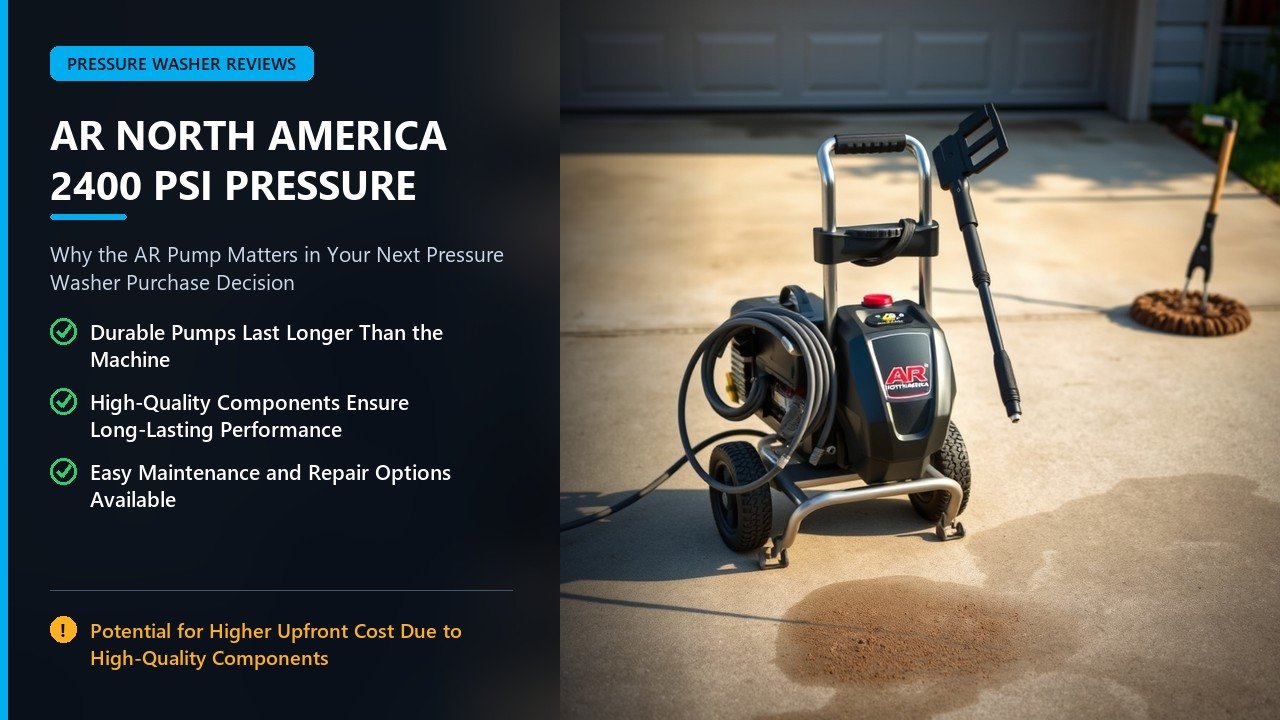
Who AR North America Is
The brand behind the machine is a pump company first, and that shapes everything about its pressure washers.
Annovi Reverberi, since 1958. AR North America traces its roots to Annovi Reverberi of Modena, Italy, founded in 1958 and recognized internationally for high-pressure pump manufacturing. The company’s reputation rests on the pumps it builds for pressure washers, car washes, and industrial cleaning, and it is a name that experienced operators recognize immediately.
The American arm. A.R. North America Inc., based in Fridley, Minnesota, distributes AR pumps and parts and builds its own line of pressure washers under names like AR Blue Clean and Blue Clean Pro. When you buy an AR-branded machine, you are buying a pressure washer built around a pump from a company that has specialized in pumps for more than sixty years.
Parts and service are the payoff. Because AR is a component supplier as well as a machine maker, its pumps, valves, seals, and rebuild kits are widely available through distributors. That means an AR machine can be repaired rather than thrown away, which is rare in a market full of disposable consumer units.
The pump is the point. Most pressure washer brands build machines around someone else’s pump and compete on price. AR brings decades of pump engineering to its own machines, and that shows up in durability, smoothness, and serviceability, exactly the qualities that matter over the life of the tool.
The 2400 PSI Class Explained
2400 PSI sits at a sweet spot for electric pressure washers, and knowing the numbers helps you judge any machine in the class.
| Spec | Typical 2400 PSI Electric | What It Means |
|---|---|---|
| Max PSI | 2400 | Peak pressure under ideal conditions |
| Rated PSI | 2000 | Sustained working pressure |
| Flow (GPM) | 1.9 | Rinsing volume, drives cleaning speed |
| Amps | 13 | Power draw from a standard outlet |
| Voltage | 120V, 60 Hz | Runs on household power |
What 2400 PSI does well. A machine in this class cleans cars, trucks, boats, patio furniture, sidewalks, decks, and light-to-medium siding, and it handles a surprising amount of driveway and patio work when paired with detergent and the right tip. It is the pressure level where an electric machine stops feeling weak and becomes genuinely capable.
The rated-versus-max distinction. Manufacturers advertise maximum PSI, but the rated figure, here around 2000 PSI, is what the machine sustains in real use. Both numbers are useful: max tells you the ceiling, rated tells you the day-to-day performance. A quality brand lists both honestly, which is a good sign to look for.
Flow matters too. At about 1.9 GPM, a 2400 PSI electric machine produces roughly 3,800 cleaning units, which is well above a small electric and enough to rinse detergent cleanly if you work methodically. As our guide to high-flow machines explains, flow often matters as much as pressure for real cleaning speed.
The AR Blue Clean Line
AR sells complete machines under the Blue Clean umbrella, and the 2400 PSI models sit near the top of its consumer range.
Representative models. The XM2400 is a common example, rated 2400 max PSI and about 1.9 GPM from a 13-amp motor. It features a four-wheel design for stability, a telescoping handle that folds for storage, and a full accessory set that includes an M22 trigger gun, a metal lance, quick-connect nozzles in 15-degree, 25-degree, and turbo styles, a quick-connect foam cannon, and a hose.
The Blue Clean Pro tier. Above the consumer line, AR offers Blue Clean Pro machines such as the AR610, AR630, and AR675 series, built for heavier use and often with higher flow, larger pumps, and more robust frames. These bridge the gap between a home machine and true commercial equipment.
Features worth having. AR machines commonly include a total stop system, which shuts the motor off when the trigger is released, and a GFCI-protected plug for safety around water. These are exactly the features that make an electric pressure washer pleasant and safe to own.
What the accessories say. The inclusion of M22 fittings, a foam cannon, and a turbo nozzle signals a machine designed for real work rather than a bare-minimum kit. Those accessories are part of what makes a 2400 PSI AR machine ready to use out of the box.
Why the AR Pump Matters
The pump is the component that actually creates pressure, and it is usually the first major part to fail on a cheap machine.
The pump does the real work. The motor spins, but the pump converts that rotation into high-pressure water. A weak pump limits pressure no matter how strong the motor, and a cheap pump wears out quickly under the constant load of pressure washing. AR’s expertise is in making pumps that survive that load.
Designs across the range. AR builds both axial and triplex plunger pumps. Axial pumps, common on consumer machines, are compact and economical. Triplex pumps, with three plungers and a swash plate or crank mechanism, are more durable and are the standard for commercial work. The higher end of the AR range leans on triplex technology, which is why those machines last longer.
Serviceable components. Good AR pumps use replaceable packings, valves, and seals. When performance drops or the pump begins to leak, these parts are the cause, and rebuild kits restore the pump for a fraction of replacement cost. That serviceability is the quiet advantage of a pump-first brand.
Materials and build. AR pumps use hardened steel, brass, and die-cast aluminum components and a double seal system, details that translate into smooth operation and long service life. These are the specifications a buyer should look for, and they are the reason an AR machine holds its value longer than an off-brand unit.
Maintaining a 2400 PSI AR Pressure Washer
Even a well-built machine needs routine care to reach its potential.
Protect the pump from dry running. The fastest way to destroy any pressure washer pump is to run it without water. Always connect the supply, turn the water on, and bleed the air by squeezing the trigger before starting the machine. A few seconds of dry running can damage seals and plungers.
Check the inlet filter. Most machines have a screen at the water inlet that traps debris. A clogged screen starves the pump, drops pressure, and causes overheating. Rinse it whenever flow feels weak.
Service the pump oil if applicable. Triplex pumps have an oil reservoir that must be checked and changed on schedule. The oil protects the pump’s internals, and running low is a fast route to failure. Consult the manual for the interval and the correct oil.
Winterize the machine. Water left in the pump or lines freezes and cracks components. Drain the machine and store it somewhere frost-free, or run a pump protector through it before storage. This single habit prevents a common and expensive failure.
Flush after detergent and chemicals. Run clean water through the soap system after every job to prevent residue from clogging the injector or the passages. The same principle explained in our guide to dish soap in a pressure washer keeps the soap system working for years.
Choosing a 2400 PSI AR Machine
A few considerations separate the right AR machine from a mismatch.
Match the class to the job. A 2400 PSI electric machine is ideal for cars, patios, decks, furniture, and light siding. For heavy concrete work or regular commercial use, step up to a gas machine or a Blue Clean Pro model, as discussed in our guide to choosing by the PSI you actually need.
Look at flow, not just PSI. Two 2400 PSI machines can differ in GPM, and the higher-flow unit cleans faster. Check the cleaning-unit math rather than trusting the pressure alone.
Consider the pump type. Consumer models use axial pumps, which are fine for occasional home use, while higher-tier machines use triplex pumps for durability. If you plan heavy or frequent use, favor the more durable pump.
Confirm the warranty and parts. AR backs its machines with a limited warranty, and its wide parts availability is a major advantage. Buy from a source that supports the product and can supply replacement parts, because that is what keeps the machine out of the landfill.
Check the accessories. A machine that includes quality nozzles, a foam cannon, and proper M22 connections saves you from buying extras. Our guide to connector types explains why standard fittings like M22 matter for future accessory choices.
AR North America Versus Other Electric Brands
Comparing AR with the big-box brands shows where the pump-first philosophy pays off.
| Brand Type | Pump Source | Repairability | Typical Lifespan |
|---|---|---|---|
| AR Blue Clean | Own AR pumps | High, parts widely sold | Long |
| Generic store brand | Unbranded import | Low, often no parts | Short |
| Premium consumer brand | Mixed OEM | Moderate | Moderate |
| Commercial brand | Varies | High | Very long |
Parts availability is the great divider. Many budget electric pressure washers use unbranded pumps with no published parts. When a seal fails, the machine is effectively disposable. AR’s position as a pump supplier means its pumps, seals, valves, and rebuild kits are stocked by distributors, so an AR machine can be kept alive for years.
A known brand versus an unknown one. The name on the pump tells you what you are buying. An AR pump is a documented product with specs, manuals, and support. A no-name pump is a gamble. That difference matters most precisely when something goes wrong, which is the moment a buyer cares about value.
Resale and confidence. Machines built around recognized pumps hold value better and inspire confidence. A buyer considering a used AR machine can check the pump model and know what it is capable of, something impossible with an anonymous import.
The Blue Clean Pro Difference
Stepping up from the consumer line to Blue Clean Pro changes the machine’s capabilities in meaningful ways.
More durable pumps. Pro models lean on larger, more robust pumps, often triplex designs, built to endure frequent use rather than occasional weekend jobs. That durability is the core reason a pro machine lasts longer under hard work.
Higher flow. Pro machines commonly deliver more GPM than the consumer line, which speeds cleaning and rinses surfaces more effectively. Flow is the quantity that determines how quickly soap and loosened dirt leave a surface, so more of it means faster, cleaner results.
Heavier-duty frames and components. Pro units use sturdier frames, larger wheels, and more robust guns and hoses, features that matter when a machine is moved daily and pushed hard. These are the details that survive real commercial schedules.
Who should step up. If you clean for a living, run a mobile detailing or pressure washing service, or simply use a machine several times a week, the Pro tier pays for itself in reliability and reduced downtime. For occasional home use, the standard line is more than sufficient.
Common Problems and Fixes
Most issues with a 2400 PSI AR machine trace back to straightforward causes, and many can be solved at home.
Low or pulsing pressure. The usual culprits are air in the line, a clogged inlet screen, a partially closed supply valve, or a worn nozzle. Bleed the system, clean the filter, open the supply fully, and check the nozzle before suspecting the pump.
Machine will not start. An electric pressure washer may fail to start because of a tripped GFCI, a loose plug, or a faulty power switch. Reset the GFCI, check the outlet, and confirm the switch is engaged. If the machine hums but does not start, the problem may be internal and worth a service call.
Water leaking from under the unit. Leaks often come from worn seals or loose fittings. Tighten connections first, then inspect seals. On an AR pump, seals and packings are replaceable, which is the whole advantage of a serviceable brand.
Soap not drawing. A detergent injector that stops working is usually clogged from dried soap or chemical residue. Flush the system with clean water, and if that fails, clean or replace the injector. Regular flushing prevents the problem entirely.
Pressure dropping as the machine warms. Some drop is normal, but a significant loss can indicate a failing unloader valve or worn pump components. On an AR machine, replacement parts are available, so the fix is generally affordable rather than fatal.
AR Pumps Inside Other Machines
AR’s influence reaches far beyond its own brand, which is why its parts network is so useful to owners.
An OEM supplier. AR North America supplies pumps to many pressure washer manufacturers, so a machine that is not branded AR may still carry an AR pump inside. This is common in the mid-range of the market, where builders want a proven pump without building their own.
Replacement pumps are widely sold. Because AR pumps are standardized, distributors stock replacements in common configurations, like 2400 PSI, 2.2 to 2.5 GPM models with standard shafts and flanges. When a pump fails on a compatible machine, an AR replacement is often the simplest fix.
Standard connections help. AR pumps commonly use standard inlet and outlet sizes and shaft dimensions, which makes them interchangeable across many machines. That compatibility is a quiet benefit that keeps equipment running when a proprietary part would strand it.
What this means for you. Even if your machine is not AR-branded, checking whether it uses an AR pump tells you whether it can be serviced and how easily. A quick look at the pump label can turn a mystery into a known quantity, with parts just a phone call or click away.
Getting the Most From Your Machine
A handful of habits separate owners who get a few seasons from their machine and those who get a decade.
Use the right nozzle for each surface. A 15-degree tip concentrates force for tough spots, while a 25-degree tip covers general cleaning and a turbo nozzle powers through concrete. Matching the tip to the surface protects both the surface and the machine. Our guide to the white pressure washer tip explains how the widest, gentlest tip handles delicate work.
Add a surface cleaner for flatwork. A rotary surface cleaner attaches to the machine and cleans large flat areas evenly and quickly, cutting job time and reducing streaks. It is the single most useful upgrade for anyone cleaning driveways or patios.
Keep spare wear parts on hand. Nozzles, O-rings, and inlet screens are inexpensive and fail eventually. Keeping spares means a five-minute fix instead of a stalled job, and it keeps you from overworking a partially clogged tip.
Store it properly. Drain the machine, coil the hose without kinks, and keep everything somewhere dry and frost-free. Proper storage prevents the frozen-pump failures that end more pressure washer lives than any worn part ever does.
Frequently Asked Questions
Who is AR North America? AR North America is the U.S. arm of Annovi Reverberi, an Italian maker of high-pressure pumps founded in 1958. It distributes AR pumps and parts and builds the AR Blue Clean and Blue Clean Pro lines of pressure washers.
Is a 2400 PSI pressure washer good? Yes, for home and light commercial work. At 2400 max PSI and about 1.9 GPM, an electric machine cleans cars, patios, decks, furniture, and light siding well, and handles moderate driveway work with detergent and the right tip.
What PSI is the AR Blue Clean XM2400? The XM2400 is rated 2400 max PSI and about 1.9 max GPM from a 13-amp, 120-volt motor, with a total stop system and GFCI protection, plus quick-connect nozzles and a foam cannon.
What is the difference between max and rated PSI? Max PSI is the peak the machine reaches under ideal conditions, while rated PSI, around 2000 on a typical 2400 class machine, is what it sustains in normal use. Both numbers help you judge real performance.
Are AR pressure washer pumps reliable? Yes. AR is a specialist pump manufacturer with decades of experience, and its pumps are known for smooth operation, durable materials, and serviceable parts. Rebuild kits are widely available, which extends the machine’s life well beyond that of an unserviceable unit.
Does a 2400 PSI pressure washer need special maintenance? It needs the same care as any machine: never run it dry, keep the inlet filter clean, change pump oil where applicable, winterize for storage, and flush the soap system after use.
Can I use an AR North America pump to replace my old pump? Often yes, as long as the specifications, shaft, and fittings match your machine. AR pumps are standardized and widely distributed, so check the GPM, PSI, shaft size, and connection types against your machine before ordering.
Where can I buy AR North America pressure washer parts? AR parts and pumps are sold through pressure washing and car wash distributors, both online and in person. Because the line is widely supported, seals, valves, and rebuild kits are usually available, often at modest cost, and a knowledgeable counter can match the part to your exact pump model quickly.
Final Thoughts on the AR North America 2400 PSI Pressure Washer
The AR North America 2400 psi pressure washer is more than a machine with a familiar PSI number. It is a product from a company that has spent more than six decades perfecting the pump at its heart, and that heritage shows in durability, smoothness, and the simple fact that it can be repaired when the time comes. For a homeowner or light professional who wants an electric machine that cleans well and lasts, the AR Blue Clean line at 2400 PSI is a sound, honest choice.
The retired teacher got years of use out of her AR machine, cleaning her car, her patio, and the siding on her house, and when a seal finally wore, a cheap rebuild kit brought it back to life instead of sending it to the curb. That is the quiet value of buying a machine with a real pump inside: it does not just clean; it endures. Match the class to your jobs, keep the pump happy with steady water and routine care, and a 2400 PSI AR pressure washer will reward you with reliable service for a long time, cleaning car after car and patio after patio without complaint.