The most satisfying moment on a pressure washing job is often the one nobody talks about: finishing the last pass and, instead of wrestling a hundred feet of stiff, wet hose into a tidy coil, simply giving it a tug and watching it wind itself away. That is the retractable hose reel, and once a machine has one, the manual reel feels like a chore. A retractable power washer hose reel uses a spring-loaded drum to pull the hose back automatically, storing it neatly and protecting it from the abrasion and kinks that shorten a hose’s life. It is a genuine upgrade, but it is also a piece of equipment with specific requirements, because not every pressure washer hose tolerates being wound onto a small drum under tension. When Robin replaced his wall-mounted manual reel with a retractable one, he stopped dreading the cleanup, and his hose lasted two seasons longer than it ever had when it was coiled by hand.
A retractable power washer hose reel is a reel equipped with a recoil mechanism, usually a coiled spring, that automatically winds the hose back onto the drum when it is released, and locks it at whatever length the operator is using. It differs from a manual reel in the automatic rewind and the tension control, and it demands a hose flexible enough to wind tightly and rated for the pressure it carries. This guide explains what a retractable reel is, how the recoil mechanism works, why the hose choice is the real decision, how to mount and install a reel, the capacity and pressure ratings to check, the pros and cons against manual and fixed reels, and the maintenance that keeps the spring and drum working.
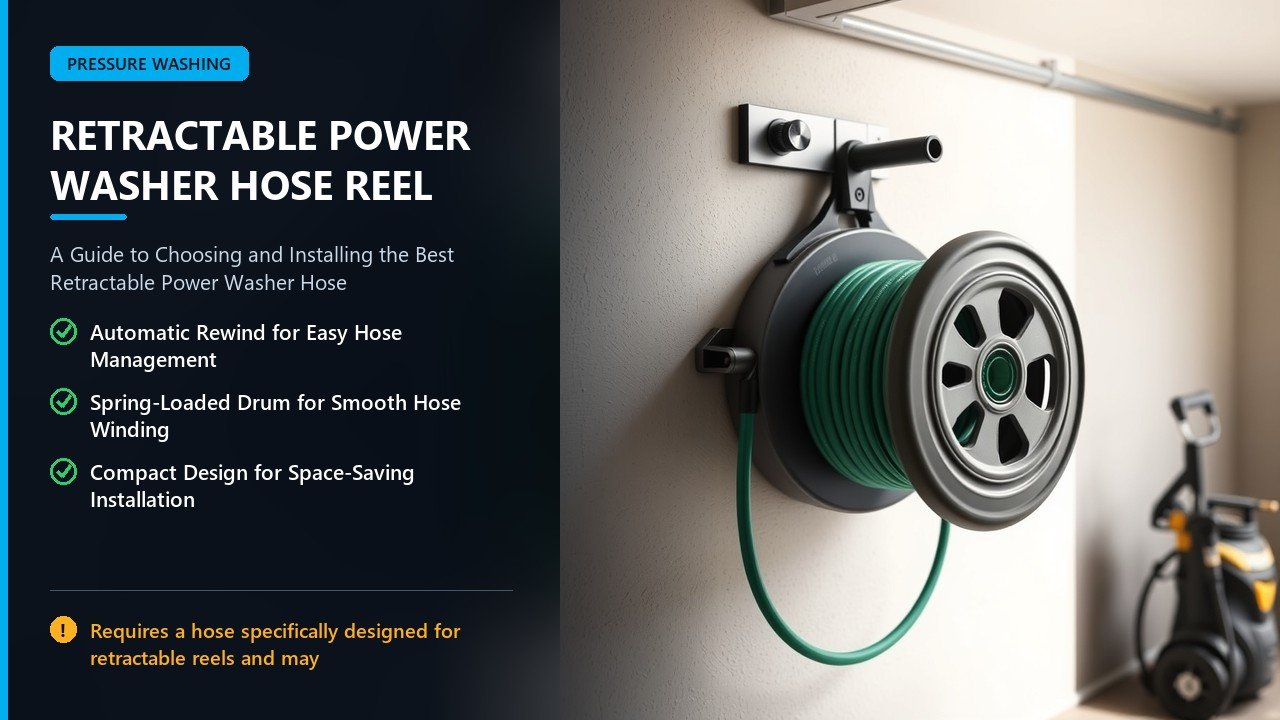
What a Retractable Hose Reel Is
The retractable reel is the automatic-rewind member of the reel family, and the distinction matters.
A spring-driven drum. Inside the reel housing, a coiled spring stores energy as the hose is pulled out, and releases it to wind the hose back when the operator lets it retract. The mechanism is similar to a tape measure’s spring, and it is what makes the reel “retractable.” The spring tension is usually adjustable so the retract force suits the hose and the operator’s preference.
A locking ratchet. A retractable reel locks the hose at the extended length with a ratchet, so the operator can pull out the working length, let the ratchet catch, and use the hose without fighting the rewind. A short tug then releases the lock and the reel retracts. This locking behavior is what distinguishes a usable retractable reel from a simple spring winder.
How it differs from manual and fixed reels. A manual reel rewinds by a hand crank, a fixed reel is simply storage, and a retractable reel rewinds by spring. The retractable version trades simplicity for convenience, adding a mechanism that can wear but saving the operator the crank or the coil every time. Our guide to wall-mounted reels covers the manual family it improves on.
Advantages over coiling by hand. A retractable reel stores the hose under even tension on a large radius, which reduces kinking and abrasion compared with coiling it on the ground or around the machine. It also keeps the hose dry, off the floor, and ready to deploy, which is cleaner and faster than a hand coil. Our guide to hose reels covers the storage benefits.
How the Recoil Mechanism Works
Understanding the mechanism explains the maintenance and the failure modes.
The spring and the spool. The heart of the reel is a flat coiled spring connected between the fixed housing and the rotating spool. Pulling the hose out winds the spring, and letting the hose go lets the spring unwind, turning the spool to wind the hose in. The spring’s tension is set by the reel’s design and often adjustable through a tension screw or by pre-winding the spring.
The ratchet and lock. A ratchet pawl engages teeth on the spool to hold the hose at the pulled-out length, so the spring does not yank the hose back while working. The lock releases on a short pull, letting the reel retract. A worn pawl or ratchet causes a reel that will not hold its length or will not retract, and both are usually serviceable.
The swivel and inlet. A retractable reel needs a rotating swivel at the axle to carry water from the fixed supply port into the rotating spool and hose, and that swivel is a common point of leaks. The inlet connector must match the supply hose, and the swivel allows it to feed the reel no matter the hose’s rotation. Our guide to hose swivels covers the sealing.
Adjustable tension. A tension adjustment lets the operator tune the retract force so a lighter hose does not slam back and a heavier hose still returns. Setting the tension to the hose is part of a good installation, and outside the right range the reel behaves badly. The maker’s guidance on tension adjustment is worth following.
The Hose Is the Real Decision
Retractable reels live or die on the hose, and the hose requirements are stricter than for a manual reel.
Flexibility for winding. A hose that winds tightly onto a reel must stay flexible, because a stiff hose resists the spool and will not retract cleanly, and it may kink as it winds. Choose a hose rated for reel use and known for flexibility, especially in cold weather, or the retractable reel’s convenience disappears. A stiff hose defeats the whole purpose.
Pressure rating for the machine. The hose and the reel’s swivel must both be rated for the machine’s working pressure with margin, because a reel used above its rating risks a burst at the swivel or a hose failure. Check the reel’s pressure rating as carefully as the hose’s. Our guide to hose ratings covers the numbers.
Length and capacity. The reel’s capacity must match the hose length you want to store, and the stored hose’s diameter must fit the drum. A reel rated for fifty feet of a given diameter will not hold a hundred feet of a larger hose, so match capacity and hose together. Overshooting the capacity means a hose that does not fit or retracts poorly.
Diameter for the machine. The hose’s inner diameter should still suit the machine’s flow, because a retractable reel does not change the physics of diameter and pressure loss. Choose the diameter for the machine and the run, then confirm the reel can hold that hose. Our guide to how diameter affects flow explains the trade.
One hose, one reel. A retractable reel is designed around one hose of a specific diameter and length, so it works best as a dedicated home for a single hose rather than a flexible storage solution for several. Match the reel to the hose you intend to store on it permanently, and treat the pairing as fixed.
Mounting and Installation
Where and how a retractable reel is mounted determines whether it works well and lasts.
Mount to solid structure. A retractable reel under spring tension pulls with force, so it must be mounted to a solid wall stud, a post, or a sturdy frame, never to drywall or thin paneling. A reel that pulls itself out of the wall is a hazard and a nuisance. Locate the studs and use appropriate fasteners for the reel’s weight and the pull force.
Choose the height for the job. Mount the reel high enough to keep the hose off the ground when retracted, but low enough to pull comfortably and to reach the inlet and outlet. A wall height around chest to shoulder is common, though the best height depends on the operator and the hose run. Our wall-mounted guide covers the siting.
Connect the supply correctly. Feed the supply from the machine to the reel’s inlet swivel, and run the working hose from the reel’s outlet to the gun, matching the connectors and sealing the swivel connection. The swivel is the reel’s leak-prone part, so make the inlet connection properly. Our fitting guide covers the connectors.
Set the tension. Adjust the reel’s spring tension so the hose retracts under control without slamming and holds at the working length without creeping. The right tension is a matter of feel, and the maker’s adjustment procedure is the guide. A well-tensioned reel is a pleasure; a badly tensioned one is a fight.
Use a leader hose if needed. If the reel mounts far from the machine, a short leader hose from the machine to the reel inlet keeps the connection clean and lets the reel sit where it is most useful. The leader stays fixed while the retractable hose does the working. Our reel guide covers the accessory.
Retractable Versus Manual and Fixed Reels
Comparing the reel types clarifies when the retractable version earns its higher cost.
Convenience. The retractable reel wins outright on convenience, retracting the hose with a tug instead of a crank or a coil. For anyone who uses the machine regularly, the saved effort and time add up quickly, which is the retractable reel’s main argument. A manual reel is cheaper but demands a hand crank every use.
Simplicity and durability. A fixed reel is the simplest and most durable, with no mechanism to wear, while a manual reel adds only a crank, and a retractable reel adds a spring, ratchet, and swivel that can all fail. The retractable reel’s convenience comes at the cost of more parts, so it needs more care and eventually more repair. Our hose reel guide covers the trade-off.
Cost. A retractable reel costs more than a manual or fixed reel of similar capacity, reflecting the mechanism. For a machine used often, the convenience justifies the price; for occasional use, a manual reel may be the better value. Match the reel to how much you actually use the machine.
Space and cleanliness. A retractable reel keeps the hose stored, dry, and off the floor with no manual effort, giving the tidiest possible setup. A fixed reel stores the hose but requires coiling it, and a manual reel requires cranking, so on the measures of cleanliness and effort, the retractable reel is the clear winner.
| Reel Type | Rewind | Best For |
|---|---|---|
| Fixed | Manual coil | Simple, low cost |
| Manual crank | Hand crank | Balance of cost and ease |
| Retractable | Spring auto | Frequent use, convenience |
Ratings and Features to Check
A short checklist separates a reel that performs from one that frustrates.
Pressure rating. Confirm the reel and its swivel are rated above the machine’s working pressure with margin, since a low-rated swivel leaks or bursts. The pressure rating is the reel’s most important number. Our hose rating guide covers why.
Capacity and hose compatibility. Check the reel’s stated capacity in feet and hose diameter, and match it to the hose you intend to store. A reel that is rated for your hose length and diameter will retract cleanly; one that is mismatched will not. Our diameter guide covers the hose side.
Hose diameter supported. Some reels accept only a specific diameter, so confirm the reel supports the diameter your machine needs. A reel built for a narrow hose may not accept a larger one, even at the same length.
Adjustable tension. A reel with adjustable tension lets you tune the retract force to the hose and your preference, which greatly improves the experience. Fixed-tension reels are less forgiving, so favor adjustable where the option exists.
Mounting hardware and swivel quality. Check that the reel includes sturdy mounting hardware and a quality inlet swivel, since those are the parts that fail first. A reel with a weak swivel or flimsy bracket disappoints, no matter how smooth the spring.
Housing and hose guide. A sturdy housing protects the mechanism and the hose, and a roller or guide at the hose opening reduces wear and helps the hose wind evenly. These details extend the reel’s and the hose’s life, so weigh them in the choice. Our reel guide covers the features.
Maintenance and Troubleshooting
A retractable reel needs a little care, and its problems are usually mechanical and fixable.
Keep the swivel sealed. The inlet swivel is the reel’s most common leak point, so inspect it for weeping and replace its o-rings when needed. A leaking swivel that is ignored can corrode the mechanism. Our weeping-seal guide covers the repair.
Do not over-stretch the spring. Pulling the hose farther than the reel’s rated length over-stretches the spring and weakens the retract, and forcing the reel when it binds damages the mechanism. Respect the rated length and let the reel work within its range. A reel used within limits lasts far longer.
Adjust the tension as it ages. Over time the spring tension may soften or the ratchet wear, causing weak or erratic retraction. Tension is often adjustable, and a small tweak restores proper behavior. Follow the maker’s procedure rather than guessing at the spring.
Free a sticking ratchet. A ratchet that will not hold or release may be grit-packed or worn, and cleaning the mechanism or replacing a worn pawl usually fixes it. Keep the housing clean and dry to prevent the grit that causes sticking. A mechanism kept clean stays reliable.
Protect the hose on the reel. Even on a reel, a hose can kink or abrade at the guide, so inspect the hose near the outlet periodically and reroute if it wears. The reel protects the hose, but the hose still needs occasional attention. Our hose care notes pair with the reel maintenance.
Store dry and drain for winter. A reel full of water freezes and splits the hose and can damage the swivel, so drain the hose and reel before freezing weather. Retract the hose dry and store the reel protected. Our winterizing guide covers the drain.
Accessories and Setup Tips
A few add-ons and habits make a retractable reel work better and last longer.
A leader hose for the inlet. A short fixed leader hose from the machine to the reel’s inlet keeps the supply connection tidy and lets the reel sit where it is most useful, rather than where the machine happens to be. The leader stays connected while the retractable hose does the moving. Our reel guide covers the arrangement.
A swivel at the gun. Adding a swivel between the working hose and the gun lets the gun rotate freely without twisting the hose at the reel, which reduces kinking and makes the hose wind more evenly. It is a small part with a real effect on how the reel behaves. Our swivel guide covers the upgrade.
A hose guide or roller. If the reel does not include one, a guide or roller at the hose opening keeps the hose centered as it winds, preventing the uneven winding and edge wear that come from a hose that pulls to one side. It is a cheap improvement that protects both hose and reel. Our reel guide covers the feature.
Route the supply out of the way. Keep the machine-to-reel supply line off walkways and out of the working path, since a trip hazard at the reel defeats the convenience of the retractable hose. Route it along a wall or edge and secure it. Safety at the reel is as important as anywhere on the setup. Our safety gear guide covers the site habits.
Match the nozzle and gun to the reel hose. Confirm that the gun and nozzle connect to the reel’s hose with the right fittings, ideally quick connect, so the whole station works as a unit. A reel that cannot connect cleanly to the gun wastes the convenience it offers. Our quick connect guide covers the standard.
Keep a small spares kit at the reel. O-rings for the swivel, a spare connector, and a wrench turn a mid-job leak into a quick fix at the reel, which is where leaks most often appear. A reel station with a few spares stays productive. Our weeping-seal guide covers the repair.
Common Retractable Reel Mistakes
Putting a stiff hose on a retractable reel. A stiff hose will not retract cleanly and kinks as it winds. Choose a flexible, reel-rated hose.
Using a hose above the reel’s rating. An under-rated reel or swivel leaks or bursts. Match the reel’s pressure rating to the machine.
Mounting to weak structure. The spring pull can tear a reel off drywall. Mount to solid studs or framing.
Over-stretching the spring. Pulling beyond the rated length weakens the retract. Respect the reel’s range.
Ignoring the swivel. The swivel is the common leak point. Check and reseal it.
Letting the hose retract uncontrolled. An uncontrolled retract whips the hose and can injure. Guide the hose in every time.
Storing it wet and freezing. Trapped water splits the hose and hurts the swivel. Drain before freezing weather.
Frequently Asked Questions
What is a retractable power washer hose reel? A hose reel with a spring-driven recoil that automatically winds the hose back, locking it at the working length and retracting it with a tug.
Does a retractable reel need a special hose? Yes, effectively. The hose must be flexible enough to wind tightly on the drum and rated for the machine’s pressure, so the reel and hose should be chosen as a matched pair.
What pressure rating does a retractable reel need? The reel and its swivel should be rated above the machine’s working pressure with margin, the same as the hose, since the swivel is a pressure point.
How much hose fits on a retractable reel? It depends on the reel’s rated capacity in feet and hose diameter. Match the reel’s capacity and supported diameter to the hose you intend to store.
Why is my retractable reel not retracting? Usually weakened spring tension, a sticking ratchet, or a stiff hose. Adjust the tension, free the ratchet, and confirm the hose is flexible enough to wind.
Can I winterize a retractable reel? Yes, and you should. Drain the hose and reel completely and retract it dry before freezing weather, so trapped water does not split the hose or damage the swivel.
Final Thoughts on the Retractable Power Washer Hose Reel
The retractable power washer hose reel is the upgrade that quietly improves every pressure washing job, replacing the wet, stubborn hand-coil with a smooth tug-and-retract and storing the hose under even tension on a large radius that reduces kinking and abrasion. Its spring-driven drum, locking ratchet, and inlet swivel are what make it convenient, and also what make it a mechanism that needs a well-chosen hose, a solid mounting, correct tension, and occasional care to keep working.
Treat the hose and reel as a matched pair, confirming that the hose is flexible enough to wind and that both the hose and the reel’s swivel are rated above your machine’s pressure, and that the reel’s capacity and diameter suit your hose. Mount it to solid framing, set the tension to the hose, seal the swivel, and guide the hose in on every retract rather than letting it whip. Keep the mechanism clean, respect the rated length, and drain it before the cold. Do all of that, and the retractable reel turns cleanup from the worst part of the job into the easiest, while protecting the hose that carries the machine’s pressure, which is exactly what makes it worth the upgrade.