A pressure washing contractor named Miguel used to coil 150 feet of high-pressure hose on the deck of his trailer after every job. Over a season, the hose developed kinks, the brass fittings got crushed underfoot, and twice he tripped dragging a tangled mess across a driveway. When he finally bolted a heavy duty pressure washer hose reel to the back of the rig, setup and breakdown dropped from ten minutes to about two, and his hose stopped failing. The reel did not clean anything by itself, but it protected the most expensive consumable on his trailer and made him look professional on every stop.
A heavy duty pressure washer hose reel does two jobs: it stores the hose neatly and, on a live reel, it carries high-pressure water through a swivel and internal plumbing. Buying well means matching the reel to your hose size, your system pressure, your water temperature, and the way you mount it. This guide walks through capacity, ratings, live versus storage reels, mounting, and maintenance so you pick a reel that lasts.
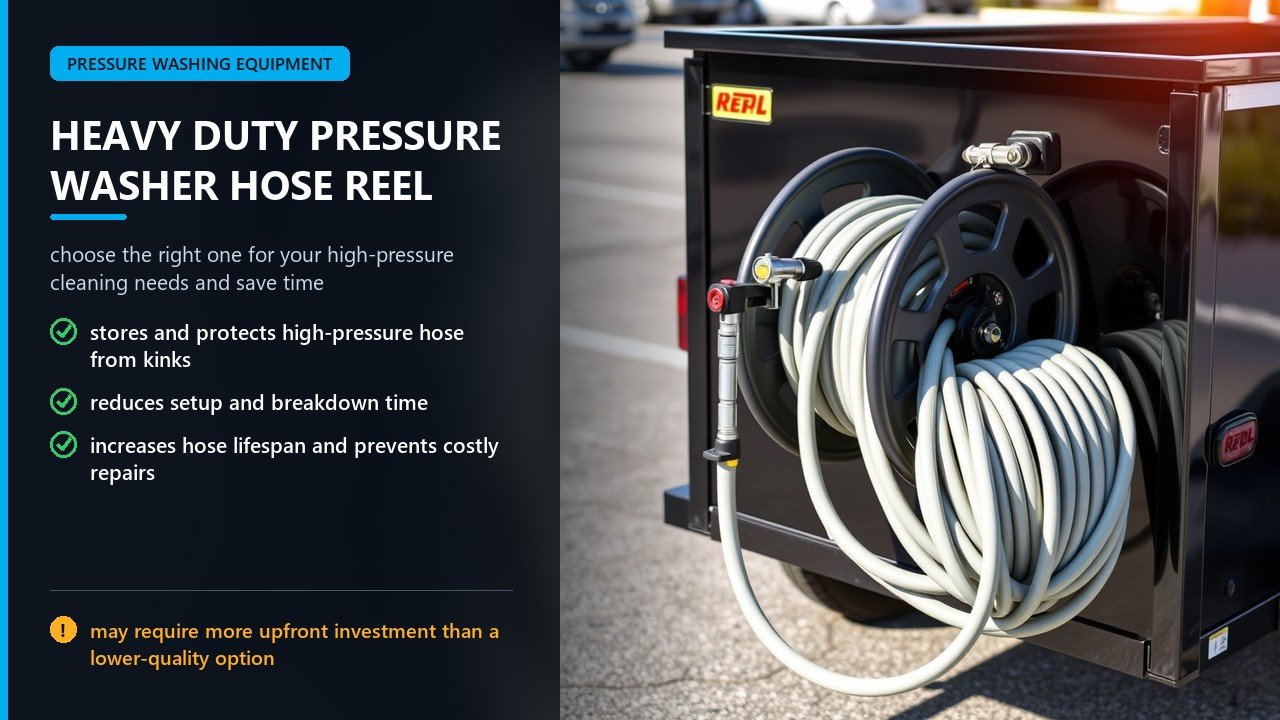
Live Reel Versus Storage Reel
This distinction decides how the reel works in your system.
Live reel. The hose stays connected to the reel, and pressurized water flows through a rated swivel and reel plumbing to the hose. You unroll the hose, spray, and crank it back without disconnecting anything.
Storage reel. The reel simply holds the hose when it is not in use. It is not part of the pressurized path, so you connect the hose to the pump separately each time.
Swivel is the difference. A live reel needs a swivel that seals while the drum rotates under pressure. A storage-only reel does not, which is why it costs far less.
Do not assume. Never treat a reel as live just because it has a crank. Check the manufacturer’s specs for a pressure-rated swivel and fluid path.
Which you want. Professionals running long hoses choose live reels for speed. Homeowners with short hoses can be well served by a simple storage or hand-crank reel.
Capacity: Match Hose Length and Diameter
Capacity is meaningless without the hose size.
Rated by inside diameter. Manufacturers publish capacity for a specific hose bore, because the outside diameter and bend radius determine how much fits on the drum. A “100-foot reel” is incomplete without the hose ID.
Bigger bore, less length. A reel that holds 200 feet of 3/8-inch hose holds far less with 1/2-inch hose, and more with 1/4-inch hose. Wound hose fills a fixed space, so larger outside diameters cut capacity.
Buy room to spare. Overfilling makes rewinding messy and strains the reel. If you use 100 feet of hose, a 200-foot reel gives you slack to work with.
Typical ranges. Reels commonly hold about 50 to 100 feet for homeowners, 150 to 200 feet for light commercial, and 300 feet or more for fleet and large commercial work.
| Hose Bore | Effect on Capacity |
|---|---|
| 1/4 in | Holds the most length |
| 3/8 in | The common professional standard |
| 1/2 in | Holds the least length, high flow |
Pressure and Temperature Ratings
The rating that counts is the one attached to the swivel, not the frame.
Rate above your machine. Match the reel to your pressure washer’s maximum output, not the working pressure it cleans at. The unloader sends a pressure spike down the line every time you release the trigger.
Working versus burst. Look for a working pressure rating, and prefer reels that state the rating next to the word swivel. A strong frame says nothing about the part that actually holds pressure while turning.
Temperature limits. Hot water machines need reels with high-temperature seals, often 200 to 250 degrees or more with Viton or similar O-rings. Standard reels may cap out lower.
Lowest component wins. Do not stack mismatched components. A 5,000-PSI reel cannot raise the limit of a 4,000-PSI hose, and a 5,000-PSI hose cannot raise a 4,000-PSI swivel. The system is limited by its weakest link.
Hot water check. If you run hot water, confirm the seal compound and temperature rating, or the swivel will leak and fail early.
| Spec | What It Governs |
|---|---|
| Working pressure | Safe continuous operating pressure |
| Swivel rating | The rotating sealed joint, the weak point |
| Temperature | Seal life and hot water compatibility |
| Ports / threads | How the reel joins your system |
Manual, Spring-Retract, and Electric
Rewind style shapes convenience and durability.
Manual hand-crank. You wind the hose by hand. Manual reels are the simplest, most durable, and most common choice for high-capacity commercial work, with the fewest parts to fail.
Spring-retract. A spring winds the hose when you release a latch. Fast and convenient, but the spring mechanism wears out and is the most complained-about part in reviews.
Electric. A motor, often 12-volt DC or 120-volt AC, powers the rewind, sometimes with variable speed and powered feed. Perfect for daily use and long hoses, but expensive and more complex.
Cost tiers. Budget manual reels run roughly 80 to 150 dollars for homeowner use, mid-range 150 to 250 dollars, and professional all-metal reels 250 to 400 dollars. Electric reels climb to 300 to 800 dollars or more.
Which to choose. Manual for occasional or budget use and maximum durability. Electric when you clean daily, run 200 feet or more, or have physical limitations.
Mounting Options
Where and how you mount the reel decides how well it works.
Wall mount. Ideal for a garage or fixed wash bay. Mount to studs or steel, never just drywall, and keep the hose exit clear of obstacles.
Trailer mount. Common on professional rigs, often at the rear for easy access. Mount to the frame, not just the deck, and use vibration-dampening washers.
Truck mount. Fits a truck bed, utility body, or rack. Watch capacity and weight, and protect the reel from weather and theft where possible.
Orientation. Horizontal mounting, with the drum axis parallel to the ground, is most common because it cranks easily and feeds the hose naturally. Confirm your reel supports the orientation you want.
Crank clearance. Leave room for the handle to rotate a full 360 degrees without hitting the trailer frame, equipment, or truck side.
Sturdy surface. A loaded reel, 200 feet of hose plus the drum, can exceed 100 pounds. The mounting surface must handle the weight plus the forces of cranking and hose tension.
Ports, Threads, and Connections
Fittings decide whether the reel joins your system cleanly.
NPT versus quick connect. Many professional reels terminate in NPT threads, while working hoses use quick-connect ends. A short jumper hose often runs from the pump or unloader to the reel inlet.
Inlet and outlet. The inlet is the high-pressure side from the pump, and the outlet feeds the hose on the drum. Check the size and gender of each, such as 3/8-inch or 1/2-inch NPT.
M22 fittings. Some consumer reels use M22 connections, common on many pressure washer guns and hoses.
Avoid adapter stacking. Every adapter adds a pressure-rated joint and a potential leak or restriction. Use the fewest adapters needed. Our guide to pressure washer adaptors covers the common conversions.
Seal properly. Use thread tape or sealant rated for the pressure, and test every joint before running a full job.
Installing the Reel
A careful install prevents most problems.
Choose the location. Mount where the hose spools and unspools without rubbing other equipment, and where you can reach it easily at the job site.
Reinforce the surface. Bolt to steel framing or a reinforced plate. Add a backing plate if the mounting surface is thin.
Level and mark. Use a level to mark the mounting holes so the drum sits straight and winds evenly.
Plumb the inlet. Connect the pump or unloader output to the reel inlet with rated fittings, and connect the high-pressure hose to the drum outlet.
Test before work. Run the system, cycle the hose on and off, and check every connection for leaks before heading to a job.
Route to avoid kinks. Plan the hose path so it cannot kink or pinch at the reel outlet or under the trailer.
Maintenance and Common Problems
The swivel is the part that needs the most attention.
Leaking swivel. The most common reel problem. Swivel seals wear from constant rotation under pressure. Replace the seals or the swivel assembly, and keep a spare on the rig.
Stiff rewind. Check the bearings and lubricate if the reel calls for it. Binding often means an overloaded drum or a bent frame.
Uneven winding. A hose guide or the wrong capacity causes the hose to pile up on one side. Do not exceed the rated capacity.
Loose mount. Vibration loosens bolts over time. Check mounting hardware regularly, especially on trailers and trucks.
Fitting leaks. Reseal threaded connections and inspect O-rings. A steady drip wastes pressure and can damage the hose end.
Inspect seasonally. Before busy periods, inspect the swivel, connections, and frame, and replace worn seals so a failure does not strand you mid-job.
Why a Heavy Duty Reel Is Worth It
A good reel protects more than the hose.
Longer hose life. Reeling the hose keeps it off the ground, away from foot traffic, vehicle tires, and sharp edges that cause kinks and abrasion.
Faster setup. Rolling out and rewinding a hose in seconds trims real time off every job, which adds up across a week of work.
Fewer injuries. No more dragging tangled hose or lifting heavy coils. A mounted reel reduces strain and trip hazards.
Professional appearance. A tidy rig signals quality to customers, and a heavy duty reel holds up to daily commercial abuse where a cheap unit fails fast.
Safer operation. A rated swivel and fluid path keep high-pressure water contained, which is a genuine safety matter, not just a convenience.
Materials and Build Quality
Materials tell you how a reel will hold up.
Steel frames. Heavy duty reels use welded steel frames, sometimes powder-coated for corrosion resistance. Steel is strong and affordable but can rust if the coating wears through.
Stainless steel. Stainless reels resist corrosion and handle chemical and coastal environments better, but they cost more and are heavier.
Aluminum. Aluminum frames are lighter and rust-resistant, which suits mobile rigs where weight matters, though they may cost more than basic steel.
Brass and stainless swivels. The best swivels use brass bodies with stainless steel stems and quality seals. Swivel quality is the single most important durability factor on a live reel.
Polymer reels. Inexpensive homeowner reels often use plastic components. They are fine for occasional use but fail quickly under daily commercial pressure.
Bearings and brake. Sealed bearings and an adjustable friction brake make winding smoother and keep the drum from free-spinning when you pull hose.
Brands and What to Look For
Familiar names set expectations.
Professional names. Coxreels, Reelcraft, General Pump, Hannay, and Alkota are established in industrial and pressure washing markets, with published capacity, pressure, and temperature specs.
Spec-sheet honesty. The best manufacturers state whether a rating applies to the swivel, the frame, or the hose, and often rate a bare reel higher than the same reel with a hose fitted.
Hose-included cautions. When a reel ships with a hose, one number is quoted for an assembly with two different limits. A bare reel plus a hose you choose is often the more auditable arrangement.
Consumer brands. Names like VEVOR, MEKOH, Tool Daily, and Giraffe Tools appear in U.S. retail listings with ranges from compact wall reels to high-capacity hand-crank units.
Read the reviews. On spring-retract and electric reels, check recent reviews for complaints about the rewind mechanism, the part most likely to fail.
Warranty and parts. Confirm you can get replacement seals, swivels, and hardware. A reel with no parts support becomes disposable.
Selection Checklist
Run these questions before you buy.
Hose capacity. Does the reel hold the exact length and diameter of hose you plan to use, with room to spare?
Pressure rating. Is the swivel rated above your machine’s maximum output, with a safety margin?
Temperature. Does the seal rating match your water temperature, especially on a hot water machine?
Threads and fittings. Does the reel connect to your existing hose ends, or will you need adapters? Confirm M22, 1/2-inch NPT, or 3/8-inch NPT.
Mounting. Wall, floor, truck, or trailer? Can your mounting surface support the loaded weight?
Rewind style. Manual, spring, or electric, matched to how often you work and how much hose you run.
Warranty and returns. How easy is it to get parts or send the reel back if the mechanism fails?
Using the Reel Efficiently
Good habits prolong reel and hose life.
Pull only what you need. Unroll just enough hose to reach the work, keeping the rest on the drum and off the ground.
Avoid sharp pulls. Do not yank the hose sideways off the reel, which strains the swivel and the guide. Pull straight out.
Do not overfill. Staying within capacity keeps winding even and prevents the hose from binding against the frame.
Wind under light tension. Guide the hose onto the drum in even wraps rather than letting it pile up.
Check the swivel. Listen and watch for drips at the swivel each time you use the reel. Early detection prevents a mid-job failure.
Protect from weather. Cover or store the reel when possible, especially steel frames and swivels exposed to rain and salt.
Applications That Benefit Most
Some users gain more from a reel than others.
Fleet and mobile washing. Reels keep long hoses organized on the truck, so operators cover large vehicles and multiple bays quickly.
Fixed wash bays. A wall-mounted reel keeps the bay tidy and the hose off the floor where it would collect dirt and get driven over.
Large residential properties. A wall reel in the garage serves driveways, siding, and patios without dragging a coiled hose around the house.
Construction and agriculture. Reels stand up to dusty, rough environments and keep heavy-duty hose protected between jobs.
Sewer jetting and specialty work. High-capacity reels handle the longer hoses these jobs require, with the pressure ratings those applications demand.
Cost and Long-Term Value
A reel is an investment that pays back over time.
Upfront cost. Manual reels start around 80 dollars for homeowner units and run 250 to 400 dollars for professional all-metal models. Electric reels climb to 300 to 800 dollars or more.
Installation cost. Budget for mounting hardware, a jumper hose, and fittings. Truck and trailer installs may add brackets, backing plates, and wiring for electric reels.
Hose savings. A reel that keeps the hose off the ground can extend hose life by years, and a quality high-pressure hose is not cheap to replace.
Time savings. For a professional doing several jobs a day, the minutes saved on every setup and teardown add up, which is where electric reels earn their price.
Downtime avoided. A rated swivel and sturdy mount prevent the mid-job failures that cost far more than the reel itself, in lost time and unhappy customers.
Common Buying Mistakes
Avoid these to prevent early regrets.
Buying by brand, not by hose. The washer’s brand does not determine reel fit. Hose length, diameter, connector type, and mounting plan do.
Ignoring the swivel rating. Shoppers focus on frame strength while the swivel, the part that leaks, gets overlooked. Look for a pressure figure attached to the swivel.
Underrating pressure. A reel rated below your machine’s maximum output can fail on the unloader spike, even if it never leaks during normal spraying.
Overfilling the drum. Cramming too much hose on a reel makes winding messy and strains the frame and swivel.
Weak mounting. Bolting a heavy loaded reel to thin decking or drywall leads to a collapsed mount and a damaged reel.
Undersizing for growth. Buying exactly the capacity you use now leaves no room to add hose later. Buy one size up when budget allows.
Frequently Asked Questions
What is a heavy duty pressure washer hose reel? It is a high-capacity reel built to store and, on live models, carry high-pressure water through a rated swivel, designed for frequent commercial use.
How much hose does a heavy duty reel hold? It depends on hose diameter. Professional reels commonly hold 100 to 200 feet of 3/8-inch hose, and larger units hold 300 feet or more.
Do I need a live or a storage reel? Choose a live reel if you want to keep the hose connected and run water through the reel. Choose storage-only if you disconnect the hose to use it.
What pressure rating should I look for? Match the reel to your machine’s maximum output, not its working pressure, and prefer a rating stated next to the swivel. The unloader spikes above working pressure when you release the trigger.
Can I use a hose reel with hot water? Only if it is rated for the temperature, with high-temperature seals such as Viton O-rings. Standard reels may fail under hot water.
Manual or electric hose reel? Manual reels are simpler, cheaper, and more durable, while electric reels save time and effort for daily commercial use and for very long hoses that would otherwise be tiring to wind by hand.
Can I mount a hose reel vertically? Some reels allow it, but many are designed for horizontal mounting. Check the manufacturer’s guidance before installing vertically.
Why is my hose reel leaking? Worn swivel seals are the usual cause. Replace the seals or swivel assembly, and inspect fittings for loose or damaged connections that let water escape under pressure.
Can I run bleach or chemicals through a hose reel? Only if the reel is rated for that chemical, with compatible internals such as poly or stainless. Standard reels corrode when harsh chemicals pass through them, so check the spec sheet before using bleach or sodium hypochlorite.
How much does a heavy duty hose reel weigh? A loaded reel with 200 feet of hose can weigh over 100 pounds, which is why the mounting surface must attach to framing rather than thin decking or drywall that can tear out under the load.
Should I buy a reel with a hose included? It is convenient, but a bare reel plus a hose you select gives you control over the bore and the working pressure, and it avoids a single combined rating hiding two different limits that can surprise you later.
How often should I inspect the swivel? Check the swivel and fittings each time you use the reel, and inspect seals more thoroughly before busy seasons or high-volume work, since swivel failure is the most common reel problem and the easiest to prevent.
Final Thoughts on Choosing a Heavy Duty Pressure Washer Hose Reel
A heavy duty pressure washer hose reel is one of the quiet upgrades that changes how a rig works. It stores the hose, protects it from kinks and abrasion, and, on a live reel, carries high-pressure water through a rated swivel. The key is to buy by the fluid path, not just the drum size, and to match capacity to your hose bore, pressure above your machine’s maximum, and temperature to your seals.
Miguel’s ten-minute teardown became two minutes, and his hoses lasted longer because they were off the ground and out of harm’s way. Choose a manual reel for simplicity and budget, an electric reel for daily high-volume work, and mount it to the frame rather than a thin surface. Inspect the swivel, keep the drum within capacity, and this one accessory will pay you back in saved time, longer hose life, and a more professional rig.
In the end, a heavy duty pressure washer hose reel is less about looks and more about protecting a serious investment. The hose, the swivel, and the fittings are what carry your pressure and your profits, and a reel rated to your system keeps all three working. Match capacity to your hose, keep pressure and temperature ratings above your machine, mount it solidly, and service the swivel. Do those things, and the reel becomes the part of your setup you never have to think about again, quietly doing its job behind the scenes on every single wash.