A new pressure washer owner named Marcus bought a foam cannon that “fit most machines,” screwed it on, and watched water spray sideways out of every joint. He ordered a second accessory, then a third, and each one leaked for the same reason. He was guessing at fitting sizes instead of reading them. Once a friend showed him how to identify the connection family, size, and gender, Marcus bought two correct adapters for a few dollars and his whole setup sealed tight. The problem was never the accessories. It was the fittings.
Power wash fittings are the couplers, adapters, quick connects, and swivels that link your pump, hose, gun, wand, and nozzles into one leak-free line. Get the sizes and genders right and everything snaps together in seconds. Get them wrong and you fight leaks all day. This guide explains the fitting types, the materials with their strengths and weaknesses, the sizing standards like M22, NPT, and quick connect, and how to match parts with confidence the first time.
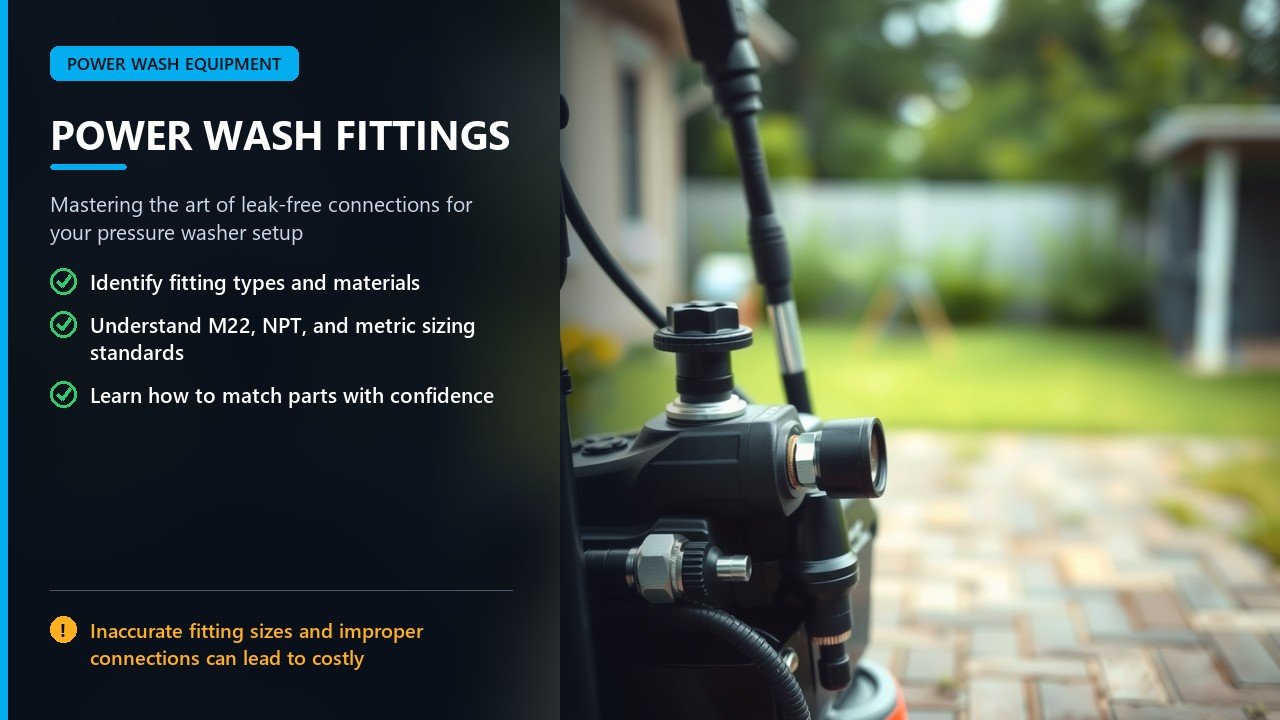
What Power Wash Fittings Do
Every fitting serves a specific job.
Couplers. The standard connectors that link the pump to the hose, or the hose to the gun. They take the brunt of the pressure, so use solid brass or steel rather than plastic.
Adapters. Parts that bridge two components which will not join on their own, such as when the pump has a male thread and the hose also ends in a male thread.
Quick connects. Push-and-click fittings that replace screw connections for fast, tool-free changes. A male plug pushes into a female socket and locks.
Swivels. Fittings that let a hose or gun rotate freely, preventing kinks and tangles as you move around obstacles.
Splitters and gauges. Accessory fittings that add a second outlet or insert a pressure gauge between the gun and hose.
Quick Connect Fittings
Quick connects are the most convenient option.
Plug and socket. The female side is called the socket or coupler, and it holds an O-ring to seal and ball bearings to grip. The male side is called the plug.
No threads. Quick connects do not screw. You pull back the collar and snap the plug in, then pull to release, which makes setup and teardown far faster.
Two common sizes. Pressure washers use two quick connect sizes. Hoses and pumps take 3/8-inch quick connects, while wands and nozzles take 1/4-inch quick connects.
Gender matters. A 3/8-inch QC plug is not the same part as a 3/8-inch QC socket, and neither tells you what thread or port sits behind it.
Sealing is in the O-ring. The O-ring in the female side is what actually stops leaks, so a worn O-ring causes drips even when the fitting is correct.
| Size | Typical Use |
|---|---|
| 1/4-inch QC | Nozzles, spray tips, foam accessories |
| 3/8-inch QC | Hoses, pumps, high-flow connections |
Threaded Fittings: M22, NPT, and Metric
Threads must match exactly to seal.
M22 metric threads. The most common thread on pressure washer pumps, hoses, and guns. The “22” is the outer thread diameter in millimeters, but that naming alone is not enough.
NPT. National Pipe Thread is a tapered U.S. standard seen on commercial hoses and pumps, commonly in 1/4, 3/8, and 1/2 inch sizes. It seals by metal-to-metal contact with sealant.
BSP. British Standard Pipe thread is an imperial naming convention common overseas. A 3/8-inch BSP thread actually measures about 16.66mm, which is why the name is misleading.
Thread pitch matters. M22 comes in pitch variants such as 1.5mm and, less often, 1.25mm. An M22-1.5 male will not screw into an M22-1.25 female, and forcing it strips the threads.
Sealing for M22. M22 fittings normally seal with an O-ring at the end of the male fitting, compressed against a mating surface inside the female fitting.
M22-14 Versus M22-15: The Critical Difference
This is the mistake that costs the most returns.
Same threads, different bore. Both M22-14 and M22-15 use the same external threads, so they usually screw together without resistance. Threading success does not mean a proper seal.
The inner stem. Inside the female M22 is a sealing stem with an O-ring. M22-14 uses a 14mm stem and M22-15 uses a 15mm stem, and the male bore must match.
What happens when they mismatch. A 14mm stem into a 15mm bore leaks, and a 15mm stem into a 14mm bore will not fit at all.
Which machines use which. M22-14 is standard on gas pressure washers and many electric units. M22-15 appears on select electric brands such as Sun Joe, AR Blue Clean, Stanley, and others.
The fix. A small M22 14mm-to-15mm adapter bridges the difference, which is one of the most useful fittings to keep on hand. Our guide to pressure washer adaptors covers these conversions.
Fitting Materials
Material affects durability and compatibility.
Brass. The most common and best all-around choice for light and mid-duty work. It resists water corrosion, seals well, and seats firmly without damaging pump threads.
Stainless steel. The choice for high pressure and harsh chemicals, with excellent corrosion and chemical resistance for professional use.
Plastic. Found on many low-pressure electric washers. Fine for light duty but not suited to high pressure.
O-rings and washers. The small rubber seals that prevent leaks. Keep spares on hand, because a worn O-ring causes drips no matter how good the metal is.
Galvanic corrosion. Joining bare brass directly to stainless steel can create a galvanic couple that corrodes the brass and seizes the parts. A rubber O-ring or a PTFE-taped joint breaks the circuit.
How to Identify Your Fittings
Measure before you buy.
Use calipers. Measure the inner bore of a male M22 connection, since 14mm looks slightly narrower than 15mm.
Check the manual. Your pressure washer manual usually states the fitting type outright.
Go by the connection, not the hose. The hose diameter does not tell you the fitting size. What matters is the fitting on the end and the port it connects to.
Use the brand as a hint, then verify. Most gas units are M22-14 and some electric brands run M22-15, but brands vary, so always measure or check the manual.
Record the full path. Write each connection as family, size, and gender, such as 3/8-inch QC male plug to M22 14mm coupler. This removes guesswork.
| Connection Point | Typical Interface |
|---|---|
| Machine outlet to hose | M22-14 or 3/8-inch QC |
| Hose to spray gun | M22 or 3/8-inch QC / threaded port |
| Gun to wand | M22 or 1/4-inch QC |
| Wand to nozzle | 1/4-inch QC |
| Water inlet | Garden hose thread |
Common Adapter Combinations
A few adapters solve most problems.
M22 to quick connect. The most common adapter, converting an M22 threaded connection to a 1/4 or 3/8-inch quick connect so accessories attach faster.
NPT to M22. Bridges a commercial NPT system with residential M22 components, such as a 3/8-inch NPT male to M22-14 male.
M22-14 to M22-15. Solves the gas-to-electric mismatch that causes leaks.
Quick connect size conversion. Converts between 1/4-inch and 3/8-inch quick connects, though most systems stick to one size on the high-pressure line.
Swivel adapters. M22 female to M22 male with a rotating joint, which stops the hose from fighting you and prevents kinks.
Pressure and Temperature Ratings
Ratings keep your setup safe.
Match the machine. Confirm every fitting is rated at or above your washer’s maximum output, not just the working pressure it cleans at.
An adapter does not raise ratings. It can make two shapes connect, but it cannot raise the pressure or temperature limit of the hose, gun, or accessory.
Never underrate. Do not put a 3,000 PSI fitting on a 4,000 PSI machine. Match the PSI stamped on the part by its maker.
Temperature for hot water. Hot water setups need seals and fittings rated for the temperature, often 200 degrees or more with Viton or similar O-rings.
Lowest component wins. The safe limit of the whole path is set by its weakest-rated component, whether that is a hose, a swivel, or a coupler.
Common Fitting Mistakes
Avoid these to prevent leaks and returns.
Assuming all M22 are the same. The inner 14mm versus 15mm size differs, and that is the most common cause of a leaking M22 connection.
Mixing NPT and BSP. They are different standards and are not interchangeable, even when the nominal size matches.
Buying by color or brand. Appearance does not guarantee fit. Match the exact connection family, size, and gender.
Using garden hose fittings on the high side. Garden hose thread is for the low-pressure inlet only, never the pump outlet.
Forcing almost-right threads. If a fitting does not start smoothly, stop. Forcing it cross-threads and damages both parts.
Ignoring small leaks. A drip under pressure worsens and wastes output. Fix it before it becomes a bigger failure.
Maintaining Your Fittings
Small care extends fitting life.
Inspect O-rings. Check for cracks, flattening, or wear, and replace them often. O-rings are cheap insurance against leaks, and a single worn ring can ruin an otherwise perfect connection.
Keep spares. A spare set of O-rings and a couple of common adapters save a trip to the store mid-job and keep a wash day moving without interruption.
Clean threads. Dirt and grit in threads prevent a proper seal and wear the metal. Wipe fittings clean before connecting, especially after working in sand or mud.
Do not overtighten. Hand-tight plus a light snug is enough for O-ring-sealed fittings. Overtightening deforms seals and can crack brass, creating a leak where none existed before.
Lubricate sparingly. A touch of silicone grease on O-rings helps them seat and last without attracting grit that would otherwise defeat the seal.
Protect from freezing. Water left in fittings can freeze and crack them, so drain and winterize as the season ends. Our guide to how to store a pressure washer for winter covers the full routine.
Fittings on Electric Versus Gas Machines
The two families differ in subtle, important ways.
Gas machines. Most gas pressure washers use M22-14mm fittings on the high-pressure hose and pump outlet, along with 1/4-inch and 3/8-inch quick connects.
Electric machines. Many electric washers use M22-15mm, and some low-pressure units use proprietary couplers or plastic fittings. This is the mismatch that trips up owners upgrading electric accessories.
Mixed setups. When you connect a gas hose to an electric gun, the female fitting may have a 14mm O-ring while the gun has a 15mm bore, leaving 1mm of space that leaks under pressure.
Brand-specific kits. Some consumer machines use interfaces that do not match standard professional components, which is why brand-specific adapter kits exist.
The rule. Measure both sides of every connection and compare before assuming any two machines will share fittings.
Building a Leak-Free Setup
Plan the whole path, not just one joint.
Map the connections. List every point from the machine outlet to the nozzle: pump to hose, hose to gun, gun to wand, wand to nozzle.
Standardize on quick connect. Converting the pump, hose, and gun to quick connects speeds setup, protects threads from wear, and makes swapping accessories easy.
Add a swivel. A gun or hose swivel reduces kinks and strain, which is one of the most satisfying upgrades for a few dollars.
Seal every threaded joint. Use O-rings where designed, and PTFE tape or a pressure-rated sealant on tapered threaded joints. Never tape a joint that relies on an O-ring.
Test under pressure. Connect water and run the machine before a job, checking each joint for drips that indicate a mismatch or worn O-ring.
Keep it minimal. Each adapter is another potential leak, so use the fewest needed to reach your goal.
Understanding Thread Standards in Depth
Threads fail to seal for identifiable reasons.
Thread diameter. The size across the threaded part, such as 3/8 inch or M22.
Thread pitch. The distance between thread lines, which must match exactly or the parts will not seat.
Tapered versus straight. NPT is tapered and seals tighter as it threads in, while M22 and BSP are generally straight and rely on an O-ring or a sealing washer.
Right versus left hand. Almost all pressure washer threads are standard right-hand, though some specialty fittings differ.
Why almost-right fails. A thread that starts but does not bottom out leaves a gap that cannot seal under high pressure, which is the classic cross-standard mismatch.
Fittings for Common Accessories
Accessories each bring their own connection needs.
Foam cannons. Most use a 1/4-inch quick connect plug, though some residential couplers need a low-profile or model-specific adapter.
Surface cleaners. They may connect at the 1/4-inch wand side or the 3/8-inch hose side depending on design, so check before buying.
Pressure gauges. A gauge with quick-connect ends needs matching adapters to insert between the gun and hose.
Extension wands. Usually 1/4-inch quick connect at both ends, letting you add reach without tools.
Turbo nozzles and tips. Almost universally 1/4-inch quick connect male plugs, which is why nozzle selection is the easiest part of the system.
Hose extensions. A dual M22 male coupling joins two M22 female hose ends, or use quick-connect couplings for a tool-free join.
| Accessory | Typical Connection |
|---|---|
| Foam cannon | 1/4-inch QC plug |
| Surface cleaner | 1/4-inch or 3/8-inch QC (check design) |
| Extension wand | 1/4-inch QC both ends |
| Nozzle tips | 1/4-inch QC plug |
| Hose extension coupling | M22 or QC |
Starter Fittings Worth Owning
A small kit prevents most headaches.
Quick connect couplers. One or two sets to convert the pump and gun to snap-on connections.
A gun swivel. Reduces kinks and makes the hose easier to manage, and it is one of the best value upgrades.
An M22-14 to M22-15 adapter. Solves the most common leak-causing mismatch.
An M22 to quick-connect adapter. Converts a threaded connection so standard accessories attach instantly.
Spare O-rings. A bag of assorted O-rings costs almost nothing and saves a mid-job trip.
PTFE tape. For tapered threaded joints, a roll of PTFE tape ensures a clean seal.
Troubleshooting Fitting Leaks
Diagnose the drip before throwing parts at it.
Leak at an M22 joint. Almost always a 14mm versus 15mm bore mismatch or a worn O-ring. Check the bore and replace the O-ring, or add the adapter.
Leak at a quick connect. Usually a worn or missing O-ring in the socket, or a damaged plug. Replace the O-ring first, then the fitting.
Leak at a threaded port. Often insufficient or incorrect sealing, cross-threading, or a tapered thread that needs PTFE tape. Clean the threads and reseal.
Spray from the collar. Debris or grit trapped in the quick connect prevents the O-ring from seating. Flush and clean it.
Fitting that will not seat. A wrong size or a cross-thread is forcing it. Stop, identify the mismatch, and use the correct adapter rather than forcing it.
Water weeping under the gun. A worn internal seal or an overtightened fitting. Loosen, replace the O-ring, and hand-tighten only.
Frequently Asked Questions
What are power wash fittings? They are the couplers, adapters, quick connects, and swivels that join the pump, hose, gun, wand, and nozzles into one sealed high-pressure line, and their correct sizing is what separates a leak-free setup from a frustrating one.
Are pressure washer fittings universal? No. Nozzle tips are close to a standard 1/4-inch quick connect, but hose and gun fittings vary by brand and size, including M22-14 versus M22-15 or 3/8-inch quick connect versus threaded. Always identify your own interface rather than trusting a “universal” label.
What is the difference between M22-14 and M22-15? The inner diameter of the M22 coupler is either 14mm or 15mm. They share the same external threads, so a 14mm will thread into a 15mm but leak, and you need a small adapter to join them properly and stop the drip under pressure.
What size quick connect does a pressure washer use? Hoses and pumps take 3/8-inch quick connects, while wands and colored nozzle tips take 1/4-inch quick connects. A 1/4-inch plug will not fit into a 3/8-inch coupler and vice versa.
How do I know if I need a male plug or female coupler? Identify the actual mating half on the washer, hose, gun, or wand. Quick-connect gender refers to the plug and socket, while threaded fittings have their own male or female thread description. Recording both family and gender before buying avoids the common mistake of ordering the wrong half.
Can I use an adapter to make any two fittings work? Adapters help when the systems are compatible but need a bridge, and the adapter must be pressure-rated for your machine. If the fit is far off, buy the correct matching part instead of stacking adapters.
Why does my M22 connection leak even though it screws on? The inner bore and stem sizes do not match, usually 14mm to 15mm. A mismatch threads together smoothly but cannot seal, so use the correct adapter and a fresh O-ring.
What is the best fitting material? Brass for most light and mid-duty setups, and stainless steel for high pressure or harsh chemicals. Avoid plastic except on low-pressure electric units.
Can I use PTFE tape on pressure washer fittings? Only on tapered metal threads like NPT. Do not tape O-ring-sealed fittings such as M22 and quick connects, because the tape interferes with the rubber seal and can actually cause a leak instead of preventing one.
Are 3/8-inch and M22 fittings interchangeable? No. A 3/8-inch threaded fitting is narrower than M22 and will not fit M22 ports or adapters, even though the two can look similar at a glance and are easy to confuse.
How do I stop a quick connect from leaking? Replace the O-ring in the socket first, since that is what seals the joint under pressure. If it still leaks, check the plug for damage or a wrong size before buying new fittings.
Do I need a swivel fitting? A swivel is not required, but it prevents hose kinks and reduces strain on your wrists, which makes it one of the most useful low-cost upgrades you can add to a pressure washer setup.
Can I connect a gas pressure washer hose to an electric gun? Sometimes, with the right adapter. The M22-14 and M22-15 mismatch is common between gas and electric machines, so confirm the bore on both sides and use an adapter if they differ.
What pressure should the fittings be rated for? At or above your machine’s maximum output, not just its working pressure, and be sure to match the temperature rating if you run hot water through the system.
Why do my brass fittings seize together? Bare brass and stainless steel in contact with water can form a galvanic couple that corrodes the brass and seizes the joint over time. A rubber O-ring or a PTFE-taped connection breaks the circuit and prevents this.
Final Thoughts on Power Wash Fittings
Power wash fittings reward a few minutes of careful identification. The connection family, the exact size, the gender, and the M22 inner bore all matter, and getting them right turns a frustrating leak into a snap-together setup. Brass covers most needs, stainless steel handles the tough jobs, and the O-ring is the small part that actually keeps water inside the line.
Marcus stopped buying “universal” parts and started reading his fittings, and his setup finally sealed. Do the same. Measure the bore, record each connection, keep spare O-rings and a couple of adapters on hand, and match every rating to your machine. Understand a handful of standards, M22, NPT, and 3/8-inch or 1/4-inch quick connect, and you will stop chasing leaks and start spending your money on cleaning instead of connectors.
The lesson is simple: fittings are the least glamorous part of a pressure washer and the most common reason a job stalls. Two connections that look identical can seal perfectly or spray water sideways, all depending on a bore size measured in a single millimeter. Take the time to identify what you own, document it once, and future accessory purchases become quick and confident. A few dollars of brass and rubber stands between a clean, reliable setup and a frustrating afternoon of leaks, so treat your fittings with the same attention you give your machine and the rest of your workflow will reward you for it.