The pressure washer hose is one of the most overlooked parts of the whole system, yet it carries every drop of water from the pump to the gun. A hose that is too short, too thin, or in poor condition throttles performance, leaks, or fails at the worst moment. Getting the right hose — and caring for it — keeps pressure high and jobs moving.
This guide explains how pressure washer hoses are made, the sizes and materials available, how to choose one for your machine, and how to maintain it so it lasts.
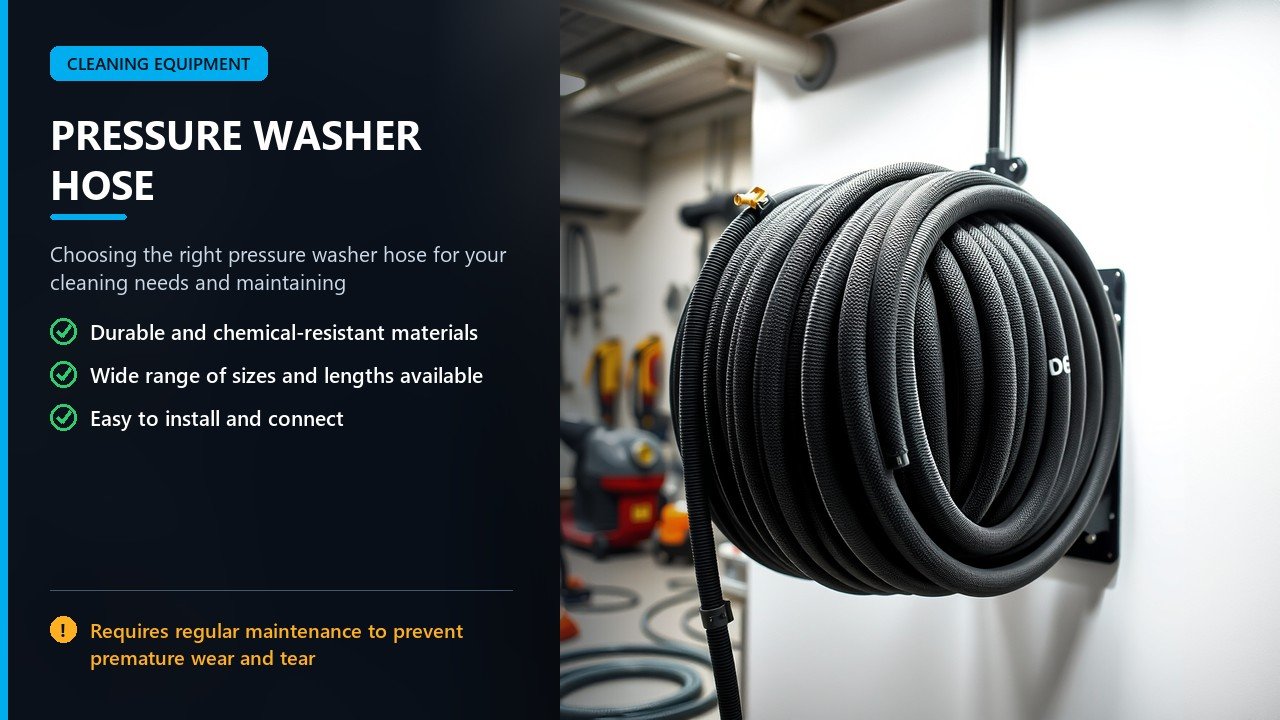
What a Pressure Washer Hose Does
The hose connects the pump outlet to the spray gun. Unlike a garden hose, it must withstand high pressure, harsh detergents, and rough handling while remaining flexible.
- Carries pressurized water from pump to gun.
- Withstands high PSI — ratings far above garden hoses.
- Resists chemicals in detergents and cleaners.
- Flexes so you can move around the job.
- Connects through standard fittings.
Quick Note: A worn or undersized hose can rob a strong machine of pressure. The hose is not just a tube — it is part of the performance equation.
How Hoses Are Made
| Component | Function |
|---|---|
| Inner tube | Carries the water; chemical-resistant |
| Reinforcement | Braided fiber or wire for pressure strength |
| Cover | Protects against abrasion, UV, and oils |
| Fittings | Brass or steel ends that connect to pump and gun |
| Strain relief | Protects the hose where it bends at the fitting |
The reinforcement layer determines the hose’s pressure rating, while the cover determines how well it survives dragging over concrete and pavement.
Sizes: Diameter and Length
| Diameter | Notes |
|---|---|
| 1/4 inch | Common on electric and smaller gas machines |
| 5/16 inch | Middle ground; good flow and flexibility |
| 3/8 inch | Higher flow; common on larger gas machines |
| 1/2 inch | High-flow commercial use |
Short Note: Larger diameter carries more flow with less pressure loss, but it is heavier and stiffer. Match the hose to your machine’s GPM rather than buying the biggest available.
Length: Reach vs Pressure Loss
| Length | Best For |
|---|---|
| 20–25 ft | Compact areas and vehicles |
| 30–50 ft | General home use |
| 50–100 ft | Large properties; needs higher GPM |
Longer hoses add reach but also pressure loss and weight. Keep the hose as short as the job allows for maximum pressure at the nozzle.
Materials and Construction Types
| Type | Characteristics |
|---|---|
| Standard rubber / PVC | Affordable; less flexible in cold |
| Thermoplastic | Durable, abrasion-resistant |
| Wrapped rubber | Flexible; common on premium hoses |
| Wire-braided | Very high pressure-rated |
| Steel-braided | Extreme pressure; less flexible |
Note: Even a budget hose handles typical residential pressure. Higher-rated hoses matter most on large gas machines and commercial rigs.
Fittings and Connections
| Fitting | Details |
|---|---|
| M22 threaded | Common pump and gun connection |
| Quick-connect | Fast connect and release |
| O-ring seals | Stop leaks at the join |
| Adapters | Bridge different standards |
Match the fittings to your pump and gun, or use adapters. A mismatched thread is the most common reason a new hose will not fit.
Choosing the Right Hose
| Priority | What to Prefer |
|---|---|
| 1. Pressure rating | Above your machine’s PSI, with margin |
| 2. Diameter | Matched to your GPM |
| 3. Fittings | Match pump and gun, or use adapters |
| 4. Length | Just enough reach |
| 5. Flexibility | Easier to handle, especially in cold weather |
| 6. Cover durability | Abrasion-resistant for concrete |
For most homeowners, a 1/4-inch or 5/16-inch hose at 25–50 feet with matching M22 or quick-connect fittings is ideal.
Signs Your Hose Needs Replacing
- Blisters or bulges — the reinforcement is failing.
- Cracks or dry rot — especially near fittings.
- Persistent leaks at the fittings.
- Kinks that stay kinked.
- Frayed cover exposing the reinforcement.
- Pressure drop despite a healthy machine.
- Bulging at the crimp where the fitting attaches.
A hose showing any of these signs should be replaced. A burst hose under pressure is a safety hazard, not just an inconvenience.
Maintenance and Care
| Task | Why |
|---|---|
| Coil loosely | Prevents kinks and stress points |
| Avoid dragging over sharp edges | Protects the cover |
| Check O-rings | Prevents connection leaks |
| Store indoors | Avoids UV and freeze damage |
| Drain before storing | Prevents freeze damage and mold |
Simple care adds years to a hose. Most failures come from kinking, dragging, and freezing — all avoidable.
Safety With Pressure Washer Hoses
- Never use a hose rated below your machine’s pressure.
- Inspect before every use for bubbles, cuts, and worn crimps.
- Keep clear of the hose when pressurizing; a burst can whip.
- Release pressure before disconnecting.
- Don’t run over the hose with vehicles or equipment.
- Keep it away from hot surfaces and sharp edges.
- Watch for leaks that spray toward people.
A pressurized hose stores energy. Treating it with respect — especially near the fittings — prevents injuries and expensive failures.
Fixing Common Hose Problems
| Problem | Likely Cause | Fix |
|---|---|---|
| Leak at the connection | Worn O-ring or loose fitting | Replace O-ring; snug the fitting |
| Kinked hose | Poor coiling and storage | Coil loosely; replace if permanent |
| Low pressure at nozzle | Hose too long or too thin | Use a shorter or larger hose |
| Bulge in the hose | Internal damage | Replace immediately |
| Burst near crimp | Worn fitting or over-pressure | Replace the hose |
Most hose problems are cheap to prevent and only sometimes worth repairing. Anything with a bulge or burst should be replaced outright.
Hoses for Different Machines
| Machine | Typical Hose |
|---|---|
| Electric 1,500–2,000 PSI | 1/4-inch, 20–35 ft |
| Gas 2,700–3,200 PSI | 5/16-inch, 25–50 ft |
| Gas 3,500–4,000+ PSI | 3/8-inch, 50 ft |
| Commercial high flow | 3/8–1/2-inch, heavy-duty |
Match the hose to the machine’s output. Undersizing restricts flow and strains the pump; oversizing adds weight without benefit.
Cold-Weather Use and Storage
- Hoses stiffen in cold weather. Warm them before use if possible.
- Never store a wet hose below freezing. Ice cracks the inner tube.
- Drain thoroughly before storage.
- Bring hoses indoors in winter.
- Avoid forcing a stiff, frozen hose.
Cold is hard on hoses. A drained, indoor-stored hose lasts far longer than one left coiled outside all winter.
Common Mistakes to Avoid
- Buying by price alone. Cheap hoses fail early.
- Ignoring the pressure rating. A burst hose is dangerous.
- Using a hose that is too long. Pressure drops.
- Kinking on the reel. Damages the tube.
- Dragging over sharp edges. Cuts the cover.
- Leaving it connected and pressurized. Stresses fittings.
- Storing wet in freezing conditions. Cracks the hose.
Understanding Pressure Loss in Hoses
Pressure loss is the drop in pressure as water travels through a hose. It is affected by length, diameter, and flow, and it explains why a longer hose can feel weaker than a short one.
| Factor | Effect on Pressure |
|---|---|
| Longer hose | More loss |
| Smaller diameter | More loss |
| Higher flow (GPM) | More loss |
| Kinks and bends | More loss |
| Worn or swollen inner tube | More loss |
Short Note: If you must extend reach, go up a diameter rather than adding length. A slightly larger hose offsets the loss from the extra distance.
Non-Marking and Specialty Hoses
| Type | Use |
|---|---|
| Non-marking hose | Leaves no scuffs on driveways and vehicles |
| Jetting hose | Drain and sewer cleaning |
| Hot-water hose | High-temperature commercial cleaning |
| Steel-braided hose | Extreme pressure applications |
| Ultra-flexible hose | Cold-weather and detail work |
Specialty hoses solve specific problems. A non-marking hose, for example, is a small upgrade that protects finished surfaces.
Extending and Joining Hoses
- Use a coupler rated for pressure. Never a garden-hose adapter.
- Add O-rings or sealing washers at every join.
- Keep joins off the ground to avoid abrasion and leaks.
- Prefer one long hose over multiple joins where possible.
- Check the coupler’s pressure rating against your machine.
Every join is a potential leak point, so keep them minimal and rated for the pressure your machine produces.
How to Coil a Hose Correctly
| Step | Action |
|---|---|
| 1. Drain the hose | Remove all water |
| 2. Lay it straight | Let it relax out of kinks |
| 3. Coil loosely | Use large loops, no tight bends |
| 4. Use a figure-eight | Prevents twist |
| 5. Hang or store | Off the floor and out of the sun |
Correct coiling is the single best way to prevent kinks. The figure-eight method keeps the hose from twisting on itself.
Getting More Life From Your Hose
- Carry, don’t drag the hose across sharp ground.
- Keep it off hot exhausts and out of sunlight.
- Rotate stress points by changing your coiling direction.
- Release pressure before disconnecting.
- Store indoors and drained.
- Replace O-rings before they fail.
- Inspect after every job for bubbles and cuts.
Most hoses die young from neglect, not wear. A little attention to how you handle and store it makes it last for years.
Upgrading Your Hose
Replacing a stock hose is one of the easiest and most rewarding pressure washer upgrades.
- Longer reach without moving the machine.
- Better flexibility reduces fatigue and kinking.
- Higher rating handles more pressure reliably.
- Non-marking covers protect driveways and vehicles.
- Quality fittings seal better and resist corrosion.
- Steel-braided options for high-pressure use.
Quick Note: A high-quality hose often improves the feel of the entire machine, because a stiff, kinking stock hose is a common frustration.
Hose Reels and Storage
| Storage Method | Benefit |
|---|---|
| Manual hose reel | Tidy and quick to deploy |
| Wall-mounted hook | Simple and cheap |
| Figure-eight coil | Prevents twist and kinks |
| Storage bag | Protects from UV and dirt |
Storing a hose in a loose figure-eight prevents the twist that leads to kinks and stress points. A reel keeps things tidy and fast to use.
Repair vs Replace
Some hose problems can be fixed; others cannot.
| Issue | Repair or Replace? |
|---|---|
| Leaking connection | Repair — replace O-ring |
| Worn fitting | Repair — replace fitting (if serviceable) |
| Small surface nick | Monitor; replace if it deepens |
| Bulge or bubble | Replace immediately |
| Burst section | Replace |
Note: Never attempt to patch a burst or bulging high-pressure hose. Internal damage cannot be safely repaired at home.
Real-World Scenarios
Scenario 1: A homeowner whose stock hose is stiff and short. Upgrading to a flexible 35-foot hose makes the machine easier to use and reaches more of the driveway.
Scenario 2: A mobile detailer. A 50-foot, 3/8-inch hose with quality fittings provides the reach and flow to work around a vehicle without moving the machine.
Scenario 3: A winter user. Draining and storing the hose indoors each winter prevents the freeze damage that ruins hoses left coiled outside.
Frequently Asked Questions
What size pressure washer hose should I use? Match the diameter to your machine’s GPM — 1/4-inch for electric, 5/16 or 3/8-inch for larger gas machines.
Does a longer hose reduce pressure? Yes, longer hoses cause more pressure loss. Keep the hose as short as the job allows.
Can I use a garden hose as a pressure hose? No. Garden hoses cannot withstand pressure washer PSI and will burst.
How long do pressure washer hoses last? With good care, several years. Kinking, dragging, and freezing shorten their life dramatically.
Can I repair a burst hose? No. A burst or bulging high-pressure hose should be replaced, not repaired.
What causes pressure loss? A hose that is too long, too thin, kinked, or internally damaged.
Final Thoughts
The pressure washer hose is easy to ignore until it fails. Choosing one rated for your machine, sized to your flow, and suited to your reach keeps pressure high and cleaning smooth. Care for it, store it dry, and replace it at the first sign of a bulge or burst.
For related reading, see our guides on the active pressure washer hose and pressure washer jetting hose.