I once watched a commercial kitchen manager try to clean the hood and exhaust filters with a standard cold-water pressure washer. Water sprayed everywhere, grease smeared down the wall, and after two hours the filters were still tacky and the floor was a slick hazard. The next week, a cleaning crew arrived with a pressure washer with steam cleaner capability, and the same filters came clean in a fraction of the time, with far less mess and a genuine sanitizing effect. That contrast is why combination pressure and steam machines exist, and why professionals in food service, healthcare, and heavy industry treat them as essential rather than optional.
But there is a lot of confusion around these machines. Some are true steam cleaners reaching very high temperatures under low moisture, others are simply hot water pressure washers marketed with the word “steam,” and still others claim steam but barely reach hot-water temperatures. If you are trying to decide whether a pressure washer with steam cleaner is worth buying, and which type actually does what you need, this guide will clear up the terminology, the temperatures, the real-world uses, and the safety rules.
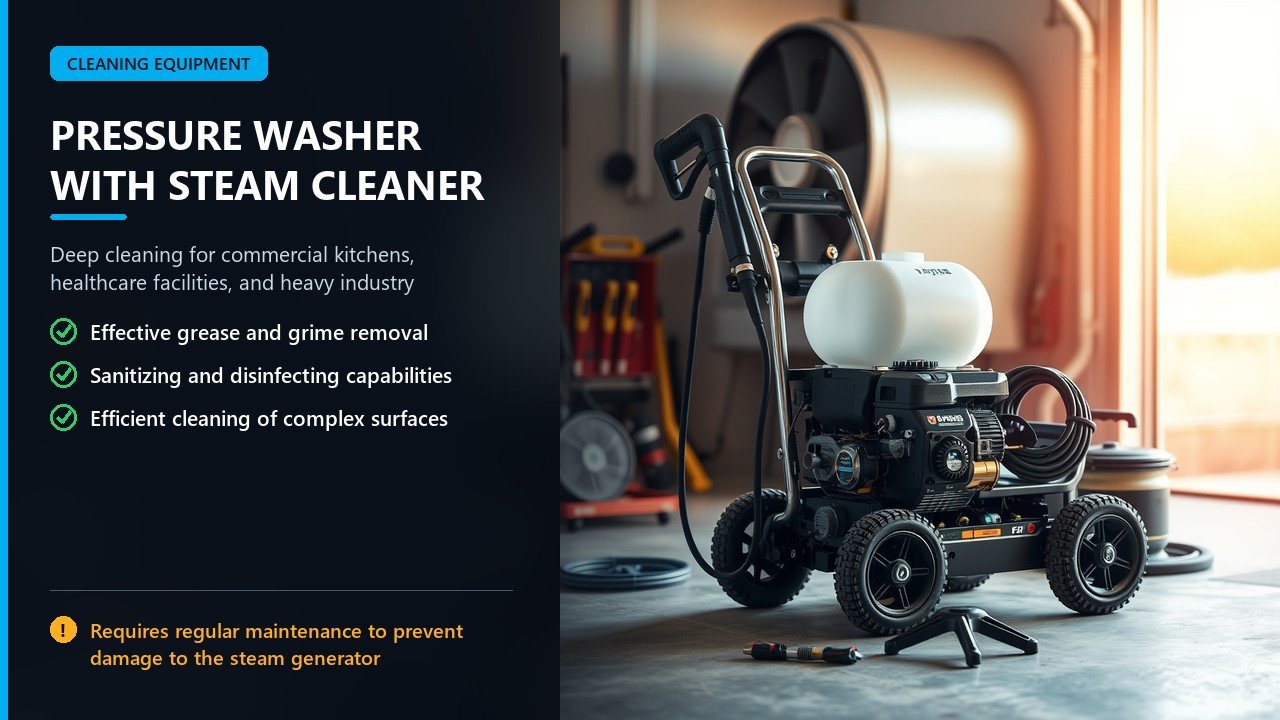
What Is a Pressure Washer With Steam Cleaner
The phrase describes machines that can both pressure wash and produce steam. In practice, that covers a spectrum of equipment, from hot water pressure washers that reach high temperatures to dedicated steam cleaners that generate true vapor. Understanding where a given machine falls on that spectrum is the single most important thing to get right, because the word “steam” is used loosely in marketing.
A conventional pressure washer uses cold water at high pressure and high flow. It relies on force and volume to blast soil away. It is great for hard, durable surfaces and stubborn mineral dirt, but it struggles with grease and it uses a lot of water.
A hot water pressure washer adds heat. It uses a burner, usually diesel or propane, to heat the water, often into the range of 180 to 200 degrees Fahrenheit. This dramatically improves grease removal and cleaning speed, but it is technically hot water cleaning, not true steam cleaning.
A true steam cleaner heats water to the point that it becomes vapor, with temperatures that can exceed 250 to 300 degrees Fahrenheit at the nozzle. The water volume is much lower, which is the key difference. Steam delivers intense heat with minimal moisture, which is why it is prized for sanitizing, for cleaning electrical and mechanical components without flooding them, and for tackling grease in environments where too much water is a problem.
When you see a machine advertised as a pressure washer with steam cleaner, ask three questions: what is the actual output temperature, does it produce true vapor or heated water, and can it operate in both pressure-wash and steam modes. The answers tell you what you are really buying.
Steam vs Pressure Washing: The Core Differences
The two methods use the same basic physics differently, and that shapes where each one wins.
Pressure washing
Steam cleaning
Many modern machines blend the two, offering hot water pressure washing and a steam mode, so the operator can choose the right approach for each job. That flexibility is the real value of a combination machine.
| Factor | Pressure Washing | Steam Cleaning |
|---|---|---|
| Primary Action | Mechanical force | Heat and vapor |
| Water Use | High | Low |
| Grease Removal | Moderate with cold water | Excellent |
| Sanitizing | Limited | Strong with heat |
| Delicate Surfaces | Can damage | Gentler at low pressure |
| Best For | Concrete, hard surfaces, heavy dirt | Grease, sanitation, crevices, machinery |
Wet Steam vs Dry Steam: What the Terms Mean
If you shop for these machines, you will encounter “wet steam” and “dry steam.” The distinction matters.
Wet steam
Dry steam
For most pressure washing tasks that involve grease and heavy soil, wet steam offers a great balance of heat and moisture. For sanitizing and precision work, dry steam wins. A combination machine may offer both, or lean toward wet steam with the ability to run hot water at high moisture.
How Steam Is Actually Generated
Knowing the mechanism helps you evaluate machines and understand their limits.
Most combination machines use a burner, fired by diesel or propane, to heat water as it passes through a heating coil. At lower temperatures and higher flow, this produces hot water for pressure washing. As you reduce flow and increase heat, the water can flash into steam at the nozzle, producing wet or dry steam depending on the machine’s design and settings.
True steam requires precise control of both temperature and flow, because you need enough heat to convert water to vapor and enough back pressure to maintain the vapor state until it reaches the nozzle. This is why dedicated steam cleaners and high-end steam pressure washers use specialized coils, burners, and controls. A basic hot water pressure washer cannot simply be turned up into a true steam cleaner without the right engineering.
Some machines are single-mode, dedicated to either hot water or steam. Others are dual-mode, letting the operator switch between pressure washing and steam cleaning. Dual-mode machines offer the most flexibility, at the cost of higher price and complexity.
What Temperature Actually Does
Heat is not just a comfort feature. It has measurable effects that matter in professional cleaning.
Dissolving grease. Grease, oil, and fats soften and flow as temperature rises, allowing water to lift and carry them away. This is why hot water and steam clean grease far better than cold water, and why food service cleaning depends on heat.
Sanitizing. High temperatures reduce and can eliminate many microorganisms. Steam and very hot water are used in food processing, healthcare, and hospitality to sanitize surfaces without relying solely on chemicals. This does not replace proper cleaning and chemical disinfection in all cases, but it is a powerful complement.
Faster cleaning. Higher temperatures speed up chemical reactions, so detergents work faster and less product is needed. On large commercial jobs, that translates to meaningful time and cost savings.
Less water. Steam cleaning in particular uses very little water, which matters where runoff is regulated, where water supply is limited, or where flooding a surface is undesirable.
Where Combination Machines Earn Their Keep
The applications for a pressure washer with steam cleaner span several industries, and each one values a different strength.
Commercial kitchens and food service. Grease, baked-on food, and food residue are the defining challenges. Steam and hot water dissolve this soil where cold water fails, and the sanitizing effect helps meet hygiene expectations. Hoods, filters, floors, dumpster pads, and equipment all benefit.
Healthcare and hospitality. Sanitation matters, and steam reduces reliance on harsh chemicals while cleaning thoroughly. Bathrooms, tile, grout, and high-touch surfaces are common targets.
Automotive and fleet. Engine bays, undercarriages, wheel wells, and heavy grease respond well to heat. Steam reaches into tight spaces on engines and components without flooding sensitive electronics, which is a major advantage over pressure washing alone.
Manufacturing and machinery. Equipment caked in oil and industrial grime is cleaned with steam to avoid saturating electrical components and to remove oily films that cold water leaves behind.
Residential deep cleaning. Homeowners use steam on ovens, grills, tile, grout, bathroom fixtures, and outdoor furniture. For barbecue grills and range hoods, steam is transformative.
Agriculture and heavy equipment. Caked mud combined with grease and hydraulic oil is a classic hot water and steam job.
| Application | Best Mode | Why |
|---|---|---|
| Restaurant hoods and filters | Steam or hot water | Dissolves grease, sanitizes |
| Engine bays | Steam | Cleans without flooding electronics |
| Concrete driveways | Pressure wash | Force and volume remove mineral dirt |
| Bathroom tile and grout | Steam | Heat lifts grime, low water |
| Industrial machinery | Steam | Removes oil film, avoids water damage |
| Wood decks | Pressure wash, gentle | Low pressure, controlled moisture |
Do You Actually Need Steam
Not everyone does, and overselling yourself on steam capability wastes money. Here is a simple decision guide.
If your cleaning is mostly concrete, driveways, siding, and general dirt, a standard pressure washer, possibly a hot water one, covers you. Steam adds cost and complexity you may never use.
If your cleaning involves grease, oil, food residue, or sanitizing, steam and hot water become genuinely valuable, and a combination machine is worth the investment. If you also need to clean sensitive equipment or work in environments where excess water is a problem, true steam moves from valuable to essential.
Homeowners usually do not need true steam, but a hot water machine can be a worthwhile upgrade for a serious garage setup. Professionals in food service, healthcare, automotive, and industrial cleaning should treat steam capability as a core requirement, not a bonus.
Choosing a Steam Pressure Washer
When you shop for a pressure washer with steam cleaner capability, evaluate these factors carefully.
Real output temperature. Find the actual nozzle temperature, not just a claim. True steam machines exceed well over 250 degrees Fahrenheit, while hot water machines typically top out around 180 to 200. Ask the seller for the real number at working flow.
Wet or dry steam. Decide which you need based on your work. Dry steam for sanitizing and sensitive areas, wet steam for general grease and dirt.
Flow and pressure. Even in steam mode, you want enough pressure and flow to do useful work. Check the ratings in each mode.
Fuel type. Diesel and propane are common. Diesel is efficient and widely available, propane burns cleaner. Consider storage and where you will operate.
Duty cycle. Commercial machines are built for continuous use. If you clean all day, buy a machine designed for it, not a light-duty unit that overheats.
Build and serviceability. Look for quality pumps, accessible burners and coils, and available parts. A machine you cannot service is a machine you cannot keep running.
Safety systems. Pressure relief, temperature controls, and total stop systems matter even more when you add heat.
Safety Rules for Steam Cleaning
Steam and hot water raise the stakes on an already dangerous tool. Follow these rules without exception.
Never point the nozzle or steam plume at a person or animal. Burns from steam are instantaneous and severe. Wear protective gloves, boots, long sleeves, and eye protection, and keep the work area clear of bystanders. Never clean your own skin, and never use steam to warm up. Because burners produce carbon monoxide, never run a fuel-fired machine indoors or in an enclosed space without ventilation. Keep the machine on stable ground, and be careful around electrical equipment and outlets, since water and electricity are a lethal combination. Finally, let the machine cool before servicing, because coils and fittings stay dangerously hot long after shutdown.
Maintenance for Combination Machines
Heat adds maintenance demands. Budget time for them or the machine will degrade.
Descale the heating coil based on water hardness and use, because scale reduces heat transfer and efficiency and can eventually cause overheating. Service the burner regularly, including the fuel nozzle and filters, because poor combustion means poor heat. Change pump oil on schedule and use the correct spec. Flush and clean the system after detergent use, and check the inlet filter often. Inspect hoses, guns, and fittings for heat damage, and replace anything rated only for cold water. Winterize the machine thoroughly, because trapped water in a coil or pump cracks components when it freezes. Finally, test all safety systems regularly.
Common Mistakes and Misconceptions
Believing every “steam” machine makes true steam. Many are hot water machines. Verify temperature and vapor type.
Using steam on every surface. Steam is not always better. On durable concrete, high-pressure water may be faster. Match the method to the job.
Ignoring water hardness. Hard water scales the coil, killing efficiency. Descale and consider softening or filtering your water.
Running indoors without ventilation. Carbon monoxide from the burner is deadly. Ventilate or work outdoors.
Neglecting safety gear. Steam burns are instant. Protect yourself every time.
Skipping descaling the coil. This is the most common cause of lost heat and failed burners.
How to Use a Steam Pressure Washer, Step by Step
Getting a professional result from these machines is about technique. Here is a workflow that works across most jobs.
1. Assess the surface and soil. Identify what you are cleaning and what is on it. Grease, food residue, mineral dirt, and biological growth each call for a slightly different approach. Test in a hidden spot before committing.
2. Choose the mode. Use steam or hot water for grease and sanitation. Use pressure wash mode for heavy mineral dirt on durable surfaces. Match the tool to the soil.
3. Pre-treat when needed. On heavy grease, apply a suitable degreaser and let it dwell, keeping the surface wet. Heat will amplify the chemistry.
4. Bring the machine to temperature. Give the burner time to heat water to full working temperature before you start. Working with lukewarm steam wastes time and fuel.
5. Work in sections. Clean in manageable areas so the surface does not dry out and so you can inspect as you go. Keep the nozzle moving and at a consistent distance.
6. Rinse where appropriate. Some steam jobs need no rinse because moisture is minimal; others, especially detergent-treated surfaces, should be rinsed and inspected.
7. Manage water and runoff. Even with low-moisture steam, commercial washing produces contaminated water. Capture or dispose of it according to local rules, and never let grease-laden runoff reach a storm drain.
8. Cool down and maintain. After the job, run the machine through its shutdown procedure, allow it to cool, and do a quick inspection for leaks, soot, or worn fittings.
Real-World Scenarios and Expected Results
Concrete examples make the value of a combination machine clear.
A restaurant range hood and filters. Steam softens baked-on grease so it releases and rinses away, and the heat adds a sanitizing effect. What takes hours with cold water and harsh chemicals can be done much faster with steam, with less chemical runoff.
A dumpster pad behind a grocery store. This is a heavy grease and organic job. A hot water machine with a surface cleaner covers the flat area fast, while steam handles the caked corners and the bin itself. The result is a clean pad with no greasy film left behind, which is exactly what inspectors look for.
An engine bay filled with oil and grime. Steam cleans around wiring, hoses, and components without flooding them, which is safer than pressure washing alone. Pre-treat heavy areas with degreaser, then let the steam do the work, keeping the nozzle at a safe distance and avoiding direct pressure on electrical parts.
A commercial bathroom with tile and grout. Steam lifts grime from grout lines and sanitizes high-touch surfaces, all with very little water, which means faster drying and less mess.
A residential barbecue grill. One of the best home uses for steam. Baked-on grease and food residue release quickly, and the grill is left clean and sanitized without a mountain of water and soap.
Cost and Return on Investment
Steam-capable machines cost more than a basic pressure washer, and they require more maintenance. Whether the investment pays off depends entirely on your workload.
For a professional cleaning business, the return comes from speed and capability. Jobs that require heat take dramatically less time, which means more jobs per day, and the sanitizing benefit opens doors to food service, healthcare, and hospitality clients who require it. On grease-heavy work, a hot water or steam machine is often the difference between winning and losing the contract.
For a homeowner, the math is different. If you own a barbecue grill, an oven, a range hood, and some tile, you may not need a full steam pressure washer, but you will appreciate one if you clean those items often. Many homeowners instead buy a smaller dedicated steam cleaner for indoor tasks and keep a standard pressure washer for outdoor work, which is often the more economical combination. If you are already in the market for a hot water machine for a serious garage or small business, paying a bit more for steam capability can be worthwhile, but only if you will actually use it.
Quick Note: Do not buy steam capability “just in case.” You will pay for it up front and in maintenance. Buy it only when grease or sanitation is a regular part of your work, because that is the only case where the premium earns its keep.
Pressure Washer With Steam Cleaner: Frequently Asked Questions
Is steam better than pressure washing? They solve different problems. Steam excels at grease, sanitation, and sensitive areas. Pressure washing excels at heavy mineral dirt on durable surfaces. Many jobs benefit from both.
Do I really need true steam, or is hot water enough? If grease and sanitizing are central to your work, true steam adds real value. If your work is general cleaning, hot water or even cold pressure washing may be sufficient.
Can a pressure washer be converted to steam? Not simply. True steam requires a machine engineered for it, with appropriate coil, burner, and controls. A basic hot water pressure washer is not a true steam cleaner.
Does steam kill germs? High temperature reduces and can eliminate many microorganisms, which is why steam is used for sanitation. Chemical disinfection may still be required in some settings and should follow proper cleaning.
Are steam pressure washers safe on cars? At appropriate settings and distance, steam is excellent for engine bays and greasy areas and safe on paint when used carefully. Never hold it in one spot, and keep it away from seals and electronics at close range.
What is the best use for a steam pressure washer at home? Grills, ovens, range hoods, tile, grout, and bathroom surfaces. For these greasy, grimy, or germ-prone spots, steam is a game changer.
Final Verdict on Pressure Washer Steam Cleaners
A pressure washer with steam cleaner capability is one of the most versatile cleaning tools you can own, precisely because it covers ground that neither pressure washing nor steam cleaning can cover alone. For grease, sanitation, and delicate or moisture-sensitive equipment, steam is unmatched. For heavy mineral soil on durable surfaces, pressure washing still wins. The machine that does both gives you a single tool for a wide range of jobs.
The critical step is buying honestly. Confirm the real temperature, the steam type, and the modes the machine offers, and match those to what your work actually demands. If grease and sanitation are part of your routine, pay for genuine heat and steam and treat descaling and burner maintenance as non-negotiable. If they are not, save your money and invest in pressure and flow instead. Choose for the jobs you truly do, respect the heat and the pressure, and a combination machine will be one of the hardest-working tools in your kit.