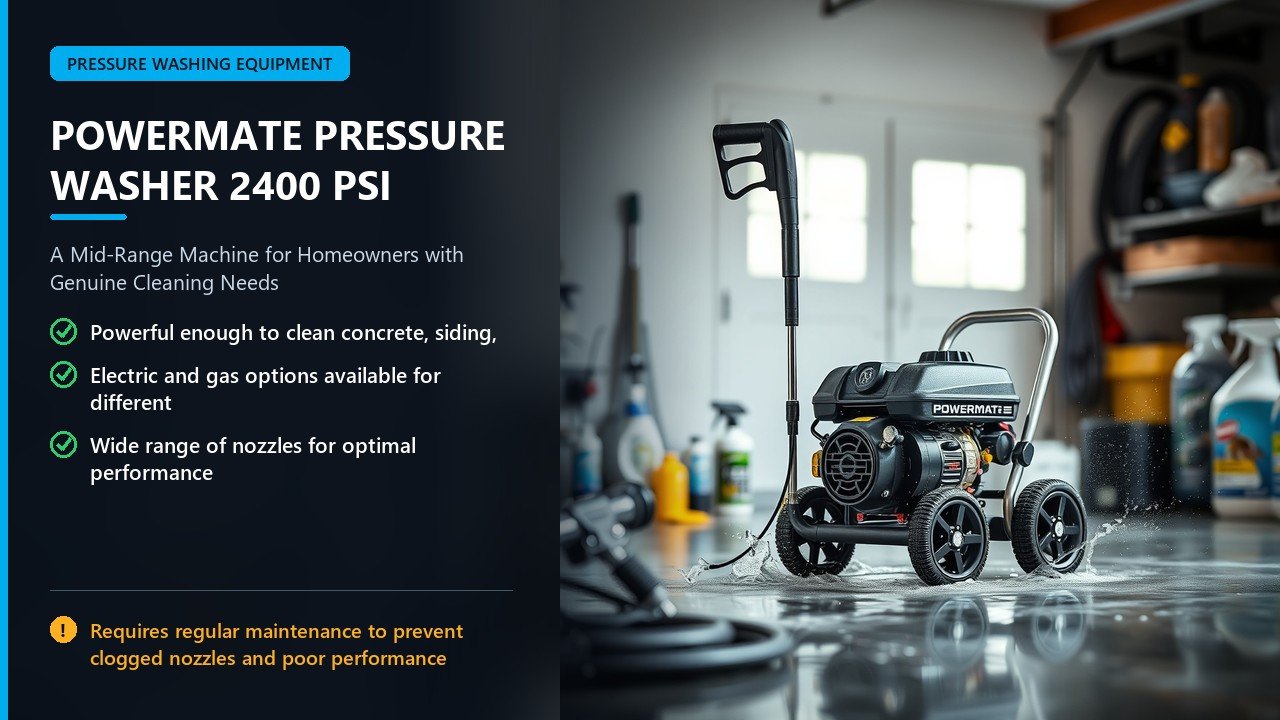
When you are shopping for a pressure washer that can handle real work without going overboard, you keep landing in a familiar middle ground. Too little power and the driveway fights back. Too much and you spend more than the jobs require. That middle ground is where a 2,400 PSI machine lives, and it is one of the most popular pressure classes for homeowners with genuine cleaning needs. A Powermate pressure washer 2400 psi sits squarely in this range, offering enough force for concrete, siding, and vehicles without demanding the price or upkeep of a heavy commercial unit.
This guide takes a close look at what a 2,400 PSI Powermate can actually do. We will cover the Powermate brand, what 2,400 PSI really means, why flow matters just as much as pressure, the difference between electric and gas options in this class, the surfaces it handles well and those it does not, the nozzles that bring out its best, setup, maintenance, winterizing, and honest pros and cons. If you are considering this class of machine, this will help you buy and use it wisely.
What Is Powermate?
Powermate is a brand known for outdoor power equipment, including generators, air compressors, and pressure washers. It is owned by the same group behind other well-known power equipment brands, and its pressure washers span gas and electric models aimed at homeowners and light-duty users.
Powermate machines are typically sold through major retailers, which makes them accessible and often well-priced. A 2,400 PSI model would be positioned as a capable home machine, stronger than the smallest compact units but short of heavy commercial rigs.
What 2,400 PSI Actually Means
PSI stands for pounds per square inch, the force pressing the water against the surface. It is what strips stubborn grime, but it is not the whole picture.
- Higher PSI means more force for tough, hard surfaces like concrete.
- Lower PSI is safer for delicate surfaces like paint and vehicle trim.
- 2,400 PSI is enough for most residential cleaning, including driveways, patios, siding, and cars.
It is a genuine step up from entry-level machines, but it is not a commercial stripper. That is exactly why it suits homeowners who want real capability without overkill.
PSI vs GPM: The Number That Gets Ignored
Flow, measured in gallons per minute (GPM), is just as important as pressure. Flow determines how quickly you rinse away loosened dirt and cover ground.
| Spec | What It Does | Why It Matters |
|---|---|---|
| PSI | Force of the stream | Strips tough grime |
| GPM | Volume of water per minute | Rinses dirt, speeds up work |
| Cleaning units | PSI x GPM | Best overall measure of cleaning power |
A 2,400 PSI machine with good flow cleans faster than one with the same PSI but weak flow. When comparing Powermate models, look at cleaning units, not just the headline PSI.
Electric vs Gas in the 2,400 PSI Class
| Feature | Electric 2,400 PSI | Gas 2,400 PSI |
|---|---|---|
| Power source | Wall outlet | Gasoline engine |
| Noise and fumes | Quiet, no fumes | Louder, exhaust fumes |
| Maintenance | Low | Engine oil, fuel, plugs |
| Portability | Unlimited with cord and hose | Unlimited, no cord needed |
| Typical flow | Often lower GPM | Often higher GPM |
| Best for | Home use, cars, patios | Larger areas, longer runs |
In practice, reaching 2,400 PSI on electric power usually means lower flow than a gas machine of the same pressure. Gas units in this class tend to offer better flow, which speeds up big jobs. The right choice depends on where and how you work.
What a 2,400 PSI Powermate Can Clean
| Surface | Suitability | Notes |
|---|---|---|
| Concrete driveways | Good with the right nozzle | Use yellow or a turbo nozzle; keep steady motion |
| Patios and walkways | Good | Watch for loosening grout or pavers |
| Vinyl and wood siding | Good with care | Use wide angles and check for loose paint |
| Wood decks | Moderate | Wide angle, keep distance, avoid furring |
| Cars and vehicles | Good | White nozzle at a safe distance |
| Fences | Good | Match nozzle to material |
| Roofs | Not ideal | Needs special technique; high PSI can damage shingles |
| Heavy paint stripping | Limited | Possible on tough surfaces only |
Nozzles That Bring Out Its Best
- White (40 degrees): Vehicles, siding, windows, and delicate surfaces.
- Green (25 degrees): General cleaning of hard surfaces.
- Yellow (15 degrees): Concrete and tough grime.
- Black: Applying detergent.
- Turbo nozzle: Fast, even cleaning of flat concrete.
- Surface cleaner attachment: Streak-free driveways and patios.
Matching the nozzle to the surface is what makes a 2,400 PSI machine feel powerful and controlled rather than unpredictable.
Setup and Use
- Connect to a reliable water supply with adequate flow.
- Attach the high-pressure hose, gun, and wand with correct connectors.
- Select the right nozzle for the surface.
- Purge air by running water through before starting.
- Start the machine and begin with a test area.
- Keep steady movement and a consistent distance.
- Work top to bottom, and rinse in sections.
Maintenance and Winterizing
- Check and change the pump oil if your model requires it.
- Clean the water inlet filter regularly.
- Check and clean nozzles for clogs.
- Inspect the hose, gun, and O-rings for wear and leaks.
- For gas models, follow engine maintenance: oil, air filter, and plugs.
- Winterize before freezing weather. Drain the pump and hose, add antifreeze where appropriate, and store indoors.
- Use fuel stabilizer in gas models, or drain fuel for long storage.
Winterizing is the single most important habit for a homeowner’s machine. Freezing water cracks pumps, and it is entirely preventable.
Pros and Cons
Pros
- Well-rounded power for most home cleaning.
- Accessible pricing through major retailers.
- Versatile across driveways, siding, patios, and vehicles.
- Manageable size and weight compared to commercial rigs.
Cons
- Electric models may have lower flow than gas equivalents.
- Not intended for heavy commercial use.
- Model and spec details vary, so careful shopping is needed.
- Gas models require engine maintenance.
Frequently Asked Questions
Is 2,400 PSI good for a pressure washer?
Yes. It is a strong range for home use, capable of cleaning driveways, patios, siding, and vehicles. It is not commercial-grade, but for most homeowners it is more than sufficient.
What can a 2,400 PSI pressure washer clean?
Concrete, patios, walkways, siding, decks, fences, and cars, with the right nozzles and technique. It is not ideal for roofs or heavy paint stripping.
Is Powermate a good pressure washer brand?
Powermate is a recognizable outdoor power equipment brand sold through major retailers, suitable for homeowner and light-duty use. Compare the specific model’s PSI, GPM, and warranty before buying.
Is 2,400 PSI strong enough to clean a driveway?
Yes, with a yellow or turbo nozzle and consistent technique. For large driveways, a surface cleaner attachment improves speed and evenness.
Should I buy electric or gas at 2,400 PSI?
Electric suits home use, cars, and smaller areas with low maintenance. Gas offers more flow and no cord, better for larger jobs and longer runs. Match it to your tasks.
Final Thoughts
A Powermate pressure washer 2400 psi represents a sweet spot for homeowners who want real cleaning power without commercial complexity. It handles the driveways, siding, patios, and cars that make up most home cleaning, and it does so at an accessible price.
Look past the headline PSI to the flow and cleaning units, choose between electric and gas based on how and where you work, match your nozzles to the surface, and keep up with maintenance and winterizing. Chosen and cared for properly, a 2,400 PSI Powermate can be a dependable home workhorse for years.