You finish a driveway or a commercial sidewalk, stand back to admire the clean concrete, and then you see them: long, dark streaks tracing where the hose dragged across the surface. On a light concrete driveway, those black marks can be more noticeable than the dirt you just removed. This is one of the most common frustrations in pressure washing, and it sends many people searching for a solution. A non marking pressure washer hose is engineered specifically to reduce or eliminate those streaks, keeping your clean surfaces looking clean when the job is done.
This guide explains what non marking hoses are, why ordinary hoses leave marks, where the problem is worst, the materials that reduce marking, how non marking hoses compare with standard ones, what they can and cannot prevent, how to choose one, and the habits that keep your surfaces streak-free. By the end, you will understand exactly why marking happens and how to stop it.
What Is a Non Marking Hose?
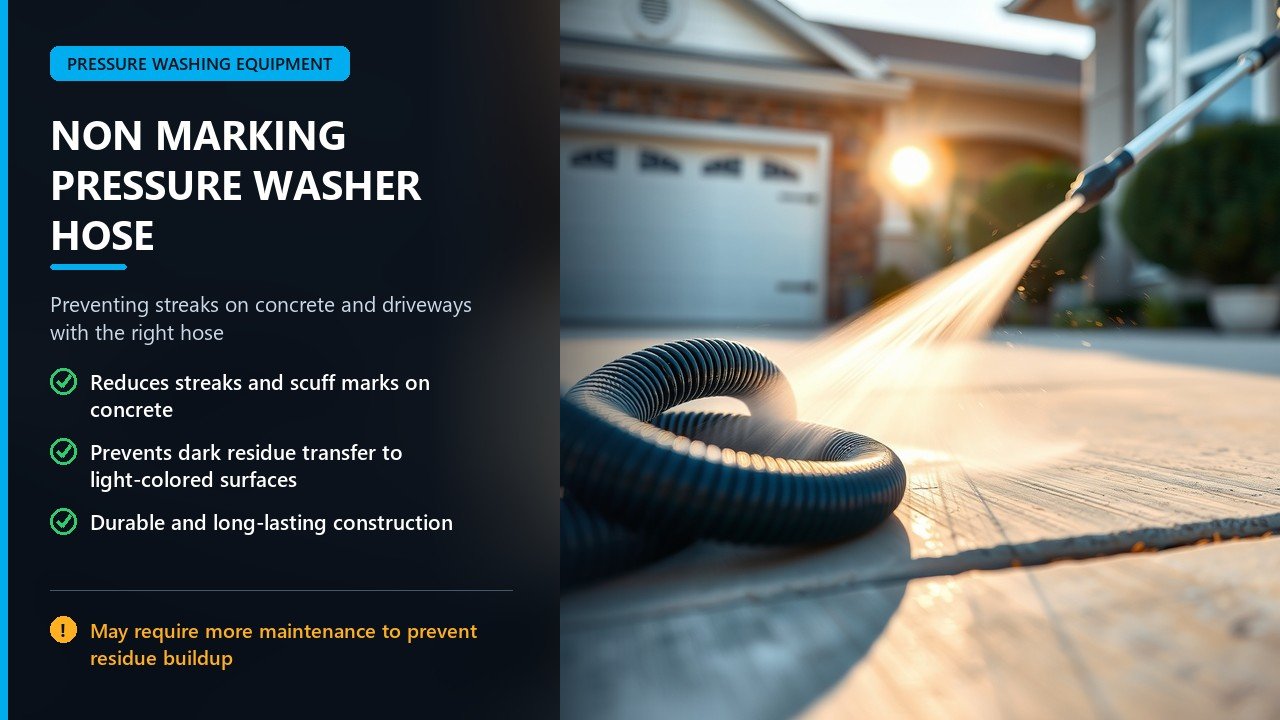
A non marking pressure washer hose is designed so that it does not transfer dark residue to surfaces it rubs against. Standard hoses, especially black rubber ones, can leave scuff marks when dragged across concrete, pavers, and light-colored surfaces.
Non marking hoses usually achieve this through their outer cover material, which is formulated to resist the transfer of color and residue. They are popular with professionals who clean driveways, sidewalks, and commercial paving where every mark shows.
Why Hoses Leave Marks
The marks come from a few sources.
- Outer cover material. Some rubber and plastic covers contain compounds that transfer to rough surfaces.
- Friction and abrasion. Dragging a hose across rough concrete wears the cover and deposits material.
- Dirt and grit. A dirty hose picks up grit and drags it, causing streaks.
- Heat and pressure. Friction from heavy dragging can soften cover material, making transfer worse.
- Pigments in the cover. Dark-colored covers are more prone to leaving visible marks on light surfaces.
The rougher the surface and the harder you drag, the worse the marking tends to be.
Where Marking Is Worst
- Light-colored concrete driveways. Marks stand out sharply.
- Decorative and stamped concrete. Textured surfaces grip and transfer more material.
- Pavers and stone. Rough textures worsen abrasion.
- Commercial sidewalks and plazas. Where appearance matters and every mark is visible.
- Freshly cleaned surfaces. When the surface is spotless, any mark is obvious.
Non Marking Hose Materials
| Material | Marking Tendency | Notes |
|---|---|---|
| Standard black rubber | High | Common and durable, but marks light surfaces |
| Gray non marking rubber | Low | Formulated to resist marking |
| Non marking PVC/blend | Low to moderate | Lighter, may be less durable than rubber |
| Thermoplastic (TPU) | Low | Durable, often non marking |
| Wire-braided high pressure | Varies | Check the cover for non marking rating |
Gray non marking rubber and some thermoplastic covers are the most common choices for reducing marks.
Non Marking vs Standard Hose
| Feature | Non Marking Hose | Standard Hose |
|---|---|---|
| Marking on light surfaces | Minimal | Common |
| Cost | Higher | Lower |
| Durability | Good to high | Good |
| Best for | Professional and visible surfaces | General and hidden use |
If you clean surfaces where appearance matters, the extra cost of a non marking hose is usually justified.
Do Non Marking Hoses Prevent All Marks?
Not entirely, and it is important to set realistic expectations.
- They greatly reduce color transfer, which is the main cause of dark streaks.
- They do not prevent dirt and grit from a dirty hose causing streaks.
- They do not stop abrasion on extremely rough or delicate surfaces.
- Proper technique still matters, including not dragging the hose harshly.
How to Choose a Non Marking Hose
- Confirm the non marking rating. Look for it explicitly in the product description.
- Match diameter to your machine, commonly 3/8 inch for high-flow setups.
- Check the pressure rating against your machine’s output.
- Check the temperature rating for hot water use.
- Consider length based on your typical jobs.
- Look for quality fittings and bend radius.
- Read reviews for real-world marking performance.
Diameter and Length
| Diameter | Typical Use | Notes |
|---|---|---|
| 1/4 inch | Compact machines | Lighter, lower flow |
| 3/8 inch | High-flow and commercial | Standard for pros, less pressure loss |
Longer hoses cover more ground but are heavier and more likely to be dragged. Match length to your jobs and use a reel to keep the hose off the ground when possible.
Care to Prevent Marks
- Keep the hose clean. Wipe it down so grit does not transfer.
- Do not drag harshly. Lift and reposition rather than scrubbing across the surface.
- Use a hose reel to keep the excess hose off the ground.
- Avoid sharp edges that abrade the cover and leave material behind.
- Inspect for wear, since a damaged cover transfers more material.
- Store properly to prevent kinks and cover damage.
Technique to Avoid Streaks
- Plan your path, keeping the hose where it will not cross fresh cleaning.
- Move the hose deliberately, rather than letting it flop across the surface.
- Clean in sections, keeping the hose behind you where possible.
- Use a reel or hose guide to control where the hose travels.
- Rinse after dragging if marks do appear, to remove any residue.
Frequently Asked Questions
What is a non marking pressure washer hose?
It is a hose designed so its outer cover does not transfer color or leave dark streaks on surfaces it rubs against, such as light concrete driveways. It greatly reduces the marking common with standard black rubber hoses.
Why does my pressure washer hose leave black marks?
Standard rubber and plastic covers can transfer color and residue, especially when dragged across rough concrete, and dirt or grit on the hose adds to the streaking. Non marking hoses reduce the color transfer.
Do non marking hoses really work?
They significantly reduce color-transfer marks, which are the main cause of dark streaks. They do not prevent streaks from dirt and grit, so keeping the hose clean and using good technique still matters.
What color is a non marking hose?
They are often gray, though color is not the defining factor. What matters is that the product is explicitly rated as non marking, regardless of its color.
Are non marking hoses worth the extra cost?
For professionals and anyone cleaning visible light-colored surfaces, yes. Avoiding streaks saves time and protects your reputation. For general use where marks do not matter, a standard hose may suffice.
Final Thoughts
A non marking pressure washer hose solves one of the most annoying problems in cleaning: dark streaks left on otherwise spotless surfaces. By resisting color transfer, it keeps driveways, sidewalks, and commercial paving looking their best after the job is done.
Choose a hose explicitly rated as non marking, match the diameter and pressure rating to your machine, and combine it with clean-hose habits and thoughtful technique. Do that, and the only thing left on your freshly cleaned surface will be the shine, not the streaks.