Few pressure washer parts cause more confusion than the swivel. It is small, it looks unimportant, and many owners never give it a second thought until they notice a problem. Then they notice it constantly. The hose twists into stiff coils. The gun fights back when you turn the wand. A kink appears mid-job and costs you pressure. All of these annoyances trace back to how well the hose is allowed to rotate, and that is precisely the job of a swivel. Understanding the power washer swivel and where it belongs is one of the easiest ways to make pressure washing more comfortable and your hose last longer.
This guide explains swivels completely. We will cover what they are, why they matter, the hose twist problem they solve, the different types, the difference between live and fixed swivels, where to install them, buying criteria, materials, installation, maintenance, common problems, and answers to frequent questions. By the end, you will understand why this tiny part punches far above its weight.
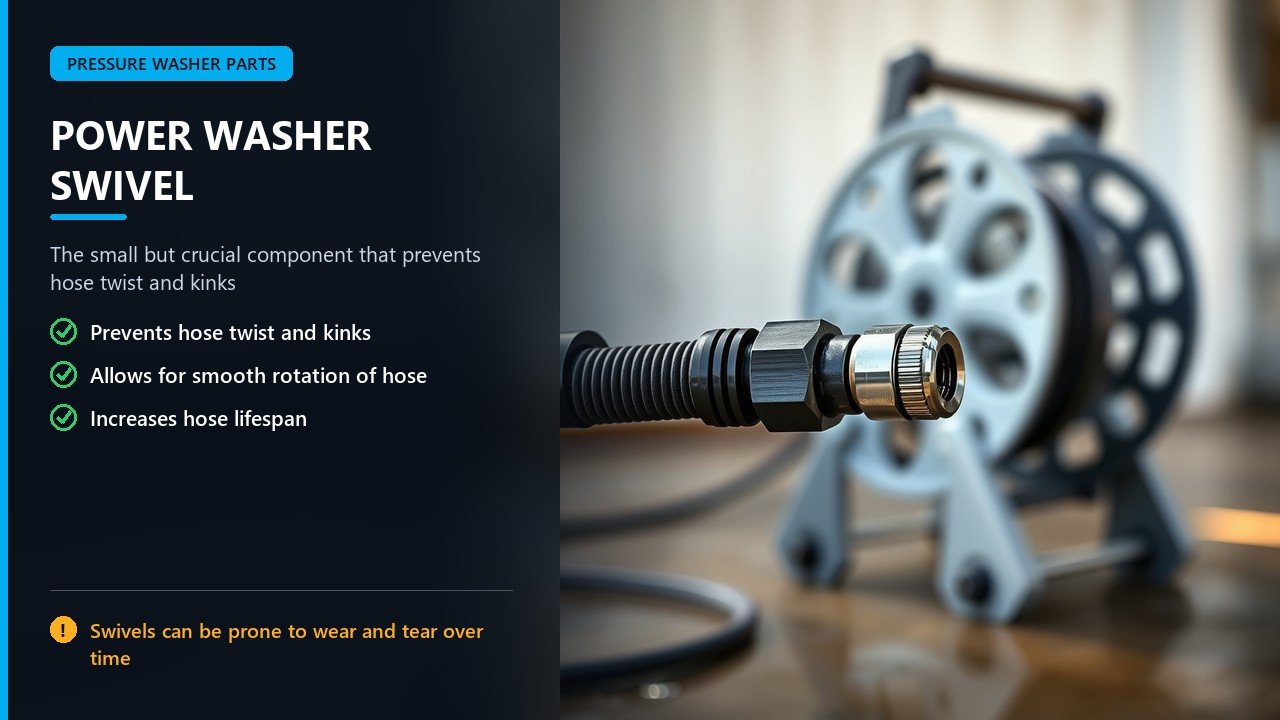
What Is a Swivel?
A swivel is a fitting that allows parts of the pressure washer system to rotate relative to one another while still carrying water under pressure. It contains seals that hold pressure while the joint turns.
Swivels appear in a few places: at the hose-to-gun connection, at the reel’s feed point, and sometimes on wands and accessories. Each one lets the connected parts rotate instead of storing twist.
Why Swivels Matter
Without swivels, turning the gun or wand forces the hose to twist. That twist has to go somewhere, so it stores as coils and kinks in the hose, which means:
- Kinks that cut off flow, lowering pressure.
- Fatigue and wear on the hose at the twist points.
- Fighting the gun as the hose resists rotation.
- Faster hose failure from repeated twisting stress.
- More effort and frustration during every job.
A swivel removes that stored twist by letting the parts rotate freely, which is why it improves both comfort and hose life.
The Hose Twist Problem
Picture pulling a stiff hose across a driveway while turning the wand to reach different angles. Each turn tries to rotate the hose, and because the hose cannot rotate along its length, the twist accumulates. The result is a hose that coils, kinks, and eventually fatigues.
Types of Swivels
| Swivel Type | Location | Purpose |
|---|---|---|
| Gun swivel | Between hose and gun | Lets the gun rotate without twisting hose |
| Hose-end swivel | At hose connections | Prevents twist at the joint |
| Reel swivel | At the reel feed point | Carries water into the rotating spool |
| Wand swivel | At the wand or accessory | Allows rotation during use |
Each type serves a specific spot in the system, and the gun and reel swivels are the most commonly upgraded.
Live Swivel vs Fixed
- Live swivel: Rotates freely under pressure, continuously preventing twist. This is what you want for hose management.
- Fixed swivel: Allows rotation only when not under pressure, or has limited movement. Less effective at preventing twist during use.
For preventing hose twist, a live swivel is the correct choice. Always confirm a swivel is live if that is the goal.
Where to Install a Swivel
- At the gun inlet to stop hose twist during use, the highest-impact location.
- At the reel feed to carry water into the rotating spool smoothly.
- At hose connections to ease assembly and reduce strain.
- At the wand or accessory where rotation improves control.
Buying Criteria
| Criterion | Why It Matters |
|---|---|
| Pressure rating | Must meet or exceed machine output |
| Temperature rating | For hot water use |
| Live rotation | Required to prevent twist under pressure |
| Material | Brass or stainless for durability |
| Seal quality | Resists leaks over time |
| Connection type | Match quick connect or M22 fittings |
| Replaceable seals | Allows servicing instead of replacement |
Materials
- Brass: The standard for durability and corrosion resistance.
- Stainless steel: Best for hot water and demanding use.
- Plastic: Only for light use; fails under high pressure.
Installation
- Relieve pressure and disconnect the affected components.
- Match the connection type and size to your gun, hose, or reel.
- Wrap threads with sealing tape where required.
- Hand-tighten then snug, avoiding overtightening.
- Pressure test gradually and check for leaks at the swivel.
- Confirm it rotates freely under pressure.
Maintenance
- Inspect the swivel seals regularly for drips.
- Replace worn seals promptly to prevent bigger leaks.
- Keep the swivel clean of grit that damages seals.
- Confirm free rotation periodically.
- Replace the swivel if it leaks persistently or seizes.
Common Problems
- Leaking swivel: Usually worn seals. Replace or rebuild.
- Seized swivel: Corrosion or grit; may need replacement.
- Hose still twisting: The swivel may be fixed rather than live, or installed in the wrong place.
- Pressure loss at the swivel: A restricted or failing swivel; inspect and replace.
- Cross-threaded connection: Caused by mismatched threads; check compatibility.
Frequently Asked Questions
What is a power washer swivel used for?
A swivel lets connected parts rotate while carrying water under pressure. It prevents hose twist, reduces kinks, eases use, and extends hose life. The gun and reel swivels are the most important.
Where should I put a swivel on a pressure washer?
The highest-impact location is at the gun inlet, where it stops hose twist during use. Swivels also go at the reel feed point and at some wands and accessories.
What is the difference between a live swivel and a regular swivel?
A live swivel rotates freely under pressure, continuously preventing twist. Other swivels may only turn when not pressurized, making them less effective at stopping hose twist during use.
Why does my pressure washer hose keep twisting?
Without a live swivel, turning the gun or wand forces the hose to store twist, causing coils and kinks. Adding a live swivel at the gun usually solves it.
How do I choose a swivel?
Match the pressure and temperature ratings to your machine, choose a live swivel for twist prevention, pick brass or stainless construction, and confirm the connection type fits your gun, hose, or reel.
Final Thoughts
The power washer swivel is a tiny part with an outsized impact. By letting parts rotate freely under pressure, it prevents the hose twist that causes kinks, pressure loss, and premature hose failure, while making the whole setup more comfortable to use.
Install a live swivel at the gun for the biggest improvement, choose one rated for your pressure and temperature, and favor brass or stainless with serviceable seals. Keep an eye on it for leaks and rotation. This small upgrade quietly solves one of the most persistent frustrations in pressure washing.