The most frustrating leak I ever had on a pressure washer came from a connector I had bought in a hurry, assuming all fittings were interchangeable. They are not. The threaded fitting looked right but had a different thread standard, so it never sealed properly, dribbling water no matter how tightly I turned it. Once I understood connector types and matched them correctly, the problem vanished. Pressure washer connectors are the small but critical links that join the hose, gun, wand, and machine, and getting the types right is essential to a leak-free, efficient setup. This guide explains the connector types, the standards behind them, how to identify and match them, and how to keep the connections sealed.
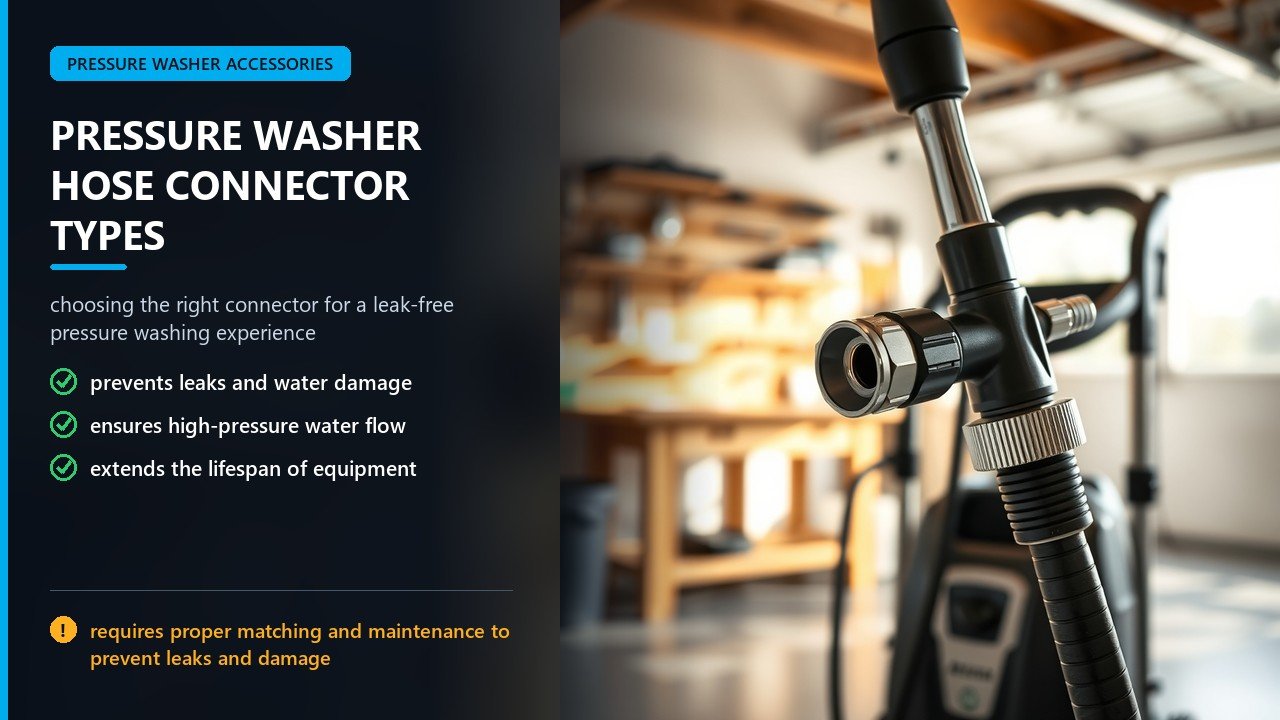
Why Connector Types Matter
Connectors join the components of a pressure washer, and their job is to hold high-pressure water without leaking, while allowing the components to be connected and disconnected. If the connectors do not match, the result is a leak at best and a failure at worst, and because pressure washers operate at high pressure, even a small mismatch can cause significant problems.
The difficulty is that pressure washers use several different connector types and standards. There are quick-connect fittings in different sizes, threaded fittings in different thread standards, and various adapters to bridge them. Two connectors can look nearly identical yet have incompatible threads or dimensions, which is why a hurried purchase so often leads to a frustrating leak. Understanding the types, and how to identify what your machine uses, is the key to matching connectors correctly and achieving reliable, leak-free connections.
Getting connectors right matters for more than avoiding leaks. Correct connectors ensure full flow without restriction, hold up to the machine’s pressure, and allow the convenient setup and teardown that makes pressure washing efficient. Wrong or mismatched connectors restrict flow, leak, or fail under pressure, undermining the machine’s performance and wasting water. This guide maps out the connector landscape so you can match, replace, and adapt with confidence.
Quick-Connect Connectors
Quick-connect, often abbreviated QC, is the most common connector type on modern pressure washers, and it is the standard at the nozzle, wand, gun, and often the hose and machine.
Quick-connect fittings use a socket that receives a plug and locks it with a collar or ring, allowing the connection to be made and broken instantly, without tools. They are the reason you can swap nozzles in seconds or attach and detach the hose quickly. Quick-connect connectors come in different sizes, and the size must match between the socket and plug for the connection to work and seal. If you try to connect a QC plug of one size to a socket of another, it will not fit or will not seal.
The most common quick-connect sizes on pressure washers are 1/4 inch and 3/8 inch, with 1/4 inch typically used at the nozzle, gun, and wand, and 3/8 inch often used on the hose and machine connections. The size refers to the nominal fitting size, and matching it is essential. Quick-connect fittings also have an internal o-ring, usually in the socket, which does the sealing, so a worn or missing o-ring is a common cause of quick-connect leaks. Quick-connect is convenient and nearly universal on quality machines, but it introduces o-ring and locking-mechanism wear points that need occasional attention.
Threaded Connectors
Threaded connectors screw together and are used where a more permanent or higher-strength connection is wanted, and they come in several thread standards.
M22 connectors. A metric thread standard extremely common on pressure washers, especially on the machine’s water outlet and the hose. M22 fittings are named for their 22-millimeter thread and exist in male and female versions, often with different thread pitches, so matching matters. M22 is frequently found at the pump outlet and on the high-pressure hose ends or the fittings that adapt them.
Garden hose thread (GHT). The standard thread on a garden hose and on the pressure washer’s water inlet, where the supply hose connects. This is the familiar outdoor faucet thread, and the inlet connection on most pressure washers uses it, though some machines use different standards and require adapters.
Other thread standards. Depending on the machine and region, other threads appear, including BSP (British Standard Pipe), NPT (National Pipe Thread), and metric variants, and these differ in thread angle and pitch, so they are not interchangeable. Connecting different thread standards usually damages the threads or fails to seal.
Threaded connectors seal in different ways. Some use a flat face with an o-ring or washer, some rely on the threads with sealant, and some use a tapered thread that seals as it tightens. The M22 connector typically uses an o-ring or a sealing washer, which is why replacing a worn o-ring often fixes a threaded leak. Because thread standards and sizes vary, identifying the exact thread on your connectors is essential, and testing fit by hand before tightening prevents cross-threading, which ruins the connector.
Thread Standards Explained
Thread standards are the source of most connector confusion, so understanding them prevents mismatches.
| Standard | Common Use | Notes |
|---|---|---|
| M22 | Pump outlet, high-pressure hose | Metric, 22mm, male and female, sealing washer or o-ring |
| Garden hose thread (GHT) | Water inlet, supply hose | Standard outdoor faucet thread |
| BSP | Various, regional | British Standard Pipe, differs from NPT |
| NPT | Various, regional | US tapered pipe thread, seals on taper |
| 1/4 in QC | Nozzle, gun, wand | Quick-connect, nominal size |
| 3/8 in QC | Hose, machine connections | Quick-connect, nominal size |
The critical point is that similar-looking fittings may use different standards and will not fit. M22 and other metric threads differ from NPT and BSP, and BSP and NPT, despite both being pipe threads, differ in thread angle and are not interchangeable without adapters made for that purpose. Even M22 comes in variants with different pitches. This is why matching by standard, not just by appearance or size, is essential, and why a connector that “looks right” can still fail. When in doubt, identify the thread standard explicitly, measure if necessary, and use adapters made to bridge the specific standards you have. Understanding the standards turns the guesswork of connector matching into a reliable process.
Adapters and Conversion
Because pressure washers use multiple connector types and standards, adapters are essential to join them, and they are among the most useful pressure washer accessories.
Adapters convert one connector type or size to another. For example, an adapter can convert a threaded M22 machine outlet to a quick-connect so a QC hose can attach, or convert a 3/8-inch QC to a 1/4-inch QC, or change a garden hose thread to another standard for the inlet. They also allow replacing or upgrading components whose connectors differ from the machine’s, such as attaching a new gun with a different fitting. Adapters come as short fittings, swivels, and combinations, and they exist for most common conversions between threaded standards and quick-connect sizes.
The importance of adapters cannot be overstated, because they make an otherwise incompatible set of components work together. They also let you standardize your connections, for instance converting a machine to accept a common quick-connect system so all your hoses, guns, and accessories interchange easily. When buying adapters, match both the source and destination type and standard precisely, because an adapter that does not match on one side defeats its purpose. A good assortment of adapters, or the specific ones your setup needs, is a small investment that dramatically improves a pressure washer’s flexibility and convenience. Our guide to a pressure wash hose connector covers these joining fittings in more detail.
Materials and Construction
Connector materials affect durability and reliability.
Brass. The common material for pressure washer connectors. Brass resists corrosion, machines well for accurate threads, and stands up to water and moderate conditions. Most quality threaded and quick-connect fittings use brass, and it is a dependable choice.
Stainless steel. Stronger and more corrosion resistant than brass, stainless steel suits demanding or corrosive environments and high-stress connections. Stainless steel fittings cost more but last longer in tough conditions.
Plastic or composite. Found on some low-pressure or inexpensive connectors, plastic is light and cheap but less durable and less suited to high pressure. Plastic connectors can crack and fail under pressure, so they are best avoided for high-pressure use.
For high-pressure connections, brass is the standard and stainless steel the premium choice, while plastic should be limited to low-pressure applications if used at all. The o-rings inside connectors are equally important: they are typically rubber or a similar elastomer, and their condition determines whether the connection seals. Worn, hardened, or damaged o-rings leak, so quality o-rings and a supply of spares matter as much as the metal fittings. Matching materials to the application, brass or stainless for high pressure, with good o-rings, ensures reliable, long-lasting connections that do not leak or corrode. Cheap connectors often skimp on material quality and o-rings, which is why they fail, and choosing quality fittings pays off in reliability.
Matching Connectors Correctly
Correct matching is the heart of a leak-free setup, and it involves several factors.
Type. Quick-connect or threaded, and if quick-connect, the correct size (1/4 or 3/8 inch, typically).
Thread standard. If threaded, the exact standard, M22, GHT, BSP, NPT, and the pitch and gender. Similar standards are not interchangeable.
Gender. Male or female, since a connection requires opposite genders, and mixing them requires an adapter.
Pressure and flow rating. The connector must be rated for the machine’s pressure and sized for its flow, or it may leak, restrict flow, or fail.
Sealing method. Whether the connection seals with an o-ring, a washer, or a taper, so the correct sealing element is present and in good condition.
Matching on all these factors ensures the connection works and seals. The process is straightforward once you know what your machine uses, which the manual and the existing fittings reveal. Measuring threads and fittings, or taking a sample to a supplier, resolves uncertainty. For most setups, standardizing on quick-connect with adapters to the machine’s threaded outlets simplifies everything, and it is why many pressure washer owners convert their connections to a common system. Matching correctly, with quality parts and good o-rings, produces the reliable, leak-free operation that makes pressure washing pleasant rather than a drip-by-drip frustration. When connectors do leak, the cause is almost always a mismatch or a worn seal, both of which matching and replacement solve.
Common Connector Problems
Most connector issues trace to a few causes.
Leaks at quick-connect. Usually a worn or missing o-ring in the socket. Replace the o-ring.
Leaks at threaded fittings. Often a worn or missing sealing washer or o-ring, or a loose connection; sometimes a cross-threaded or mismatched fitting.
Mismatched threads. Different standard, which never seals properly and can damage threads. Use the correct fitting or an adapter.
Cross-threading. Starting threads incorrectly damages them. Start by hand, and never force a fitting.
Restricted flow. An undersized connector or an adapter that narrows the passage, reducing performance. Use correctly sized parts.
Frozen or stuck connections. Corrosion or debris; clean and lubricate, and use quality materials.
Recognizing these causes makes connector troubleshooting quick. Most leaks come down to a worn seal, since o-rings and washers degrade, and replacing them solves the problem for a few cents. Mismatches and cross-threading come from rushing, and careful matching and hand-starting prevent them. Because connectors are inexpensive and their problems are cheap to fix, there is no reason to tolerate a leaky connection: identify the cause, replace the worn seal or mismatched fitting, and the connection seals. Keeping spare o-rings and a few adapters on hand means connector problems never slow your work, and treating connectors as the important links they are keeps the whole setup performing. Our guide to pressure washer repair kits covers the seals and o-rings that resolve most connector leaks.
Connector Maintenance
A little care keeps connectors sealing and easy to use.
Inspect o-rings and washers regularly, and replace any that are worn, hardened, cracked, or missing, since these seals do the actual work of stopping leaks. Lubricate o-rings and threads occasionally with a suitable lubricant to keep connections easy to join and seal and to prevent seizing. Keep threads clean and free of debris and grit, and start threaded connections by hand to avoid cross-threading. Store hoses and connectors properly, without strain or dirt, and protect the connectors’ sealing surfaces from damage. When winterizing, disconnect and store connectors dry to prevent freeze damage and corrosion.
These simple habits keep connections reliable and prevent the leaks and stuck fittings that frustrate users. Because connectors are where the machine’s components meet, their condition determines whether the whole setup works smoothly, and because the fixes are cheap, maintaining them is easy and worthwhile. Examining connectors during regular maintenance, replacing worn seals proactively, and keeping spares on hand ensure that connections never become the weak link. Good connector care is a small part of pressure washer ownership with an outsized effect on convenience and performance, and it is the difference between a setup that works flawlessly and one that drips and frustrates. Our guide to pressure washer components explains how the connectors fit into the machine as a whole.
Standardizing Your Connections
One of the best upgrades for a pressure washer is standardizing its connections, so every component joins easily and reliably.
The source of most connector frustration is a mix of incompatible types and sizes. A machine might have an M22 outlet, a hose with a threaded end, a gun with a 1/4-inch quick-connect, and a wand that matches only the original gun. Each connection is a potential mismatch and leak. Standardizing means converting the setup to a common system, usually quick-connect, using adapters at the machine outlet and on each component, so everything snaps together uniformly.
For example, adding an M22-to-quick-connect adapter at the machine outlet lets a quick-connect hose attach. Converting the gun and wand to the same quick-connect size lets any gun or wand interchange. Once standardized, connecting and disconnecting becomes instant, and any component can be swapped without hunting for the right adapter. This makes maintenance, repair, and upgrades far easier, because new components need only match the common standard, not the specific original fittings.
Standardizing also reduces the number of adapters in the chain, since a consistent system needs fewer conversions, and each adapter removed is a potential leak and flow restriction eliminated. Many experienced owners standardize their machines early, treating it as a small, worthwhile project that pays off on every job. The result is a setup that is convenient, reliable, and flexible, where connectors do their job without fuss. If your connections are a patchwork of mismatched types, standardizing them is the single most effective improvement you can make, turning a source of leaks and hassle into a smooth, interchangeable system.
Choosing Quality Connectors
Since connectors are inexpensive, choosing quality ones is easy and worthwhile.
Prioritize brass for general high-pressure use and stainless steel for demanding or corrosive conditions, and avoid plastic connectors for high pressure, reserving them for low-pressure applications if used at all. Confirm the connector is rated for your machine’s pressure and sized for its flow, because an underrated or undersized connector can leak, restrict flow, or fail. Check that the o-rings are quality material that seals well and resists wear, since the o-ring often determines whether the connection holds.
Buy from reputable sources, and be wary of very cheap connectors with poor threads or seals, which cause the leaks and stuck fittings that give connectors their bad reputation. Because a good connector costs only a little more than a bad one, the reliability it provides is a bargain, and a connector failure mid-job is far more costly in frustration and lost time than the price difference. Keeping a starter assortment of quality adapters, o-rings, and spare quick-connect fittings on hand ensures you can handle any mismatch or leak as it arises, and it means the small but critical parts that hold your setup together are always available.
A modest investment in quality connectors and a small spares kit prevents most connection problems and keeps the whole machine dependable. Since connectors are the links where the components meet, their quality directly affects the machine’s reliability, and cheaping out on them undermines everything else. Choose quality, stock a few spares, and your connectors will seal reliably for years, supporting the machine’s performance and your convenience. This is one of the easiest and most impactful improvements in pressure washer ownership.
Frequently Asked Questions About Pressure Washer Hose Connector Types
What are the main pressure washer connector types? Quick-connect fittings, common in 1/4 and 3/8 inch sizes at the nozzle, gun, wand, and hose, and threaded fittings such as M22 and garden hose thread, used at the machine and hose connections, plus adapters between them.
What is an M22 connector? A metric threaded fitting, 22 millimeters, common on pressure washer pump outlets and high-pressure hose connections, available in male and female versions and multiple pitches.
Are all quick-connect fittings the same? No. Quick-connect fittings come in different sizes, commonly 1/4 and 3/8 inch, and the sizes must match. A mismatched QC will not seal.
Why is my hose connector leaking? Most often a worn or missing o-ring, since quick-connect and threaded fittings seal with o-rings or washers. Replace the seal. Less often, a mismatched or cross-threaded fitting.
Can I connect different connector types? Yes, with the right adapter. Adapters convert between connector types, sizes, and thread standards, letting otherwise incompatible components join.
How do I identify my connector type? Check your machine’s manual and existing fittings, measure threads if needed, or take a sample to a supplier. Match the type, size, thread standard, and gender.
Final Verdict on Pressure Washer Hose Connector Types
Pressure washer hose connector types are small parts with a large impact. The two main families, quick-connect and threaded, come in several sizes and thread standards, and matching the type, size, standard, and gender is essential to a leak-free, unrestricted connection. Adapters bridge the differences and let you standardize your setup, while quality materials and good o-rings ensure reliability under pressure.
Most connector problems, a leak or a stuck fitting, trace to a worn seal or a mismatch, both of which are cheap and easy to fix. Keep spare o-rings and a few adapters on hand, inspect and lubricate connectors regularly, and match carefully rather than buying on appearance. Do that, and your connections stay leak-free and convenient, letting the machine perform as intended. The connector that frustrated me with its stubborn drip taught me the value of understanding these types, and once I matched them correctly, the problem disappeared for good. Master connector types, and the plumbing of your pressure washer becomes reliable and simple.