If you have ever watched a pressure washer nozzle that seems to spin, throwing a fast-moving circle of water instead of a fixed fan, you have seen a rotary tip. Also called a turbo nozzle or rotary nozzle, this clever accessory turns the pinpoint force of a zero-degree jet into a rotating pattern, giving you the cleaning intensity of a narrow stream with the coverage of a wider one. A rotary tip for a pressure washer can dramatically speed up tough cleaning, but it is also a specialized tool with specific uses and important safety considerations. This guide explains what a rotary tip is, how it works, what it is good for, how to choose the right one, and how to use it safely and effectively.
What a Rotary Tip Is
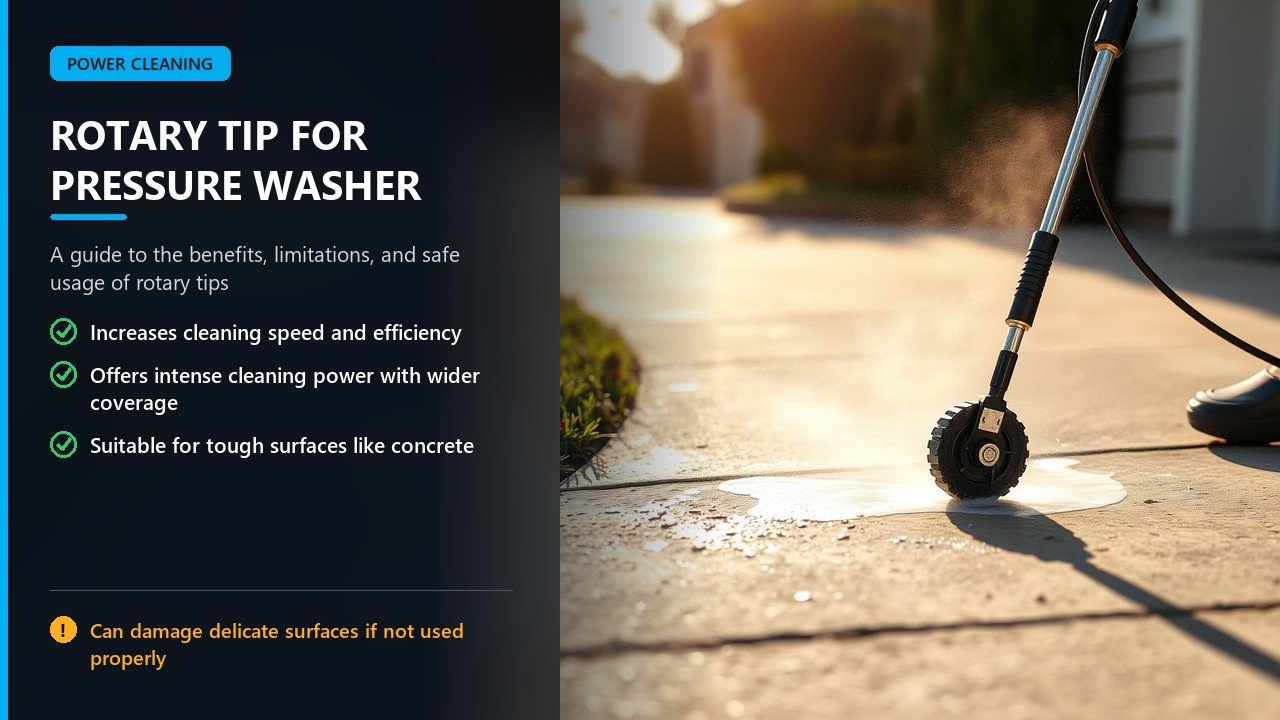
A rotary tip concentrates and sweeps water for powerful cleaning.
A rotary tip is a pressure washer nozzle containing a rotating mechanism that directs a narrow, high-impact water jet in a circular pattern. Instead of a fixed fan like a standard 25-degree or 40-degree nozzle, it spins the stream rapidly, so the concentrated force of a zero-degree jet sweeps across a small circular area many times per second. The result is a cleaning action that is more intense than a fixed fan at the same pressure, because the energy is concentrated, yet covers more ground than a stationary zero-degree stream.
Rotary tips are typically recognizable by their shape, often larger or differently built than standard color-coded nozzles, and they may have a rotating internal part. They fit a standard quick-connect wand like other nozzles, so they are easy to swap in. Some are fixed-size, matched to a machine’s flow, while others may be adjustable in size on more elaborate versions. Their defining feature is the rotating jet, which gives them their distinctive cleaning power and their common names, turbo and rotary nozzle.
Understanding what a rotary tip is sets up its uses and limits. It is not just a different angle but a different mechanism, trading the simplicity of a fixed nozzle for the concentrated, sweeping power of a rotating jet. This makes it valuable for tough cleaning but also more aggressive, so matching it to the task and the machine matters. Recognizing its nature explains both its strengths and its caution, and it helps you decide when a rotary tip is the right tool. Our guide to a jet washer turbo nozzle covers the same accessory under another name.
How a Rotary Tip Works
The rotating mechanism is what gives the tip its power.
Inside a rotary tip, the water flow drives a rotating element, often a small turbine or offset mechanism, that makes the nozzle’s jet spin in a circle. As the pressurized water exits the small orifice, it is swept around rapidly, so the high-impact stream traces a circular path. This concentrates the water’s energy into a narrow jet, which cleans aggressively, while the rotation spreads that jet over a circle, so you cover area efficiently without the stream sitting still in one spot.
The rotation also helps the jet do more work per unit of water, since the concentrated stream repeatedly strikes the surface as it sweeps, lifting dirt effectively. This is why rotary tips clean faster and more aggressively than fixed fans of similar flow, and why they are popular for tough jobs like concrete. The mechanism relies on the water’s flow and pressure to spin, so correct flow and pressure are important for the tip to work well, and the tip must be sized to the machine so it receives adequate flow.
Knowing how a rotary tip works clarifies why it performs as it does and why sizing matters. Because the rotation depends on the water flow, a mismatched tip either spins poorly or restricts flow, degrading performance or stressing the machine. When correctly matched, the rotating jet delivers intense, efficient cleaning, which is its advantage. Understanding the mechanism also explains its aggressiveness, since the concentrated jet is powerful enough to damage soft surfaces, which is why its use requires judgment and care. Our guide to nozzle size for pressure washer explains how to size any nozzle, including rotary tips.
Benefits of a Rotary Tip
Rotary tips offer clear advantages for the right tasks.
More cleaning power. By concentrating the jet, a rotary tip cleans more aggressively than a fixed fan at the same pressure and flow, removing stubborn dirt, stains, and coatings that a fan may leave behind.
Faster coverage. The rotating pattern covers a circle, so you clean area more quickly than with a stationary zero-degree stream, improving productivity on large surfaces.
Great for concrete and tough surfaces. Concrete, stone, brick, and other hard, durable surfaces benefit most, where the aggressive action strips grime, mold, and even some coatings.
Efficient use of water. The concentrated, rotating jet does more work per gallon, so results improve without increasing water use.
Versatility within its limits. For many tough cleaning jobs, a rotary tip replaced a need for higher pressure, letting a modest machine clean more effectively.
These benefits make the rotary tip a favorite for heavy cleaning, especially on concrete and masonry, where its aggressive, fast action shines. It can turn an ordinary pressure washer into a more capable cleaner for these surfaces, and it is often the go-to nozzle for driveways, sidewalks, and patios. However, these benefits come with the caveat that the tip is aggressive, so it suits durable surfaces and demands care on softer ones. Understanding the benefits helps you use the rotary tip where it excels. Our guide to high pressure washer nozzle compares nozzle types and their strengths.
Limitations and Risks
A rotary tip is powerful, and that power has limits.
Damage to soft surfaces. The concentrated jet can etch, gouge, or strip soft or delicate surfaces, including wood, painted finishes, siding, and even some concrete if held too close or too long. It is not a general-purpose nozzle and should not be used on surfaces that cannot take aggressive cleaning. This is the most important limitation.
Less control than a fan. Because the jet is concentrated, a rotary tip offers less fine control than a wide fan for delicate work, and it can leave marks if used carelessly. For washing and rinsing, a fan nozzle is gentler and more suitable.
Sizing sensitivity. A rotary tip must be matched to the machine’s flow and pressure; a mismatched tip spins poorly, cleans weakly, or restricts flow and strains the pump.
Not for all tasks. It is not ideal for applying soap, rinsing, or cleaning delicate items, where other nozzles are better.
These limits mean the rotary tip is a specialized tool, best reserved for tough, durable surfaces and heavy cleaning. Using it indiscriminately risks surface damage and poor results, while using it appropriately delivers its benefits. Matching it to the machine and the surface, and exercising care, are essential. Recognizing the limits prevents the common mistake of treating the rotary tip as a universal nozzle, which it is not. Our guide to power washing nozzle tips covers the right nozzle for each task.
Choosing a Rotary Tip
Selecting the right rotary tip ensures performance and safety.
Match the tip to your machine’s flow and pressure, using the machine’s nozzle chart or recommendation, since a rotary tip must be sized like any nozzle to let the machine deliver its rated flow. A tip that is too small restricts flow and strains the pump, while one too large lowers performance. Many machines specify a rotary tip size, and buying one matched to your machine ensures it spins correctly and performs. Consider the connection type, usually a standard quick-connect, so it fits your wand.
Choose a quality tip, since construction affects durability and the smoothness of the rotating mechanism, and replace it if the rotation degrades or the jet weakens, as wear affects performance. Some rotary tips are fixed-size while others offer adjustments, so decide based on your needs and machine. For tough surfaces like concrete, a properly sized rotary tip is a worthwhile addition to your nozzle set, complementing the standard color nozzles. Keep it clean and stored with your other nozzles.
| Factor | What to Check |
|---|---|
| Size | Matched to your machine’s PSI and GPM per its chart |
| Connection | Standard quick-connect to fit your wand |
| Quality | Durable build, smooth rotation, reliable mechanism |
| Use | Reserved for durable surfaces like concrete |
Choosing correctly ensures the rotary tip performs as intended and is safe. Because sizing governs performance and connection determines fit, these factors matter for any nozzle, and the rotary tip is no exception. A quality, correctly sized tip delivers the aggressive cleaning that makes it valuable, while a poor or mismatched one disappoints or strains the machine. With the right rotary tip in your kit, tough cleaning becomes faster and more effective, and you have the tool for the surfaces that need it. Our guide to surface cleaner washer covers another tool for large, tough surfaces that often pairs with strong cleaning.
Using a Rotary Tip Safely
A rotary tip demands care because of its power.
Never point a pressure washer nozzle, and especially a rotary tip, at people, animals, or yourself, since the concentrated jet can cause serious injury, including deep cuts and injection wounds. Wear eye protection and appropriate clothing, and keep bystanders clear. On surfaces, test on an inconspicuous area first, keep the nozzle moving, and avoid holding it in one spot or too close, which causes damage; maintain a suitable distance and let the rotating jet do the work. Avoid soft, delicate, or finished surfaces where the tip can cause harm.
Use the tip at appropriate pressure for the surface, and consider starting farther away and moving closer as needed, rather than starting close. Manage the water and runoff, protecting plants and following any regulations, and be mindful that aggressive cleaning can spread debris. Maintain the tip and the machine, and store the tip safely. These precautions make rotary tip use safe and effective, preventing both injury and surface damage.
Safety and care make the rotary tip a productive tool rather than a hazard. Because its concentrated jet is both effective and dangerous, respect for the surface and for people is essential, and testing and controlled technique prevent damage. With proper use, the rotary tip delivers its powerful cleaning without harm, and it earns its place in the kit. For tough surfaces, used carefully, it is one of the most effective nozzles available, and it turns demanding cleaning jobs into faster, more thorough work. Our guide to pressure washer components places the rotary tip among the machine’s accessories.
Rotary Tip Versus Fixed Nozzles
Comparing the rotary tip with standard nozzles clarifies when to use each.
A standard fixed nozzle projects a fan of a set angle, from a narrow 0-degree stream to a wide 40-degree fan, with the water fixed in that pattern. A rotary tip instead spins a concentrated jet, so it cleans more aggressively but with less predictability and control than a fan. For tough, durable surfaces, the rotary tip’s extra power is an advantage; for general washing, rinsing, and delicate surfaces, a fixed fan is gentler and more controllable. The two complement each other rather than one replacing the other.
Think of the standard nozzles as the everyday tools and the rotary tip as the heavy-duty specialist. A 25-degree or 40-degree nozzle handles most cleaning and rinsing, a 15-degree tackles tougher spots, a 0-degree concentrates on stubborn marks, and a soap nozzle applies detergent, while the rotary tip steps in for aggressive cleaning of durable surfaces like concrete. A complete kit includes several standard nozzles plus perhaps a rotary tip, so you can match the tool to the task.
Understanding the comparison helps you choose the right nozzle for each job and avoid the mistake of using the rotary tip everywhere. Because fixed nozzles cover the routine tasks and the rotary tip handles the heavy ones, having both lets you clean efficiently and safely, using the gentle tool where needed and the aggressive one where it helps. This balance is what makes a nozzle set versatile, and it prevents damage from overusing the rotary tip. With both types on hand, you are prepared for any surface and soil. Our guide to a high pressure washer nozzle compares the standard nozzle types in detail.
Rotary Tips and Surface Cleaners
For the largest surfaces, a surface cleaner may outdo a rotary tip.
A rotary tip cleans a circle about the size of its pattern, so on large flat surfaces like driveways and parking lots, you still move it over the area manually. A flat-surface cleaner, by contrast, is a tool with a housing and spinning nozzles that cleans a much wider path in one pass, covering large areas far faster and more evenly, with less streaking and with the spray contained to reduce splash. For big flat surfaces, a surface cleaner is usually the more efficient choice.
Rotary tips remain useful for edges, corners, vertical surfaces, and areas a surface cleaner cannot reach, and for smaller tough spots, while surface cleaners handle the broad expanses. Many professionals use both: a surface cleaner for large flat areas and a rotary tip or standard nozzles for edges, walls, and details. The two tools are complementary, and together they make large-area cleaning quick and thorough. A rotary tip is not obsolete in the presence of a surface cleaner; it serves the areas the cleaner cannot.
Knowing when to use a surface cleaner versus a rotary tip improves efficiency on big jobs. Because surface cleaners cover large flat areas faster and more evenly, they are ideal there, while rotary tips handle edges and details, so combining them gives the best results. For a homeowner cleaning a driveway, a surface cleaner may be the highlight, with a rotary tip for the edges, and for a professional, both are standard. Understanding each tool’s role ensures you use the right one and get efficient, high-quality results. Our guide to a surface cleaner washer covers the large-area tool that pairs with a rotary tip.
Maintaining a Rotary Tip
Care keeps a rotary tip spinning and performing.
Keep the tip clean, since debris or mineral buildup can affect the rotating mechanism and the jet, and rinse it after use, especially after spraying detergent or dirty water. Inspect it periodically for wear, checking that it still rotates smoothly and that the jet remains strong; if the rotation slows, stops, or the cleaning power drops, the tip is worn and should be replaced. Store it protected with your other nozzles, avoiding damage to the mechanism, and use the correct size to avoid overworking the tip or the pump. Replace worn nozzles as a matter of course, since a degraded tip quietly reduces performance.
Because the rotary tip has moving parts, it may wear faster than a simple fixed nozzle, so periodic inspection and replacement are part of maintaining your nozzle set. Keeping spare tips or a replacement handy prevents downtime, and using the right size protects both the tip and the machine. The care is simple and inexpensive relative to the performance it preserves, and it ensures the rotary tip delivers its powerful cleaning whenever you need it.
Maintenance keeps the rotary tip a reliable part of your kit. Because its moving parts wear, and because a worn tip underperforms, periodic checks and timely replacement keep cleaning effective, and the low cost of a replacement makes this easy. Combined with correct sizing and storage, maintenance ensures the tip spins and cleans as it should for its useful life. Treated well, a rotary tip remains a valuable accessory, ready to tackle tough surfaces whenever the job calls for it. Our guide to pressure washer components helps you keep your whole nozzle and machine setup in good order.
Frequently Asked Questions About a Rotary Tip for a Pressure Washer
What is a rotary tip for a pressure washer? A nozzle, also called a turbo or rotary nozzle, that spins a zero-degree jet in a circular pattern, combining intense cleaning power with wider coverage.
Is a rotary tip the same as a turbo nozzle? Yes, rotary tip, turbo nozzle, and rotary nozzle refer to the same type of spinning nozzle, differing mainly in name.
What surfaces is a rotary tip good for? Durable surfaces like concrete, stone, and brick, where its aggressive action removes tough grime. It should not be used on soft or delicate surfaces.
Can a rotary tip damage my concrete? It can etch or mark concrete if held too close or in one spot, so keep it moving and at a suitable distance. Used correctly, it cleans concrete well.
How do I choose the right rotary tip size? Match it to your machine’s pressure and flow using the manufacturer’s nozzle chart or recommendation, so the machine delivers its rated flow and the tip spins correctly.
Can I use a rotary tip to wash a car? Generally no. Its concentrated jet can damage paint and finishes, so use a gentler fan nozzle or a car-specific nozzle for vehicles.
Final Verdict on a Rotary Tip for a Pressure Washer
A rotary tip for a pressure washer is a specialized nozzle that spins a concentrated jet to deliver aggressive, fast cleaning on tough, durable surfaces. Its rotating mechanism concentrates the water’s energy, giving it more cleaning power and speed than a fixed fan, which is why it is a go-to tool for concrete, stone, and heavily soiled hard surfaces. For those jobs, it can make a modest machine far more capable.
The rotary tip is not for everything, though. Its aggressive jet can damage soft, delicate, or finished surfaces, so reserve it for durable materials, match it to your machine’s flow and pressure, and use it with care, keeping it moving and never pointing it at people. Chosen and used correctly, a rotary tip is one of the most effective accessories you can add to a pressure washer, turning demanding cleaning into faster, more thorough work. Respect its power, and it becomes a valuable part of your cleaning toolkit.