Reach is often what stands between you and finishing a cleaning job. If your pressure washer sits in one spot while the work stretches far away, a longer hose is the answer, and a 100 foot power washer hose is the most common length people reach for when they need serious distance. It lets you clean a large driveway, wrap around a house, or leave the machine parked while you work across a big area. But a hundred feet is a lot of hose, and choosing the right one involves more than just length. This guide covers what matters when buying a 100 foot power washer hose, from diameter and pressure rating to material, fittings, and handling, so you get a hose that delivers reach without sacrificing performance.
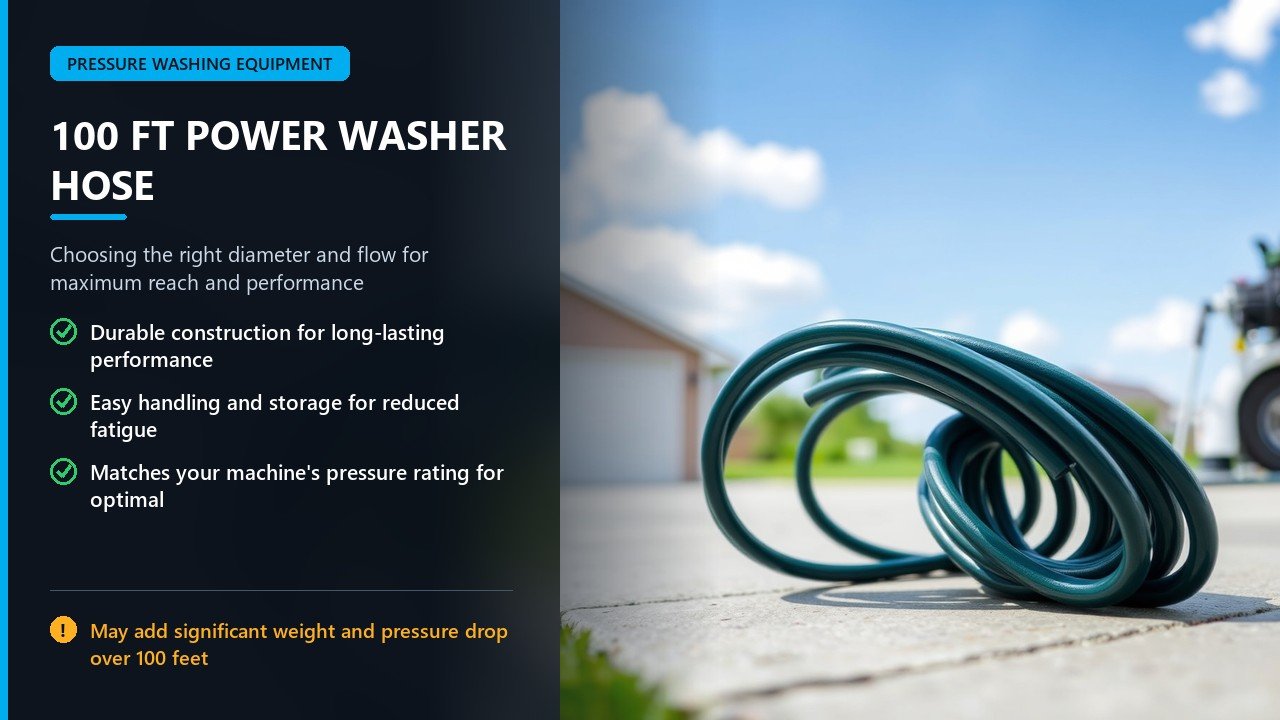
Why Choose a 100 Foot Hose
Length solves reach problems that would otherwise slow you down.
A 100 foot hose lets you clean areas the machine cannot be moved to easily, such as the far side of a large property, a long driveway, a roof or second story, or a work area spread out across a site. Instead of repositioning the machine repeatedly, you park it once and rely on the hose’s reach, saving time and effort. For many cleaning tasks on larger properties, a hundred feet is the sweet spot between reach and manageability, long enough for most jobs without the extreme weight and loss of much longer hoses.
The trade-offs of a long hose are weight, bulk, handling difficulty, and pressure loss over the distance. A hundred feet coiled is heavy and can be awkward, and friction reduces the pressure at the nozzle compared with a shorter hose of the same diameter. These trade-offs are worth it when reach matters, but they mean the hose must be chosen carefully, with attention to diameter and rating, and paired with a reel for manageability. A 100 foot hose is a tool of convenience for large jobs, not always the best choice for small ones.
Deciding on a 100 foot hose comes down to whether the reach is worth the trade-offs for your work. If you clean large or spread-out areas and value not moving the machine, the length is a big help; if your work is compact, a shorter hose is lighter and loses less pressure. Many owners keep multiple lengths and choose based on the job. Understanding why length is valuable, and its costs, helps you decide, and it sets up the factors that make a 100 foot hose work well. Our guide to a 100 ft pressure washer hose covers this length in related detail.
Diameter and Flow
Hose diameter affects pressure loss and flow.
Pressure washer hoses come in common inside diameters, such as 1/4 inch and 3/8 inch, and the diameter affects how much pressure is lost over the length. A larger-diameter hose reduces friction and pressure loss, delivering more of the machine’s pressure to the nozzle, which is especially important over a long hose like 100 feet. A 3/8 inch hose generally loses less pressure than a 1/4 inch hose of the same length, so for a 100 foot run, a larger diameter helps maintain performance. This matters more as both length and flow increase.
However, larger diameter also means a heavier, bulkier hose, which is harder to handle, and it must be matched to the machine and reel. The right diameter balances pressure loss against weight and manageability, and it should suit the machine’s flow. A high-flow machine benefits from a larger hose, while a lower-flow machine may be fine with a smaller one, and the hose must also be rated for the machine’s pressure. Matching diameter to the machine and the run keeps performance up and handling reasonable.
Diameter is a key choice for a long hose because of its effect on pressure loss and handling. For a 100 foot hose, going up a size can noticeably reduce pressure loss, but at the cost of weight and bulk, so the decision depends on your machine and how much pressure loss you can accept. Considering your machine’s flow and pressure, and how the hose will be handled, guides the choice. A well-chosen diameter keeps the pressure where you need it while keeping the hose workable, which is the balance a long hose demands. Our guide to a 100ft pressure washer hose covers diameter and material differences.
Pressure Rating
The hose must be rated for your machine’s pressure, with margin.
A pressure washer hose has a maximum pressure rating, and it must exceed your machine’s operating pressure with some margin for safety and longevity. Using a hose rated below the machine’s pressure risks bursting, a serious safety hazard, especially with a long hose under pressure. Choose a hose whose rating comfortably exceeds your machine’s output, and consider a higher rating for durability and peace of mind. The rating is a hard requirement, not a suggestion.
Pressure rating often pairs with a burst rating, which is several times the working rating, and both indicate the hose’s capability. A quality hose from a reputable source will list these, and you should verify them against your machine before buying. Temperature also affects hoses, so if you use hot water, ensure the hose is rated for the temperature. Rating and temperature compatibility are essential for safe, reliable use, and they must not be compromised for price.
Pressure and temperature ratings define whether a hose is safe for your machine, so they are among the first things to check. Because exceeding a hose’s rating can cause failure and injury, and because hot water demands temperature-rated hoses, these specifications are non-negotiable. A hose that meets the rating with margin and handles your water temperature is a safe foundation for the setup. When buying a 100 foot hose, confirm the ratings match your machine, and do not accept a hose that falls short. Our guide to pressure washer components explains the parts your hose must work with.
Hose Material
Material affects flexibility, durability, weight, and cost.
Rubber. Rubber hoses are durable, flexible, and resistant to kinking, abrasion, and temperature, making them a premium choice, especially for professional use and cold or hot conditions. They are heavier and more expensive but last well and handle nicely, which matters for a long hose.
Hybrid (rubber and polymer). Hybrid hoses blend rubber and polymer for a balance of flexibility, durability, and lighter weight, often at moderate cost, and they are popular for their handling.
PVC / thermoplastic. These hoses are lightweight and inexpensive, but they are stiffer, more prone to kinking, and less durable, and they may harden in cold. They suit light-duty and budget use, though a long PVC hose can be unwieldy.
For a 100 foot hose, material matters even more than for a short one, since flexibility and kink resistance affect how manageable the long hose is. A rubber or hybrid hose is easier to handle and more durable over the length, reducing frustration and lasting longer, while a PVC hose, though cheap, may kink and stiffen, making the long hose harder to use. Matching material to your needs and climate balances cost, handling, and longevity.
| Material | Characteristics | Best For |
|---|---|---|
| Rubber | Durable, flexible, kink-resistant, handles temperature | Professional and demanding use |
| Hybrid | Balanced flexibility, lighter weight, moderate cost | Most users wanting good handling |
| PVC / thermoplastic | Lightweight, inexpensive, stiffer, less durable | Light-duty and budget use |
Choosing the right material improves the experience with a long hose. Because a hundred feet of stiff, kinking hose is a burden, investing in a flexible, durable material pays off in easier handling and longer life, while a budget hose may suffice for occasional light use. Consider your climate, frequency of use, and budget when deciding, and favor handling and durability for a hose this long. The material is a major factor in how the hose performs and how pleasant it is to use. Our guide to pressure washer hose connector covers the fittings that join the hose to the machine.
Fittings
The hose’s end fittings must match your machine.
A pressure washer hose connects to the machine and the gun (or accessories) with fittings, and these must match your setup. Many hoses use M22 fittings, and M22 has variants that must match, while others use machine-specific or quick-connect fittings. Some hoses have the same fitting on both ends, and others have different fittings for the machine and the gun. Before buying, identify the fittings your machine and gun require, and choose a hose that matches, or use adapters.
Adapters can bridge differences, such as converting M22 to quick connect or matching a machine-specific fitting, and they are common accessories for making a hose compatible. Quick-connect conversions are a popular upgrade, letting you attach the hose fast without threading. When choosing a hose, confirm the fittings fit your machine, since a hose that does not connect is useless regardless of its other qualities. Matching fittings, or planning adapters, is essential.
Fittings are the point of connection and must match, so they are a primary consideration when buying a hose. Because a mismatch prevents connection or causes leaks, identifying your machine’s fittings and choosing a compatible hose, or adding adapters, is necessary. Quick-connect upgrades add convenience, and matched fittings ensure the hose works. For a 100 foot hose, getting the fittings right is as important as getting the length, since the hose must connect reliably to deliver its reach. Our guide to m22 pressure washer hose fittings covers the common connector type in detail.
Handling and Storage
A long hose must be managed, and a reel helps greatly.
A hundred feet of hose is heavy and unwieldy, so a reel makes a big difference, letting you wind and store the hose neatly and deploy it smoothly. Without a reel, coiling such a long hose by hand is a chore and invites kinks and tangles. If you use a 100 foot hose regularly, a reel sized for its length and diameter is a worthwhile companion, and it protects the hose and keeps it organized. Reels come in manual, retractable, and motorized types, with a manual reel often sufficient and powered options easing the work.
Beyond the reel, handle the hose with care: avoid sharp bends, dragging over abrasive surfaces, and pulling hard on the fittings, and drain and store it properly, especially in cold weather to prevent freezing. Winding the hose evenly and storing it off the ground extends its life. These practices keep a long hose manageable and lasting, and the reel makes them easier, turning a heavy coil into an orderly, ready tool.
Handling and storage determine whether a 100 foot hose is convenient or a nuisance. Because the length is heavy and prone to tangling, a reel and careful habits make it usable and long-lasting, and they protect the hose from damage. For anyone using a long hose regularly, the reel is nearly essential, and good storage keeps the hose ready. With proper handling and storage, the reach of a 100 foot hose comes without the hassle, and the hose serves reliably for years. Our guide to a pressure washer hose reel 100 ft covers reels built for this length.
Pressure Drop Over 100 Feet
Understanding pressure loss helps you choose a hose that performs.
As water flows through a hose, friction against the hose wall reduces the pressure, so the pressure at the nozzle is lower than at the machine, and the loss increases with length and with smaller diameter. Over 100 feet, this drop can be noticeable, meaning your machine’s rated pressure is not fully available at the surface. A larger-diameter hose reduces the drop, and a shorter hose would too, but at 100 feet you accept some loss in exchange for reach. Knowing this helps you set expectations and choose a diameter that limits the loss.
The drop also depends on flow, since more water moving through the hose means more friction, and on the hose’s condition and fittings, as kinks and restrictive connections add to the loss. Keeping the hose straight and free of kinks, using adequately sized fittings, and choosing a larger diameter all help preserve pressure. For a high-flow machine or a demanding job, minimizing pressure loss over a long hose is worthwhile, and the hose choice is central to it. In practice, the nozzle pressure is what cleans, so preserving it matters.
Pressure drop is an inherent cost of a long hose, but it can be managed. By choosing a larger diameter, keeping the hose in good condition, and avoiding restrictions, you limit the loss and deliver more pressure to the surface, and by understanding the loss, you can judge whether a hose meets your needs. Accepting a little drop for the reach of 100 feet is usually a fine trade, especially with a diameter that controls the loss. With this awareness, you can choose a hose that provides reach without sacrificing more pressure than necessary. Our guide to 100 ft pressure washer hose covers how diameter affects performance.
Matching the Hose to Your Machine
The right hose fits your machine’s pressure, flow, and fittings.
Start with the pressure and temperature ratings, ensuring the hose comfortably exceeds your machine’s output and handles your water temperature, especially for hot water machines. Then match the fittings to your machine and gun, or plan adapters, so the hose connects properly. Consider the diameter for your machine’s flow and the length of the run, favoring a larger diameter if pressure loss is a concern. Finally, weigh the material for handling and durability, since a long hose benefits from flexibility and kink resistance. Together, these factors define a hose suited to your setup.
Also consider how you will use and store the hose, since a 100 foot hose benefits from a reel and careful handling. If you move the machine often, a shorter hose may pair better; if you leave it in place, the long hose shines. Think about whether you spray chemicals, since some hoses resist chemicals better, and whether you work in cold, where rubber withstands stiffening better than PVC. Matching the hose to your machine and conditions ensures good performance and long life.
Matching the hose to your machine and needs is the essence of a good purchase. Because pressure, temperature, fittings, diameter, material, and use all matter, considering them together yields a hose that connects, performs, and lasts. A hose chosen this way delivers the reach of 100 feet without avoidable problems, while a poorly matched one disappoints. Take the time to identify your machine’s requirements and your working conditions, then choose accordingly, and the hose will serve you well. Our guide to 100ft pressure washer hose covers options and specifications.
Care and Maintenance
Good care extends a hose’s life and keeps it performing.
Drain the hose after use, especially before cold weather, to prevent trapped water from freezing and damaging it, and store it wound on a reel or coiled neatly, off the ground and out of harsh sun. Avoid dragging the hose over abrasive surfaces, pulling hard on the fittings, and leaving it kinked or under tension, all of which cause wear. Inspect the hose and fittings periodically for cracks, bulges, leaks, and worn O-rings, and replace damaged parts or the hose as needed, since a failing high-pressure hose is a safety risk. Clean the hose as appropriate, and protect it from chemicals that could degrade it unless it is rated for them.
Because a 100 foot hose is a significant investment and a safety-relevant component, caring for it is worthwhile. The practices are simple: drain, store properly, handle gently, and inspect regularly. These keep the hose flexible, leak free, and safe, and they extend its life, so the reach it provides remains reliable for years. Replace worn hoses promptly rather than risking a burst, and keep spare O-rings for the fittings to prevent drips. With good care, the hose delivers dependable performance.
Care and maintenance protect both the hose and the operator. Because a high-pressure hose can fail dangerously if neglected, and because proper care is easy, attention to draining, storing, and inspecting keeps the setup safe and functional. A well-maintained hose lasts longer, saving money and avoiding interruptions, and it performs at its best throughout its life. Treated with care, a 100 foot power washer hose remains a reliable tool that delivers the reach that made it worth choosing in the first place. Our guide to a pressure washer repair kit is a reminder that keeping spare parts helps maintain a reliable setup.
Frequently Asked Questions About a 100 Foot Power Washer Hose
Is a 100 foot power washer hose too long? Not if you need the reach. It adds weight and pressure loss, but for large or spread-out areas it saves repositioning the machine. For compact work, a shorter hose is lighter and more efficient.
What diameter is best for a 100 foot hose? A larger diameter, such as 3/8 inch, loses less pressure over the length than 1/4 inch, but it is heavier. Match the diameter to your machine’s flow and your handling preference.
How much pressure do you lose with a 100 foot hose? Some pressure is lost to friction over the length, more with a smaller diameter. A larger-diameter hose and a free-flowing setup reduce the loss and preserve nozzle pressure.
What pressure rating does a 100 foot hose need? A rating that comfortably exceeds your machine’s operating pressure, with margin, and a temperature rating if you use hot water. Never use a hose rated below your machine’s pressure.
What material is best for a long hose? Rubber or hybrid hoses offer the best flexibility and durability and resist kinking, making a long hose easier to handle. PVC is lighter and cheaper but stiffer and less durable.
Do I need a reel for a 100 foot hose? A reel is not mandatory but is highly recommended, since a hundred feet of hose is heavy and prone to tangling. A reel sized for the length and diameter makes it manageable.
Final Verdict on a 100 Foot Power Washer Hose
A 100 foot power washer hose delivers the reach to clean large or spread-out areas without constantly moving the machine, making it a valuable tool for bigger jobs. The cost is weight and some pressure loss over the length, which means choosing the hose carefully matters. Diameter affects that pressure loss and the hose’s weight, the pressure rating must exceed your machine’s with margin, the material determines handling and durability, and the fittings must match your machine.
Choose a hose with a rating and temperature capability suited to your machine, a diameter that balances pressure loss against handling, a flexible, durable material for a long hose, and fittings that fit, using adapters if needed. Pair it with a reel and handle and store it well to keep it manageable and long-lasting. Selected and cared for properly, a 100 foot power washer hose gives you the reach that makes large-area cleaning practical, delivering distance without giving up too much performance.