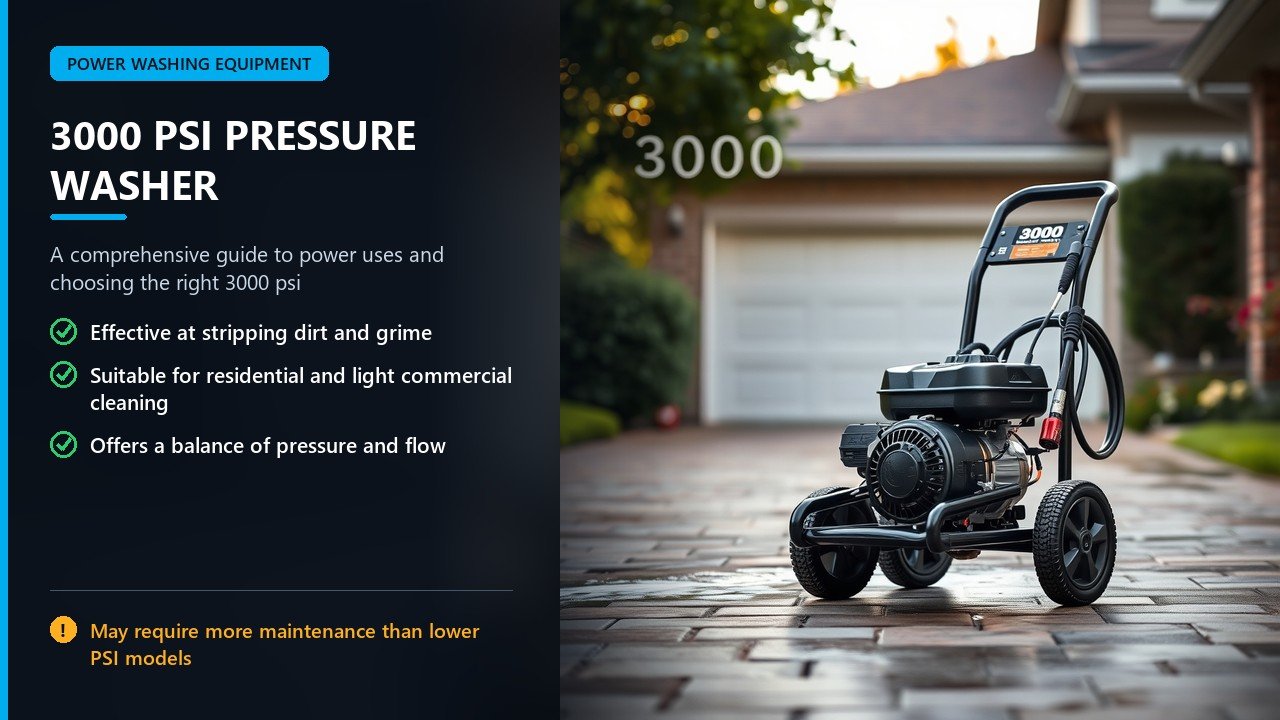
3000 PSI is a common pressure washer rating that sits in the middle to upper range for consumer and light commercial machines. PSI, or pounds per square inch, measures the force of the water spray. A 3000 PSI pressure washer delivers strong cleaning power, enough to strip dirt, mold, and grime from concrete, siding, decks, and vehicles, while remaining manageable for home and small business use.
What Does 3000 PSI Mean
Measuring water force.
PSI stands for pounds per square inch and describes the pressure at which a pressure washer ejects water. A 3000 PSI machine pushes water at 3000 pounds of force per square inch, which is powerful enough to lift stubborn dirt and stains from hard surfaces. For comparison, light-duty electric washers often run 1300-2000 PSI, while heavy-duty commercial gas units reach 4000 PSI or more, placing 3000 PSI in the strong middle-to-upper range.
Pressure alone doesn’t tell the whole story. Cleaning power is the product of PSI (pressure) and GPM (gallons per minute, the flow rate). A 3000 PSI washer at 2.5 GPM cleans differently from one at 3000 PSI and 1.2 GPM. Higher flow rinses and cleans faster, while higher pressure penetrates and strips. A balanced 3000 PSI machine typically runs around 2.4-2.8 GPM, giving excellent all-around performance.
Pressure plus flow equals power. Because PSI and GPM together determine cleaning ability, understanding both helps you judge a 3000 PSI machine. This informs your choice. With balanced specs, cleaning is effective. Our guide to what is the best psi covers choosing PSI.
What a 3000 PSI Pressure Washer Can Clean
Tough surfaces and jobs.
A 3000 PSI pressure washer handles a wide range of demanding cleaning tasks. On concrete, it strips dirt, mildew, tire marks, and light oil stains from driveways, sidewalks, and patios. On siding, it removes mold, mildew, and grime from vinyl, brick, and stucco when paired with the right nozzle and distance. On decks and fences, it cleans weathered wood, though pressure must be controlled to avoid damage.
It also cleans vehicles, trailers, and equipment, removes paint and loose coatings, and rejuvenates outdoor furniture and grills. With the right nozzle and technique, 3000 PSI covers most exterior cleaning needs. However, it’s too strong for some delicate surfaces, such as soft wood, painted surfaces that may chip, and certain vehicle finishes, where a gentler setting or lower pressure is safer.
Power for many surfaces. Because 3000 PSI tackles concrete, siding, decks, and vehicles, it’s versatile for exterior work. This makes it a popular rating. With proper technique, it cleans many surfaces. Our guide to what color pressure washer tip for concrete covers nozzle selection.
Gas Versus Electric at 3000 PSI
Gas leads in this range.
Most 3000 PSI pressure washers are gas-powered, because gasoline engines readily deliver the power needed for that pressure at good flow rates. Gas units offer portability, high performance, and no cord, ideal for large yards and job sites. They require fuel, oil changes, and more maintenance, and they’re louder and heavier than electric models.
Electric pressure washers can reach 3000 PSI, but fewer do, and they tend to have lower GPM at that pressure and draw significant power. Electric units are quieter, lighter, and maintenance-light, and they’re ideal where a cord or outlet is available. At 3000 PSI, gas generally offers better flow and performance, while electric suits users who prioritize convenience and lower noise.
Power source shapes performance. Because gas dominates the 3000 PSI range and electric has limits, your needs and location guide the choice. This affects portability and maintenance. With the right type, performance matches your work. Our guide to electric pressure washer covers electric options.
| Factor | Gas 3000 PSI | Electric 3000 PSI |
|---|---|---|
| Availability | Very common | Less common |
| GPM | Higher (2.4-2.8 typical) | Lower at same PSI |
| Portability | High (no cord) | Limited by cord |
| Noise | Louder | Quieter |
| Maintenance | More (fuel, oil) | Less |
This table compares gas and electric 3000 PSI pressure washers across availability, GPM, portability, noise, and maintenance, showing that gas units are more common and higher-flow in this range while electric units are quieter and easier to maintain.
Matching 3000 PSI to Surfaces
Pressure must suit the surface.
Using 3000 PSI correctly means matching pressure and nozzle to the surface. Concrete, brick, and stone tolerate high pressure well, so 3000 PSI with a rotating or 15-degree nozzle works. Wood decks and siding need lower pressure and a wider nozzle, plus greater distance, to avoid gouging or splintering. Vinyl siding cleans well at moderate pressure with a 25-degree or 40-degree tip.
Vehicles require care: use a wide tip, keep distance, and avoid concentrating the spray, or use a lower-pressure setting, because 3000 PSI can strip paint or damage trim if misused. Always test in an inconspicuous area and start with less pressure. The key is that more pressure isn’t always better; the right pressure for the surface cleans safely.
Technique prevents damage. Because 3000 PSI can harm delicate surfaces, matching nozzle and distance protects them. This avoids costly mistakes. With the right approach, cleaning is safe. Our guide to is pressure washing a car safe covers vehicle cleaning.
Choosing and Maintaining a 3000 PSI Washer
Balance PSI, GPM, and build.
When choosing a 3000 PSI pressure washer, look beyond the PSI number. Check the GPM for flow, as higher flow cleans faster. Consider the pump type, triplex pumps last longer than axial ones and suit frequent use. Look at engine or motor quality, brand reputation, and the included accessories such as nozzles, hoses, and a detergent tank. For regular or commercial use, prioritize durability.
Maintain the machine to protect your investment. Use the correct nozzles, avoid running the pump dry, change pump and engine oil per schedule, and winterize or use antifreeze in freezing climates to prevent freeze damage. Flush detergent from the system, inspect hoses and o-rings, and store the unit properly. With good care, a 3000 PSI washer delivers years of strong performance.
Specs and care matter. Because GPM, pump type, and maintenance affect performance and lifespan, choosing and caring wisely pays off. This maximizes value. With the right machine and care, cleaning is powerful. Our guide to powerhorse 3000 psi covers a specific model.
Frequently Asked Questions About 3000 PSI
Is 3000 PSI good for a pressure washer? Yes. 3000 PSI is a strong rating suited to tough residential and light commercial cleaning, handling concrete, siding, decks, and vehicles with the right technique.
What can a 3000 PSI pressure washer clean? Driveways, sidewalks, patios, siding, decks, fences, vehicles, trailers, equipment, and outdoor furniture. Avoid delicate surfaces or use lower pressure and wider nozzles.
Is 3000 PSI too much for a car? It can be if misused. Use a wide nozzle, keep distance, avoid concentrating the spray, and test first. 3000 PSI can damage paint or trim if directed too closely.
Gas or electric for 3000 PSI? Most 3000 PSI washers are gas, which offers higher flow and portability. Electric 3000 PSI units exist but are less common and often have lower GPM.
What GPM should a 3000 PSI washer have? A balanced 3000 PSI machine typically runs about 2.4-2.8 GPM. Higher flow cleans faster; check both PSI and GPM when comparing.
Is 3000 PSI better than 2000 PSI? For tough surfaces and large jobs, yes, 3000 PSI cleans faster and handles heavier grime. For delicate surfaces and light tasks, 2000 PSI may be safer and sufficient.
Final Verdict on 3000 PSI
3000 PSI is a sweet spot for pressure washers, delivering enough power for demanding residential and light commercial cleaning without the cost and bulk of heavy-duty commercial machines. It handles concrete, siding, decks, and vehicles effectively when combined with the right nozzle and technique.
Remember that GPM, pump type, and maintenance matter as much as the PSI number. Whether gas or electric, choose a balanced machine, match pressure to each surface, and care for it properly, and a 3000 PSI pressure washer will serve as a powerful, versatile cleaning tool.