You stand at the base of a two-story house, spray gun in hand, staring up at a band of green algae that has settled into the siding and gutters above the first-floor windows. The ladder is in the garage, the ground is uneven, and climbing up with a pressure washer wand in one hand is exactly the kind of task that leads to a fall. This is the problem a pressure wash extension wand solves. With the right extension, you can reach second-story siding, gutters, soffits, and rooflines from solid ground, cutting the risk of ladder work and the time it takes to move and reposition.
This guide explains what extension wands are, how they work, the different types, how to choose the right one for your machine, and how to use it safely. You will find comparison tables, side notes, and clear answers to the questions homeowners and pros ask most. By the end, you will know exactly how to add safe reach to your pressure washing setup.
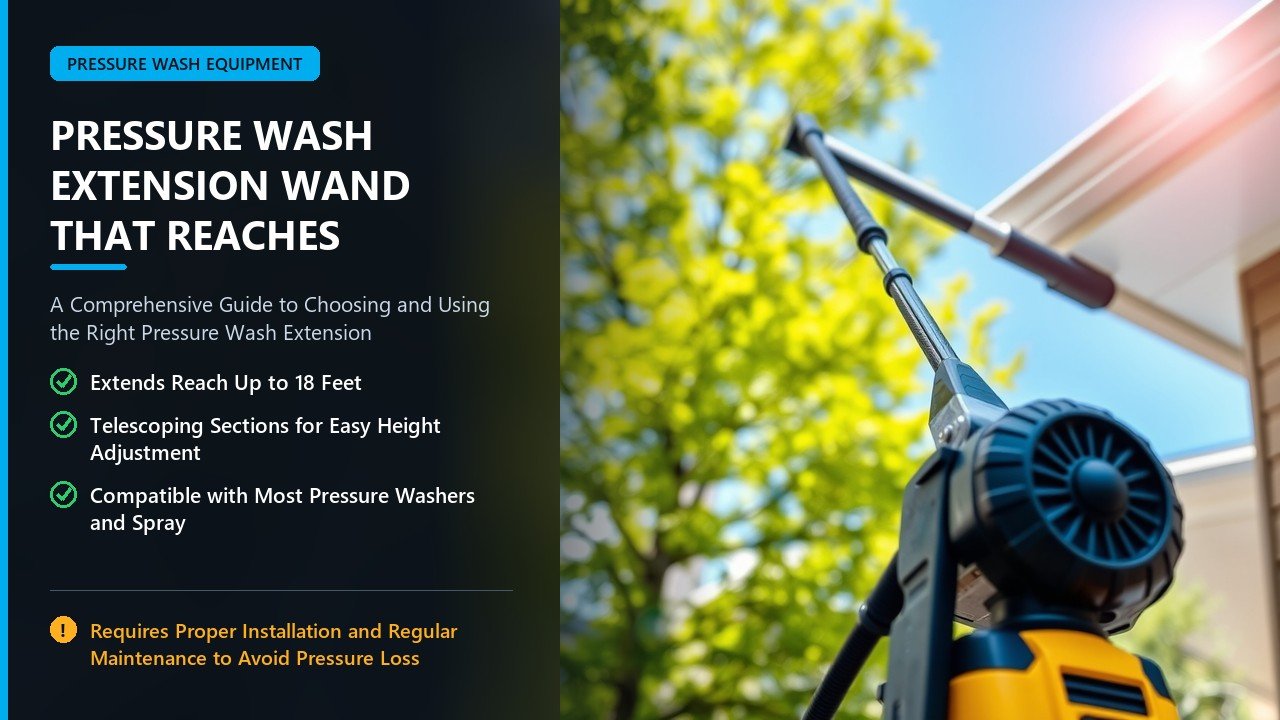
What Is a Pressure Wash Extension Wand
The basics first.
A pressure wash extension wand is a length of rigid tube that connects between your spray gun and the nozzle, extending your reach. Where a standard pressure washer wand or lance is usually a couple of feet long, an extension wand can run from a few feet to eighteen feet or more, often telescoping in sections so it collapses for storage and extends for use. The nozzle mounts at the far end, and the near end connects to your gun through the same fitting your machine already uses, usually a quick connect or a threaded M22 coupling.
The wand is made from materials that can handle high pressure and the bending load of a long lever arm. Common materials include anodized aluminum, stainless steel, and reinforced composites. Good extension wands use lightweight but stiff tubing, because a long wand that flexes or feels flimsy is hard to control and tiring to hold. Many models add a foam grip or padded sleeve so you can brace the wand against your body or a wall and manage the reaction force of the spray.
Extension wands are one of the simplest upgrades in pressure washing, but they are not just longer lances. The extra length changes how the tool behaves: pressure drops over distance, reaction force increases as a lever, and the nozzle must still deliver an effective spray pattern at the target. Understanding those effects is what separates a wand that helps from one that frustrates.
How Extension Wands Work
Length changes the physics.
When you add length between the gun and the nozzle, you add distance that the water must travel under pressure, and that adds friction loss. The longer and narrower the extension, the more pressure is lost before the water reaches the nozzle. A short extension of two or three feet barely changes performance. A long telescopic wand of fifteen feet can drop several hundred PSI, which is why matching the extension to your machine’s output matters so much.
The second effect is reaction force. Newton’s third law applies to water, so every bit of force the spray pushes out, the wand pushes back on you. On a short wand you barely notice it. On a long wand, that force acts at the end of a lever, which magnifies the effort needed to hold and aim the nozzle. This is why long wands place the nozzle at an angle and include grips for bracing, and why operators are taught to keep the wand close to their body and never let the nozzle stray toward a person.
The third effect is control. A long wand is harder to keep steady, so the spray pattern wanders. Manufacturers solve this with swivels that let the nozzle head rotate independently, with angled tips that let you clean overhead surfaces while standing safely below, and with balanced tubing that reduces fatigue. When all three work together, a long extension feels stable and the nozzle stays where you point it.
Types of Pressure Wash Extension Wands
Match the design to the job.
Extension wands come in several forms, and each suits different work. Fixed-length extensions are simple rigid tubes in one length, light, strong, and inexpensive. They are ideal for adding a couple of feet or reaching under and behind obstacles. Telescopic or telescoping wands extend in sections, usually from about six feet out to twelve, eighteen, or more, and collapse for transport. They are the go-to choice for reaching second-story siding and rooflines.
Angled and curved wands place the nozzle at an angle to the tube so you can clean gutters, soffits, and other overhead surfaces while standing safely below. Swivel wands add a rotating joint so the nozzle can be turned without twisting the whole wand, which helps on uneven surfaces. Some wands combine features, offering telescoping length plus an angled head, and these all-in-one designs are popular for gutter and roof work, similar to the reach that a dedicated telescoping pressure washer wand provides.
The table below compares the main types to help you pick the right one.
| Type | Best For | Strengths | Tradeoffs |
|---|---|---|---|
| Fixed length | Reaching under cars, decks, and fences | Cheap, strong, simple | One length, no adjustability |
| Telescopic | Second-story siding and rooflines | Adjustable reach, compact storage | More pressure loss, heavier |
| Angled or curved | Gutters and soffits | Cleans overhead while standing low | Limited reach, fixed angle |
| Swivel head | Uneven or detailed surfaces | Easy nozzle rotation | Slightly higher cost |
| Combination | Gutter and roof cleaning | Telescoping plus angled head | Higher price, more weight up high |
This table shows that fixed wands win on simplicity, telescopic wands win on reach and storage, and angled or combination wands are the best answer for overhead work like gutters and rooflines. Choosing by task keeps you from buying reach you will never use.
Benefits of an Extension Wand
Reach translates to safety and speed.
The biggest benefit is safety. Most pressure washing injuries at height come from falling off ladders while holding a wand, or from trying to balance on a roof edge. An extension wand lets you clean many second-story surfaces from the ground, removing the ladder from the equation entirely. When ladder work is unavoidable, the wand still reduces how often you must climb and reposition. Ladder safety is serious business; the OSHA ladder standard exists because these injuries are so common, and the American Ladder Institute offers guidance that every homeowner should read before climbing with a spray wand.
The second benefit is speed. Cleaning siding, gutters, and soffits from the ground means no ladder setup, no repeated climbing, and no moving a ladder every few feet. A job that takes an hour with frequent ladder moves can drop to a fraction of that time. For professionals, that time is money on every estimate.
The third benefit is coverage. A long wand reaches over bushes, behind fences, under eaves, and across wide walls without repositioning the machine. It lets you clean the top of a wall, the underside of a deck, and the far side of a driveway from one spot.
The fourth benefit is reduced strain in some cases. While a long wand is heavier to hold up high, a properly balanced wand with a body grip can spare your wrists and shoulders the awkward angles of a short wand, especially for overhead work.
How to Choose the Right Extension Wand
Match length, rating, and connection.
Start with length. Decide how high and how far you need to reach. Reaching a second-story window band usually calls for a wand in the twelve to eighteen foot range. Reaching under a car or deck needs only a few feet of fixed extension. Remember that a wand’s advertised length is often the fully extended length, and holding a long wand overhead is far more tiring than holding a short one, so buy only the reach you will actually use.
Check the pressure rating. The wand must be rated at or above your machine’s PSI, with margin to spare. A wand rated for 3000 PSI on a 4000 PSI machine risks failure and injury. Check the fittings too: the wand inlet must match your spray gun’s outlet and the nozzle connection at the tip. Many wands use quick connect on both ends, which pairs well with a machine already set up with pressure washer quick connects.
Consider material and weight. Aluminum is light and corrosion resistant, stainless steel is strong and durable but heavier, and composites split the difference. For long wands, weight is critical because you hold it high. A comfortable grip, a swivel if you want nozzle rotation, and a nozzle that suits the surface round out the choice. An angled head is worth the extra cost if gutters and soffits are your main targets, and a telescoping design helps when reach needs change from job to job. The table below shows how length affects both reach and performance demands.
| Wand Length | Typical Reach | Best On | Performance Note |
|---|---|---|---|
| 2 to 4 ft fixed | Low and under obstacles | Any machine | Minimal pressure loss |
| 6 to 8 ft telescopic | Single story and low eaves | Electric or gas | Slight pressure loss |
| 12 ft telescopic | Second story siding | Strong gas or pro electric | Moderate pressure loss |
| 18 ft telescopic | Rooflines and tall walls | High PSI gas only | Notable pressure loss, heavier |
| 20 ft and up | Commercial high reach | Commercial machines | Requires high flow to stay effective |
This table shows that reach grows with length but so does the pressure and power required to stay effective. Match the longest wand your machine can still feed properly rather than the longest wand you can find, and you will get reach without losing cleaning performance.
Using an Extension Wand Safely
Control is everything at length.
Safety with a long wand comes down to three habits. First, brace the wand. Keep the tube close to your body, plant one foot, and use the grip to steady the nozzle. Never let the nozzle come near your face, hands, or feet; high pressure water can inject through skin and cause serious injury. Never point the wand at a person or pet, even briefly.
Second, manage the reaction force. On a long wand the recoil is real, especially at high PSI. Start on a low-pressure nozzle setting and a lower-pressure tip, get a feel for the push-back, and only then work up. Use two hands, lean into the wand, and avoid overextending your arms, which makes you unstable.
Third, respect electricity and glass. Keep water away from electrical outlets, fixtures, and wires, and never spray near a downed or exposed line. Be cautious with windows; high pressure can force water past seals and crack older glass. For gutter work especially, be mindful that extension wands are often paired with specific techniques and risks, so review a guide on whether you can pressure wash gutters before you start.
How to Set Up Your Extension Wand
Connect, test, then work.
Setup is quick once you have the right parts. First, confirm your machine is off and the pressure is released. Connect the wand inlet to your spray gun. If both use quick connects, push and click; if threaded, hand tighten and then a quarter turn with a wrench, never forcing. Connect the nozzle to the wand tip, again matching the fitting type.
Turn on the water supply and let it flow before starting the engine, so the pump is primed. Start the machine and test the spray on a safe surface, checking every connection for leaks in the first few seconds. Tighten any dripping fitting a little, or replace its o-ring. Then extend the wand to the length you need and lock the sections so they do not slide under pressure.
Work top to bottom and left to right, keeping the nozzle at a consistent distance from the surface. Overlap each pass by about half so you do not leave stripes. For overhead surfaces like soffits, use an angled tip so the water and debris fall away from you, not onto you. Rinse from the top down so dirty water does not streak surfaces you already cleaned.
Common Extension Wand Mistakes
Avoid these and your wand will last.
The most common mistake is buying a wand that is too long for the machine. The result is weak pressure and disappointing cleaning. The second is using a wand with too low a pressure rating, which risks a burst and an injury. The third is forgetting that a long wand demands more muscle, then overextending and losing control of the nozzle.
Other frequent errors include skipping the o-ring check, leading to drips and pressure loss; failing to lock telescoping sections, so the wand collapses mid-job; and using a worn nozzle that sprays unevenly at the end of a long wand, making the reach useless. Owners also forget to dry and store the wand properly, leaving water inside to corrode aluminum or freeze and crack it in winter.
Each mistake is easy to avoid. Size the wand to your machine, confirm the rating, lock the sections, keep fresh o-rings on hand, and drain and dry the wand after every use. A little care turns an extension wand into a long-lasting tool instead of a one-season frustration.
Extension Wand vs Other Reach Solutions
When to reach and when to climb.
An extension wand is not the only way to reach high surfaces, and knowing the alternatives helps you choose the safest tool. A ladder gets you close for detailed work and lets you use a standard wand, but it means climbing with a spray gun, which is the riskiest part of many pressure washing jobs. A ladder is still the right tool for tight detail work that a nozzle on the end of a long wand cannot handle.
A surface cleaner is better for large flat areas, and a short wand works for low surfaces. For most second-story siding, soffits, and gentle gutter cleaning, an extension wand is the best balance of safety and speed. The smart approach blends tools: use the extension wand for reach, the ladder only when you truly need to be close, and never force one tool into a job it was not made for.
A common middle path is a shorter telescopic wand combined with an angled nozzle. This keeps pressure loss low while still reaching single-story eaves and overhead surfaces. Because so many buyers ask about the difference between a fixed extension, a telescoping wand, and a full power washer extension setup, it is worth reading a dedicated comparison before you buy.
Maintaining Your Extension Wand
Simple care, long life.
Maintenance is minimal but worthwhile. After every use, flush the wand with clean water to remove soap and grit, then drain it fully. Store it collapsed and dry, indoors if possible, to prevent corrosion and freeze damage. Inspect the o-rings at both ends and replace any that look flat, cracked, or cut, since a worn o-ring causes pressure loss at the worst time.
Check the telescoping locks and the grip for wear, and keep the sliding sections clean so they extend smoothly. If the wand has a swivel, make sure it turns freely and does not leak. In freezing climates, treat the wand like the rest of the machine: a few drops of water left inside a tube can freeze and split it, so always drain before storage.
Frequently Asked Questions
What is a pressure wash extension wand used for? It extends your reach so you can clean high siding, gutters, soffits, rooflines, and hard-to-reach areas from the ground, while also reaching under vehicles, decks, and behind obstacles. It reduces the need for ladder work.
Do extension wands reduce pressure? Yes, longer wands lose more pressure to friction. A short extension loses very little, while a fifteen-foot wand can drop a few hundred PSI. Match the wand length to your machine’s output to keep the spray effective.
How long can a pressure washer extension wand be? Wand lengths range from a couple of feet up to about twenty feet or more. The practical limit depends on your machine’s PSI and GPM, because longer wands need more power to remain effective.
Can I use an extension wand with an electric pressure washer? Yes, but electric machines have less power, so long extensions may weaken the spray noticeably. A short or medium telescopic wand is usually the realistic limit for a typical electric washer.
Are angled extension wands better for gutters? Yes. An angled or curved head lets you clean gutters and soffits while standing safely below, directing the water and debris away from you. Many combination wands add an angled head to a telescoping tube for this exact job.
How do I connect an extension wand to my spray gun? Match the connection: use quick connect if both the gun and wand use it, or match the thread type if threaded. Tighten firmly but do not overtighten, and check the o-ring for a good seal.
Is a telescoping wand better than a fixed extension? It depends on the job. A telescoping wand offers adjustable reach and compact storage, ideal for high work, while a fixed extension is lighter, cheaper, and perfect for shorter, low-reach tasks.
Final Verdict on Pressure Wash Extension Wands
A pressure wash extension wand is one of the smartest tools you can add to a pressure washing setup. It turns dangerous ladder work into safe ground work, speeds up jobs by removing the constant climb-and-move cycle, and extends your reach to second-story siding, gutters, soffits, and rooflines. The catch is that length changes performance, so you must match the wand to your machine’s PSI and GPM rather than simply buying the longest one available.
Choose the type that fits your main task, confirm the pressure rating and connection, lock the sections, and brace the wand to control the reaction force. Keep the o-rings fresh and the wand drained and dry. Do that, and your extension wand becomes a reliable, safe way to clean high and far without ever leaving the ground.