Most pressure washers live on the garage floor, rolled out when needed and shoved back when the job is done. The humpback 3000 pressure washer takes a different approach. It is built around a wall-mounted, low-profile platform with an integrated hose reel, so the machine hangs out of the way and the hose stores itself.
This guide explains what the humpback 3000 is, how its wall-mount design works, what its 3000 PSI class means in practice, its key features and accessories, and how it compares with a conventional cart-style washer.
What Is a Humpback 3000 Pressure Washer
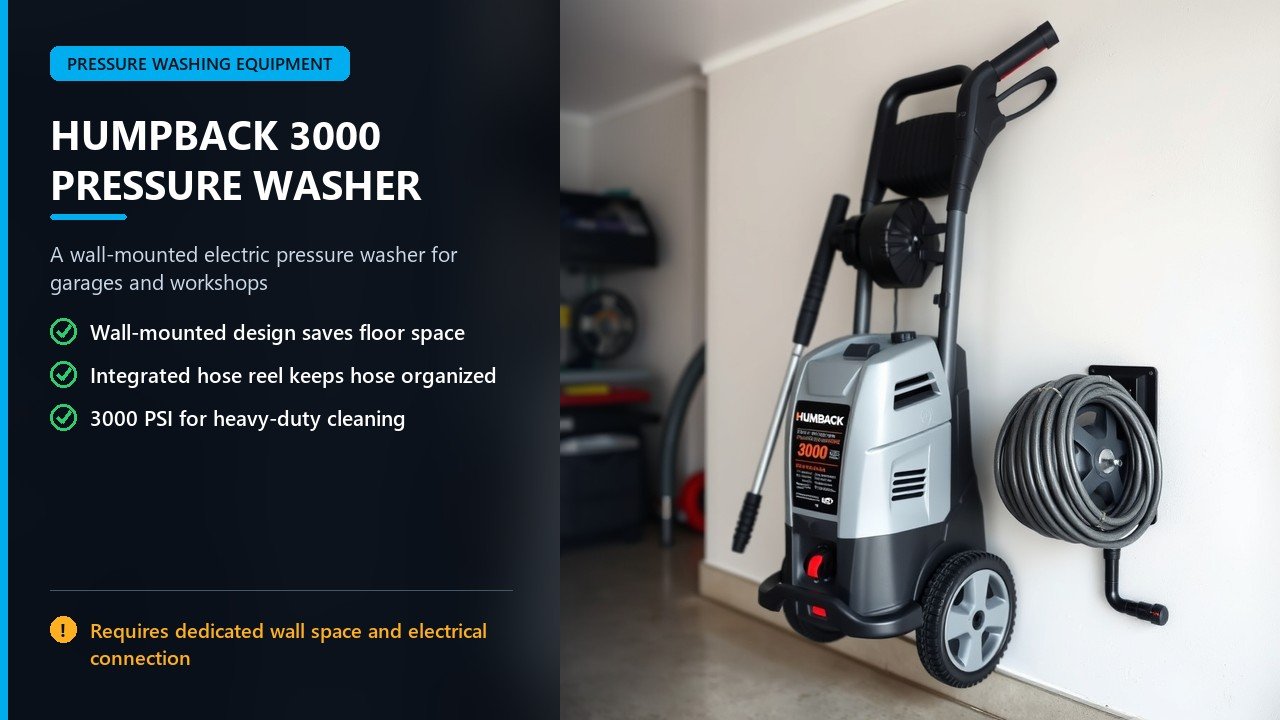
The humpback 3000 is an electric pressure washer in the 3000 PSI class, designed to be mounted on a wall rather than rolled on wheels. The “humpback” name comes from its arched, low-profile housing that sits flat against the mounting surface while protecting the motor, pump, and internal hose reel underneath.
Because it is wall-mounted, the machine saves floor space and keeps the cleaning area clear. It runs on standard household electricity rather than gasoline, so there is no fuel to store, no engine to tune, and no exhaust to manage. The integrated reel is central to the design: the hose winds onto the machine itself, which keeps it out of the way and protects it from kinks and damage.
It is best understood as a permanent or semi-permanent installation for a garage, workshop, carport, or small business, rather than a portable unit that follows you from site to site. That fixed position is a feature, not a limitation — it means the machine is always ready exactly where you clean most often.
How the Wall-Mount Design Works
The humpback design combines three ideas: a compact housing, a wall-mount plate, and an integrated hose reel. The housing holds the motor and pump in a single low-profile unit. A mounting plate or bracket attaches the machine to a solid wall or post, positioning the unit at a convenient height. The hose reel is built into the housing, so the pressure hose coils inside or onto the machine instead of lying in a pile on the floor.
Around the housing, the inlet hose and power cord connect to nearby supply points, which is why the machine suits a location with a nearby water tap and outlet. The trigger gun and wand hang from the machine or an included hanger, so the entire system stays organized between uses.
The practical payoff is a tidier setup and a longer hose life. When a hose is routinely wound onto a reel rather than dragged across concrete and left kinked on the floor, it lasts longer and resists the cracking and abrasion that ruin hoses prematurely. For anyone who uses a pressure washer in the same spot repeatedly, this design removes daily hassles.
What 3000 PSI Means for the Humpback
A 3000 PSI rating puts the humpback 3000 in the mid-to-upper range of consumer and light-commercial machines, and it is enough for a broad range of outdoor cleaning. At that pressure, the machine can tackle concrete walkways and patios, garage floors, driveways, fences, siding on single-story homes, decking, vehicles, and outdoor furniture.
Pressure alone does not tell the whole story — flow in gallons per minute matters too. Electric machines in this class often trade some flow for pressure, which means they clean effectively but may take longer to rinse large areas than a gasoline machine with higher GPM. For most residential jobs, that tradeoff is a good one, because the electric unit is quieter, cleaner, and easier to maintain.
To get the most from a 3000 PSI machine, match the nozzle to the task. A 0-degree tip concentrates the spray for tough spots on hard surfaces, while 15-, 25-, and 40-degree tips widen the pattern for softer or more delicate surfaces. A soap nozzle applies detergent at low pressure, and a turbo nozzle can speed up stubborn flatwork. Using the widest safe pattern for each surface protects finishes and gets better coverage.
Key Features and Accessories
The humpback 3000’s feature set centers on convenience. The wall-mount platform and integrated reel are the defining features, but the machine typically ships with the accessories that make it usable out of the box: a pressure hose, a trigger gun, a spray wand, and a set of quick-connect nozzles in common angles such as 0, 15, 25, 40, and soap. Some configurations add a foam cannon or surface cleaner, and the standard quick-connect fittings let it accept many aftermarket accessories.
Because it is an electric machine, it also includes a power cord with a ground-fault circuit interrupter, which protects the user when water and electricity are close together. The housing and mounting plate are typically metal or heavy-duty plastic, built to hold the pump and motor securely against a wall over years of use.
Optional upgrades include a longer high-pressure hose, additional nozzle sets, undercarriage cleaners, and rotary surface cleaners. With its M22-style fittings and standard quick-connects, the humpback 3000 accepts the same accessories as most consumer pressure washers, so expanding its capabilities is straightforward.
Humpback vs Cart-Style Pressure Washers
The clearest way to understand the humpback 3000 is to compare it with a conventional cart-style washer. A cart washer is portable: it rolls to any job and works anywhere there is water and power. The humpback trades that mobility for organization, a smaller footprint, and a permanently ready setup.
For someone who cleans multiple locations or works on job sites, a cart washer usually makes more sense, because portability is the priority. For someone who cleans the same driveway, garage, or shop over and over, the humpback’s fixed wall position and integrated reel are more convenient day to day. There is no single right answer — the choice depends on whether you value movement or tidiness.
On cleaning power, both can reach 3000 PSI. The humpback’s advantage is not raw performance but workflow: it hangs out of the way, stores its own hose, and keeps tools together. Its limitation is that it stays where you mount it, so cleaning distant areas depends on hose length and access to water and power.
Setting Up a Wall-Mounted Washer
Installing a humpback 3000 starts with choosing the right location. Pick a solid wall near both a water tap and a power outlet, in a spot where the hose can reach your main cleaning areas without excessive stretching. A garage wall, an exterior wall under an overhang, or a workshop post are all common choices.
Mount the plate or bracket securely into framing or masonry rather than just drywall, because the loaded machine and full hose reel carry real weight and should not pull free. Position the unit high enough to be out of the way but low enough to reach the controls and reel comfortably. Connect the water supply with a proper inlet hose and the power cord to a GFCI-protected outlet.
Before the first run, bleed air from the system by running the machine with the gun open until the water flows steadily, then check all fittings for leaks. Confirm the pressure and nozzle behavior, then wind the hose onto the reel and hang the gun in its holder. A careful setup makes the machine safe and ready.
Using the Integrated Hose Reel
The integrated reel is the humpback’s signature feature, and using it well extends the life of the hose. Unwind only as much hose as you need for the job — leaving the rest on the reel keeps it protected and prevents tangles around obstacles. Pull the hose straight off the reel rather than yanking it at an angle, which strains the reel and the hose fitting.
When you finish, drain the hose before winding it back. A hose wound wet traps moisture against itself and the reel, which shortens its life. Coil it evenly across the drum rather than letting it bunch to one side, which causes uneven winding and kinks on the next use. Avoid kinking the hose during winding, since sharp bends create weak points.
Lubricate the reel bearing or swivel occasionally and keep the guide clean, so the hose winds and unwinds smoothly for years. A reel that operates freely is what makes the humpback design pay off, and a little care keeps it that way.
Maintenance and Care
The humpback 3000 needs the same care as any electric pressure washer. Keep the inlet water clean with a filter or strainer, never run the pump without water, and never deadhead the machine. Check the nozzle and inlet for clogs if pressure drops, and inspect the O-rings and quick-connects for wear that causes leaks.
Flush detergent from the system after each use so it does not dry and clog passages. If the pump has a crankcase, check and change its oil on schedule, and watch for milky oil that signals water intrusion. Winterize before freezing by draining water and drawing pump protector fluid through the pump, even though the machine is mounted indoors, because unheated garages and shops still freeze.
Finally, inspect the power cord and GFCI before each season and replace damaged cords rather than repairing them. Because the machine is fixed in place, it is easy to forget — a quick annual inspection keeps it safe and reliable.
Who Should Buy a Humpback 3000
The humpback 3000 suits homeowners and small businesses that clean the same areas repeatedly and want a machine that stays organized and out of the way. It is ideal for garages, workshops, carports, and small commercial spaces where floor space is tight and a permanent cleaning station makes sense.
It is less suitable for users who need to move the washer between locations or job sites, or who clean areas far from a water or power source. Those users are better served by a portable cart or gas machine. When the cleaning spot is fixed, though, the humpback’s design is a genuine convenience that a portable washer cannot match.
Performance in the Real World
On the jobs it is meant for, the humpback 3000 performs well. Rinsing a muddy car, cleaning a driveway, washing siding on a single-story home, and blowing debris off a patio are all within its 3000 PSI class. Because it is electric, it starts instantly and runs quietly, which matters in residential areas and indoor workshops.
The main real-world limitation is flow. At 3000 PSI with the modest GPM typical of electric machines, it cleans thoroughly but a little slower than a high-flow gas unit. Using the right nozzle and a rotary surface cleaner can close much of that gap, spreading the water more evenly and speeding up flat-surface work.
Water supply matters too. The machine needs a feed that keeps up with its flow, and a long, undersized hose run can starve the pump. Setting up near a good tap, with a short and adequately sized inlet hose, gets the best performance and protects the pump.
Humpback vs Cart: Quick Comparison
The table below summarizes the trade-offs between a wall-mounted humpback washer and a conventional cart-style machine. The right choice depends on how and where you clean.
| Factor | Humpback Wall Mount | Cart Washer |
|---|---|---|
| Footprint | Minimal; hangs on wall | Occupies floor space |
| Hose storage | Integrated reel | Loose or separate reel |
| Portability | Fixed location | Highly portable |
| Setup effort | One-time wall mount | Roll out and go |
| Best for | A fixed cleaning station | Multiple sites and jobs |
Neither design is superior in the abstract. A tidier station that stays put is ideal for repeated same-spot cleaning, while a cart is essential when the job moves around. Matching the tool to the workflow is what matters.
Common Mistakes to Avoid
The most common mistake with a wall-mounted washer is mounting it to an unsuitable surface. Drywall alone cannot hold a loaded machine and reel; the bracket must fasten into framing or masonry. A poor mount can pull free and damage the machine and the wall.
Another frequent error is starving the pump by using too small or too long an inlet hose, or by running the machine with a partially opened supply. The pump needs full, unobstructed flow. Deadheading — running with the gun closed — is equally damaging and should always be avoided.
Other mistakes include leaving the hose wound wet and kinked on the reel, forgetting to winterize an unheated installation, and neglecting the GFCI and power cord. Each is easy to prevent with a little routine care, and each prevents a much bigger headache later.
Maintenance and Safety Notes
Safety matters with any electric washer because water and electricity are close together. Always plug into a GFCI-protected outlet, keep connections dry and off the ground, and never touch the plug with wet hands. Inspect the cord before each use and stop if it is damaged. Never spray toward the outlet, the machine, or any electrical component.
Wear eye protection and keep the high-pressure spray away from skin and from other people. The spray from a 3000 PSI machine can injure, and the safest habit is to treat the wand as you would a cutting tool — pointed only at the work, never at anyone. With these habits, the humpback 3000 is a safe and dependable cleaning station for years.
Frequently Asked Questions
What is a humpback 3000 pressure washer? It is a 3000 PSI-class electric pressure washer designed to mount on a wall, with an integrated hose reel in its low-profile housing.
Is the humpback 3000 gas or electric? It is electric, powered by a standard household outlet, so it does not use gasoline or an engine.
Can a humpback 3000 clean a driveway? Yes. At 3000 PSI it handles concrete, patios, and garage floors, though electric flow makes it somewhat slower than high-flow gas machines.
Does it come with a hose reel? Yes. The integrated reel is central to the design and stores the pressure hose on the machine.
Can I move a wall-mounted pressure washer? It is not meant to be moved between sites. It is designed as a fixed cleaning station, so portability is limited to the reach of its hose.
What water supply does it need? It needs a tap that keeps up with its flow, connected by an adequately sized inlet hose, so the pump is never starved.
How do I winterize a wall-mounted washer? Drain the water, draw pump protector fluid through the pump, and store hoses dry, even if the machine is in a garage that may freeze.
What nozzles does it use? Generally standard quick-connect tips in 0, 15, 25, 40, and soap angles, with M22-style fittings that accept many accessories.
Final Thoughts
The humpback 3000 pressure washer is built around a simple idea: put the machine where you clean and keep everything organized. Its wall-mount housing, integrated hose reel, and electric 3000 PSI power make it a tidy, ready-to-use cleaning station for garages, workshops, and small businesses.
Choose it if your cleaning spot is fixed and you value a clear floor and stored hose. Choose a portable cart instead if you move between locations. Mounted securely, fed with enough water, and winterized each year, the humpback 3000 delivers convenient, dependable cleaning season after season. For related reading, see our guides on the pressure washer with reel and the 3 phase pressure washer.