When a pressure washer is used every day, the hose reel stops being a convenience and becomes a piece of equipment. Cheap reels seize, leak at the swivel, and jam the hose. That is where a Reelcraft pressure washer hose reel enters the picture. Reelcraft is an American manufacturer known for industrial-duty reels, and its pressure wash line is built to handle the demands of professional cleaning day after day.
This guide explains what a Reelcraft pressure washer hose reel is, the types available, how to choose the right one, how to install and use it, and how to maintain it for a long service life.
What Makes Reelcraft Reels Different
Reelcraft Industries has built hose, cord, and cable reels in the United States for decades, and its products are common in industrial, agricultural, and professional settings. The pressure wash reels are designed specifically for high-pressure water service, with pressure ratings that suit commercial pressure washers rather than just garden hoses.
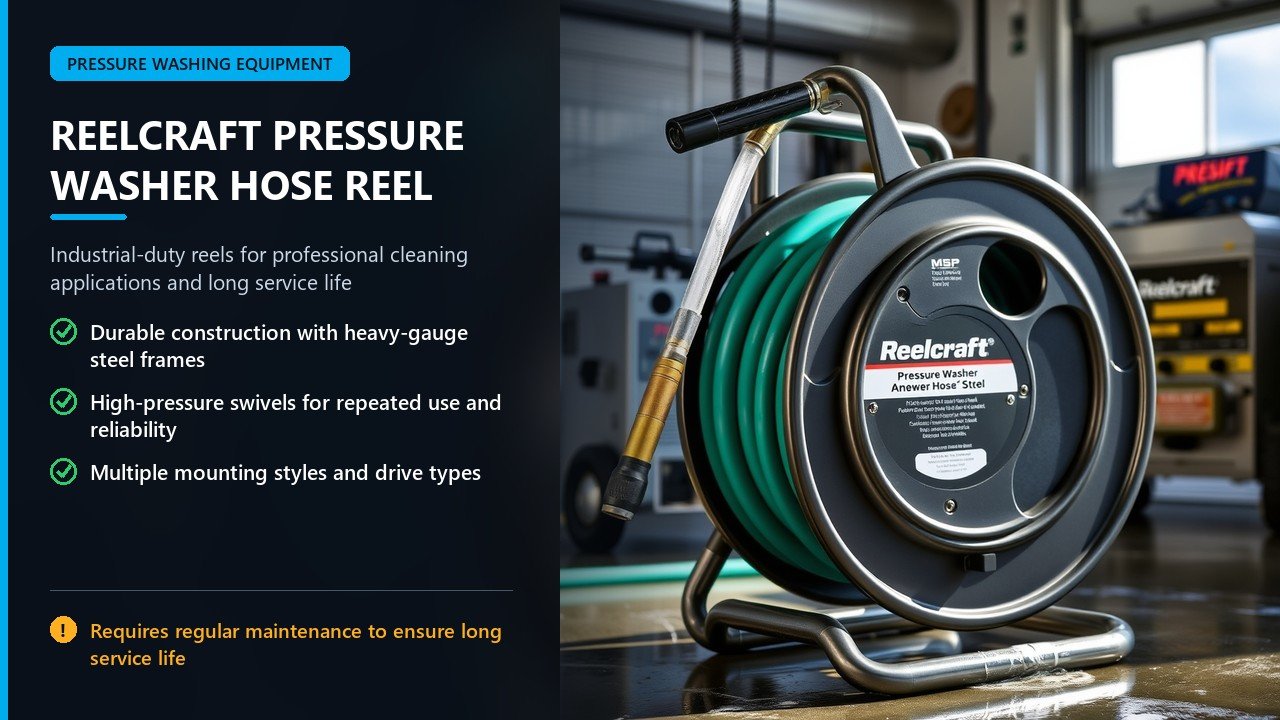
The emphasis is on durability and serviceability. Reelcraft reels typically use heavy-gauge steel frames and all-bolted construction, and their swivels are built to withstand high pressure and repeated use. Many models are made to be serviced and rebuilt rather than discarded, which matters when a reel is a working tool.
The company also makes reels in multiple mounting styles and drive types, from compact hand-crank units to heavy-duty spring-retractable and motor-driven reels. That range lets a cleaning business match the reel to the machine, the hose length, and the working environment.
Types of Reelcraft Pressure Wash Reels
Reelcraft’s pressure wash lineup includes several drive styles. Spring-retractable reels, often identified by the OHP designation, wind the hose automatically using a spring and latch mechanism. You pull the hose out to the length you need, and a short tug engages the latch; when you release, the spring retracts the hose. These are popular for mounted stations where the hose should store itself.
Hand-crank reels are wound manually, usually with a large handle, and offer simple, reliable operation with no spring to tension or wear. They suit users who prefer to control the winding themselves and who want minimal maintenance.
Motor-driven reels wind the hose using an electric or hydraulic motor, which is convenient for very long hoses and frequent use on trucks and service vehicles. These are heavier and more expensive, and they need a power source, but they save significant effort on long, heavy hoses.
Specifications That Matter
The first specification is pressure rating. Reelcraft pressure wash reels are rated for high-pressure service, commonly in the range of several thousand PSI, so they can handle commercial pressure washers. Always confirm the reel’s rating exceeds your machine’s maximum pressure, since the swivel and seals must withstand the full system pressure.
Hose capacity is the next key figure. Reels are rated by hose inside diameter and length — for example, a reel sized for a 3/8-inch hose in lengths of 50, 75, or 100 feet. Match the capacity to the hose you use, and leave a little room so the hose winds without binding. The inlet and outlet fittings also matter, typically in standard National Pipe Thread sizes.
Construction and mounting round out the picture. Reelcraft reels often use heavy-gauge steel and all-bolted frames, with adjustable guide arms for wall, ceiling, or vehicle mounting. The swivel, guide rollers, and latch mechanism are the parts that determine how smoothly the reel operates, so their quality is worth noting.
Why Choose a Professional-Grade Reel
A professional-grade reel like a Reelcraft costs more than a basic consumer reel, and for heavy use the difference is justified. Industrial reels hold up to constant winding and unwinding, resist weather and abuse, and keep their swivels sealing under high pressure. A cheap reel that fails mid-job costs far more in downtime than it saves upfront.
Serviceability is another advantage. Reelcraft reels are designed to be repaired and rebuilt, with replacement swivels, seals, springs, and latches available. That means a reel can be maintained for years instead of replaced, which is exactly what a working cleaning operation needs.
For a homeowner who pressure washes occasionally, a premium reel may be more than necessary. But for a business that depends on the equipment, a durable, serviceable reel is a sound investment that keeps the hose protected and the workflow smooth.
Choosing the Right Reelcraft Reel
Choosing a reel starts with your hose. Decide the hose diameter and length your pressure washer needs, then pick a reel rated to hold that hose with a little extra capacity. Confirm the reel’s pressure rating exceeds your machine’s maximum, and check the inlet and outlet fitting sizes so it connects without restrictive adapters.
Next, choose the drive type based on how you work. A spring-retractable reel suits a fixed station where the hose stores itself, and it is convenient but relies on correct spring tension. A hand-crank reel suits users who want simplicity and control, with minimal maintenance. A motor-driven reel suits long hoses and frequent use where winding by hand would be a burden.
Finally, choose the mounting style. Reelcraft offers wall, ceiling, and vehicle mounting options, with adjustable guide arms on many models. Match the mount to your setup: a wall-mount reel for a fixed cleaning bay, a ceiling-mount for overhead reach, or a truck-mount for mobile cleaning. Confirm the mounting hardware suits your surface and load.
Installing a Reelcraft Reel
Installation follows sound practices for any heavy reel. Mount the reel into solid framing, steel, or masonry, not drywall, because a full hose reel is heavy and pulls outward as it winds. Follow the manufacturer’s instructions for bracket placement and guide-arm orientation, and use the specified hardware.
Connect the inlet and outlet as directed, using the correct fittings and sealant where required. For a spring-retractable reel, set the spring tension according to the manual so the hose retracts fully but not forcefully. For a motor-driven reel, wire the motor per the instructions and provide the correct voltage and protection.
Before winding the hose, pressurize the system briefly and check the swivel and every connection for leaks. Fix any drip before the hose goes on, since reaching a leaking swivel afterward means removing the hose. Then wind the hose onto the reel and check that it spools evenly and the latch engages correctly.
Using a Reelcraft Pressure Wash Reel
With a spring-retractable reel, pull the hose out to the length you need; each pull-and-release engages the latch to hold it. To retract, give the hose a short tug to disengage the latch and guide the hose back onto the drum, keeping it straight and free of kinks. Never let the hose retract freely without guiding it, because a loose, snapping retraction can whip the gun or damage the hose.
With a hand-crank reel, wind the hose by hand while keeping it straight, and secure the crank when not in use. With a motor-driven reel, follow the manufacturer’s operating procedure and keep the hose guided as it winds, since the motor will not correct a tangle on its own.
In all cases, pull the hose straight off the reel rather than at an angle, and keep it clear of sharp edges, hot exhaust, and chemicals. When the job is done, drain the hose before winding it back, so trapped water does not sit against the hose or freeze in the swivel.
Maintaining a Reelcraft Reel
Maintenance keeps a professional reel working for years. Inspect the swivel for leaks and smooth rotation, and service or replace the swivel per the manual when it wears. Keep the guide rollers and the drum bearing clean and lubricated as allowed, so the hose winds smoothly.
For spring-retractable reels, check the spring tension periodically and adjust it per the manufacturer’s instructions if the hose does not retract fully or retracts too forcefully. For motor-driven reels, check the motor, wiring, and drive components for wear.
Inspect the frame and mounting hardware for looseness or corrosion, and tighten bolts as needed. Because Reelcraft reels are often mounted outdoors or on vehicles, watch for rust and treat it early. Before winter, drain the hose and the reel’s swivel to prevent freeze damage.
Common Mistakes to Avoid
The most common mistake is using a reel whose pressure rating or capacity does not match the hose and machine, which leads to leaks, binding, or failure. Another is mounting into weak material, letting the reel pull free under load. Ignoring a leaking swivel or a slack spring allows a small problem to grow.
On the use side, letting a spring reel retract without guiding the hose, winding a kinked hose, and leaving water in the reel over winter are frequent errors. So is pulling the pressure washer by the hose or overloading the reel beyond its capacity.
Finally, treating a professional reel as maintenance-free misses its main advantage: it is built to be serviced. Replacing swivels, seals, and springs when they wear keeps the reel working and the hose protected far longer than replacing the whole unit. With modest care, a Reelcraft reel outlasts the machines it serves.
Drive Types Compared
Drive type is the biggest choice in a Reelcraft pressure wash reel. The table below compares the main options so you can match one to your workflow.
| Drive Type | How It Works | Best For |
|---|---|---|
| Spring-retractable | Pull out; spring winds it back | Fixed stations, self-storing hose |
| Hand crank | Manual winding with a handle | Simple, low-maintenance setups |
| Motor driven | Electric or hydraulic motor winds it | Very long hoses, trucks, heavy use |
Match the drive to how often and how far you deploy the hose. For a mounted cleaning bay, a spring reel is convenient; for maximum simplicity, a hand crank; for the longest hoses on a service truck, a motor-driven reel.
Mounting Options
A reel is only as useful as its mounting. Reelcraft reels are designed for wall, ceiling, and vehicle mounting, with adjustable guide arms that let the hose feed in the right direction for each position. Matching the mount to the workspace keeps the hose out of the way and easy to deploy.
A wall mount suits a cleaning bay or garage, placing the reel near the machine and the work area. A ceiling mount lifts the reel overhead, which is useful in spaces where a wall mount would obstruct movement. A vehicle mount anchors the reel to a truck or trailer for mobile cleaning, where the reel must withstand vibration and road conditions.
In every case, mount into solid structure and follow the manufacturer’s guidance for the load. A reel loaded with a long high-pressure hose is heavy, and dynamic loads during winding and unwinding are greater than the static weight. Secure mounting prevents the reel from pulling free and keeps the operator safe.
Integrating With a Pressure Washer
To integrate a reel with a pressure washer, connect the pump’s outlet to the reel’s inlet and the high-pressure hose to the reel’s outlet, so the water travels through the reel’s swivel to the hose. The reel then acts as both storage and a rotating coupling, letting the hose unwind without twisting.
The swivel is the critical part of this integration, because it must pass full pressure while rotating. A quality swivel rated for the system pressure is essential, and it is the part most likely to need service over time. Confirm the reel’s swivel rating exceeds your machine’s pressure before connecting.
Once connected, the reel becomes part of the high-pressure circuit, so treat its fittings with the same care as the rest of the system. Check for leaks at the swivel and fittings before each use, and never operate with a leaking swivel under pressure, since a failure there can be dangerous.
Maintenance Schedule
A professional reel benefits from a simple schedule. After each use, check the swivel for leaks and confirm the hose winds and unwinds smoothly. Periodically clean and lubricate the guide rollers and bearing as allowed, and inspect the hose for wear where it flexes near the reel.
For spring reels, check tension and the latch mechanism periodically, and adjust per the manual if retraction weakens or becomes forceful. For motor reels, inspect the motor, wiring, and drive for wear. Tighten mounting hardware on a regular basis, since vibration loosens bolts over time.
Annually, or before seasonal storage, service the swivel, inspect seals, and drain all water from the hose and reel. Store a portable or vehicle-mounted reel with the hose drained and, where possible, protected from freezing. This routine keeps a Reelcraft reel performing like new for years.
Is a Reelcraft Reel Worth It
A Reelcraft pressure washer hose reel is worth it for users who rely on a pressure washer regularly or professionally. Its industrial construction, high pressure ratings, and serviceable design keep the hose protected and the workflow efficient, and it stands up to conditions that destroy cheap reels.
For occasional home use, a less expensive reel may suffice, as long as it matches the hose and machine. But when downtime, hose replacement, and reliability matter, the professional-grade reel earns its cost through durability and repairability.
Whichever reel you choose, the principles are the same: match it to the hose and machine, mount it securely, use it with care, and maintain it. A good reel turns a loose, vulnerable hose into an organized, long-lasting part of a professional cleaning system, and a Reelcraft is built to do exactly that.
Frequently Asked Questions
What is a Reelcraft pressure washer hose reel? A pressure wash hose reel made by Reelcraft Industries, an American manufacturer of industrial hose, cord, and cable reels, built for high-pressure service.
Are Reelcraft reels high pressure? Yes. Reelcraft pressure wash reels are rated for high-pressure service in the thousands of PSI, suited to commercial pressure washers.
Which Reelcraft drive type is best? A spring-retractable reel suits a fixed station, a hand crank suits simple setups, and a motor-driven reel suits very long hoses and heavy, mobile use.
What hose length can a Reelcraft reel hold? Capacity depends on the model and hose diameter — commonly 50, 75, or 100 feet of 3/8-inch hose. Match the reel to your hose.
Is Reelcraft made in the USA? Yes, Reelcraft manufactures many of its reels in the United States, and its products are common in industrial and professional settings.
Can a Reelcraft reel be repaired? Yes. Reelcraft reels are designed to be serviced, with replacement swivels, seals, springs, and latches available.
How do I mount a Reelcraft reel? Wall, ceiling, or vehicle mounting options are available. Mount into solid structure using the provided hardware and follow the manufacturer’s instructions.
How do I maintain a Reelcraft reel? Check the swivel for leaks, keep rollers and bearings clean and lubricated, adjust spring tension, tighten mounting bolts, and drain water before storage.
Final Thoughts
A Reelcraft pressure washer hose reel is a professional-grade solution for keeping a high-pressure hose organized and protected. Its industrial construction, high pressure ratings, and serviceable design make it a durable choice for users who depend on their pressure washer, whether in a cleaning bay or on a service truck.
Match the reel’s rating and capacity to your hose and machine, choose the drive and mount for your workflow, install it securely, and keep it maintained. Serviced rather than discarded, a quality reel like a Reelcraft outlasts the equipment it serves and keeps every job cleaner and faster. For related reading, see our guides on the pressure washer reel with hose and the reel for power washer.