Buy a 150 ft pressure washer hose reel and it feels like you have solved reach forever. Then you park at the base of a two-story house, walk out 150 feet, and discover you cannot quite touch the far corner you bought it for. A 150 ft reel rarely delivers 150 feet of usable reach, and understanding that gap is the difference between a reel that fits your work and one that leaves you short.
This guide looks at the 150 ft reel specifically — why it is the most common professional size, what it actually reaches, how pressure behaves over that length, and how to match one to your machine and rig.
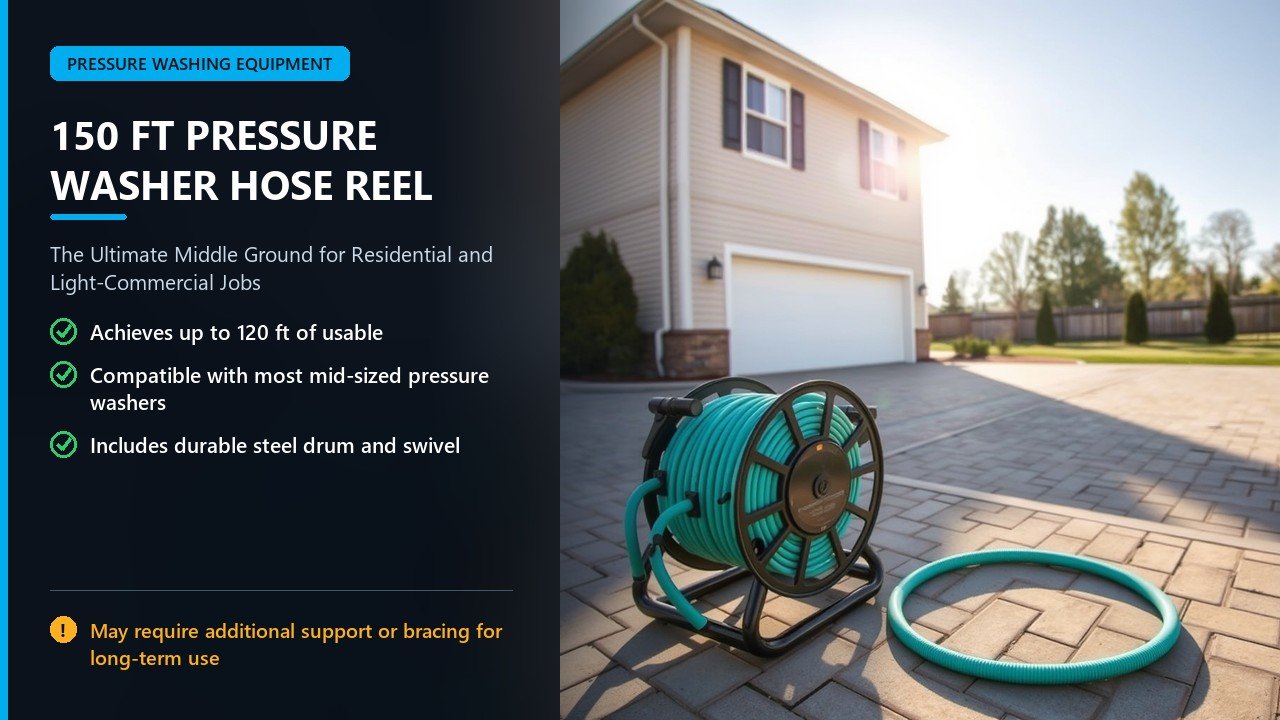
Why 150 ft Is the Sweet Spot
Hose reels are sold in a handful of standard capacities: 50, 100, 150, 200, 300, 450 feet, and more. The 150 ft size sits in a useful middle ground. It is big enough to cover most residential and light-commercial jobs from a single parking spot, yet small enough to stay manageable in weight and size on a portable rig.
Go smaller and you are moving the machine or adding a second hose far more often. Go much larger and the drum, the hose, and the weight grow fast — 200 feet of 3/8-inch high-pressure hose is heavy, and reeling it by hand all day is real work. For a mid-sized trailer or van setup, 150 feet is often the point where coverage and effort balance.
It is also a common factory capacity, which means parts, swivels, and replacement hoses for 150 ft reels are widely available. Standardization matters in the field, and the 150 ft reel is close to a standard.
The Reach Math You Should Do First
Usable reach is not the same as hose length. Start from the machine, and every component eats into the length before water reaches your work. The jumper hose to the reel, the reel’s internal plumbing, the working hose, the wand, and your own arm all consume some of it. Then real-world factors cut deeper.
Height is the biggest reducer. Washing a second-story wall or the top of a building means the hose runs diagonally, not straight out, so horizontal coverage shrinks as vertical rise grows. Wrapping around obstacles, going up and over fences, and taking a non-straight path all reduce reach further.
As a rough rule, plan on losing a meaningful margin off the stated length once you account for plumbing, slack, height, and routing. A 150 ft reel might give you something closer to 120 to 130 feet of practical working coverage on flat ground, and less on a tall building. Do that math before buying, and 150 feet looks very different from the number on the box.
How Pressure Behaves Over 150 Feet
Length costs you pressure. Water moving through hose loses pressure to friction, and the longer and narrower the hose, the greater the loss. At 150 feet, that loss is real — enough to feel at the nozzle, especially on a machine that is already near its limit.
Hose diameter is the key variable. A 3/8-inch hose, the commercial standard, flows far better than a 1/4-inch hose over distance. Running 150 feet of 1/4-inch hose on a high-flow machine strangles the flow and drops pressure noticeably, while the same length of 3/8-inch hose holds up much better.
Bigger is not always free, though. A larger-diameter hose is heavier, bulkier, and needs a bigger reel. For a 150 ft capacity, 3/8-inch is the usual sweet spot: good flow, manageable weight, and compatibility with standard commercial reels and fittings.
Matching a 150 ft Reel to Your Machine
A reel does not care how many PSI your washer makes, but its swivel and seals do. The reel’s pressure rating must exceed your machine’s maximum output, and its temperature rating must cover your hottest water. A 150 ft reel rated to 4,000 PSI is common and safe for most gas machines; hot-water rigs need a reel rated accordingly.
Capacity needs a margin too. A reel rated for exactly 150 feet, filled to exactly 150 feet, winds poorly — the hose stacks unevenly, rubs against itself, and strains the frame. If you plan to run 150 feet, choose a reel rated somewhat higher so the drum never fills to its limit. Many operators deliberately oversize the reel for this reason.
The connection type must match your system. Most 150 ft reels use 3/8-inch NPT inlet and outlet ports, matching standard commercial fittings and hoses. Confirm the port sizes and the swivel type before you buy, and keep a high-pressure jumper hose on hand to connect the machine to the reel’s inlet.
Reach, Pressure, and Capacity at a Glance
The table below summarizes the practical picture for a 150 ft reel. Treat the reach figures as planning estimates, since terrain, height, and routing vary.
| Factor | What to know |
|---|---|
| Stated length | 150 ft |
| Practical flat reach | Roughly 120–130 ft after plumbing, slack, and routing |
| Reach on a tall building | Less, because vertical rise consumes horizontal coverage |
| Best hose diameter | 3/8 in. for flow and manageable weight |
| Reel rating to choose | Above your machine’s PSI and temperature |
The takeaway is to size the reel for the work, not just the number. If your typical job truly needs 150 feet reaching the far side of a tall building, buy a reel that holds more than 150 feet and run 3/8-inch hose. If your work is mostly ground-level, a 150 ft reel has comfortable margin.
Mounting a 150 Foot Reel
A 150 ft reel with hose is a substantial load. Mount it into solid structure — a skid frame, a truck bed, a trailer beam, or a building wall — never into thin sheet metal that can deform. Reinforce the mounting surface if there is any doubt, and use hardware rated for the weight plus the pull of a pressured hose.
Position matters for effort. Mount the reel where you can crank it comfortably without leaning or reaching, ideally high enough that the hose leaves the drum cleanly. On a trailer, floor-mount at a height you can operate from the ground. In a fixed wash bay, a wall mount saves floor space and lets the hose hang clear.
The hose must leave the drum before it carries pressure. Never pressure wash with 150 feet of hose coiled on the reel — the coiled, pressurized hose cannot dissipate heat, rubs against itself, and damages both the hose and the reel. Pull the working length off the drum every time.
Maintenance Specific to a 150 Foot Reel
Longer hoses mean more of them to manage. Wind the hose evenly and completely after each job, guiding it so it lays flat rather than piling to one side. A poorly wound 150 ft hose kinks at the drum and shortens its own life.
Check the swivel and the jumper hose more often on a long-hose rig, because they take the most stress. A drip at the swivel under load means worn seals, and a rebuilding kit is inexpensive insurance. The jumper hose flexes most, so keep a spare on hand.
Mind the weight and the heat. A 150 ft hose run at high pressure through a small coil holds heat near the drum, so never leave the working length coiled while under pressure. In winter, drain the hose and swivel completely so freezing water cannot split a swivel or split the hose itself.
Is 150 Feet Right for Your Work
Whether 150 feet is generous or tight depends entirely on the jobs you take. For residential cleaning — driveway, siding, walkways, a typical house — 150 feet reaches the far end of most properties from a single parking spot. That is why it is the sweet spot so many operators settle on.
For larger buildings, long commercial frontages, or jobs with obstacles in the path, the effective reach shrinks fast and you will reposition the machine. A 150 ft reel covers the common case, not every case. Knowing which case you are buying for is the whole point.
If your work runs to big flatwork, fleet lots, or tall multi-story buildings, step up to a 200 ft or 300 ft reel and a motorized drive. The extra capacity removes the repositioning and the hand-cranking that make long hoses a chore.
Choosing the Drive for a 150 Foot Reel
At 150 feet, the drive type starts to really matter. A hand-crank reel is perfectly workable, but winding 150 feet of 3/8-inch hose by hand, job after job, is real effort. Many operators accept it for the simplicity and durability; others pay more for a motorized reel to save their shoulders.
A spring-retractable reel is convenient for shorter lengths and fixed stations, but 150 feet of high-pressure hose is heavy for a spring to handle, so spring reels are less common at this capacity. For heavy daily use, a motorized or electric reel is the comfortable choice.
If your rig runs one hose and moderate frequency, a hand-crank 150 ft reel is the pragmatic pick. If it runs all day, every day, the motorized reel earns its premium by cutting fatigue and time.
Sizing It Right the First Time
Put the pieces together and the 150 ft reel decision is really a set of small, clear choices. Confirm your real reach by measuring a typical job. Pick 3/8-inch hose for flow. Buy a reel rated above your machine’s pressure and temperature, with capacity to spare so the drum never fills. Then match the drive to how often you reel hose in.
Make those choices deliberately and a 150 ft reel stops being a guess and becomes a tool sized to your work. Get them wrong and you either come up short or strain the machine. The length is only a number; the fit is what matters.
Frequently Asked Questions
How much hose does a 150 ft reel hold? Up to about 150 feet of 3/8-inch hose, though buying a slightly larger reel and not filling it to the limit winds much better.
Is 150 feet enough for a house? For most residential work, yes. You can reach the far side of a typical property from one parking spot, though a tall building reduces usable reach.
What size hose should I use? 3/8-inch hose is the commercial standard for a 150 ft reel — good flow, manageable weight, and standard fittings.
Does hose length reduce pressure? Yes. Friction over a long hose lowers pressure at the nozzle, and a thinner hose loses more. 3/8-inch hose handles 150 feet better than 1/4-inch.
What PSI rating do I need? A reel rated above your machine’s maximum pressure — commonly 4,000 to 5,000 PSI for gas machines — and rated for your hottest water.
Can I pressure wash with the hose still on the reel? No. Pull the working length off the drum. Washing with it coiled traps heat and damages the hose and reel.
Hand crank or motorized? Hand-crank is simple and durable; motorized saves effort on long hoses and heavy daily use. At 150 feet, the choice is about how often you reel it in.
Should I buy bigger than 150 feet? Only if your jobs need the extra reach or you want to avoid repositioning. For most residential work, 150 feet is plenty.
The Takeaway
A 150 ft pressure washer hose reel is the middle-ground workhorse of pressure washing rigs: enough reach for most residential and light-commercial work, light enough to handle, and widely supported with parts. But the stated length is not the usable reach, and pressure drops over distance, so match the reel to your real jobs and to your machine.
Run 3/8-inch hose, choose a reel rated above your machine’s pressure and temperature, oversize the capacity slightly, and mount it solidly where you can operate it comfortably. Measure a real job before you buy, and a 150 ft reel will do exactly what you need — no more illusions, no more coming up short. For related reading, see our guides on pressure washer reel with hose and reel for power washer.