Shoppers fixate on PSI. Pressure is the number on the box in big letters, and it sounds impressive. But the number that most often decides how fast a pressure washer actually cleans is GPM — gallons per minute, the measure of flow. Two washers with the same PSI can behave completely differently, and the difference is almost always the GPM.
This guide explains what GPM means in a pressure washer, why it matters as much as pressure, and how to use it when choosing a machine or matching accessories.
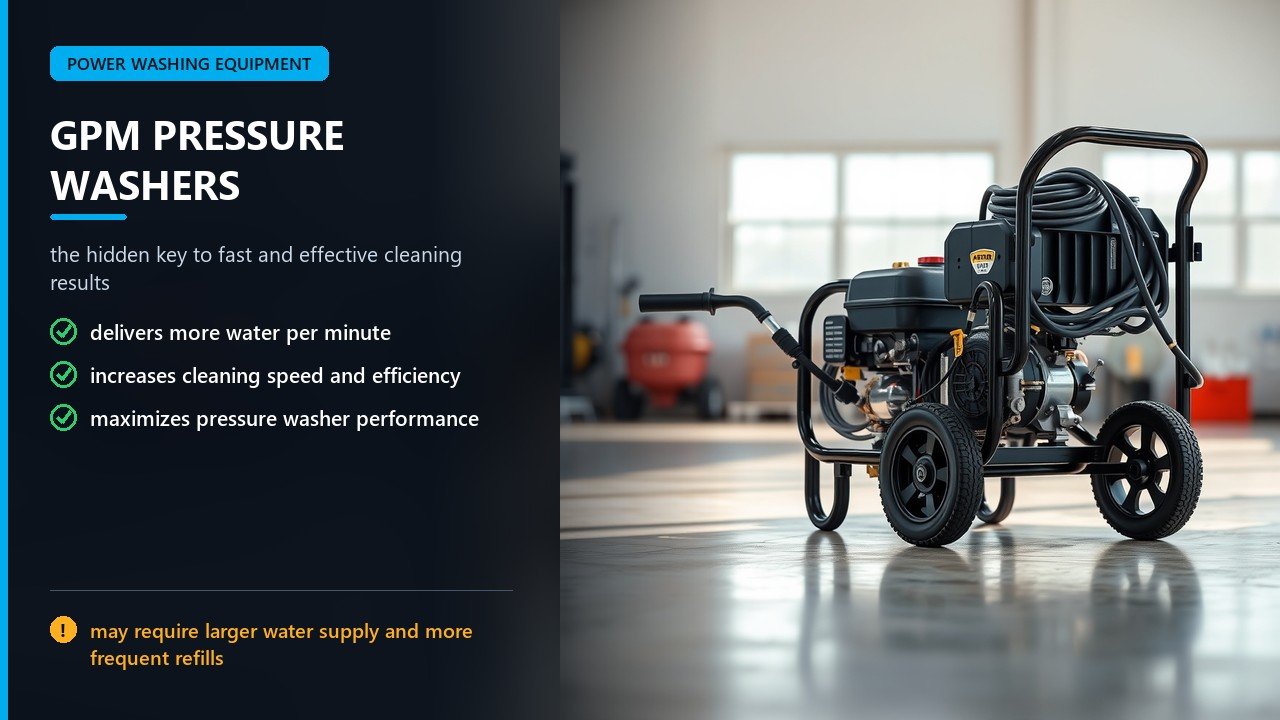
What GPM Means
GPM stands for gallons per minute. It is the volume of water the machine pushes through the nozzle every minute. A machine rated at 3 GPM delivers three gallons each minute; a machine at 4 GPM delivers four. Flow is separate from pressure, and the two work together to produce cleaning power.
The difference between pressure and flow is easy to picture. Pressure is how hard the water hits the surface — it decides whether the stream can break the bond between dirt and surface. Flow is how much water carries that dirt away — it decides how fast the surface is covered and rinsed. A machine with high pressure but low flow blasts a narrow, powerful stream; one with more flow covers ground faster and rinses better.
Because both matter, the honest measure of a pressure washer’s cleaning capability is a combination of the two, not pressure alone. Manufacturers know that PSI sells machines, which is why pressure is emphasised. Buyers who understand GPM see past the marketing.
Cleaning Power and Flow
Multiplying pressure by flow gives a rough measure of cleaning power, often called cleaning units. A machine at 3,000 PSI and 2.5 GPM produces about 7,500 cleaning units. A machine at 3,000 PSI and 4.0 GPM produces about 12,000 — far greater, even though the pressure is identical. This is why flow is so important to how fast a job goes.
In practice, more GPM means faster cleaning, especially on large surfaces like driveways and decks. The stream carries dirt away more quickly, so each pass removes more and the nozzle can move faster. Time and again, a machine with moderate pressure and good flow out-works one with high pressure and poor flow, particularly with a surface cleaner or on wide areas.
The table below outlines typical GPM levels and what they suit.
| GPM | Typical use |
|---|---|
| 1.2 – 1.5 | Light electric washers, cars, small patios |
| 2.0 – 2.5 | Home gas washers, driveways, decks, siding |
| 3.0 – 4.0 | Heavy home and light commercial, large flatwork |
| 5.0 and up | Industrial, sewer jetting, high-volume cleaning |
The pattern is clear: as GPM rises, the machine suits larger and more demanding work. Pressure still matters for breaking up tough grime, but flow sets the pace.
Matching Nozzles to GPM
GPM is not just a machine specification — it also drives nozzle choice. The nozzle has an orifice, and the orifice size must match the flow. A nozzle with an orifice too small for the machine chokes the flow, raising pressure beyond the machine’s rating and making it work harder. A nozzle with an orifice too large lets the water through too freely, so pressure drops and the stream loses its bite.
Nozzle charts pair orifice sizes with flow rates at given pressures. Two machines can share a PSI rating but need different nozzles because their GPM differs, and using the wrong one wastes the machine’s capability. This is why a nozzle set bought for one machine may not suit another of the same pressure but a different flow.
The same principle applies to other accessories. A surface cleaner, a turbo nozzle, and a spray gun all have flow requirements. Matching an accessory to the machine’s GPM — not just its PSI — is what lets the machine perform as designed. A surface cleaner sized for more flow than the machine provides will turn slowly and clean poorly; one sized correctly spins fast and cleans evenly.
GPM In and GPM Out
A detail that trips up new owners is that the machine needs a supply that matches its output. A washer rated at 4 GPM must receive at least 4 GPM from its water source, or the pump will starve, lose pressure, and risk damage through cavitation. The garden tap, supply hose, and any fittings must deliver enough flow, not just enough pressure.
This is why high-GPM machines often need a tank or a large supply line rather than a standard garden hose. A thin, long, or kinked hose restricts flow, and a weak tap cannot keep up. Before buying a high-flow machine, check that the supply can feed it, and use a hose and filter large enough to keep the pump full.
The inlet side also needs a clean filter, because debris cuts flow and starves the pump just as surely as a weak supply. Matching the supply to the machine’s GPM, keeping the line clear, and never running the pump dry are the rules that protect the pump and keep the machine producing its rated output.
Using GPM When You Buy
When comparing machines, read the GPM as carefully as the PSI. A slightly lower PSI with a higher GPM often cleans faster than the reverse. For large flat surfaces and general washing, prioritise flow; for the toughest stuck-on grime, pressure still helps break it loose, but it works best alongside good flow.
Match the machine’s GPM to the job and to the accessories. A homeowner cleaning cars and a small patio needs little flow, while someone washing driveways, siding, and large decks benefits from more. Anyone using a surface cleaner should check that the cleaner is rated for the machine’s GPM so the pairing works.
Beware of peak ratings that may not be sustained. A machine that claims high flow on paper but cannot hold it under load will disappoint, just as one that claims high pressure but has no flow behind it. The combination of realistic PSI and GPM, sustained under load, is the true measure of a pressure washer’s worth. For related reading, see our guide on power washer 4 gpm.
Why GPM Matters More Than Buyers Think
Cleaning power, the product of PSI and GPM, explains why flow deserves a closer look. A machine at 3,000 PSI and 2.5 GPM produces about 7,500 cleaning units. One at 3,000 PSI and 4.0 GPM produces about 12,000 — far greater, with identical pressure. On paper the two look equal if you only read PSI; in use they are very different machines.
On large surfaces, the machine with more GPM finishes sooner. The stream carries dirt away more quickly, so each pass removes more and the nozzle can move faster. With a surface cleaner, the effect is even clearer: flow drives the cleaning pace, and a low-flow machine leaves the cleaner turning slowly over the same ground.
This is why experienced buyers treat GPM as equal to or more important than PSI. Pressure sells, but flow cleans. A machine should be judged on the combination, sustained under load, rather than on whichever number is printed largest on the box.
Common GPM Misconceptions
Several misconceptions cost buyers either money or performance. The first is that pressure alone determines cleaning power — it does not, because flow matters too. The second is that more GPM is always better; it is not, because more flow means a larger, heavier, costlier machine and a supply that can keep up, which is wasteful for light work.
The third is that GPM only affects speed and not quality. In practice, more flow rinses dirt away more thoroughly as well as faster, so both the pace and the finish improve. The fourth is that the rated GPM is always achieved; in reality, a restricted supply or a capped hose can starve the pump and drop the flow well below the rating.
Understanding these points saves money. Buying for flow you will not use wastes it, and ignoring flow you do need means slower, less satisfying work. Reading the machine’s real, sustained GPM — and matching it to the job — is the honest way to choose.
Getting the Most From Your GPM
Once you own a machine, a few habits make the most of its flow. Use the correct nozzle orifice so the water flows freely at the right pressure, and keep nozzles clean so they do not restrict flow. Check the inlet filter and supply hose regularly, since a restricted supply starves the pump and robs the machine of its rated GPM.
Match accessories to the flow. A surface cleaner, turbo nozzle, or extension wand with the wrong flow requirement will underperform or strain the machine. If you use a hose reel, choose a hose diameter that carries the flow without excess pressure loss — a narrow hose on a high-flow machine is a bottleneck.
Finally, respect the supply. Keep the garden hose as short and wide as practical, avoid kinks, and never let the pump run dry. A machine delivers its rated flow only when everything upstream allows it, and protecting that flow is the same as protecting the pump.
Frequently Asked Questions
What does GPM mean on a pressure washer? Gallons per minute — the volume of water the machine pushes through the nozzle each minute. It measures flow, which is separate from pressure.
Is GPM as important as PSI? Yes. Cleaning power combines pressure and flow. A machine with moderate pressure and good flow often cleans faster than one with high pressure and poor flow.
What is a good GPM? It depends on the job. Around 1.2 to 1.5 GPM suits light work, 2.0 to 2.5 GPM suits typical home cleaning, 3.0 to 4.0 GPM suits heavy home and light commercial work, and 5.0 GPM and up is industrial.
What are cleaning units? A rough measure of cleaning power, calculated by multiplying PSI by GPM. “Cleaning units” is the common term. Higher total means more cleaning power.
Why does my machine not deliver its rated GPM? Usually a restricted supply — a weak tap, a long or narrow hose, a kink, or a clogged inlet filter — that starves the pump.
Does GPM affect nozzle choice? Yes. The nozzle orifice must match the flow. Too small chokes the flow and raises pressure; too large drops pressure and weakens the stream.
Can a garden hose supply a high-GPM machine? Not always. High-GPM machines may need a tank or a large supply line, because a standard garden hose cannot always keep up.
Should I buy higher GPM? Only if the job needs it. More flow means a larger, heavier, costlier machine and a bigger supply, which is wasteful for light work.
Final Thoughts
GPM is the number that most buyers underestimate and most often decides how fast a pressure washer cleans. Flow works with pressure to produce cleaning power, and on large surfaces it is flow that sets the pace. Reading GPM — the real, sustained figure — alongside PSI is the smartest way to compare machines.
Match the machine’s flow to the job, choose the right nozzle orifice, keep the supply full, and match accessories to the GPM rather than the pressure alone. Pressure sells, but flow cleans, and a buyer who understands both gets the right machine the first time. For related reading, see our guides on power washer 4 gpm and a 12 gpm pressure washer.