Tanya had just landed her first commercial account, a small warehouse complex with four buildings spread across a paved lot. Her pressure washer was fine, her technique was fine, and the first three buildings went quickly. Then she reached for the last one, measured the distance from the spigot to the far wall, and realized she was ninety feet short. The rental yard quoted her a hundred dollars for the day, so she bought a cheap hundred-foot hose from a hardware store instead, threaded it on, and started washing.
The water came out. It just did not come out with any conviction. Where the first three buildings had been stripping grey film off concrete in slow, deliberate passes, the fourth was moving at half speed, and she found herself leaning into the gun trying to will more force out of the tip. She spent two hours wondering whether her pump was failing.
It was not. The question underneath her afternoon was one every pressure washer owner eventually hits: hose length for pressure washer performance, and specifically how long a hose can get before the machine stops doing the work you bought it to do. The answer is more forgiving than most people fear and more specific than most people assume.
This guide walks through the friction loss numbers with real measurements, shows which hose diameter matches which machine, explains the elevation penalty that nobody accounts for, and lays out the practical limits around weight, cost, and wear that matter more than raw physics once you are standing in a driveway.
Why Longer Hoses Cost Pressure at All
Water is not weightless in motion. As it travels down a hose, it rubs against the inner wall, and that rubbing converts pressure into heat. Every additional foot adds another inch of rubbing, so the loss accumulates linearly with length. Doubling the hose doubles the loss. That is the entire physical principle, and it applies whether the hose is twenty feet or two hundred.
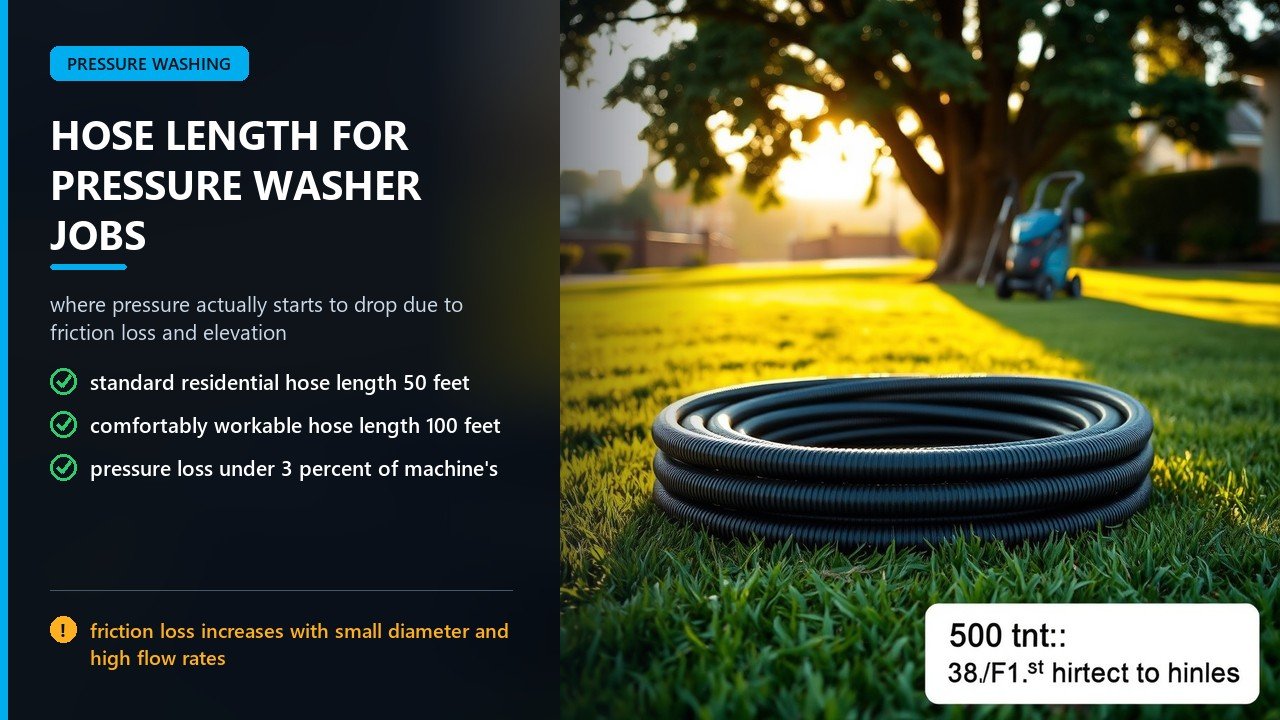
The reason it surprises people is scale. A pressure washer generates three to four thousand pounds per square inch, and the loss from a hundred feet of hose is measured in tens of psi. Against three thousand, a seventy psi drop is roughly two percent, which rounds to nothing in everyday use. The math changes, though, when three variables stack together: long length, small inside diameter, and high flow. Any one of them alone is manageable. All three together is how you get Tanya’s afternoon.
Cat Pumps publishes a friction loss reference that makes the relationship concrete. At four gallons per minute through a 3/8 inch hose, the loss runs about ninety psi per hundred feet. A fifty-foot hose drops roughly forty-five psi. A hundred and fifty-foot hose drops around a hundred and thirty-five. The same chart shows that a fifty-foot hose exhibits exactly half the pressure drop of a hundred-foot hose, because the relationship is proportional to length.
None of that is a defect in the hose. It is fluid dynamics doing what it does in every pipe, hose, and tube on the planet, from the water line in your wall to the fire hose on a truck.
The Friction Loss Numbers That Actually Matter
Tables beat descriptions here, because the values are not intuitive. The figures below are approximate pressure loss over a hundred-foot run, drawn from manufacturer friction loss references and industry flow data.
| Flow Rate | 1/4 in Hose | 3/8 in Hose | 1/2 in Hose |
|---|---|---|---|
| 1.5 GPM | About 25 to 30 psi | Under 10 psi | Negligible |
| 2.5 GPM | About 70 psi | About 25 psi | Under 8 psi |
| 4.0 GPM | Severe, not recommended | About 90 psi | About 25 psi |
| 6.0 GPM | Not usable | Heavy loss, marginal | About 60 psi |
Read the table by finding your machine’s flow rate first, which is the GPM number on its plate or the spec sheet, then finding the column that matches the hose you have or plan to buy. The pattern is unambiguous. Flow rate drives loss far harder than length does, because friction scales with the square of flow. Double the gallons per minute and you quadruple the loss, while doubling the length only doubles it.
That single relationship explains almost every long-hose complaint in the field. A contractor running a six-gallon-per-minute machine through a hundred feet of undersized hose sees a dramatic drop, while a homeowner running 1.5 GPM through the same hose sees nothing worth measuring. Trade analysis of longer hose runs reaches the same conclusion using the same manufacturer data, and Cat Pumps’ friction loss reference is the primary manufacturer source for the numbers above.
Worked example, since the arithmetic is worth doing once in public. A machine rated at 4 GPM running through a hundred feet of 3/8 inch hose loses roughly ninety psi. If the pump makes 3,000 psi, ninety psi is three percent, and nobody will ever see it. If instead that same machine runs two hundred feet, the loss doubles to a hundred and eighty psi, still only six percent. Now put it on 1/4 inch hose over the same two hundred feet, and the loss is large enough that the machine effectively cannot reach its rating at all. Same pump, same length, entirely different outcome, decided by one number stamped on the hose jacket.
How Much Hose Length You Need for Each Job
The pressure loss argument tends to overshadow a simpler question, which is how much hose the work actually requires. The right amount is usually less than people buy and more than people expect at the start of a job.
| Task | Recommended Length | Why | Watch Out For |
|---|---|---|---|
| Vehicles, boats, patio furniture | 25 to 50 feet | The machine sits beside the work | Extra hose just becomes a trip hazard |
| Driveways, sidewalks, patios | 50 to 100 feet | One spigot usually covers the slab | Surface cleaners need full flow, so size up |
| Single-story house wash | 100 feet | Corners and elevations from one connection | Snags on downspouts and landscape edging |
| Two-story home, wraparound | 100 to 150 feet | Multiple sides from a single spigot | Verify diameter before adding length |
| Commercial lots, large properties | 150 to 300 feet, sectional | Distance between water sources and work | Weight, kinking, and pump starvation |
Notice that the recommendations level off around a hundred feet for residential work. That is not a coincidence. Most homes have a spigot within fifty feet of at least three sides, and a hundred-foot hose gives coverage of the whole footprint without excess. The industry consensus matches the observation, with consumer hose kits almost universally shipping with fifty feet of hose and residential cleaning guides recommending a hundred for full-house work.
For the longer commercial runs, sectioning beats lengthening. Contractors who run two hundred feet or more almost always buy it as fifty-foot or hundred-foot sections joined by quick couplers rather than a single continuous piece. The logic is the same one firefighters use. When a section fails, you lose fifty feet instead of the whole investment, you can carry only the length the job needs, and each individual piece stays light enough to handle. Our piece on 100-foot hose setups and the companion guide to 50-foot hoses both cover the section-by-section approach in practical terms.
Diameter Matters More Than Length
This is the part most buyers skip, and it is the part that decides whether a long hose works. Inside diameter controls how much room water has to move, and the restriction rises sharply as the bore shrinks.
Industry flow testing makes the effect vivid. Over a hundred-foot run at high pressure, a hose with a 0.29 inch inside diameter delivers roughly three gallons per minute, while a 0.38 inch hose over the same distance delivers around five, and a 0.5 inch hose delivers substantially more. Same length, same machine, completely different output at the tip, purely because of bore size.
| Hose Size | Typical Machine Range | Comfortable Length | Character |
|---|---|---|---|
| 1/4 inch | 1,600 to 3,000 PSI, up to 2.5 GPM | 25 to 50 feet | Light, kink-friendly, small electrics |
| 5/16 inch | 2,700 to 3,400 PSI, up to 2.6 GPM | 50 to 100 feet | Common on mid-range gas machines |
| 3/8 inch | 3,000 to 4,500 PSI, 3 to 5 GPM | 100 to 200 feet | The industry default for gas units |
| 1/2 inch | 5,000 to 7,000 PSI, 5 to 12 GPM | 200 feet and beyond | Commercial and trailer rigs |
The practical takeaway is simple. If you need to go farther, step the diameter up rather than accepting the loss. Adding fifty feet of 1/4 inch hose to reach a distant corner is almost always worse than buying fifty feet of 3/8 inch, even though the second option costs more. Our explainer on what GPM does for cleaning speed covers why flow carries so much weight in this equation, and our guide to choosing the right hose size for PSI and GPM covers the matching process in depth, while picking a high-pressure hose walks through the ratings that go with the sizes.
There is a weight cost to going bigger, and it is not trivial. A hundred feet of 1/2 inch hose filled with water is a genuinely heavy object to drag across a lot. That is why the correct move is often to run a large-diameter main line to the work area and finish with a shorter, lighter section, which is exactly what a whip hose accomplishes. Our note on whip hoses explains that setup.
The Elevation Penalty Nobody Accounts For
Friction is not the only loss. Lifting water costs pressure too, at roughly five psi for every ten feet of vertical rise. Spray the second-story siding of a two-story house and you are pushing water up twenty feet, which is an additional ten psi of loss before a single foot of hose friction counts.
The number sounds small next to three thousand psi, and it is. But it stacks. A hundred-foot run plus a twenty-foot climb on a machine operating near the edge of its rating can push the effective tip pressure low enough that the fan flattens and cleaning slows. The Engineering ToolBox pressure loss reference covers the general relationship for water in hoses, and it is the kind of engineering baseline that applies across plumbing, irrigation, and pressure washing alike.
Elevation also cuts the other way. Pressure washing downhill from the machine adds pressure rather than removing it, which is a small advantage worth knowing when you can choose where to park the unit. On a sloped driveway, setting the machine at the high end gives you free pressure rather than free loss.
The Real Limits, Weight, Wear, and Cost
Physics says you could run a pressure washer hose for hundreds of feet and still have useful pressure. Practicality objects, and practicality usually wins.
Weight is the first objection. Industry estimates put a hundred feet of water-filled hose in the neighborhood of thirty pounds, so every additional hundred feet adds roughly that much to the drag load. Over a long workday, pulling an extra thirty pounds across gravel and grass is exhausting in a way that does not show up on a pressure chart. Distributor analysis of hose length effects makes the same point after working through the pressure math, concluding that past about a hundred to two hundred feet the practical penalties outweigh the theoretical benefit of staying put.
Wear is the second. More hose lying on the ground means more hose exposed to foot traffic, vehicle tires, sharp edges, and UV. Hoses are wear items by design, and their working pressure rating drops sharply once the outer cover is torn or the casing has been run over. Manufacturers set burst pressure at four times the working pressure as a safety margin, and that margin assumes an undamaged hose. A compromised hose loses strength rapidly, which is why replacement on visible damage is not optional.
Cost is the third. Hose pricing does not scale linearly with length. A two-hundred-foot hose can cost more than twice a hundred-foot version because of manufacturing and shipping weight, which makes sectional purchases the cheaper strategy as well as the more sensible one.
Kinking and memory are the fourth. Long single-piece hoses store in coils, and coiled hose remembers. The kinks that form at the transition from coil to ground are the same points that develop leaks first. Premium rubber and hybrid hoses resist this better than budget PVC, which is the main reason the price gap between them exists at all. Our comparison of non-marking and standard hose construction covers the material differences.
When to Move the Machine Instead of Adding Hose
There is a decision point in every long-run job where the better answer stops being more hose and starts being a different setup. Three signs point to it clearly.
The first is a water source within reach of the work. If a spigot sits closer than another hundred feet of hose would run, connecting there and moving the machine costs almost nothing and eliminates the loss entirely. The second is a power source for gas machines that needs to travel with the unit, which is usually satisfied by a small generator or a vehicle parked alongside. The third is repetition, where the same run happens every week rather than once. A recurring two-hundred-foot pull justifies solving the problem permanently, whether that means a tank-fed rig, a second water connection, or a hose reel mounted to the vehicle rather than the machine.
For the occasional distant job, a cart and a hundred-foot hose remain the simplest answer. For the weekly one, rearranging how the water reaches the machine almost always beats stretching the hose farther.
Setting Up a Long Run the Right Way
When the job genuinely requires distance, the setup matters as much as the hose you choose.
Start from the water source, not the machine. Lay the supply side first, then the high-pressure side, so you know exactly how much run you have before committing to a route.
Plan the route to avoid pinch points. Corners of buildings, driveway edges where tires cross, and gate gaps are where hoses get damaged. Walk the path first and route around the obvious hazards.
Use sections with quick couplers. Two fifty-foot sections beat one hundred-foot piece for every reason listed above, and a coupler adds negligible loss when it is clean and properly sealed.
Protect the couplers from the ground. A joint lying in the gravel where a truck will back up is a joint waiting to be crushed. Keep connections off the travel path or mark them clearly.
Do not coil the high-pressure hose under load. Unspool it fully before pressurizing. A hose that comes off the reel into a tight spiral will fight you for the entire job and kink at the worst moment.
Drain and dry before storage. Water left in a hose that sits in a garage promotes corrosion at the fittings and breaks down the interior over winter. Our seasonal checklist in winterizing a power washer pump includes the hose as part of the sequence.
Signs Your Hose Run Is Working Against You
You will not have a gauge on the wand, but the symptoms of an over-long or undersized run are consistent.
The fan pattern looks soft. A nozzle that used to produce a sharp, defined fan now looks slightly rounded or misty at the edges. Tip pressure has dropped below what the orifice was designed for.
Cleaning takes noticeably longer. The same driveway that used to take twenty minutes now takes thirty, with no change in technique or nozzle.
The engine bogs when you pull the trigger. On a gas machine, a restrictive hose can load the pump differently, and the engine note changes under load in a way it did not before.
Adding hose made it worse in stages. Each new section you add produces a visible drop in performance. That pattern points squarely at cumulative friction rather than a machine fault.
Performance recovers when you shorten the run. The definitive test. Remove a section, reconnect, and spray again. If the tip pressure comes back, the hose was the issue and the pump is fine.
When those signs appear, the fix order is: check the nozzle for wear first, then the hose diameter, then the length, then the couplers for internal restriction. Only after those four does the pump itself become a suspect, which is a much cheaper diagnosis than the alternative.
What to Buy, a Short Checklist
Match the working pressure to the machine with margin. If the washer is rated at 3,000 PSI, the hose rating should sit comfortably above that rather than exactly at it. The four-to-one burst ratio only protects you if the working rating is honest.
Match the diameter to the flow. Use the table above. When in doubt between two sizes, take the larger one.
Buy sections, not monoliths. Fifty-foot lengths with quick couplers give you flexibility, redundancy, and easier handling.
Prioritize material over length. A hundred feet of quality rubber hose outperforms two hundred feet of stiff PVC that fights you around every corner.
Check the fittings. Stainless or brass couplers survive being dropped on concrete. Plastick fittings do not, and they crack in cold weather.
Keep a spare. One fifty-foot spare section in the vehicle means a failure costs you ten minutes instead of a day’s revenue.
Questions Owners Ask About Hose Length
How long can a pressure washer hose be? Practically, two hundred to three hundred feet for most machines when the diameter is matched to the flow. Below that range, loss is manageable; above it, you are better off relocating the machine or adding a water supply.
Will a longer hose reduce my PSI? Yes, proportionally to length, and more sharply as flow rises. In residential use the reduction is usually a single-digit percentage and hard to notice.
Is a hundred-foot hose too long for a small electric washer? It is more hose than those machines need, and the small inside diameter on the cheapest hundred-foot hoses can noticeably reduce performance. If you need the reach, buy a quality 3/8 inch hose rather than a bargain 1/4 inch.
Does hose diameter affect pressure more than length? Yes. Restriction rises steeply as bore shrinks, and the loss from going down a size usually exceeds what fifty extra feet would cost you.
How much pressure is lost climbing a second story? Roughly ten to twelve psi for twenty feet of vertical rise, which is small on its own but additive with friction.
Can I join two hoses together? Absolutely, with matching quick couplers rated for the pressure. Sectioned setups are standard practice in commercial work.
What is the safest length for a high-flow machine? With 1/2 inch hose, two hundred feet and beyond is normal. With 3/8 inch on six gallons per minute, keep runs short or step up the diameter.
Should I worry about a hose rated exactly at my machine’s PSI? Yes, buy higher. The rating should exceed the machine so that pressure spikes, which happen every time the trigger closes, stay inside the safety margin.
Length Is a Decision, Not a Guess
Coming back to that warehouse lot, Tanya eventually solved her problem by swapping the cheap hundred-foot hose for a quality 3/8 inch section and moving the machine closer to the fourth building. The spray came back, the job finished, and the pump she had been blaming never needed a thing.
Hose length for pressure washer work is a decision you make with three numbers in hand, the flow rate, the inside diameter, and the distance. Get those matched and a hundred feet feels like nothing. Get them mismatched and fifty feet can disappoint. The charts above give you the reference, the checklist gives you the buying rules, and the sectioned approach gives you the flexibility to match hose to job every time instead of dragging a permanent compromise around the property.
For the rest of the setup that surrounds the hose itself, from fittings to reels to material choices, the linked guides throughout this article cover each piece in the same practical detail.