The first clue that Powermate pressure washers are a little different from the competition comes when you go looking for a manual and the search redirects you to Generac. That is not an error. Powermate, a name many homeowners know from the heavy yellow machines at the hardware store, is now part of the Generac family, and its pressure washer line spans a wide range – from compact electric units under 2,000 PSI to commercial-grade gas machines pushing past 3,000 PSI. For a buyer trying to sort out which Powermate fits a driveway, a deck, or a small business, that spread is both an opportunity and a source of confusion.
This guide untangles the Powermate pressure washer range. We will cover who makes them, how the electric and gas lines differ, the specific models worth knowing, what the duty tiers mean in real terms, and how Powermate’s pumps, parts, and safety features hold up over time. By the end, you should be able to look at any Powermate model number and understand exactly what you are buying.
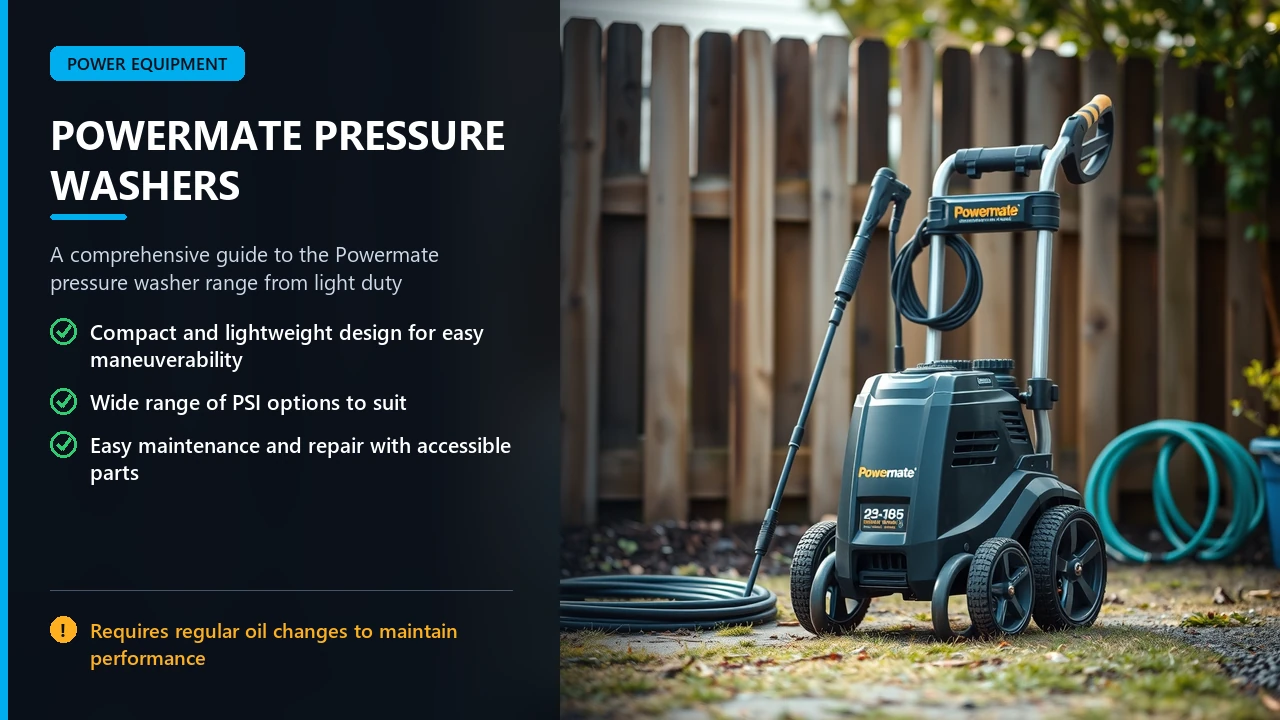
Who Makes Powermate Pressure Washers
Powermate is a brand that has changed hands over the years – many customers remember it as Coleman Powermate – and it is now owned by Generac, one of the largest names in power equipment. That matters for two practical reasons: parts and support. Because Powermate manuals and parts diagrams now live on Generac’s support site, owners can still find exploded views, owner’s manuals, and replacement components long after purchase. A brand with that kind of documentation behind it is far easier to live with than an anonymous machine with no parts stream.
The practical upshot is that a Powermate pressure washer is not a disposable appliance. Pumps, nozzle kits, inlet screens, thermal relief valves, and chemical injection stems are all orderable parts, which means a machine that loses pressure can usually be repaired rather than replaced. For a homeowner planning to keep a washer for years, that serviceability is a genuine advantage. Owners can look up their specific unit through the Generac product manual and support library, where Powermate documentation is now maintained.
Garden Hose or Powermate: Do You Need One at All?
Before spending money, it is worth asking a blunt question: does your job actually need a pressure washer, or would a garden hose and elbow grease do? A pressure washer is roughly thirty times more powerful than a garden hose, which is why it strips grime a hose cannot touch – but that power is not free, and it is not always necessary.
Reach for a pressure washer when you are fighting embedded dirt, algae, mold stains, oil drips, caked mud, peeling paint, or years of accumulated film on concrete, siding, decks, or vehicles. Those are the jobs where a hose simply smears the mess around. Reach for the garden hose when you are rinsing light dust, knocking pollen off a patio, or washing a car that is only lightly soiled – a hose, a brush, and a quality detergent handle those fine, and you avoid the risk of etching a delicate surface.
The middle ground is a light-duty pressure washer, which is exactly where Powermate’s electric models live. At 1,400-2,200 PSI they are gentle enough for vehicles and furniture but strong enough that a muddy truck bed or a grimy grill comes clean in minutes instead of an hour. If you are on the fence, a compact electric Powermate is the low-risk way to add real cleaning power without committing to a gas machine.
Electric vs. Gas Powermate Pressure Washers
The first fork in the road is power source, and it decides almost everything else. Powermate’s own pressure washer buying guide frames it simply: electric machines are less expensive and less powerful, suited to light-duty jobs, while gas machines deliver more cleaning capacity for medium-to-large jobs and can be used anywhere without an outlet.
Electric makes sense when your work is close to a power source and relatively light – washing a car, spraying off patio furniture, cleaning a grill, or rinsing siding. These machines start instantly, need almost no maintenance, run quietly, and produce no fumes, so you can even use them in a garage. The catch is that you are tethered to a cord and limited to lower pressure.
Gas makes sense when the job is heavy or the location is remote – concrete driveways, large decks, farm equipment, or any job where no outlet is nearby. Gas units reach higher pressure and flow, run longer without overheating, and go anywhere. The trade-offs are noise, exhaust, and a real maintenance routine of fuel, oil, and periodic pump care.
Powermate Electric Models
The electric side of the Powermate range is built for convenience and everyday residential cleaning. Several models recur in the lineup, and their specs tell you exactly where each one belongs.
| Model | Pressure | Flow (GPM) | Cleaning Units | Notable Features |
|---|---|---|---|---|
| PW0551750 | 1750 PSI | 1.6 | 2800 | Induction motor, 19 ft hose, adjustable nozzle, chemical injection, 38.5 lbs |
| Model 8886 | 2100 PSI | 1.35 | 2835 | Compact, 20 ft kink-resistant hose, auto-stop switch to save energy |
| EPW2123100 | 3100 PSI | Varies | High | One of the strongest electric units; AXB28-style pump, full parts support |
The PW0551750 is the classic entry point: an induction motor that tends to run smoother and last longer than a brushed one, an adjustable nozzle that changes pattern and pressure without swapping tips, a detergent applicator, and a light 38.5-pound frame. It is rated for around 2,800 cleaning units, which is plenty for vehicles, grills, and light siding.
The EPW2123100 sits at the top of the electric line at 3,100 PSI, a figure that would have been gas-only territory a few years ago. It is the model to consider if you want to stay electric but still attack concrete and heavier grime. Because it uses a serviceable pump, it also benefits from Powermate’s parts catalog – inlet connection kits, thermal relief kits, and oil breathers are all replaceable.
Powermate Gas Models
The gas lineup is where Powermate earns its reputation for value, pairing familiar engines with practical features like onboard soap tanks, color-coded nozzles, and pneumatic tires. These are the machines most homeowners picture when they think of a serious pressure washer.
| Model | Pressure | Flow (GPM) | Cleaning Units | Engine | Notable Features |
|---|---|---|---|---|---|
| PW0872700 | 2700 PSI | 2.5 | 6750 | Briggs & Stratton Intek 205cc | 10 in pneumatic tires, reversible handle, 5 nozzles, 95 lbs |
| PW0952750 | 2750 PSI | 2.5 | 6875 | Honda GC190 190cc | DURAFRAME carrier, pull-out soap tray, 25 ft hose, thermal relief valve |
| Powermate 7131 | 3100 PSI | 2.5 | 7750 | Powermate 208cc OHV | 30 ft non-marring hose, 5 quick-connect nozzles, onboard detergent tank, low-oil sensor, CARB approved |
The PW0872700 is the classic mid-range machine: a Briggs & Stratton Intek engine, five color-coded nozzles, 10-inch pneumatic tires for rolling over grass and gravel, and a reversible handle that makes it more compact to store. At 6,750 cleaning units it handles most residential jobs and lighter concrete work with ease.
The PW0952750 steps up slightly with a Honda GC190 engine – a name many buyers actively seek for its easy starting and smooth running – wrapped in a rust-resistant DURAFRAME carrier with a pull-out soap tray. Honda engines carry a well-earned reputation for reliability, which is a real selling point on a machine you plan to keep for years.
The Powermate 7131 is the headliner of the residential gas range. At 3,100 PSI and 2.5 GPM it produces roughly 7,750 cleaning units, enough for concrete, siding, and deck stripping. It adds an onboard detergent tank for no-bucket soap application, five quick-connect tips (0, 15, 25, 40, and soap), a long 30-foot non-marring hose, a low-oil sensor that protects the engine, and CARB approval for sale in California. The full specifications are published on the Powermate 3100 PSI model page for buyers who want to verify every number.
Powermate Nozzles and Accessories
A pressure washer is only as versatile as the nozzles and add-ons you use with it, and Powermate machines ship with a useful starting set. Understanding those pieces turns a single machine into a toolkit for many surfaces.
Most Powermate gas models include five quick-connect nozzles, color-coded by angle. The red 0-degree tip concentrates full force for spot blasting, the yellow 15-degree tip handles heavy stripping, the green 25-degree tip is the general-purpose angle for driveways and patios, the white 40-degree tip is the gentle choice for siding and vehicles, and the black soap tip applies detergent at low pressure. The color coding is not decoration – it is a quick way to pick the right power level without thinking, and it is worth memorizing if you pressure wash often.
Beyond nozzles, the accessories that make the biggest difference are a surface cleaner for even, streak-free concrete work, an extension wand for reaching siding and gutters, a turbo or rotary nozzle for stubborn stains, and a foam cannon or detergent applicator for soap. Powermate’s onboard detergent tanks and chemical injection systems feed soap directly into the low-pressure stream, so you do not need a bucket. Replacement nozzles, O-rings, wands, and guns are all available through the parts network, which means a lost tip or a worn seal is a minor inconvenience rather than a show-stopper.
If you want to compare Powermate’s top gas machines against another well-known 4000 PSI brand, our breakdown of the Karcher 4000 PSI pressure washer line makes a useful counterpoint, and for a deep dive into engine-driven performance, our 3000 PSI pressure washer guide covers the tier just below Powermate’s heaviest units.
Duty Tiers: Matching PSI to the Job
Powermate organizes its pressure washers by duty level, and those tiers are the single best guide to whether a given machine will handle your work. The table below summarizes what each range is built to clean.
| Duty Level | Pressure | Flow (GPM) | Cleaning Units | Typical Applications |
|---|---|---|---|---|
| Light duty (small jobs) | 1,400-1,750 PSI | 1.4-1.6 | 1,960-2,800 | Vehicles, grills, small cleaning tasks |
| Light duty (larger jobs) | 1,800-2,200 PSI | ~2.0 | 3,600-4,400 | Siding, decks, most residential jobs |
| Medium duty | 2,300-2,500 PSI | 2.2-2.3 | 5,060-7,130 | Most residential jobs and driveways |
| Commercial medium duty | 2,600-3,100 PSI | ~2.5 | 6,500-7,750 | Prepping wood, cleaning concrete |
| Commercial heavy duty | 3,200-4,000 PSI | 3.0-4.0 | 9,600-14,000 | Stripping paint, large cleaning jobs |
Read that table against your actual to-do list. A homeowner washing cars and patio furniture lives happily in the light-duty rows and never needs a gas machine. Someone with a concrete driveway, a weathered deck to prep, and a fence to clean is squarely in medium to commercial-medium territory, where a Powermate gas machine like the 7131 makes sense. Heavy-duty 3,200-4,000 PSI machines are for stripping paint and cleaning large commercial surfaces – genuinely more than most homes require.
Pumps, Thermal Relief, and Low-Oil Sensors
Three features quietly determine how long a Powermate pressure washer lasts, and knowing them helps you separate a machine that survives a decade from one that quits after a summer.
The pump is the heart of any pressure washer, and Powermate uses axial cam pumps on many models – compact, reliable units that are also replaceable. Axial pumps are common and affordable to service, and Powermate backs them with parts kits, so a pump that loses pressure can often be rebuilt or swapped rather than junking the machine. This is where a brand with a real parts catalog pays off.
The thermal relief valve, found on models like the 7131 and PW0952750, protects the pump from overheating. When you hold the trigger closed for a while with the engine running, water stops flowing and heat builds inside the pump. The thermal relief valve opens to release that hot water before it damages seals and valves. It is a small part that prevents an expensive failure, and it is exactly the kind of detail that separates a well-designed machine from a cheap one.
The low-oil sensor, present on the 7131 and other Powermate engines, shuts the engine down if the oil level gets too low. Gas engines that run low on oil can seize, and a sensor that prevents that is cheap insurance. Combined with the thermal relief valve, these two safeguards show that Powermate builds for longevity at the medium and heavy tiers, not just for the spec sheet.
Parts, Maintenance, and Keeping a Powermate Running
One of the underrated strengths of the Powermate line is how much of it you can maintain and repair yourself. Between the parts diagrams on Generac’s support site and the common pump service kits, a motivated owner can keep a machine running for many seasons.
- Engine oil: change it on schedule and check it before use. Gas machines that run dry seize; our guide on the right oil for a power washer engine and pump explains what to use and when to change it.
- Pump oil: serviceable pumps that carry oil need it checked and changed. Protect the pump through winter with our winterizing routine for pressure washer pumps to avoid cracked housings.
- Pump service kits: inlet connection kits, inlet screens, thermal relief kits, oil breathers, and injection stems are all replaceable items that restore performance.
- Nozzles and O-rings: the cheapest parts to replace and the most common cause of poor spray or leaks. Keep spares.
- Fuel: use fresh gasoline with a stabilizer, or drain the tank for long storage to avoid gummed carburetors.
For owners of comparable machines, our reviews of Predator pressure washer parts and the Westinghouse power washer parts guide show how parts availability and pump design play out across other brands – a useful lens for judging any washer’s long-term value.
Which Powermate Is Right for You
Run your situation through these questions and the answer usually falls out quickly.
- Where will you work? Near an outlet and light-duty – go electric. Remote, heavy, or large-area – go gas.
- What surfaces? Cars, grills, and furniture want light-duty electric (1,400-2,200 PSI). Driveways, decks, and siding want medium-to-commercial gas (2,300-3,100 PSI).
- How big are the jobs? Occasional small tasks suit a compact electric unit; repeated large tasks justify a gas machine with higher flow.
- Do you want low maintenance? Electric wins – no fuel, no oil changes, no seasonal starting problems.
- Do you need portability and endurance? Gas wins – no cord, longer run times, higher cleaning power.
For most homeowners who want one machine for cars, patios, and light siding, a Powermate electric model like the PW0551750 is the sensible pick. For those who own a concrete driveway and a lot of outdoor surfaces, a gas unit like the Powermate 7131 delivers the cleaning units to make the work go fast. Buying the tier you actually need beats buying the biggest number on the shelf.
Common Powermate Problems and How to Fix Them
Most pressure washer complaints trace back to a handful of causes, and nearly all of them are fixable without replacing the machine. Knowing the usual suspects saves money and downtime.
- No pressure or weak spray. Usually a clogged nozzle, a restricted inlet screen, or air in the line. Clean the nozzle with the supplied nozzle cleaner, flush the inlet screen, and run water through the pump with the gun open before starting to purge air.
- Pulsing or surging spray. Often air being drawn in through a loose connection or a low water supply. Check that the garden supply provides adequate flow and that fittings are tight.
- Water leaking from the pump. A worn O-ring or seal, often repairable with a pump service kit rather than a whole new pump.
- Engine will not start. Stale fuel, a fouled spark plug, or a gummed carburetor from long storage. Use fresh treated fuel, replace the plug, and clean the carburetor if the machine sat for a season.
- Engine starts then dies. Frequently a low-oil shutdown – check the oil level. On models with a low-oil sensor, this is a safety feature doing its job, not a fault.
- Pump overheats. Caused by running too long with the trigger closed. On models with a thermal relief valve this is handled automatically, but it is still best practice to release the trigger periodically so water keeps moving.
The through-line is that pressure washers rarely fail catastrophically; they degrade through wear parts you can replace. Because Powermate uses documented, serviceable pumps and offers kits for the common wear points, most of these fixes cost little and keep the machine out of the landfill.
Frequently Asked Questions
Who actually makes Powermate pressure washers?
Powermate is now owned by Generac, and its owner’s manuals and parts diagrams are hosted on Generac’s support site. The brand has changed hands over the years – many long-time owners remember it as Coleman Powermate – but the current line benefits from Generac’s parts and service network, which is a real advantage for repairs.
What size Powermate do I need for a driveway?
For most concrete driveways, aim for a medium-duty or commercial-medium machine in the 2,300-3,100 PSI range with at least 2.5 GPM. A gas model such as the Powermate 7131 delivers the cleaning units to make short work of a driveway, and pairing it with a surface cleaner attachment produces even, streak-free results with far less effort. A light-duty electric unit will clean a small driveway slowly but will struggle with large areas and stubborn stains.
Are Powermate pressure washers any good?
They are solid value machines, especially in the gas range, where models like the 7131 pair dependable engines with practical features such as onboard soap tanks, thermal relief valves, and low-oil sensors. The strongest selling point is serviceability: because the pumps and parts are documented and replaceable, a Powermate can be maintained and repaired rather than discarded.
What is the difference between the Powermate 2700 and 2750 models?
The PW0872700 uses a Briggs & Stratton Intek 205cc engine and produces 2,700 PSI at 2.5 GPM for about 6,750 cleaning units. The PW0952750 uses a Honda GC190 engine and produces 2,750 PSI at 2.5 GPM for about 6,875 cleaning units, with a DURAFRAME carrier and a pull-out soap tray. The specs are close; buyers often choose the Honda for its engine reputation.
Can I use a Powermate pressure washer indoors?
Only an electric model. Gas Powermate pressure washers produce carbon monoxide and must only run outdoors or in well-ventilated areas. An electric Powermate unit emits no exhaust and can be used in a garage or other enclosed space, which is one of the clearest reasons to choose electric over gas.
Where can I find Powermate pressure washer manuals and parts?
Owner’s manuals, parts lists, and exploded diagrams are available through Generac’s support resources, since Powermate is a Generac brand. Having the serial number of your unit handy speeds up the search, and most pump and nozzle components are orderable as replaceable parts.
Is higher PSI always better on a Powermate?
No. Higher pressure cleans tougher surfaces faster, but it also risks damaging wood, paint, and soft masonry if used carelessly. Flow matters just as much for cleaning speed, and many residential jobs are handled easily by a medium-duty machine. Match the duty tier to the surface, and use the right nozzle and distance for the material.
The Bottom Line
Powermate pressure washers cover the full span of what a homeowner or small contractor needs, from a 1,750 PSI electric unit that makes car washing effortless to a 3,100 PSI gas machine that turns a grimy driveway into clean concrete. The brand’s connection to Generac gives it something many competitors lack – a real parts and support network that keeps machines serviceable for years. Between induction-motor electric models for quiet indoor work and engine-driven gas models with thermal relief valves and low-oil sensors for the heavy jobs, there is a Powermate for nearly every surface and every budget.
Choose by power source and duty tier, not by the biggest number on the box. If your work is light and near an outlet, go electric; if it is heavy and anywhere you can point a hose, go gas. Buy the tier your surfaces demand, keep up with oil and winterizing, and lean on the parts catalog when something wears out. Do that, and a Powermate will quietly outlast the impulse to replace it – which, in the end, is the whole point of buying a tool worth maintaining.