When a city, county, or utility buys a commercial pressure washer for municipalities, it is not shopping the way a homeowner or even a contractor does. Public works departments clean sidewalks, transit shelters, fleet vehicles, dumpster pads, park paths, playgrounds, parking garages, and storm drain grates, often on a schedule that never stops. The machine has to survive daily duty, run hot water for grease and gum, meet safety and environmental rules, and fit a procurement process that demands documented specifications and defensible spending.
That combination of heavy duty cycle and public accountability makes municipal pressure washing its own niche. A machine that would be overkill for a landscaping crew is a normal Tuesday for a city streets division, and a machine that looks like a bargain can become a budget problem the moment it cannot keep up or fails an inspection.
This guide covers what municipalities actually clean, the features that separate a municipal-grade machine from an ordinary commercial unit, the specs cities write into bids, hot water and cold water trade-offs, water supply and reclamation, environmental compliance, mounting choices, fuel options, how to write or meet a municipal specification, total cost of ownership, and maintenance. If you buy, specify, or supply municipal cleaning equipment, this is the ground you need to cover.
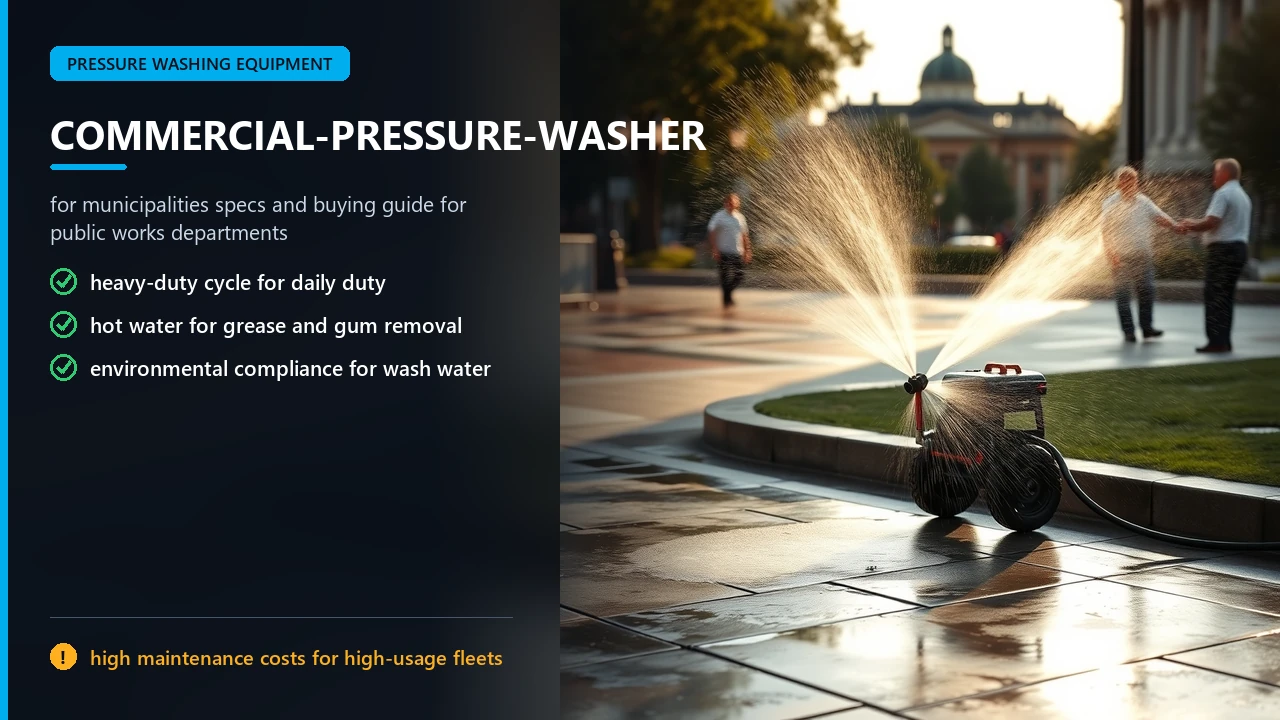
What Municipalities Actually Clean
The scope of public cleaning is wider than most people assume. A single public works department may use pressure washers for:
- Sidewalks and plazas. Gum, spills, stains, and grime on high-traffic pedestrian areas.
- Transit stops and shelters. Bus stops, benches, platform edges, and signage.
- Fleet and equipment. Trucks, garbage packers, plows, mowers, and utility vehicles washed at a yard.
- Dumpster pads and transfer stations. Grease, leachate, and food waste residue.
- Park paths and hardscape. Walkways, retaining walls, and monuments.
- Playgrounds and recreation surfaces. Concrete pads and equipment areas.
- Parking garages and lots. Oil stains, exhaust film, and gum.
- Storm drains and grates. Debris removal under environmental oversight.
- Buildings and facilities. Facades, loading docks, and wash bays.
- Graffiti and adhesive removal. Often with hot water and appropriate surfaces.
Each task shapes the machine. Sidewalk gum removal needs hot water and sometimes high pressure. Fleet washing needs flow and reliability at a fixed wash bay. Dumpster pads need heat and degreaser. Drain cleaning runs into environmental rules that a homeowner never considers. The best municipal rig handles several of these without struggling, which is why hot water and high duty cycles dominate public bids.
What Makes a Municipal Machine Different
Several traits separate municipal-grade equipment from ordinary commercial units.
- Duty cycle. Municipal machines run for hours, day after day. They need industrial pumps, robust engines, and components rated for continuous use, not weekend jobs.
- Hot water. Heat is almost universal in municipal bids because it removes grease, gum, and biological film far better than cold water.
- High flow. GPM cleans faster than PSI alone, and public crews cover large areas, so flow matters.
- Water flexibility. Municipal machines often draw from tanks, hydrants, or a wash bay supply, so they must tolerate varied inlet conditions.
- Serviceability. Parts must be easy to source and replace, because downtime is unacceptable and a dealer network matters.
- Compliance readiness. Machines must support best management practices for wash water and safety.
- Documented specs. Municipal purchases hinge on written specifications, so the machine’s ratings must be clear and defensible.
In practice this pushes municipalities toward skid-mounted and trailer-mounted hot water machines with industrial triplex pumps and durable engines. The wall-mount stationary machines for wash bays are treated in our guide to wall, skid, and trailer mounting.
Key Specs Cities Write Into Bids
Municipal solicitations tend to converge on similar numbers. Real public bids give a clear picture of the ranges expected.
| Spec | Typical Municipal Range | Why It Matters |
|---|---|---|
| Flow (GPM) | 4.0 – 5.0 (up to 8) | Coverage speed on large areas |
| Pressure (PSI) | 2,000 – 4,000 | Penetration on stubborn deposits |
| Hot water | Required | Grease, gum, biofilm removal |
| Engine | 18–22 HP gas/diesel | Power for high-duty operation |
| Water tank | 200+ gallons | Onboard supply between fills |
| Hose | 100 ft, 3/8″ | Reach and flow |
| Mounting | Skid or trailer | Mobility and stability |
For example, one large water utility specified machines with a minimum of a 22 HP engine and 4,000 PSI hot water to strip mud and hydraulic fluid, while a California city quoted two pressure washers as a Hotsy 5.0 GPM at 3,500 PSI with an 18 HP Vanguard engine, a 230-gallon tank, and a 5×10 trailer. A Minnesota public works department installed a natural gas, vented, 4.0 GPM at 2,000 PSI stationary machine for its shop. The lesson is that municipal specs are specific and written around the work, so any machine offered must meet or exceed them on paper and in practice.
Hot Water Versus Cold for Municipal Work
Almost every serious municipal application favors hot water. The reason is simple: heat dissolves grease, oil, gum, and organic film that cold water only pushes around.
- Grease and oil. Dumpster pads, fleet undercarriages, and food-waste areas need heat to break down fats.
- Gum and adhesive. Hot water softens sticky deposits on sidewalks and transit surfaces.
- Biological film. Mildew, algae, and grime release faster with heat.
- Faster coverage. Hot water often lets crews clean with less pressure and fewer passes, protecting surfaces.
Cold water machines have a place for light rinsing and where heat is impractical, but they rarely satisfy a municipal sidewalk or fleet bid. That is why public solicitations so often state “hot water required” and even specify a minimum temperature. Heat is not a luxury in this world; it is a specification. Choosing the right heated machine is the subject of our guide to the best pressure washer for commercial use.
Water Supply: Tanks, Hydrants, and Reclaim
Water supply is one of the most overlooked parts of municipal pressure washing, and one of the most consequential. Public crews face three common scenarios.
- Wash bay supply. A fixed water line feeds a stationary machine. Reliable, but limited to one location.
- Tank supply. A trailer or skid carries 200 gallons or more, letting crews work away from a spigot. These tanks are usually sized larger than a contractor’s because public jobs run long.
- Hydrant supply. Crews fill from fire hydrants using a meter and permit, a common municipal practice. A hydrant meter leases from the water authority and must be permitted first.
Hydrant use is tightly controlled. A city or utility typically issues a hydrant meter and permit, and contractors or crews must not tamper with hydrants without authorization. This is also where environmental compliance begins, because every gallon used has to go somewhere when the job is done.
Wash Water and Environmental Compliance
Municipal pressure washing is regulated in a way that homeowner cleaning is not. Wash water that carries dirt, soap, oil, grease, metals, or paint chips can be a pollutant if it reaches storm drains or surface water. Many jurisdictions require containment, collection, and proper disposal of wash water and debris.
- Best management practices (BMPs). Public bids commonly require crews to follow BMPs that prevent pollutants from entering storm drains, gutters, and waterways.
- Containment and recovery. Wash water may have to be directed to containment areas, collected, and disposed of properly rather than allowed to run off.
- NPDES considerations. Runoff discharged to a storm drain, ditch, or surface water can fall under permit requirements under the Clean Water Act.
- Reclamation equipment. Surface cleaners with built-in vacuum recovery capture water at the source, a common requirement for indoor or sensitive areas.
- Local rules vary. Some bids allow certain discharge, others forbid it entirely, and crews must follow the strictest applicable rule.
This is where a municipality’s machine choice ties back to compliance. Reclaim systems, surface cleaners with recovery, and documented BMPs are often written directly into the specification. Public agencies answer to regulators such as the U.S. Environmental Protection Agency and state environmental departments, so the equipment must support, not undermine, clean-water obligations. A machine that spreads contaminated water across a storm drain is a liability no matter how well it cleans.
Mounting: Trailer, Skid, or Stationary
| Mount | Best For | Trade-off |
|---|---|---|
| Trailer | Roaming crews, multiple sites | Needs towing and storage |
| Skid | Truck beds, existing vehicles | Requires a host vehicle |
| Stationary wall/floor | Fixed wash bays and shops | No mobility |
Municipalities often run more than one. A trailer-mounted hot water unit handles sidewalk and park routes, a skid unit rides in a pickup for quick calls, and a stationary machine serves the fleet wash bay. Trailer rigs typically carry the largest tanks and the most equipment, which is why public bids frequently call for a specific trailer platform and tank size. Our look at hot water pressure washer trailer builds covers the components a municipal trailer should include.
For sidewalk work specifically, a surface cleaner speeds coverage dramatically and improves consistency. Public bids often require one, and the right attachment is covered in our guide to sidewalk cleaners for pressure washers.
Fuel and Power Options
- Gasoline engines. Common, affordable, easy to refuel, and suited to trailer and skid machines.
- Diesel engines. Longer life and lower fuel cost per hour for high-usage fleets, though higher upfront cost.
- Natural gas or LP. Used for stationary, vented shop machines where clean combustion and indoor use matter.
- Electric. For wash bays and indoor work where exhaust is unacceptable, available in 230V and 240V commercial configurations.
The choice follows the location. Indoor shop machines favor electric, natural gas, or LP, with venting to the outside. Field machines favor gasoline or diesel for independence from outlets. Public works budgets often weigh fuel cost, emissions, and ventilation alongside purchase price, and the specification reflects that. Stationary machines must be vented properly, which is why installing one usually involves utility work beyond the machine itself.
How Municipal Procurement Works
Selling into or buying for a municipality involves a formal process that shapes what equipment gets purchased.
- Written specifications. Agencies publish an Invitation to Bid, Request for Quotation, or RFQ with exact equipment requirements.
- Solicitation portals. Bids appear on city purchasing sites and portals; vendors must respond in the required format and by the deadline.
- Cooperative contracts. Municipalities often buy through cooperative purchasing vehicles to streamline compliance and pricing.
- Low-bid to best-value. Some awards go to the lowest responsive bid, others to best value considering service, parts, and warranty.
- Licensing and insurance. Contractors and vendors must hold required licenses, permits, and insurance, and comply with rules such as E-Verify.
- Bonds. Larger public works contracts may require performance and payment bonds.
For a supplier, the winning move is to quote equipment that clearly meets every line of the specification and to document compliance. For a public buyer, the winning move is to write specifications around the actual work, performance, reliability, serviceability, and compliance, rather than around a single brand. Well-written specs produce choices; poorly written specs produce sole-source outcomes that invite protest.
Total Cost of Ownership
Municipal buyers increasingly weigh total cost of ownership, not just purchase price. The lowest bid can be the most expensive machine over its life if it fails often, uses more fuel, or needs parts that take weeks to arrive.
- Purchase price. Only one part of the cost.
- Fuel use. Diesel and efficient engines reduce hourly cost on high-usage fleets.
- Maintenance and parts. A dealer network and common parts cut downtime.
- Downtime cost. A broken machine means idle crews and missed service levels.
- Lifespan. Industrial components last longer, spreading cost over more years.
- Warranty and service agreements. Coverage and response time matter for public fleets.
A robust engine, an industrial pump, and a serviceable design cost more upfront and less over time. For public budgets, the honest calculation compares total cost across the machine’s life, including the cost of a failed sidewalk cleaning season when the rig is down.
Maintenance for High-Usage Fleets
- Follow the engine and pump service schedule without delay; public machines rarely get rest.
- Check oil and filters frequently on high-hour machines.
- Inspect hoses and fittings for wear, especially at crimps and couplings.
- Descale and maintain the heater if hard water is used.
- Winterize and store properly to prevent freeze damage in cold climates.
- Track hours to schedule service before failures.
- Keep spare consumables such as nozzles, o-rings, and filters on hand.
Because municipal machines run hard, preventative maintenance is not optional. A simple hour-based service program keeps a fleet running and turns a machine that would fail in a year into one that lasts many. The same care that keeps a contractor’s machine healthy applies with more urgency on a public rig.
Matching the Machine to Common Municipal Jobs
Different public tasks pull different capabilities out of the same machine. Thinking in scenarios keeps a purchase grounded in real use.
- Sidewalk and plaza cleaning. A hot water unit paired with a rotary surface cleaner covers wide areas evenly and controls overspray. Gum removal benefits from heat and a focused nozzle.
- Fleet washing. A fixed wash bay machine with high flow and hot water, plus a foam system, handles trucks and heavy equipment. Flow matters more than peak pressure here.
- Dumpster pads and transfer stations. Heat, degreaser, and reclaim define this work, because grease and leachate must be contained, not spread.
- Transit shelters and signage. Moderate pressure and hot water clean touchpoints without damaging coatings.
- Storm drain area maintenance. Careful, low-impact cleaning with containment to avoid pushing debris into the drainage system.
- Park paths and hardscape. Consistent coverage and controlled pressure protect decorative concrete and stone.
A machine that excels at one job may be mediocre at another, which is why larger departments run more than one unit. If a single machine must cover everything, prioritize hot water and high flow, since those unlock the widest range of tasks, then add attachments such as surface cleaners and reclaim kits for specific needs.
Safety Considerations for Public Crews
Municipal work happens in public spaces with pedestrians, traffic, and shared infrastructure, so safety carries public expectations on top of standard pressure washing hazards.
- Pedestrian and traffic control. Barricades, cones, and signage protect the public from high-pressure spray and wet surfaces.
- High-pressure injury. Never point the wand at people, animals, or bare skin. High pressure can inject water into tissue, a serious medical emergency.
- Electrical hazards. Keep water away from outlets and wiring, and use ground-fault protection with electric machines.
- Hot water burns. Heated water and steam can scald; crews need heat-rated guns, insulated wands, and gloves.
- Slip and fall. Wet, soaped surfaces are slick, especially on slopes and stairs.
- Chemical handling. Degreasers and cleaners require proper mixing, ventilation, and protective equipment, and many public bids restrict chemicals entirely.
- Confined space. Drains, vaults, and tanks can create confined-space hazards that require special procedures under OSHA rules.
Public agencies answer to occupational safety regulators such as the U.S. Occupational Safety and Health Administration, so training, protective equipment, and documented procedures are part of the job, not optional extras. A machine that supports safe practice, with proper heat-rated accessories and controls, fits public work better than one that ignores the realities of cleaning in crowded spaces.
Why the Dealer Network Matters to Public Fleets
Municipalities cannot afford a machine that sits waiting for a part with no clear arrival date. When a public works rig goes down, the work still has to happen, and the department either rents a replacement, pulls a crew off task, or falls behind on a scheduled service level. That reality makes the dealer and service network a genuine part of the value equation, even though it never appears on a spec sheet. A widely supported machine with commonly stocked parts returns to service in hours; an exotic one can idle for weeks.
This is why public bids often weigh local service, parts availability, warranty response, and dealer stability alongside the hardware itself. A slightly higher purchase price for a machine backed by a responsive dealer is frequently the better public investment. Buyers should ask how quickly parts ship, whether service is local or distant, and what the warranty actually covers. Sellers should be ready to answer those questions with specifics rather than promises, because a public procurement committee will ask, and the answer often decides the award. Reliability on paper is one thing; reliability on a Tuesday morning when a sidewalk route is scheduled is another, and the network behind the machine is what makes the difference.
Frequently Asked Questions
What pressure washer do municipalities use?
Mostly hot water, high-flow machines in the 4 to 5 GPM and 2,000 to 4,000 PSI range, mounted on skids or trailers, often with 200-gallon or larger tanks and industrial engines in the 18 to 22 HP class.
Why do municipal bids require hot water?
Hot water dissolves grease, gum, oil, and biological film that cold water cannot remove efficiently, and public jobs such as dumpster pads and fleet washing depend on it.
Can municipalities clean near storm drains?
Only under best management practices and local environmental rules. Wash water often must be contained, collected, and disposed of properly rather than discharged to storm drains.
Do cities buy pressure washers through bids?
Yes. Public agencies procure through formal solicitations such as Invitations to Bid and RFQs, sometimes through cooperative contracts, with written specifications and compliance requirements.
What is needed to draw water from a fire hydrant?
A permit and a hydrant meter issued by the water authority. Unauthorized hydrant use is illegal and can compromise firefighting capacity.
Trailer or skid for municipal cleaning?
Trailers suit roaming crews and carry the largest tanks, skids fit truck beds for quick calls, and stationary machines serve fixed wash bays. Many departments use a mix.
Final Thought
A commercial pressure washer for municipalities has to do three jobs at once: clean heavy public grime, survive relentless duty, and satisfy written specs and environmental rules. That is a demanding combination, and it explains why public works fleets gravitate toward hot water, high-flow, industrial-grade machines with large tanks and serviceable designs.
For buyers, the path to a good purchase is to specify the work and the performance rather than a brand, weigh total cost of ownership, and confirm that the equipment supports compliance and safety. For suppliers, it is to meet every line of the specification and stand behind the machine with parts and service. Get that right and the machine earns its place, keeping sidewalks clean, fleets washed, and the public trust that comes with managing taxpayer dollars well.
Municipal cleaning is unglamorous, but it is visible to everyone who walks the sidewalks, rides the bus, or parks downtown, and the equipment behind it quietly shapes how a city looks and functions every single day.