A 240V pressure washer sits between the ordinary plug-in electric machine and the heavy three-phase industrial unit. By running on 240 volts instead of the standard 120, it can draw more power from a single-phase supply, which means higher pressure and flow, longer duty, and capability closer to a gas machine. For users who want electric convenience with serious cleaning power, 240V is the sweet spot.
This guide explains what a 240V pressure washer is, what it offers, what it takes to run one, and how to choose.
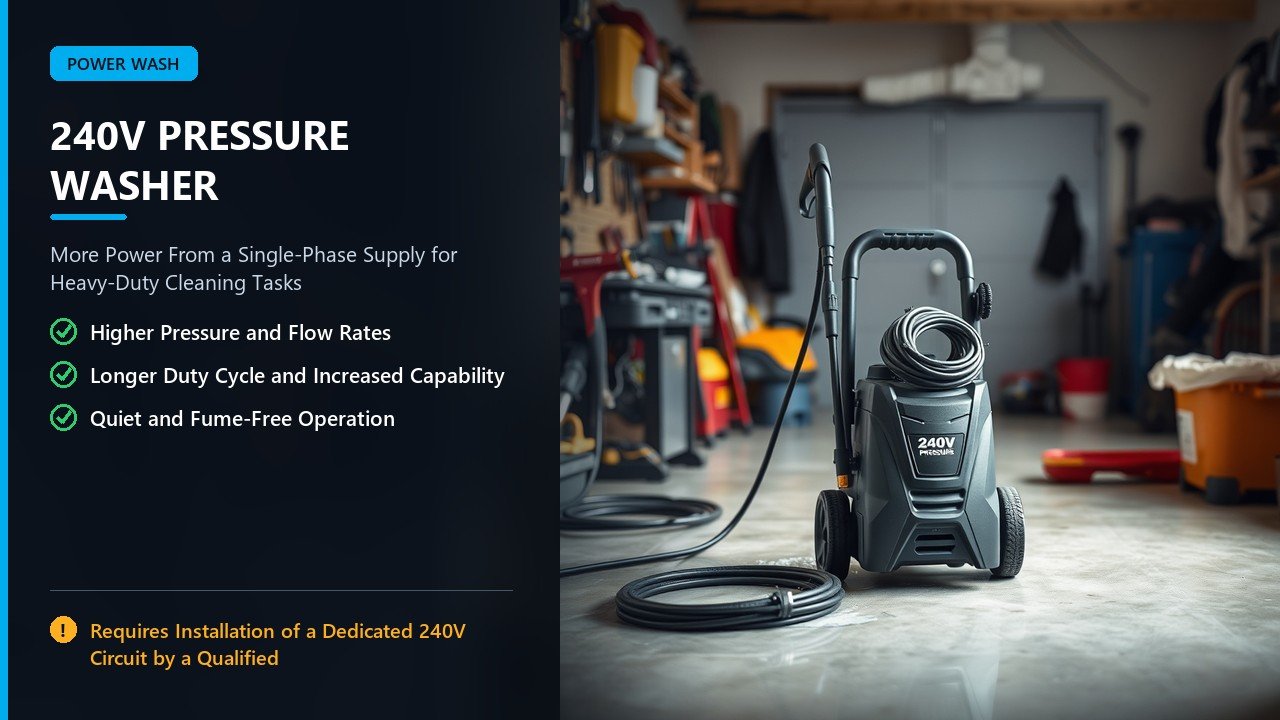
Why Voltage Matters
Electrical power is voltage multiplied by current. A 120-volt circuit limited to, say, 15 or 20 amps can deliver only so much power. Doubling the voltage to 240 means the same current delivers roughly twice the power, so a 240V machine can run a more powerful motor without needing an impractically large current draw.
That extra power goes straight into cleaning capability. A stronger motor can drive a bigger pump at higher pressure and flow, and can run for longer periods. This is why 120V electric washers tend to be light-duty, while 240V machines climb toward the pressure and flow ranges of gas machines, all while staying quiet and fume-free.
The trade-off is the supply. A 240V pressure washer needs a 240-volt circuit, which is not the ordinary wall outlet. Many homes and workshops have 240V available for things like dryers, ovens, or welders, but installing or extending a 240V circuit is electrical work that should be done properly by a qualified electrician.
What a 240V Washer Offers
The main benefit of a 240V pressure washer is more cleaning power without fuel. Compared with a 120V machine, it typically delivers higher pressure and flow, which means faster, more capable cleaning. For tasks that would otherwise call for a gas washer, 240V can do the job indoors or in enclosed spaces where exhaust would be a problem.
It also handles longer duty cycles better. Because the motor has more power in reserve and can be built for heavier service, a 240V machine tolerates longer runs than a light 120V unit. For commercial users who clean throughout the day, that sustained capability matters as much as peak pressure.
And it stays electric. There is no fuel to store, no engine to start, no exhaust, and far less noise than a gas washer. For indoor use, food areas, workshops, and anywhere emissions or noise are concerns, that is a decisive advantage. A 240V machine brings gas-level performance into places a gas machine cannot go.
When You Need 240V
You need a 240V machine when the cleaning task is beyond what a 120V unit can handle, but you want or need to stay electric. Typical cases include small commercial operations, workshops, food and beverage facilities, and serious home users who clean large areas or stubborn dirt regularly. Where a 120V washer would be overworked, a 240V machine keeps pace.
You also need 240V when the environment rules out a gas engine. Indoors, in enclosed bays, or anywhere exhaust and noise are unacceptable, a gas washer is not an option, and a 240V electric machine becomes the only way to reach higher performance. This is a common reason commercial kitchens and indoor facilities choose 240V.
Finally, consider it if duty cycle is a limitation. A light 120V washer often needs frequent rest breaks. If your work demands longer continuous running, the additional headroom of a 240V machine lets it work harder for longer, which suits professional and semi-professional use.
Running a 240V Washer
The first requirement is a suitable 240-volt circuit. Machine ratings vary, so match the circuit’s voltage, current capacity, and breaker to the machine’s requirements. Using a dedicated circuit is wise, so other appliances cannot overload it, and the breaker must be sized to protect the wiring and the machine.
The outlet type matters as well. 240V machines use specific plug and receptacle types, sometimes with different configurations for different current ratings, and an electrician should install the correct outlet for the machine. Because the washer is used near water, ground-fault protection appropriate to the installation is important, and the electrical work should meet local codes.
Extension cords deserve caution. If one is unavoidable, it must be rated for the voltage and current, kept as short as possible, and kept out of water and off wet ground. An undersized or overly long cord causes voltage drop and overheating. The safest approach is to position the machine near a properly installed outlet and avoid extension cords entirely.
Volts, Amps, and Watts
A little electrical literacy helps when choosing a 240V machine. Voltage is the electrical pressure, current in amps is the flow, and power in watts is the two multiplied together. Watts divided by 746 gives roughly the horsepower of the motor, so a machine’s wattage tells you how much power it can apply to the pump.
This is why a 120V circuit has a ceiling. At 120 volts, a 15-amp circuit provides about 1,800 watts, and much of that is best not used continuously. A 240V circuit at the same current provides roughly double the watts, which is what allows a stronger motor and a bigger pump. Understanding the arithmetic makes the advantage of 240 volts concrete.
When comparing machines, look at the load the machine places on the circuit, not just a marketing horsepower figure. The circuit must comfortably supply the machine’s current, with headroom and correct protection. That is the practical meaning of matching a washer to its supply.
The table below summarises the practical differences to plan for.
| Consideration | What to do |
|---|---|
| Circuit | Dedicated 240 V circuit sized to the machine; installed by an electrician |
| Breaker | Matched to the machine and wiring to protect both |
| Outlet | Correct NEMA type for the machine’s plug and current |
| Protection | Ground-fault protection suited to a wet environment |
| Extension cords | Avoid if possible; if used, rated, short, and dry |
240V vs 120V vs Gas
It helps to place 240V in context. A 120V electric washer is the light-duty option: convenient, cheap to run, and adequate for cars, patios, and light jobs, but limited in pressure, flow, and duty cycle. A 240V machine lifts the ceiling considerably, offering more pressure and flow and longer running, while keeping the electric advantages of quiet, fume-free operation.
A gas washer still leads on raw portability and, at the top end, on pressure and flow, and it needs no mains supply. But it brings fuel, exhaust, noise, and engine maintenance. A 240V machine trades the need for a 240-volt supply against a quieter, cleaner, lower-maintenance experience with performance that overlaps mid-range gas machines.
For three-phase, the comparison extends further: a three-phase machine offers even more power and suits industrial settings where three-phase supply exists, but it is not a plug-in-everywhere solution. The choice is really about the supply available and the environment. Where 240 volts is available and the setting suits electric, a 240V machine is often the best balance.
Choosing a 240V Pressure Washer
Choose by pressure and flow first, weighing flow as heavily as pressure, since cleaning power depends on both. Then look at the motor, duty cycle, and build quality, because a 240V machine is bought for sustained, capable work and should be built to match. A serviceable pump and sound construction add to its life.
Confirm the electrical requirements before you buy, because the machine must suit the supply you can provide. Check the voltage, current draw, plug type, and any circuit needs, and plan the installation with an electrician if necessary. Buying a machine your supply cannot run is a costly mistake.
Then consider the accessories and the whole system: a hose, gun, wand, and nozzles suited to the higher pressure and any heat if the machine offers it, plus a reel if you want a tidy setup. Build the system around the machine’s capability so nothing becomes the weak link.
Care and Safety
A 240V pressure washer is a powerful electrical tool used near water, so electrical safety comes first. Keep the outlet, plug, and connections dry and protected, use ground-fault protection, and never handle the plug or machine with wet hands. Inspect the power lead for damage and keep it clear of the water you are spraying. Do not run the machine if the electrical parts show any sign of moisture ingress or damage.
Look after the mechanical side too: keep the pump oil and inlet filter in order, avoid running the machine dry, respect its duty cycle even though it tolerates longer runs, and protect it from freezing. With a fixed or heavy machine, also make sure the mounting or position is stable and the water supply is reliable.
Because a 240V machine delivers near-gas performance without fuel, it is worth treating with the same respect as a serious tool. Install the supply correctly, keep the electrical side dry and safe, and maintain the pump. Done right, a 240V pressure washer brings quiet, clean, high-performance cleaning to places a gas machine cannot reach.
Frequently Asked Questions
What is a 240V pressure washer? An electric pressure washer that runs on 240 volts rather than 120, letting it draw more power from a single-phase supply for higher pressure, flow, and duty.
Why does 240V give more power? Power is voltage times current. Doubling the voltage lets the same current deliver roughly twice the power, so a 240V machine can drive a stronger motor and pump.
Do I need a special circuit? Yes. A 240V machine needs a 240-volt circuit, ideally dedicated, with the correct breaker and outlet, installed by a qualified electrician.
Can I use an ordinary outlet? No. A standard 120V wall outlet will not run a 240V machine. It needs the proper 240V receptacle and supply.
Is 240V better than 120V? For heavier work, yes. It offers more pressure and flow and longer duty, while staying quiet and fume-free. For light jobs, a 120V machine is cheaper and simpler.
How does 240V compare with gas? A 240V machine overlaps mid-range gas performance but needs no fuel, exhaust, or engine maintenance. Gas still leads on portability and top-end power.
Can I use an extension cord? Avoid it if possible. If you must, use a cord rated for the voltage and current, keep it short and dry, and never let it sit in water.
Is it safe near water? With care. Use ground-fault protection, keep the plug and connections dry, never handle them with wet hands, and inspect the lead for damage.
Final Thoughts
A 240V pressure washer is the bridge between light plug-in electric machines and heavy industrial units. By running on 240 volts, it draws enough power to deliver higher pressure and flow and longer duty, all while staying quiet, clean, and fume-free. For indoor and commercial cleaning, that combination is hard to beat.
Check that you have or can install a suitable 240-volt circuit, choose the machine by pressure, flow, motor, and build, and match the rest of the system to its output. Keep the electrical side dry and safe and maintain the pump, and a 240V pressure washer gives you serious cleaning power without the fuel and noise of a gas machine. For related reading, see our guides on pressure washer motors and a 3 phase pressure washer.