Two detailers can own the identical pressure washer and get different results, and the difference often comes down to a piece of hardware barely a foot long. One spends his afternoon fighting a full-length wand under a truck chassis, twisting his wrist at an awkward angle, missing spots behind the brake calipers. The other clicks on a compact gun, crouches, and finishes the same undercarriage in a third of the time with far less fatigue. The machine, the hose, and the water pressure were never the problem. The pressure washer gun short model – sometimes called a stubby gun – simply fits the job better.
Short guns have quietly become a standard piece of kit for professional detailers, and their popularity is spreading to homeowners who are tired of wrestling a long wand in tight spaces. They do not change your pressure, your flow, or your cleaning power. What they change is control, comfort, and access – and on close-quarters work, that is most of the battle.
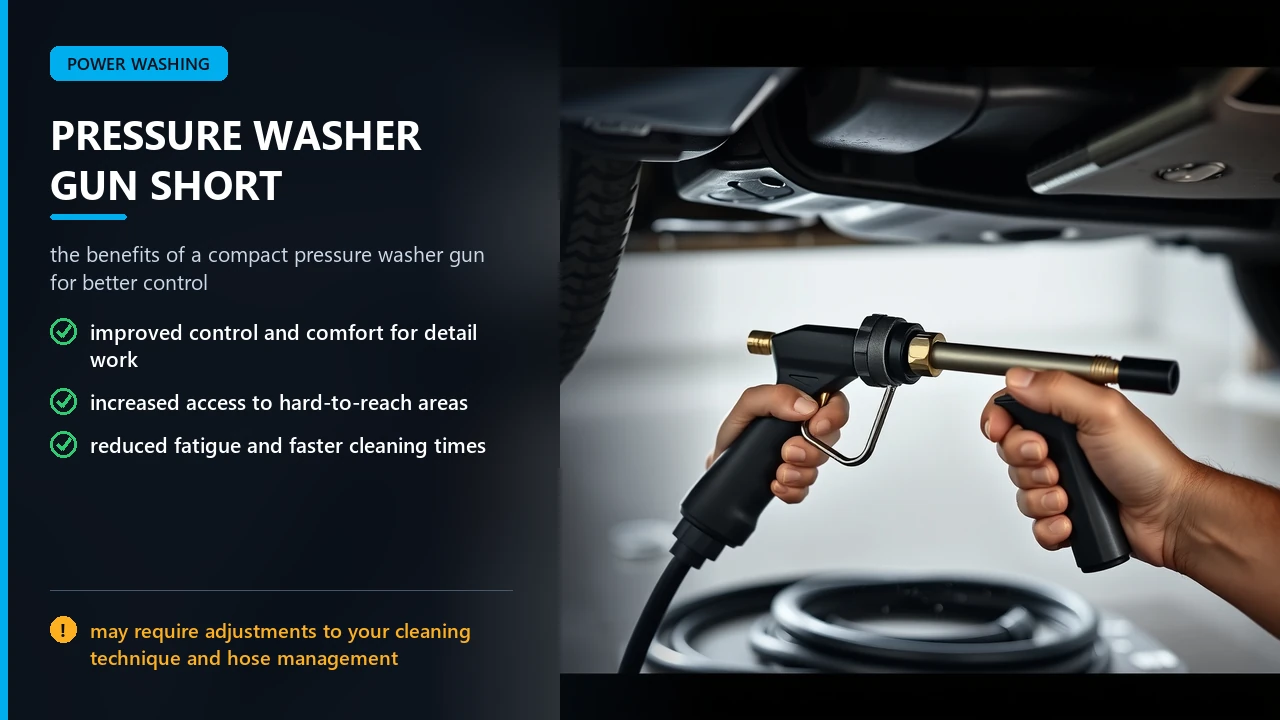
What Makes a Pressure Washer Gun Short
A short gun is a trigger gun with the barrel removed or built at a compact length – typically eight to twelve inches from inlet to nozzle seat, compared to eighteen to twenty-four inches on a standard wand gun. The trigger mechanism, safety lock, and connection fittings are the same concept; only the body length changes.
Most modern short guns are built around quick-connect fittings, so you snap a nozzle directly onto the front or attach a two- to six-inch extension when you need a bit more distance. That modularity is the real appeal: one short gun covers everything from inches-away wheel wells to mid-range panel work by swapping what sits on its nose.
Where a Short Gun Wins
- Wheel wells and undercarriages. The single biggest use case. A long wand physically will not fit between a tire and the fender liner at a usable angle; a short gun slides in and points where you aim.
- Engine bays. Precision matters when water is being sprayed around batteries, alternators, and intakes. A compact gun gives finer control of spray direction.
- Door jambs, mirrors, and trim. Detail work around badges and emblems requires short, controlled bursts – easier with less leverage pulling on your wrist.
- Inside tight garages and around parked cars. Less barrel means fewer accidental contacts with the vehicle you are trying not to hit.
- Foam cannon use. Short guns pair beautifully with foam cannons, keeping the assembly balanced and light instead of front-heavy.
There is a fatigue argument too. Holding a long wand extended away from your body creates a lever arm – the further the mass sits from your wrist, the harder your forearm works. Over a multi-hour detail session that adds up. A short gun keeps the weight close, and detailers consistently report less wrist and shoulder strain.
Short Gun vs Standard Gun: Honest Comparison
| Factor | Short (Stubby) Gun | Standard Length Gun |
|---|---|---|
| Length | About 8-12 inches | About 18-24 inches |
| Reach | Minimal – add a wand when needed | Built-in, good for floors and siding |
| Control in tight spaces | Excellent | Poor – barrel gets in the way |
| Fatigue over long sessions | Lower – weight stays close to wrist | Higher – extended leverage |
| Best pairing | Foam cannon, 1-6 inch extensions | Long wands, direct floor cleaning |
| Typical user | Detailers, undercarriage work | Driveway, deck, and siding work |
Neither is universally better – they are tools for different geometries. Most serious users end up owning both and switching in seconds via quick connect. If you only have one, the choice depends on what you actually clean: vehicles and tight spaces favor the short gun; large flat surfaces and high walls favor the standard wand.
Connection Types: What to Check Before Buying
This is where buyers get tripped up. Short guns are sold with different inlet and outlet fittings, and they must match what you already own.
- M22 inlet (14mm or 15mm). Common on many consumer washers. Critically, M22 comes in two thread depths and the o-ring seat differs – a 14mm gun on a 15mm outlet leaks, and vice versa. Check your machine or measure before ordering.
- 3/8 inch quick connect inlet. Standard on most professional hoses and swivel connections. If your hose already ends in a 3/8″ plug, this is the cleanest option.
- 1/4 inch quick connect outlet. Nearly universal for nozzles and wands. Confirm your short gun has this so your existing tips fit.
- Garden hose thread (GHT). Appears only on the water inlet side – never on the high-pressure outlet.
The safest approach is to identify your hose end first, then buy the gun that mates to it. Adapters exist for every mismatch, but every adapter is another seal that can leak.
Swivel Guns: The Upgrade Inside the Upgrade
Many short guns now come with a swivel at the hose inlet. The benefit sounds small and proves large: the hose rotates freely instead of fighting you. Without a swivel, a stiff high-pressure hose constantly tries to twist back to its coiled memory, tugging the gun sideways and forcing your grip to counteract it all day.
With a swivel, the gun stays where you point it and the hose follows. For anyone doing repeated around-the-vehicle passes – the core motion of detailing – a swivel gun cuts the constant small wrist corrections that cause fatigue. It also reduces hose kinking, which protects the hose itself over time.
If your budget allows one upgrade beyond simply choosing a short body, the swivel is the one professionals mention most often.
Choosing the Right Short Gun: Practical Criteria
- Pressure rating. Match or exceed your washer’s maximum psi. Most quality short guns are rated 4,000 to 5,000 psi, which safely covers consumer and light-commercial machines.
- Flow compatibility. Confirm it passes your gpm without restriction – particularly important if you run a 4 gpm or larger machine.
- Inlet fitting. Buy for the hose you already have, not the one you wish you had.
- Trigger effort. A stiff trigger becomes exhausting quickly. If possible, try before buying or read user feedback on trigger weight.
- Safety lock. Confirm it has a positive lock that stays engaged – a gun that unlocks in a tool bag is a hazard.
- Build material. Brass and stainless bodies outlast zinc alloy. A gun is a lifelong tool; it is not where to save a few dollars.
Pairing Nozzles and Extensions With a Short Gun
A short gun is the hub; what you attach determines its job.
- Nozzle directly on the gun: maximum compactness, ideal for close wheel and trim work at 25° or 40° tips.
- 1- to 6-inch extension: a small standoff that keeps the gun further from the surface while staying compact – a good default for most panel work.
- 12-inch extension: bridges toward floor and mid-height work without committing to a full wand.
- Foam cannon: the classic detailing pairing – thick foam application with a balanced, light assembly.
- Full wand (18-24 inches): attach when you switch to driveway or deck cleaning, then pop it off when you return to the vehicle.
Because everything sits on quick connect, transitions take a couple of seconds. That flexibility is exactly why detailers standardize on a short gun rather than owning two complete setups.
Care and Maintenance
Short guns are simple devices, but they live in a wet, high-pressure, often chemically exposed environment. A few habits keep them reliable:
- Replace o-rings proactively. The seals at nozzle seat and inlet are wear items. A small kit of the correct sizes costs almost nothing and prevents the drips that eventually become leaks under load.
- Lubricate the trigger pivot. A drop of silicone lubricant keeps the trigger from developing grit and sticking.
- Rinse after chemical use. Detergents and degreasers left in the gun body accelerate seal deterioration.
- Store with the trigger unlocked and dry. A trigger locked down for months can take a set, and trapped moisture corrodes internal parts.
- Inspect before each session. Check the safety lock function and look for weeping at the inlet – the first sign of a failing seal.
Common Mistakes to Avoid
- Buying for the wrong thread. The M22 14mm versus 15mm confusion causes more returns than any other factor. Measure or check your manual first.
- Under-rating pressure. A cheap gun rated below your pump’s output is not a bargain – it is a projectile.
- Using a short gun for floor work without an extension. Bending double all afternoon trades one kind of fatigue for another. Add a wand for flat surfaces.
- Ignoring trigger ergonomics. The stiffest trigger in the lineup will hurt by hour two of real work.
- Skip cleaning after soap. Chemical residue is the quiet killer of trigger seals.
Frequently Asked Questions
Does a short pressure washer gun change my cleaning power?
No. Pressure and flow are set by your pump and nozzle. A short gun changes only ergonomics and reach – it lets you aim more precisely in confined spaces and reduces fatigue, which indirectly helps you clean better because you are not fighting the tool.
Will a short gun fit my pressure washer?
It depends on your hose connection. Match the gun’s inlet to your hose end – 3/8″ quick connect for most professional hoses, or M22 (verify 14mm vs 15mm) for many consumer machines. Also confirm the gun’s pressure rating meets or exceeds your washer’s maximum psi.
Can I use a short gun with a foam cannon?
Yes – it is one of the most popular pairings. The compact, balanced assembly makes foam application easier and less tiring, and most foam cannons connect via the same 1/4″ quick connect used by nozzles.
Do I still need a standard wand?
For floors, driveways, decks, and high siding, yes – or at least a longer extension. Keep the short gun for vehicle and detail work and swap to a wand for flat surfaces. Many users mount both on quick connect and change in seconds.
Is a swivel inlet worth the extra cost?
For regular use, absolutely. The swivel lets the hose rotate instead of fighting your grip, which noticeably reduces fatigue and hose kinking during around-the-vehicle work. For occasional light use it is a nice-to-have rather than a necessity.
What pressure should I use on a car with a short gun?
Use a 25° or 40° nozzle and keep the gun at least 12 inches from the paint. Avoid 0° and 15° tips on vehicle finish. Short guns make it easier to maintain that distance and angle in tight areas where a long wand would force you closer than you should be.
The Bottom Line
A pressure washer gun short in length is one of those upgrades that sounds marginal until you use one. It does not add power, but it adds something arguably more valuable on close work: control. Access to wheel wells and jambs improves, wrist strain drops, and transitions between nozzles, foam cannons, and extensions happen in seconds.
Match the inlet to your existing hose, verify the pressure rating exceeds your machine, prefer brass construction and a smooth trigger, and add a swivel if your work involves a lot of movement around vehicles. Keep a standard wand or extension nearby for flat surfaces, replace the o-rings before they leak, and the short gun will likely become the trigger you reach for first.