Every pressure washing crew has that moment at the end of a job. The washer shuts off, but now you are left with a hundred feet of hose in the mud, wrapped around your ankles, or knotted so badly it takes ten minutes to untangle. Multiply that by five jobs a day and you have wasted nearly an hour just wrestling hose. A good power wash hose reel fixes that in a single pull.
Whether you are running a compact cart for residential work, a wall-mounted reel in your wash bay, or heavy-duty reels on a mobile trailer, the right reel keeps your hose off the ground, protects it from abrasion, and speeds up setup and teardown. This guide breaks down reel types, sizing, materials, mounting, buying criteria, and maintenance so you can pick the right power wash hose reel for your setup.
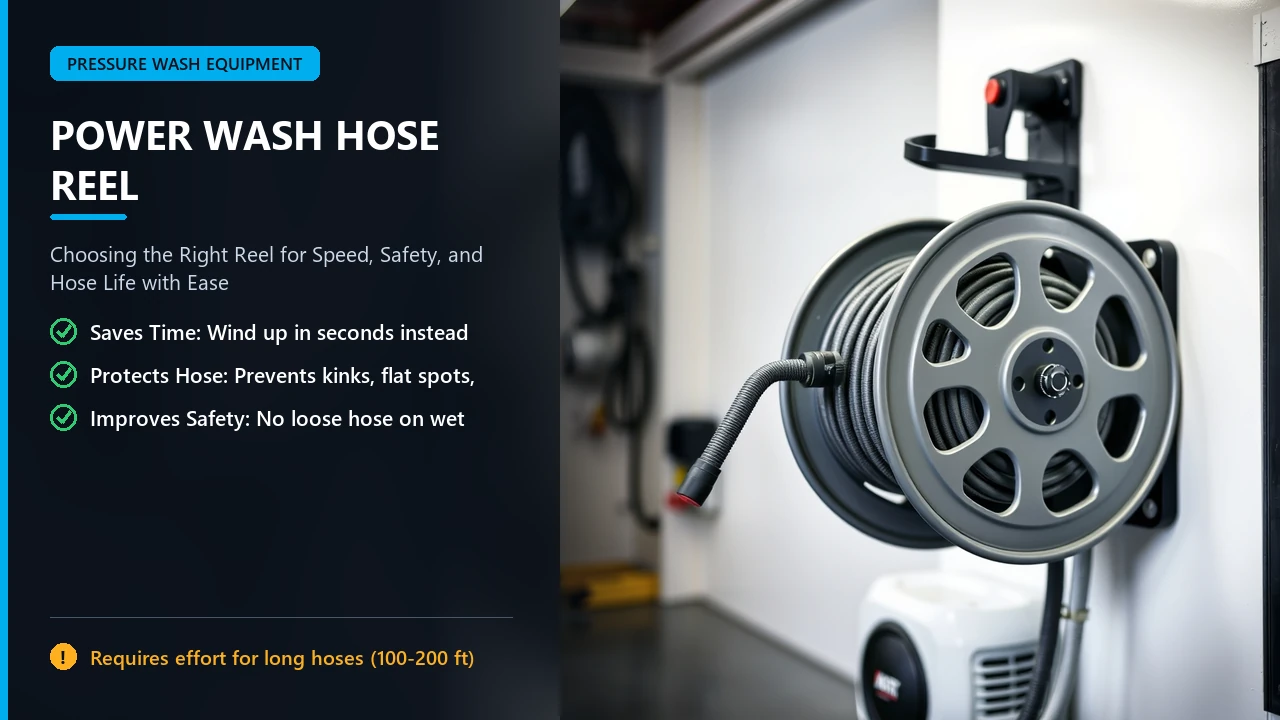
Why Use a Power Wash Hose Reel
- Saves time: Wind up in seconds instead of coiling by hand.
- Protects your hose: Prevents kinks, flat spots, and abrasion that shorten hose life.
- Improves safety: No loose hose on wet concrete or in traffic areas.
- Looks professional: A tidy rig impresses customers and speeds inspections.
- Maximizes space: Wall mounts free up floor space; trailer reels keep the deck clear.
Types of Power Wash Hose Reels
| Reel Type | Best For | Pros | Cons |
|---|---|---|---|
| Manual hand-crank | Most residential and light commercial setups | Affordable, reliable, no power needed, simple to repair | Requires effort for long hoses (100-200 ft) |
| Spring-powered retractable | Wall mounts in bays, garages, or tight spaces | Auto-rewinds with a gentle pull; saves time and space | Higher cost, spring tension needs care, not ideal for very heavy commercial abuse without quality build |
| Electric rewind | Trailer rigs, fleet, high-volume commercial | Fastest rewind with minimal effort; great for 150-200 ft hoses | Most expensive, needs 12V/120V power, more components to maintain |
| Hose reel cart | Mobile jobs without a trailer, multi-site work | Portable, holds hose + often gun/nozzles, easy to roll | Less stable on slopes, takes floor space, smaller tankless setups |
| Pivot/swivel mount | Trailers where you pull from multiple angles | Reduces hose binding and wear; pulls smoothly from curbside/rear | More complex mounting, higher price point |
Sizing Your Power Wash Hose Reel
Size for your hose length plus a little breathing room. Overstuffing a reel causes kinks and makes rewinding hard. Undersizing forces you to buy again.
| Hose Length | Recommended Drum Size | Notes |
|---|---|---|
| 50 ft (3/8″) | 6-8″ drum diameter | Compact for carts and small jobs |
| 100 ft (3/8″) | 8-10″ drum diameter | Most common for residential and light commercial |
| 150 ft (3/8″) | 10-12″ drum diameter | Good for larger properties and trailer setups |
| 200 ft (3/8″) | 12-14″ drum diameter | Needs larger frame; electric rewind is often worth it |
| 100-150 ft (1/2″) | 12″+ drum diameter | 1/2″ hose is stiffer and bulkier; size up |
Always check the reel’s stated capacity for your exact hose ID (inner diameter) and pressure rating. A reel rated for 100 ft of 3/8″ may only hold 75 ft of 1/2″. For hose setup advice on trailers, see our 100 ft hose reel capacity and setup tips.
Materials and Construction
- Frame: Powder-coated steel or heavy-gauge aluminum. Steel is stronger for commercial abuse; aluminum resists rust in wet climates.
- Drum: Steel, aluminum, or UV-stabilized plastic. Steel drums take more abuse; plastic is lighter but less impact-resistant.
- Swivel: The most critical wear point. Look for a brass or stainless-steel high-pressure swivel with replaceable seals.
- Bearings: Sealed ball bearings roll smoother and last longer than bushings.
- Hose guide: A roller or adjustable guide prevents rubbing against the frame and reduces wear.
- Fittings: Use high-pressure rated fittings matched to your washer’s PSI/GPM. Avoid garden-hose-only reels for pressure washing.
Mounting Options
| Mount | Ideal Use | Notes |
|---|---|---|
| Wall mount | Wash bays, garages, workshops | Space-saving. Must be anchored to solid framing/block. Retractable or hand-crank work well. |
| Floor/cart mount | Portable jobs, no fixed location | Wheels help mobility. Keep low center of gravity. |
| Trailer mount | Mobile power washer trailers | Mount low and balanced. Pivot mounts reduce binding when pulling at angles. Secure to frame with grade hardware. |
| Skid mount | Enclosed trailers or custom builds | Integrates with your skid layout. Plan for reel swing and hose routing. |
| Ceiling mount | Rare for pressure washing (awkward) | Generally not recommended due to weight and safety. |
For trailer-specific layouts, our mobile trailer setup guide covers reel placement to minimize pull effort and maximize safety.
Key Buying Criteria
- Pressure & temperature rating: Match or exceed your washer’s max PSI and temp. Hot water reels need seals rated for heat.
- Hose capacity: Size for your hose length + 10% margin.
- Drum diameter & width: Larger drum = less bend radius stress on hose.
- Swivel quality: Brass/stainless, replaceable O-rings, and smooth rotation.
- Rewind type: Manual is fine for <100 ft. Go electric for frequent 150-200 ft use.
- Mounting compatibility: Check bolt pattern and space on wall/trailer/cart.
- Durability: Powder coat, sealed bearings, and solid welds.
- Ease of repair: Can you get swivel, spring, or bearing parts?
- Hose included? Sometimes reels come bare; factor hose cost if needed.
- Safety lock: Retractable reels should have a lock to prevent uncontrolled rewinding.
Recommended Power Wash Hose Reel Features
| Feature | Why It Matters |
|---|---|
| Roller hose guide | Reduces friction and frame wear |
| Replaceable high-pressure swivel | Saves buying a whole new reel |
| Slow-retract mechanism | Prevents hose whipping on retractable models |
| Adjustable brake/lock | Keeps hose at desired length safely |
| Powder-coated finish | Resists corrosion in wet/chemical environments |
| Drain holes | Let water escape to avoid rust/freezing issues |
| Low-profile design | Fits tight trailer bays and walls |
Installation Tips
- Wall mounts: Anchor into studs, concrete, or masonry with appropriate lag bolts/anchors. Never mount to drywall alone.
- Trailer mounts: Use grade 5/8 hardware with lock washers. Welded tabs are ideal; avoid flimsy U-bolts in high-vibration spots.
- Height: Mount so the drum is at waist-to-chest height for easy cranking or safe retracting.
- Hose routing: Keep bends gentle. Avoid sharp 90° turns at the swivel inlet.
- Lead hose: Use a short, flexible high-pressure lead hose between swivel and main line to reduce stress.
- Drainage: On trailers, angle slightly or ensure water can drain from the hose before rewinding in freezing weather.
- Safety: For retractable reels, ensure the path is clear when rewinding. Post a quick reminder if crew shares the bay.
Maintenance and Care
- Rinse after use: Flush with clean water, especially after using harsh chemicals.
- Rewind properly: Avoid kinking. Guide hose onto drum evenly to prevent overlapping.
- Lubricate swivel: Grease or replace O-rings per manufacturer. A sticky swivel wears hose fittings.
- Check hardware: Tighten bolts monthly on trailers due to vibration.
- Inspect hose: Look for cuts, bulges, or wear at the swivel connection. Replace damaged hose immediately.
- Winterize: Drain hose completely before freezing temps. Retractables can trap water; pull out fully and drain. For full rig prep, see our winterizing your power washer pump and gear.
- Spring care: On retractables, never let go uncontrolled. If spring loses tension, have it serviced or replaced by a qualified shop.
Common Mistakes to Avoid
- Buying by price alone: Cheap reels often use low-grade swivels that fail in months.
- Undersizing capacity: Forcing 150 ft onto a 100 ft reel ruins hose and makes rewinding a chore.
- Mounting to weak surfaces: Pulling 200 ft of hose puts serious torque on mounts.
- Ignoring hot water rating: Standard garden reels can’t handle 200°F water safely.
- Skipping lead hose: Direct rigid connections stress the swivel and fittings.
- Over-tensioning retractables: Trying to “fix” slow rewind by forcing usually damages the spring.
- Leaving hose pressurized: Always relieve pressure before rewinding to protect swivel and reel.
Power Wash Hose Reel Buying Recommendations by Use Case
| Use Case | Recommended Type | Capacity | Notes |
|---|---|---|---|
| Residential (driveways, decks) | Manual hand-crank or small retractable | 50-100 ft (3/8″) | Affordable and easy to store |
| Wash bay / fixed shop | Wall-mount retractable | 100-150 ft (3/8″) | Space-saving, fast turnaround |
| Mobile trailer (1-person crew) | Manual or pivot hand-crank | 100-150 ft (3/8″) | Reliable, low maintenance |
| High-volume commercial trailer | Electric rewind with pivot mount | 150-200 ft (3/8″ or 1/2″) | Worth it for time saved |
| Hose cart (no trailer) | Cart-mounted manual reel | 100 ft (3/8″) | Portable, all-in-one mobility |
Frequently Asked Questions
What size hose reel do I need for 100 ft of pressure washer hose?
A reel with at least an 8-10″ drum diameter is typical for 100 ft of 3/8″ hose. If you run 1/2″, size up to 10-12″. Always check the manufacturer’s stated capacity for your exact hose diameter.
Can I use a garden hose reel for a pressure washer?
No. Most garden hose reels are not rated for high pressure (often 150-300 PSI max) and lack a proper high-pressure swivel. Use a reel explicitly rated for your pressure washer’s PSI/GPM, especially for hot water.
Is a retractable hose reel worth it for pressure washing?
Yes, in fixed locations like wash bays where speed matters. For rough trailer use, a heavy-duty manual or electric reel often holds up better. Quality matters more than the “retractable” feature.
How do I keep my hose reel from freezing?
Drain the hose completely after each use in freezing weather. Pull the hose fully off the drum to let water escape. For trailer rigs, winterize the entire system. See our pressure washer winterization guide.
Should I mount my reel high or low?
Waist-to-chest height is ideal. Too high makes cranking awkward and retractables less safe. Too low increases bending and can collect debris.
How long should a power wash hose reel last?
With proper care, a quality commercial reel lasts 5-10 years. The swivel and O-rings are wear items and may need replacement every 1-3 years depending on use.
Final Thought
The best power wash hose reel is the one you will actually use at the end of every job. For most operators, that means sizing up slightly for capacity, investing in a quality high-pressure swivel, and choosing a mounting style that matches how you work. Manual reels win on reliability. Retractables win on convenience in fixed bays. Electric reels win on speed for high-volume routes. Pick based on your real workload, and you will save time, protect your hose, and make every job cleaner from start to finish.