The right pressure washer upgrades can transform how a machine performs without the cost of replacing it. A better nozzle, a smoother gun, a wider hose, or a useful accessory can turn a basic washer into a far more capable tool. The trick is knowing which upgrades genuinely improve cleaning and which are money poorly spent.
This guide covers the upgrades worth making to a pressure washer, from nozzles and guns to hose, accessories, and the small parts that improve reliability.
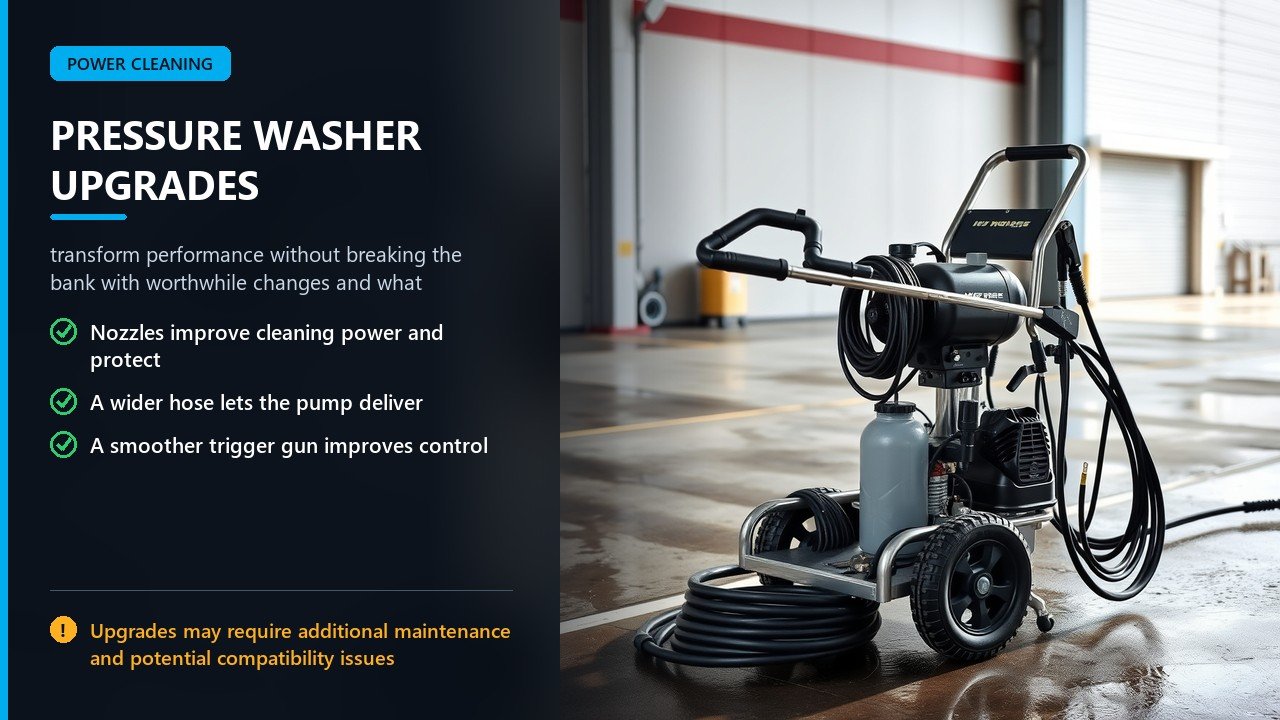
Start With the Output
The most effective upgrades improve the machine’s output or how you use it, not its looks. Since cleaning power depends on pressure and flow reaching the nozzle, upgrades that reduce restrictions or improve control give the biggest gains. A better nozzle, a wider hose, and a smoother gun all fall into this category.
Nozzles are the cheapest and most impactful upgrade. A quality set with correct spray angles and the right size for the machine’s flow cleans better and protects the pump. A worn or mismatched nozzle can rob a good machine of performance, so refreshing the nozzles and matching them to the flow is the first place to look.
Next comes the hose. If the machine is restricted by a thin or short hose, upgrading to a larger-diameter hose sized for the flow lets the pump deliver its full output, and a longer hose, used carefully, improves reach. This is a straightforward upgrade with a real effect on performance and convenience.
The Gun and Connections
A better trigger gun improves control, comfort, and reliability. A quality gun with a smooth trigger, a lock-off safety, and a swivel inlet reduces fatigue, prevents hose kinking, and holds pressure without leaking. If the original gun is stiff, drippy, or awkward, upgrading it is worthwhile and makes long jobs far easier.
Quick-connect fittings are a small upgrade that pays off in daily use. They let you swap nozzles, wands, and accessories in seconds instead of wrestling with threaded connections. Fitting quality quick-connects rated for the machine’s pressure, and standardising the connection type across your accessories, speeds up every job.
Replacing worn seals and O-rings is the humblest upgrade of all, but it stops the drips and pressure losses that make a machine feel tired. A small kit of spare seals costs little and can restore a leaking gun, wand, or coupling to like-new condition. Fixing leaks is always a better upgrade than adding parts.
Do Upgrades Change Pressure or Flow?
Most upgrades do not create pressure or flow; they let the machine deliver what it already has. The pump sets the output, and the nozzle, hose, gun, and fittings either let that output through or restrict it. So the goal of an upgrade is usually to remove a restriction, not to add power.
A nozzle is the exception in how it shapes the jet. The right nozzle converts the pump’s flow into the ideal spray for the job, so a correct nozzle can make a machine feel stronger even though it changes nothing inside the pump. A wrong or worn nozzle, by contrast, wastes the flow and weakens the jet.
Understanding this keeps upgrades honest. If a machine is limited by its pump, no accessory will add pressure, and anyone promising otherwise is selling a gimmick. If it is limited by a thin hose, worn nozzle, or a weak water supply, then the right upgrade removes that limit and the machine performs as it should. Knowing which limitation you have is the key to choosing upgrades that work.
Accessories That Add Real Capability
A surface cleaner is one of the best upgrades for anyone cleaning flat surfaces. It spreads the jet over a wide rotating path, cleaning driveways, patios, and paths faster and far more evenly than a wand, and it reduces the risk of zebra striping and surface damage. For large flatwork, it transforms the job.
A foam cannon or foam lance is another popular upgrade, applying thick detergent foam for vehicle and surface cleaning. It lets the soap dwell and lift dirt before you rinse, improving results on cars and delivering a more satisfying clean. For anyone who washes vehicles, it is a worthwhile addition.
A hose reel is a practical upgrade that keeps the hose tidy, prevents kinks and tangles, and speeds up setup and storage. A swivel at the gun or an angled wand adapter can make the hose follow your movement without fighting it, reducing fatigue on long jobs. These are small conveniences that make a machine much nicer to use.
Upgrades Worth Skipping
Not every upgrade is worthwhile. Fitting a higher-pressure pump or motor than the machine was designed for risks stressing the frame, drive, and hoses, and rarely works well. Internal power upgrades are best left to a new machine rather than bolted onto an existing one.
Cheap generic accessories can also be a false economy. A budget gun, nozzle, or fitting that barely meets the machine’s ratings may leak, restrict flow, or fail early, giving no real benefit. It is usually better to spend on one quality item than to stack several cheap ones, especially on pressure-carrying parts.
And upgrades that do not address a real problem are wasted. If the machine is underperforming because of a worn nozzle, a blocked filter, or a poor water supply, buying accessories will not fix it. Diagnose the actual limitation first, then upgrade the part that solves it.
Maintenance Upgrades
Some of the best upgrades are not accessories at all but maintenance. Fitting a proper inlet filter protects the pump from grit; using the correct pump oil and changing it on schedule keeps the internals healthy; and a pump saver or antifreeze for storage prevents freeze damage. These modest additions protect the machine and extend its life.
Adding a water filter or a buffer tank to solve a supply problem can transform how a machine performs, especially for high-flow washers that outrun the tap. Fixing the supply is often the single biggest upgrade available, and it costs far less than a new machine.
The table below sums up which upgrades pay off.
| Upgrade | Value |
|---|---|
| Quality nozzles | High: better cleaning, protects the pump |
| Larger-diameter hose | High for restricted machines |
| Better gun and quick-connects | Good: control, comfort, speed |
| Surface cleaner | High for flatwork cleaning |
| Water supply fix | High: unlocks full performance |
Focus on these and the machine improves without risky or gimmicky changes.
Matching Upgrades to the Machine
Every upgrade must be rated for and matched to the machine. Parts fitted to a pressure washer must handle the machine’s full pressure and flow, so any new hose, gun, wand, or fitting should exceed those ratings with margin. An upgrade that is under-rated is worse than none, because it fails under load and may be unsafe.
Match the flow as well as the pressure. A larger hose only helps if the machine can use the flow, and a nozzle must be sized to the pump. Upgrades that are out of step with the machine’s capability can reduce performance rather than improve it, so check the machine’s ratings before buying any part for it.
Fit upgrades correctly. Use the right seals for each connection type, tape tapered threads and use O-rings on quick-connect and M22 joints, and test under pressure. A well-chosen upgrade fitted badly, with a leaky seal or a sloppy adapter, undoes its own benefit, so take the same care with a small part as with the machine.
When to Upgrade vs Replace
Upgrading makes sense when the machine is fundamentally sound and the upgrade removes a limitation. If the pump and engine or motor are strong but the hose is thin, the nozzle is worn, or the supply is weak, upgrades and fixes will unlock the machine’s real capability for modest cost.
Replacing makes more sense when the machine itself is the limit. If the pump is worn out, the pressure and flow are simply too low for your work, or an axial-cam pump has failed, no accessory will fix that. In those cases, a better machine is the real upgrade, and spending on accessories would be wasted.
Judge honestly. Upgrades reward good machines and are wasted on worn ones. If the core is healthy, a few well-chosen parts and a fixed water supply can make a machine clean far better; if the core is tired, put the money towards a replacement instead.
It also helps to set a budget and stick to it. Most worthwhile upgrades cost little, and a small spend on nozzles, seals, and a proper hose often restores more performance than a large spend on cosmetic extras. Spend where it improves cleaning, not where it merely looks impressive.
Frequently Asked Questions
What is the best first upgrade? Quality nozzles, sized to the machine’s flow. They are cheap, clean better, and protect the pump. Fixing any leaks with new seals is a close second.
Does a bigger hose improve performance? It can, if the original hose is thin or restricting flow. A larger diameter, properly rated hose lets the pump deliver its full output. Too short a hose also limits reach.
Can I upgrade the pressure or flow? Not safely by swapping a pump or motor. The frame, drive, hose, and gun are matched to the design output. If you need more power, buy a machine built for it.
Is a surface cleaner worth it? For driveways, patios, and other flatwork, yes. It cleans faster and more evenly than a wand and reduces the risk of stripes and surface damage.
Are quick-connects a good upgrade? Yes. They let you swap nozzles, wands, and accessories in seconds. Use quality fittings rated above the machine’s pressure.
Do I need a foam cannon? It is a worthwhile upgrade for vehicle washing, applying thick foam that lifts dirt before rinsing. For hard-surface cleaning, it is less essential.
Why did my cheap upgrade not help? Likely because it was under-rated, mismatched to the machine, or did not address the real limitation. Diagnose the actual problem before buying.
Should I upgrade or replace? Upgrade a sound machine to remove a specific limitation; replace it if the pump, pressure, or flow are themselves inadequate.
Final Thoughts
The best pressure washer upgrades are the ones that remove a real limit on the machine. Better nozzles, a wider hose, a smoother gun, quick-connects, and a surface cleaner turn a basic washer into a far more capable and pleasant tool, and fixing the water supply can unlock performance no accessory can match.
Just as important is what not to do. Skip under-rated parts, cheap pressure-carrying accessories, and any attempt to push a machine beyond its design. Match every upgrade to the machine, fit it carefully, and let the core stay within its limits. Upgraded wisely, a good pressure washer works better, lasts longer, and does more. For related reading, see our guides on a high pressure power washer gun and high pressure hose for a pressure washer.