The handle is the part of a pressure washer you hold all day, and it has more influence on comfort, control, and safety than its simple looks suggest. On most machines, the handle is part of the trigger gun assembly: the grip you hold, the trigger you squeeze, and the safety lock that keeps the machine from firing unexpectedly. A good handle makes long jobs far easier; a poor one leaves you tired and aching.
This guide looks at the power washer handle, what it does, the types available, and how to choose and care for one.
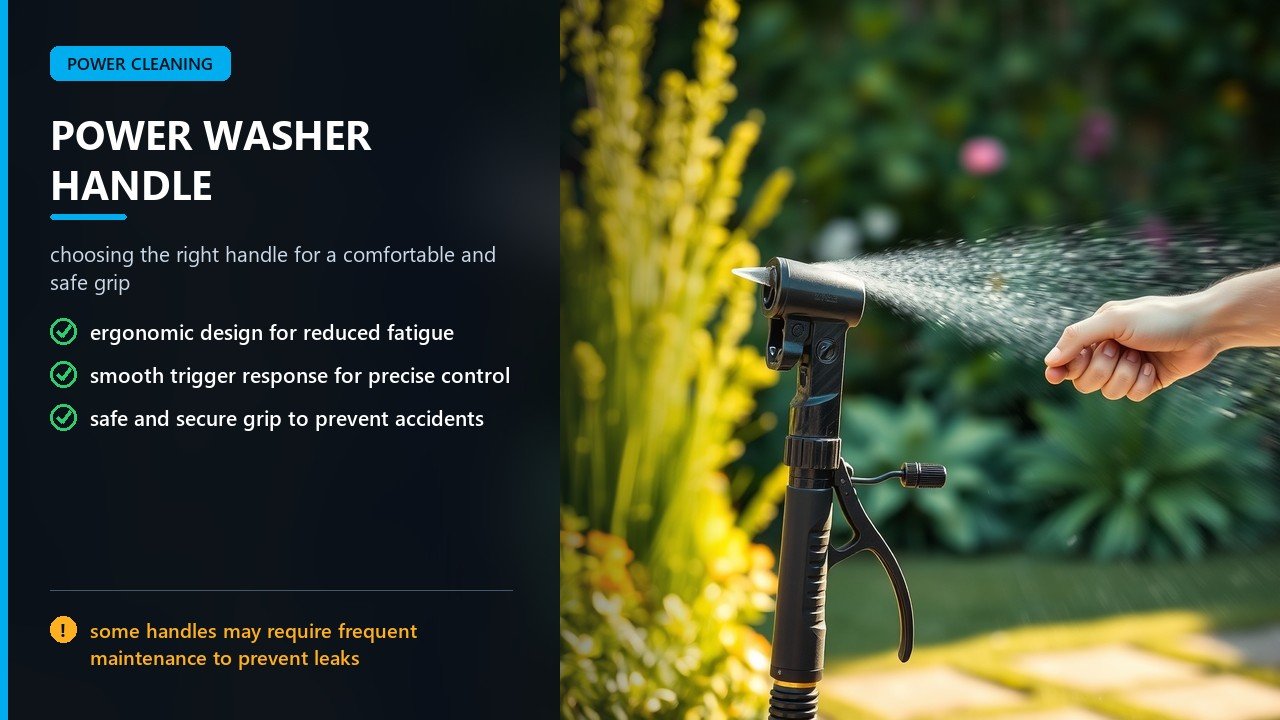
What the Handle Does
The handle is your interface with the high-pressure jet. Squeezing the trigger opens the valve and releases the water; releasing it stops the flow and, on machines with a total stop system, shuts the pump down. The handle also carries the safety lock, the part that prevents the trigger being squeezed accidentally when you are not spraying, and it holds the connection to the wand at the front.
Behind the simple grip sit the handle’s internal parts: the valve, the spring, and the seals that control the flow of pressurized water. The handle must contain full machine pressure without leaking, hold that pressure when the trigger is released, and respond smoothly when squeezed. It is, in effect, the pressure valve of the whole machine, held in your hand.
Because it is held and used constantly, the handle’s ergonomics matter. Its shape, weight, length, and balance affect how tired your hand and arm become, and how precisely you can direct the jet. A handle that fits your hand and sits well on the machine makes cleaning more controlled and less tiring, especially on long jobs.
Types of Handle
Handles come in a few broad styles. The traditional pistol grip is the most common, with a vertical grip and a trigger, and it suits most work. A rear-handle or shoulder-stock design moves the grip to the rear, giving a different balance and longer reach, and is favoured on some professional machines. Compact stubby handles suit tight spaces and short wands.
Materials and grip surfaces vary. Handles are usually made from metal or tough polymer, and many have rubberised or textured grips to improve purchase when wet. A comfortable, non-slip grip is a real benefit, since hands get wet and slippery during use, and it reduces the effort needed to hold and control the jet.
Many handles today are sold with quick-connect inlet and outlet fittings, and some have a swivel inlet, which lets the high-pressure hose rotate freely and prevents it twisting and kinking as you move. A swivel-inlet handle greatly improves comfort on the job, and standardising on quick-connect fittings lets you swap wands and nozzles quickly.
Anatomy of a Handle
Inside the handle are the parts that make it work. The trigger operates a valve, usually a poppet or ball valve, which opens and closes the water path. A spring returns the valve to the closed position when the trigger is released. Seals and O-rings at the valve and the inlet and outlet connections keep the pressurized water contained, and the safety lock blocks the trigger when engaged.
The handle connects to the high-pressure hose at its inlet and to a wand or nozzle at its outlet. These connections are the points where leaks most often appear, and their seals are the parts most often renewed. Understanding this layout makes troubleshooting straightforward: a leak on releasing the trigger points to the valve seals, while a leak at the inlet or outlet points to the connection seals.
The valve inside a handle works hard, opening and closing under full pressure every time you pull and release the trigger. That repeated action wears the seals and, eventually, the valve seat, which is why even a good handle will at some point need a seal kit or rebuild. Choosing a handle whose seals can be replaced extends its useful life considerably.
Threaded vs Quick-Connect Handles
Handles differ mainly in how they connect, either threaded or quick-connect. Threaded handles use screw-on fittings, usually M22 or BSP/NPT, and they seal with the thread or a washer depending on the type. They are secure and common, but slower to attach and detach, and they need the correct thread and seals to avoid leaks.
Quick-connect handles use push-and-click fittings, letting you attach a hose, wand, or nozzle in seconds. They seal on an O-ring, so they never use thread tape, and the O-ring is the part to renew when they leak. Quick-connect is faster and more convenient for swapping attachments, which is why it is popular on modern machines.
Either type works well if it matches your other equipment. The important thing is consistency: standardise on the connection type across your handle, wands, and hoses, so you can swap parts without adapters. Adapters add joints that can leak and reduce flow, so matching connections is worth the small effort and keeps the handle working with the rest of the machine.
Ergonomics and Comfort
Comfort is about match and balance. A handle that is too large or too small for your hand is awkward to hold, and one that is badly balanced makes the machine feel heavier and harder to aim. The best handle suits your hand size, sits naturally on the wand, and lets you direct the jet with small movements rather than wrestling the machine.
Weight and trigger effort matter on long jobs. A lighter handle is easier to hold over time, and a smooth, low-effort trigger reduces hand fatigue. Some handles have trigger hold or lock features that let you maintain the flow without squeezing continuously, which on a long job saves a great deal of hand strain, though the safety lock and sensible use still apply.
The hose’s behaviour affects comfort too. A standard handle with a fixed inlet can let the hose twist and pull against your grip, whereas a swivel-inlet handle lets the hose follow your movement smoothly. Along with a well-routed, kink-free hose, a swivel handle keeps the machine balanced and controllable.
Safety Features
The most important safety feature of a handle is the trigger lock-off, sometimes called the safety lock. It locks the trigger so it cannot be squeezed when the machine is not being used, which prevents accidental spraying. Always engage it when you set the machine down, and never defeat or disable it, since a high-pressure jet can cause serious injury.
Handles should also be rated for the machine’s pressure, flow, and water temperature. A handle that is under-rated can fail under load, and hot-water machines demand a handle and seals rated for the heat, often with Viton seals rather than standard ones. Matching the handle to the machine’s ratings is a safety matter as much as a performance one.
Good seals complete the safety picture. A leaking handle can spray water unpredictably and lose pressure, and worn seals let pressurized water escape where you cannot see it. Reliable sealing, a working safety lock, and correct ratings are the features to check, and they matter more than any cosmetic detail.
Choosing a Handle
Start with the ratings. The handle must be rated for at least the machine’s pressure and flow and for the water temperature, so cold-water and hot-water handles are not interchangeable. Check the connection type, whether threaded BSP/NPT or quick-connect, and match it to your wand and hose, or plan to use adapters rather than forcing an ill-fitting connection.
Then consider comfort. Hold the handle, or a similar one, and judge the grip size, the trigger feel, and the balance. Choose a grip that suits your hand, a trigger that is smooth and not too stiff, and, if you work with a hose that twists, a swivel-inlet model. A rubberised or textured grip helps when your hands are wet.
Finally, weigh serviceability. Handles with replaceable seals and internal rebuild kits last far longer than sealed ones, because a leaking handle can be repaired rather than replaced. Since the handle is the machine’s pressure valve and a common wear point, a serviceable, well-rated handle is the sensible choice.
Care and Common Problems
Care for a handle is mostly about its seals. Keep them clean and replace them when they wear, since worn seals cause drips, pressure loss, and unpredictable spray. On a serviceable handle, seal kits and rebuild parts are cheap and restore the handle quickly; on a sealed handle, a leaking unit is usually replaced outright.
Common handle problems include water spraying from the handle when the trigger is released, which points to worn trigger-valve seals, and leaks at the inlet, which point to inlet seals or a loose connection. A trigger that sticks or is hard to squeeze suggests the internal valve or spring needs attention. In each case, a seal kit or rebuild is the usual fix.
The table below sums up what to look for in a power washer handle.
| Feature | Why It Matters |
|---|---|
| Rated for pressure and heat | Safety and reliability under load |
| Trigger lock-off | Prevents accidental spraying |
| Comfortable grip | Less fatigue on long jobs |
| Swivel inlet | Stops the hose twisting and kinking |
| Serviceable seals | Repair leaks instead of replacing the handle |
Check these and the handle serves comfortably and safely.
Frequently Asked Questions
What is a power washer handle? The grip and trigger assembly you hold, part of the trigger gun. It controls the flow of water, carries the safety lock, and connects to the wand.
Does the handle affect performance? It can. A handle with good seals and a smooth valve delivers reliable flow, while a worn or under-rated one leaks and loses pressure.
What is a swivel inlet? A rotating hose connection on the handle that lets the high-pressure hose turn freely, preventing it twisting and kinking as you work. It improves comfort noticeably.
Why does my handle leak when I release the trigger? Usually worn trigger-valve seals inside the handle. A seal kit or rebuild restores it on a serviceable handle.
Can I use my handle with hot water? Only if it is rated for the temperature, with heat-rated seals. A cold-water handle may fail under hot water.
Is the safety lock necessary? Yes. It prevents accidental spraying when the machine is set down, and it should never be disabled. High-pressure jets can cause serious injury.
Can I repair a leaking handle? Often, yes, if it is serviceable and you can get the seal kit or rebuild parts. Sealed handles are usually replaced instead.
How do I choose the right one? Match the pressure, flow, and temperature ratings and the connection type, then choose a comfortable grip and, ideally, a swivel inlet and serviceable seals.
Final Thoughts
The power washer handle is more than a grip: it is the pressure valve you hold in your hand, controlling the flow, carrying the safety lock, and shaping how comfortable and controlled the machine feels. A well-chosen handle suits your hand and the machine, seals reliably, and keeps a long job from becoming a strain.
Choose one rated for the machine’s pressure, flow, and temperature, with a safety lock, a comfortable grip, a swivel inlet to stop the hose twisting, and serviceable seals so a leak can be repaired. Looked after this way, the handle does its quiet but vital job reliably. For related reading, see our guides on a pressure washer handle gun and on pressure washer gun parts.