The motor is what drives an electric pressure washer. It spins the pump that pressurises the water, and its type and quality go a long way to explaining a machine’s power, noise, weight, and lifespan. Understanding the motor helps you choose between machines and, when something goes wrong, work out where the fault lies.
This guide explains the types of motor used in pressure washers, how they drive the pump, and how to keep one running well.
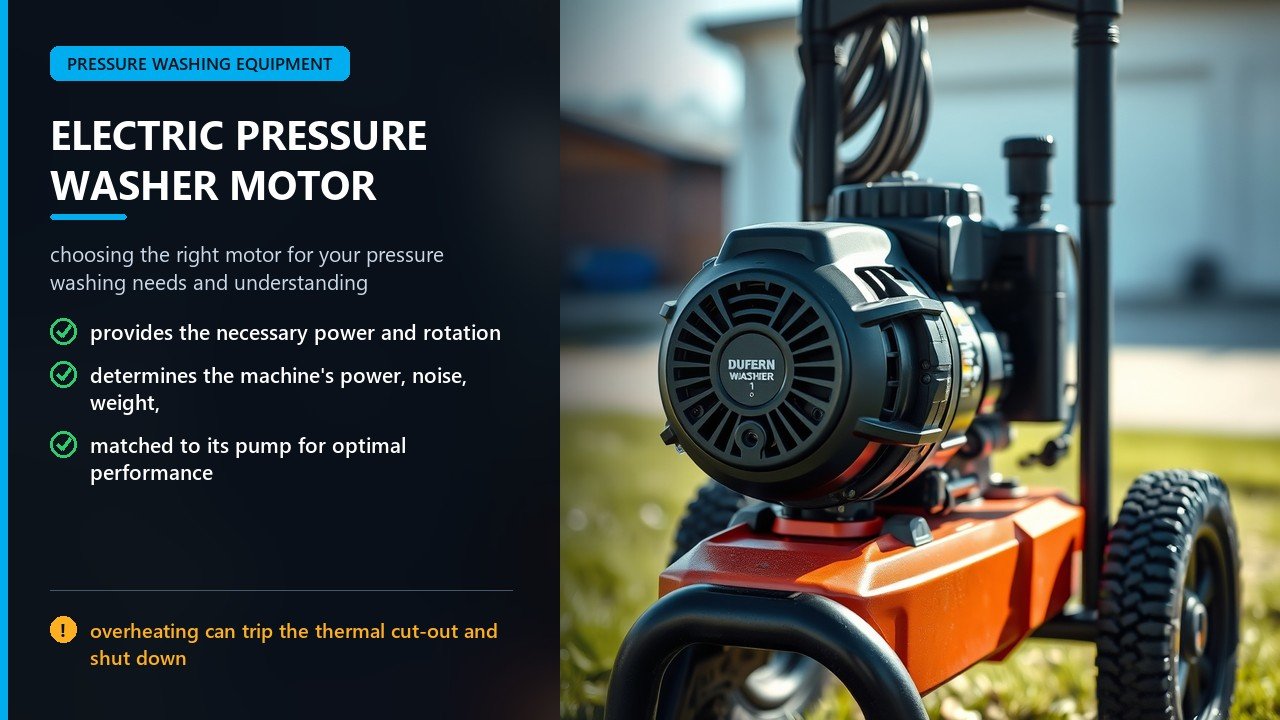
The Motor’s Job
In an electric pressure washer, the motor converts electricity into rotation and spins the pump. The pump then takes the water, pressurises it, and pushes it out through the hose and nozzle. The motor does not touch the water; it simply provides the turning force, and its power, measured in watts or horsepower, determines how much work the pump can do.
A motor is matched to its pump, so a small motor driving a large pump will labour, and a large motor on a small pump is wasted. For this reason, motor power and pump size travel together in a well-designed machine, and the flow and pressure figures on the label reflect both.
Temperature matters to a motor, so pressure washers include cooling and protection. Most electric motors are air-cooled by a fan, and many have a thermal cut-out that shuts the machine down if it overheats, protecting the windings. Running a motor hard in hot conditions, or in an enclosed space, can trip this protection until the machine cools.
Types of Motor
Two types of motor dominate electric pressure washers: induction motors and universal (or brushed) motors. An induction motor has no brushes, runs more quietly, and generally lasts longer, but it is heavier and usually costs more. It is found on better-quality and larger machines and is a hallmark of a robust design.
A universal or brushed motor uses carbon brushes that make contact with a spinning commutator, and it is lighter, cheaper, and often noisier, with a higher-pitched tone. Its brushes wear over time and eventually need replacement, though in many consumer machines the motor is sealed and replaced as a unit when it fails.
In both cases the motor spins the pump, either directly or through a belt. A direct-drive machine couples the motor straight to the pump for simplicity and a compact size, while a belt-drive machine uses a belt and pulleys, which reduces load on the motor and is common on larger, professional equipment.
Power and Electrical Supply
An electric pressure washer’s motor draws a substantial current, and the supply must be able to carry it. Small machines may run from a standard household socket, while larger ones need a dedicated circuit, and many professional machines run on three-phase power. Matching the machine to a supply that can carry its current avoids nuisance tripping and overheating.
Extension leads are a common source of trouble. A long or thin extension cord adds resistance, drops the voltage, and can cause the motor to run hot or fail to start. The advice is to avoid extension cords where possible, and, if one must be used, to choose a heavy, short cable rated for the machine’s current.
The supply should also be protected. A residual-current device, or RCD, protects against earth faults, which is important around water, and the machine’s own thermal protection guards the motor against overheating. Together, these safeguards let the motor run safely from a suitable supply.
Direct Drive vs Belt Drive
Direct-drive pressure washers connect the motor shaft straight to the pump, often through a flange. This is compact, efficient, and inexpensive, and it is how most home electric machines are built. The trade-off is that the pump bearings take the motor’s thrust directly, and a worn pump can, in time, damage the motor, so direct-drive machines reward good pump maintenance.
Belt-drive machines separate motor and pump with a belt and pulleys. The belt lets the motor run at its own speed and cushions loads, and it means pump and motor can be serviced independently. Belt drive is heavier and more complex but is favoured on larger, professionally used machines for its durability and serviceability.
For a home user, direct drive is the norm and is perfectly adequate. The distinction matters most when machines are worked hard for long periods, where belt drive’s robustness and easy servicing become valuable. Either way, the principle is the same: the motor turns the pump, and the pump makes the pressure.
Motors and Pressure Ratings
A pressure washer’s output depends on both motor and pump. The motor must supply enough power to drive the pump at the pressure and flow the machine claims, so a high-pressure rating requires a capable motor behind it. This is why the smallest, cheapest machines, with modest motors, cannot match the output of larger ones, whatever the pump design.
Motor power is not the whole story, though. Pump design matters greatly: a triplex pump, which uses three pistons, outperforms a cheap axial-cam pump at the same motor power, and a well-matched machine gets more useful cleaning from the same electricity. The motor sets the ceiling; the pump determines how close to it the machine works.
For the buyer, the lesson is to look at the stated pressure and flow and trust that a well-made machine matches motor to pump. A very high pressure figure on a machine with an obviously small motor should raise doubts, because the two must be in balance to deliver the claimed performance.
Noise and Vibration
Motor type is the main reason one pressure washer is quieter than another. An induction motor hums quietly, whereas a brush motor whines at a higher pitch. For use near neighbours, indoors, or in a quiet area, an induction motor is markedly more pleasant, and this is one reason such machines command a higher price.
Vibration is another motor-related trait, and it often points to a fault. A smooth-running machine vibrates little, so a sudden increase in vibration can mean worn pump bearings, a loose mount, or a motor problem. Vibration also travels into fittings and hoses, so addressing it early protects the whole machine, not just the motor.
In normal use, some noise and vibration are unavoidable, and mounting the machine on stable ground and keeping it maintained minimises both. If the machine becomes noticeably noisier or rougher, treat it as a warning: find the cause before continuing to run it, since a small issue left unchecked can grow into an expensive one.
Common Motor Problems
When an electric pressure washer fails, the motor is sometimes the cause. A machine that will not start may have no power, a tripped supply, or a faulty switch or capacitor. A motor that hums but does not turn may be seized, or the pump may be jammed, and a machine that trips the supply or overheats may have a failing motor or a supply that cannot carry the load.
On a brush-type motor, worn brushes cause weak or intermittent running and, eventually, failure to start. On some machines the brushes can be replaced; on sealed units the motor is replaced as a whole. For any electric fault, first rule out power supply, extension-cord problems, and a jammed pump before suspecting the motor itself.
Overheating is a common warning sign. If the motor cuts out after a while and restarts when cool, the thermal protection is doing its job, and the cause is likely heavy use, poor ventilation, or a supply problem. Repeated overheating should be investigated, since continuing to run a hot motor can shorten its life or destroy it.
Looking After the Motor
Motor care is mostly about keeping it cool and dry and not overworking it. Keep the cooling vents clear of dirt so air can flow, never cover the machine while it runs, and give it breaks during long jobs so heat does not build up. Store and use the machine in dry conditions, and protect it from water ingress around the electrics.
Use the machine within its design. Do not run it for long periods without water flow, since the pump and motor can overheat, and do not stall it against a blocked nozzle. On a brush motor, replace the brushes when they wear, and on any machine with a capacitor or switch issue, fix it promptly rather than forcing the machine to run.
The table below sums up the main motor points.
| Aspect | Detail |
|---|---|
| Induction motor | Quiet, durable, heavier, costs more |
| Brush motor | Lighter, cheaper, brushes wear |
| Direct drive | Compact, common on home machines |
| Belt drive | Durable, serviceable, heavier |
| Overheating | Check vents, supply, and duty cycle |
Mind these and the motor gives reliable service.
Frequently Asked Questions
What does the motor do in a pressure washer? It converts electricity into rotation and drives the pump, which pressurises the water. The motor does not touch the water; it supplies the turning force.
Which motor is better, induction or brush? Induction motors are quieter and longer-lasting but heavier and costlier. Brush motors are lighter and cheaper but their brushes wear and need replacing.
What is direct drive? A design in which the motor shaft couples straight to the pump. It is compact and common on home machines. Belt drive separates them with a belt for durability and easier servicing.
Does a bigger motor mean more pressure? It sets the ceiling, but the pump determines the output. A well-matched motor and pump deliver the stated pressure and flow; an out-of-balance machine will not.
Why does my motor hum but not start? Common causes are a faulty capacitor or switch, a seized motor, or a jammed pump. Rule out power and pump problems before suspecting the motor.
Why does the motor cut out? Likely thermal protection reacting to overheating, caused by heavy use, poor ventilation, or a weak supply. Let it cool and check the cause.
Can I replace the brushes? On some brush-type motors, yes. On sealed units the motor is replaced as a whole. Check your machine’s parts list.
How do I make the motor last? Keep the vents clear, never cover it while running, give it breaks, keep it dry, avoid running without water flow, and fix faults promptly.
Final Thoughts
The motor is the engine of an electric pressure washer, turning electricity into the rotation that drives the pump. Its type, size, and condition determine how powerful, quiet, and long-lived a machine is, and matching motor to pump is what makes a pressure washer work well.
Choose an induction motor and a well-balanced machine for quiet, durable performance, or accept a lighter brush motor for a smaller budget. Keep the motor cool and dry, use the machine within its limits, and address faults early. Looked after this way, the motor serves reliably for years. For related reading, see our guides on the parts of a pressure washer and on a hot water electric pressure washer.