Mike ran a small property maintenance business. For years he ran a light-duty pressure washer that could knock off loose dirt, but when he hit heavy concrete, oil stains, or large fleet jobs, he was stuck doing multiple passes and losing time on every job. After upgrading to a pressure washer 3.0 GPM, his crew started finishing driveways in half the time. The difference wasn’t maxing out PSI — it was having enough water volume to rinse the grime away fast. That is the real tradeoff: PSI breaks it loose, GPM carries it off.
A pressure washer 3.0 GPM hits the upper end of what most homeowners and many prosumer operators use. With flow rates this high, you cover large horizontal surfaces quickly, rinse more thoroughly, and cut total job time dramatically. This guide explains what 3.0 GPM means, what it can clean, how it compares to lower flow rates, electric vs gas, and how to choose the right balance of PSI and GPM for your work.
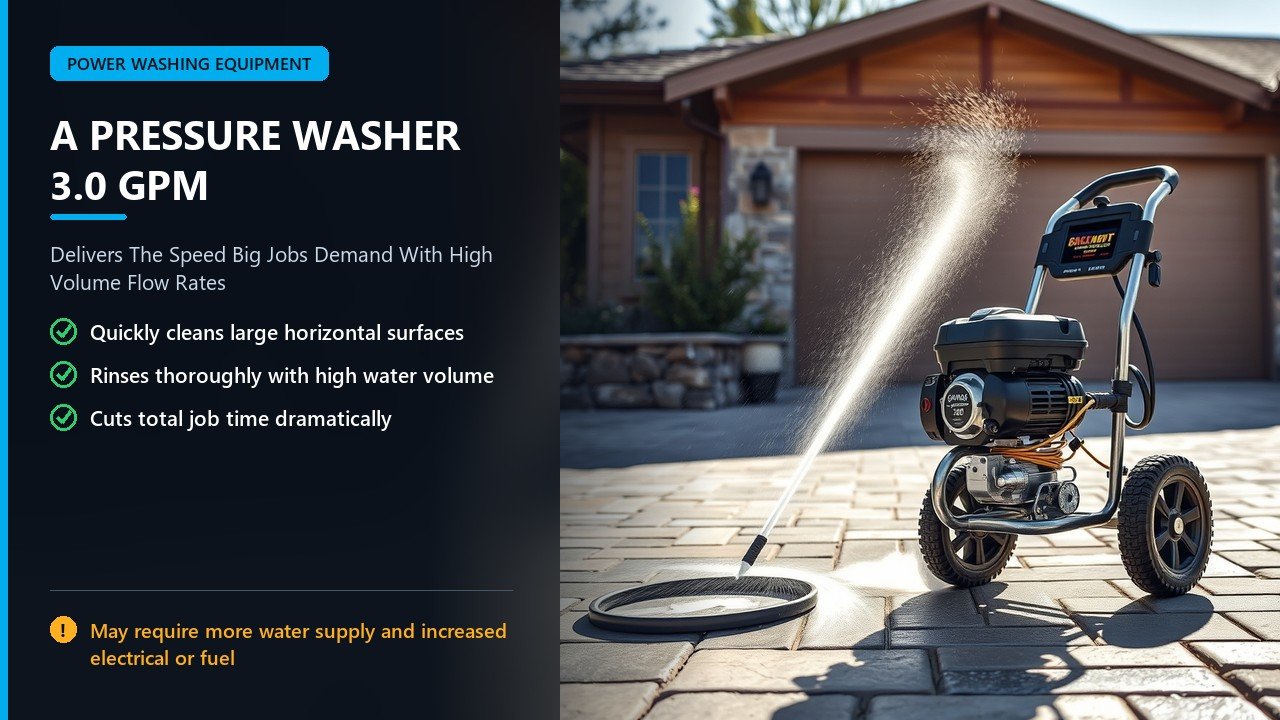
What Does 3.0 GPM Mean on a Pressure Washer?
GPM stands for gallons per minute — the volume of water moving through the pump and out the nozzle each minute. A pressure washer 3.0 GPM moves 3 gallons of water per minute. That extra volume is what makes the biggest difference on flat surfaces like driveways, parking lots, and patios. Pressure (PSI) provides the impact, but flow (GPM) determines how quickly you rinse away what PSI loosened.
The industry uses cleaning units (CU) to compare machines: CU = PSI x GPM. A 3000 PSI at 3.0 GPM gives 9000 cleaning units. A 2500 PSI at 2.5 GPM gives 6250. A 2000 PSI at 2.0 GPM gives 4000. The math is clear: higher flow adds up fast, and for production work, a pressure washer 3.0 GPM is often worth the investment over a lower-GPM machine with slightly higher PSI.
What Can a Pressure Washer 3.0 GPM Clean?
With the right PSI pairing, a pressure washer 3.0 GPM is built for bigger jobs. It excels at cleaning large concrete driveways, parking pads, and sidewalks, removing mud, mildew, and most surface oil stains. It powers through heavy equipment, trailers, and fleet vehicles much faster than lower-flow units. It is also great for commercial property exteriors, warehouse aprons, dumpster pads, brick and block walls, and large decks or patios. When paired with a surface cleaner, the results are even and streak-free on big slabs.
At 2500–3300 PSI and 3.0 GPM, it hits the sweet spot for many commercial and serious homeowner tasks. It can handle paint prep on sound surfaces, but it is not a dedicated sandblasting replacement. For delicate surfaces like softwood decks or vehicle paint, you must dial back to a wider tip and safer distances, because the high flow amplifies the impact.
How 3.0 GPM Compares to Lower Flow Rates
The jump from 2.0 GPM to 3.0 GPM is one of the most noticeable upgrades. A pressure washer 2.0 GPM is plenty for cars, siding, and medium jobs. A pressure washer 3.0 GPM cuts cleaning time on big horizontal areas by roughly 25–40% in real use. That time savings adds up fast for contractors billing hourly or for anyone with large areas to cover. On vertical surfaces, flow helps but technique matters more.
Compared to 2.5 GPM, 3.0 GPM still feels faster on driveways and parking lots. The difference is less dramatic than jumping from 2.0 to 2.5, but for high-volume work it pays off. If you only clean small patios and vehicles a few times a year, 2.0 GPM is likely enough. If you clean large concrete or run a small business, 3.0 GPM is worth it.
| GPM | Ideal Use | Speed on Large Concrete |
|---|---|---|
| 1.5–2.0 | Cars, furniture, siding, small patios | Moderate |
| 2.3–2.5 | Driveways, decks, medium jobs | Fast |
| 3.0 | Large driveways, fleet, commercial | Very fast |
| 4.0+ | Industrial, high-volume production | Production speed |
Electric vs Gas at 3.0 GPM
True 3.0 GPM pressure washers are almost always gas-powered. Most electric pressure washers top out around 1.8–2.3 GPM because of household electrical limits (120V). To reliably deliver 3.0 GPM at usable pressure, you need a gas engine driving a larger pump. Gas units are untethered, powerful, and built for bigger jobs. They are also louder, heavier, produce exhaust, and need fuel, oil, and winterization.
If you need true 3.0 GPM, plan for a gas machine. Some “prosumer” electric models advertise high numbers but fall short of sustained 3.0 GPM in real use. Stick to verified specs from reputable brands. For homeowners with large properties, a gas pressure washer 3.0 GPM makes sense if you use it often enough to justify maintenance. For occasional use, renting might be smarter.
Matching PSI With 3.0 GPM
The best PSI range for a pressure washer 3.0 GPM depends on what you clean. For concrete, parking lots, and heavy equipment, 2800–3300 PSI at 3.0 GPM is ideal — plenty of force with maximum rinse speed. For siding, fences, and painted surfaces, 2000–2500 PSI is safer even with high flow; use wider tips. For softwood decks, stay under 2000 PSI with a 40° tip and test in an inconspicuous spot. Going above 3300 PSI with 3.0 GPM is rarely needed for most work and increases wear and surface damage risk.
The sweet spot for general commercial work is around 3000 PSI at 3.0 GPM (9000 cleaning units). That combination cuts through grime without being unnecessarily aggressive on most hard surfaces when used with the right nozzle.
Accessories That Maximize 3.0 GPM
High flow deserves the right accessories. A surface cleaner is practically mandatory for driveways and large slabs — it uses the full 3.0 GPM to cover a wide path with even pressure, eliminating zebra stripes. A 50-foot (or longer) high-pressure hose with the correct inner diameter is critical; undersized hose restricts flow and kills performance. Use quick-connect nozzles matched to your PSI/GPM, and consider a turbo nozzle only for very hard, unpainted surfaces. A quality spray gun and unloader valve also matter, because a pressure washer 3.0 GPM puts more stress on fittings than lower-flow units.
Water Supply and Practical Considerations
Before buying a pressure washer 3.0 GPM, check your water supply. You need a garden hose that can deliver at least 3.0 GPM at adequate pressure (usually 20–60 PSI inlet). Many residential spigots can supply 3–5 GPM, but long hoses, small-diameter hoses, or restrictive fittings can choke flow. Use a 5/8-inch (or larger) supply hose for best results. Also consider water source: if you plan to pull from a tank, you need a pump designed for suction.
High flow also means more water used per minute — 3 gallons per minute. That is efficient compared to a garden hose, but you should be mindful of water restrictions in some areas. For most jobs, the time saved more than offsets the per-minute volume.
Pros and Cons of a Pressure Washer 3.0 GPM
Pros: Blazing fast on large concrete and fleet jobs, high cleaning units for production work, pairs beautifully with surface cleaners, handles heavy grime with ease, cuts total labor time.
Cons: Almost always gas-powered (heavier, louder, needs maintenance), uses more water per minute, can damage delicate surfaces if misused, higher upfront cost, needs adequate water supply and proper hose sizing.
Who Should Buy a Pressure Washer 3.0 GPM?
A pressure washer 3.0 GPM is ideal for contractors, property managers, small businesses, farmers, or homeowners with very large driveways and frequent big jobs. If your work is mostly vehicles, siding, and small patios, 2.0–2.5 GPM is more than enough and easier to live with. If time is money on big jobs, the productivity boost is hard to ignore.
Final Thoughts
Flow is the unsung hero of pressure washing. A pressure washer 3.0 GPM delivers the rinse speed that turns hour-long jobs into 20-minute jobs on large surfaces. The key is balance: pair it with the right PSI for your surfaces, use proper accessories like a surface cleaner, and make sure your water supply can keep up. For production work and big concrete, 3.0 GPM is the point where speed and efficiency really take off.
Buy for the work you actually do. If big slabs and fleet cleaning dominate your to-do list, a pressure washer 3.0 GPM is one of the best investments you can make in saved time and better results.